

Most experienced property investors don't ask whether interest-only loans are better. They ask when and why they make sense.
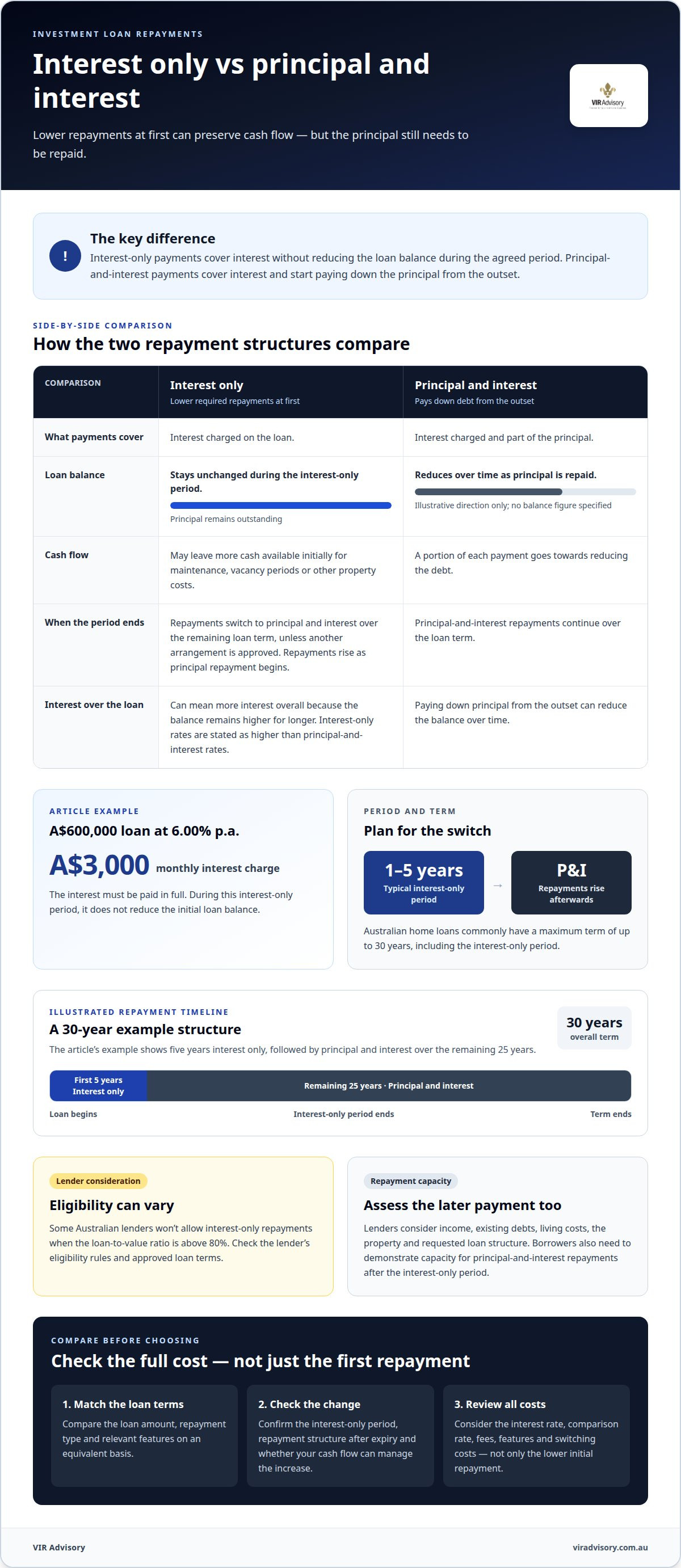
The answer depends on five things: cash flow, portfolio building, debt reduction, equity growth and future borrowing capacity. An interest only investment loan keeps repayments to interest alone, so the balance stays where it is. Principal-and-interest repayments reduce the balance with every payment. Interest-only periods typically range from 1 to 5 years, after which repayments rise.
Key Takeaways
- Interest-only repayments ease cash flow at first, but the amount borrowed does not fall during the interest-only period.
- Principal-and-interest repayments pay down the loan balance, while interest-only repayments can mean more interest across the loan term.
- Repayments rise when the interest-only period ends, so budget for that change from day one.
- On a $700,000 loan at 6%, interest-only costs $3,500 a month; principal and interest over 30 years costs about $4,197.
- The right structure depends on your strategy: building a portfolio, reducing debt, or holding for the long term.
How investors compare the two structures
Sophisticated investors judge a loan structure against their plan, not against the lowest starting repayment. The table below sets out the five questions they ask.
| Factor | Interest only | Principal & interest |
|---|---|---|
| Cash flow | Lower repayments during the interest-only period | Higher repayments from the start |
| Portfolio building | More cash left over for deposits and further purchases | Less cash available, but each payment reduces debt |
| Debt reduction | Balance stays the same during the period | Balance falls with each repayment |
| Equity growth | Repayments do not build equity | Repayments build equity alongside any value growth |
| Future borrowing capacity | Lenders assess the repayments that follow the interest-only period | Repayments are assessed on the same schedule from the start |
Pick the column that matches the next five years of your plan, then test it against the worked example below.
Why Many Property Investors Choose Interest-Only Loans
Investors who choose this structure usually have a specific purpose for the cash it frees up.
Preserving cash flow
Lower scheduled repayments leave more of the rent available for maintenance, vacancy periods and other property costs. Map expected rent against repayments and outgoings before committing.
Building larger portfolios
Cash not spent on principal can go towards the deposit and costs of the next purchase. Investors planning more acquisitions often use the structure for that reason. Our guide to building a property portfolio in Australia covers the wider strategy.
Maintaining liquidity
Keeping cash accessible gives you room to respond to repairs, rate changes or a new opportunity without selling or refinancing in a hurry.
Using offset accounts
An offset account can sit alongside the loan structure. Money held in offset reduces the interest charged while staying accessible, which suits investors who keep a cash buffer.
Debt recycling strategies
Investors using debt recycling often prefer interest-only repayments on the investment loan, so cash goes towards the home loan. Discuss the tax treatment with your accountant.
Renovations and value-add opportunities
Freed-up cash can fund renovations on an existing property. Investors may also draw on equity from their home to fund improvements or another purchase.
Worked example: $700,000 investment loan at 6%
Here is how the two structures compare on a $700,000 investment loan at 6% over 30 years, with the first 5 years interest only.
| Measure | Interest only (5 years) | Principal & interest (30 years) |
|---|---|---|
| Monthly repayment | $3,500 | About $4,197 |
| Loan balance after 5 years | $700,000 | About $651,000 |
| Total interest paid over 5 years | $210,000 | About $200,000 |
The interest-only investor keeps about $697 a month during the period, but still owes the full $700,000 after 5 years. Repayments then switch to principal and interest over the remaining 25 years, and they rise to about $4,510 a month on that balance. The principal-and-interest investor has paid down about $49,000 and pays less interest over the same five years.
Total interest across the full loan term is higher with interest only, because the balance stays higher for longer. The saving in monthly cash flow is real, and so is the larger balance. Compare both before choosing.
Cash flow versus total interest
Interest-only repayments lower what you pay each month, while principal-and-interest repayments lower what you owe.
Cash-flow flexibility
The lower payment helps when rent and costs vary through the year, such as during repairs or a vacancy. Assess your budget using rent after property expenses, not gross rent.
Interest costs over the loan
When principal remains unpaid, interest keeps being calculated on the higher balance. The starting repayment does not show the full cost of the loan. Compare the repayment schedule across the full term, including the years after the interest-only period.
- Map expected rent against repayments and property costs.
- Include the post-interest-only repayment in the budget from the outset.
- Compare total interest, not just the initial payment.
What happens when the interest-only period ends
When the period expires, repayments switch to principal and interest over the remaining loan term. Because that term is shorter, the repayment is higher than it would have been on a standard 30-year schedule. In the example above, the monthly repayment moves from $3,500 to about $4,510.
Common mistakes include spending the freed-up cash without a plan and leaving the review until the expiry notice arrives. To avoid them:
- Confirm your lender's expiry date.
- Calculate the new repayment on the remaining term.
- Test it against your rent and other commitments.
- If you want an extension, ask before the period ends; the lender will reassess, and approval is not automatic.
- Compare refinancing options if the new repayment does not suit you.
How long do interest-only periods last?
Interest-only periods on Australian home loans typically range from 1 to 5 years, while some loans allow up to 10 years. The period sits inside the overall loan term, which commonly has a maximum of up to 30 years.
Typical and maximum periods
A shorter period means principal-and-interest repayments begin sooner. A longer period delays principal reduction and leaves fewer years to repay the balance, which raises the repayment after the switch. The lender's product terms set the maximum available.
Investor and owner-occupier limits
Lender policies can differ by loan and by borrower, and the property's intended use forms part of the assessment. Check the terms and conditions, interest rate and any charges before accepting a period.
Some Australian lenders won't allow interest-only repayments when the loan-to-value ratio is above 80%. Our article on how LVR affects interest rates, LMI and borrowing power explains the effect.
Decision framework: which structure fits your strategy?
Interest Only May Be Worth Considering If:
- You are building a portfolio
- You are planning another purchase
- You are using debt recycling
- You are prioritising cash flow
- You are holding multiple properties
Principal & Interest May Be Worth Considering If:
- You are focused on debt reduction
- You are near retirement
- You are not planning further acquisitions
- You have strong surplus cash flow
Lenders assess income, existing debts, living costs and the property, including your ability to meet repayments after the interest-only period. Our guide on debt-to-income ratio shows one number that affects approval.
How VIR Advisory Helps Property Investors Structure Debt
VIR Advisory is a Melbourne-based brokerage working with property investors across Australia. Founder & Managing Director, Raina Doshi, helps investors match their loan structure to their plans. Areas of support include:
- Investment loan structures
- Interest-only lending
- Debt recycling
- Equity releases
- Portfolio growth strategies
- Refinancing existing investment loans
Contact VIR Advisory to discuss your investment loan structure.
Conclusion
The right structure depends less on the interest-only feature itself and more on your broader investment strategy. The investors building portfolios often view their loan structure as a strategic tool, while others may prioritise reducing debt and increasing equity. The key is ensuring the loan aligns with your long-term property goals.
Frequently Asked Questions
Interest-only term expiring soon?
Review the lender's expiry notice and latest loan statement to confirm the change date and current balance. Ask for a repayment schedule showing repayments after the period. Update your cash-flow forecast, including rent and property outgoings. If the new repayments do not fit, assess loan structures and refinancing before deciding.
Why are interest rates higher on interest-only loans?
Lenders price loans according to their product settings and their assessment of the application. Rates vary with loan-to-value ratio, fixed or variable pricing and borrower circumstances. Compare the same loan amount, security, rate type and features rather than headline figures alone.
Need a cash flow boost?
Build a property cash-flow forecast before changing repayment settings. List rent, council and strata outgoings, maintenance and insurance costs, then compare timing with available income. Include the loan's later repayment schedule in the same forecast.
What documents do I need to apply for an investment home loan?
Prepare identification, income evidence, bank statements, details of existing debts and information about the property. A lender may also request rental evidence or a sale contract. Our home loan application checklist lists the documents banks want.
What is an interest-only investment loan in Australia?
It is an investment mortgage where scheduled repayments cover interest only for an agreed period. The product's terms set the rate, the length of the period and what happens when it ends.
How do interest-only investment loans work and how are repayments calculated?
The lender calculates repayments using the loan balance, the rate and its calculation method. On $700,000 at 6%, annual interest is $42,000, or $3,500 a month. The amount changes if the rate or balance changes.
What are current interest rates for Australian interest-only investment loans?
Rates differ between lenders and depend on the loan structure and application details. Collect offers using the same loan amount, security, loan-to-value ratio and rate type, and compare the comparison rate and features as well. See our guide to comparing home loans like a mortgage broker.
How much higher are interest-only rates than principal-and-interest investment loan rates?
There is no single margin across the market. To find the gap, compare interest-only and principal-and-interest offers from the same lender on the same loan amount, security and rate type. Record the difference in percentage points and see how it changes repayments and total cost.

Article by
Raina Doshi
Raina Doshi has worked in banking and finance since 2011, including experience with major Australian lenders. She helps homeowners, property investors, business owners and professionals secure and structure lending solutions across home loans, refinancing, commercial finance and business lending.
Areas of expertise include residential lending, investment property finance, debt recycling, commercial property finance, equipment finance, construction finance and strategic debt structuring.
Drawing on extensive banking and finance experience, Raina helps clients navigate lender requirements, improve borrowing outcomes and structure effective finance solutions.
Disclaimer
The information in this article is general in nature and does not take into account your personal objectives, financial situation or needs. Before acting on any information, consider whether it is appropriate to your circumstances and seek professional advice.


