

A loan can put more than the property it financed at risk. With cross-collateralisation, a lender uses two or more properties as security for one or more loans, so default could expose multiple assets to a claim. A guarantor may also support a loan, but that is a separate obligation from using property as security.
It’s understandable to see this structure as a straightforward way to use existing equity, particularly when buying an investment property or arranging business and equipment finance. The risk is that linked securities can limit your control over individual properties, including when you want to sell or refinance.
This article explains how the structure works, what can happen if repayments fall behind, and how a guarantor may fit into the arrangement. It also compares the trade-offs of linking securities and keeping loans separate, so you can better understand what the documents mean for your properties and borrowing options.
Key Takeaways
- Read the loan and mortgage documents to identify which properties secure each facility; the number of loan accounts alone won’t show whether securities are linked.
- A guarantor’s promise to repay is different from providing property as security, while a general security agreement may cover business assets.
- Compare linked and separate securities before borrowing: separate loans can give you more flexibility to sell or refinance individual properties.
- Consider the default exposure carefully, as a lender may be able to claim against more than the property originally bought with the loan.
- Equity and LVR matter, but lenders also assess serviceability, existing debts, property values and ownership arrangements.
Can cross-collateralisation involve a guarantor?
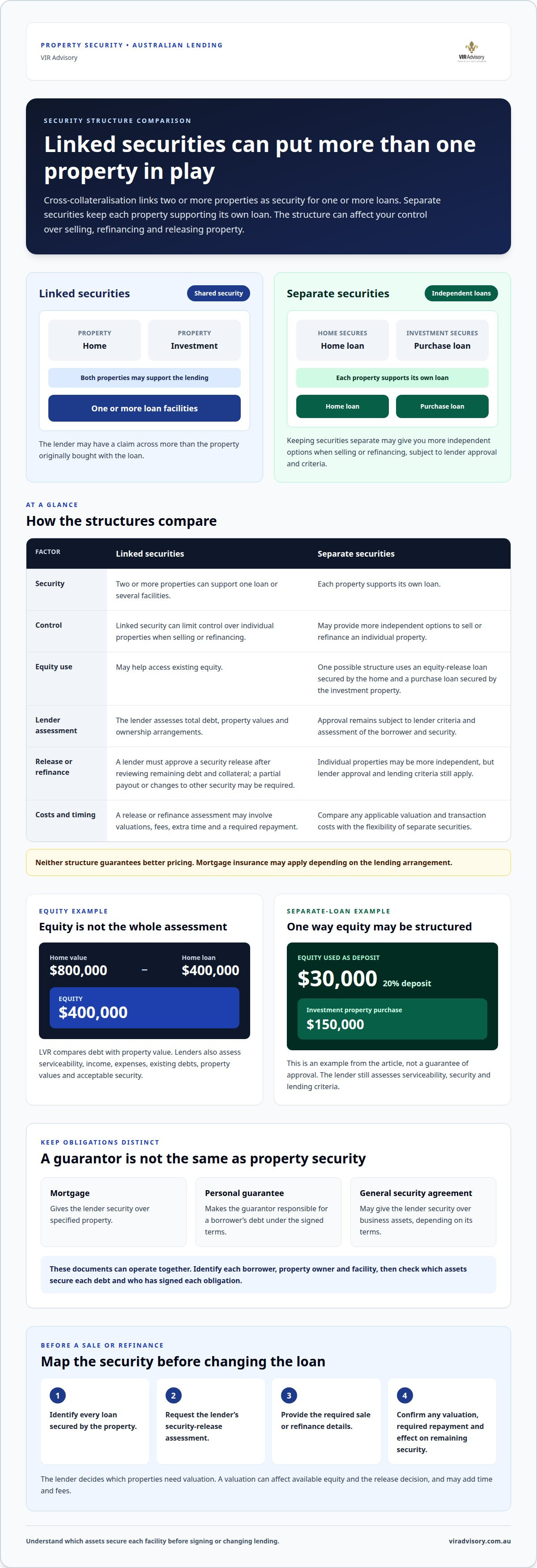
Yes, a guarantor can be involved, but a guarantee and property security are different obligations. A personal guarantee makes the guarantor responsible for a borrower’s debt under the signed terms. A mortgage gives the lender security over specified property. A general security agreement may give a lender security over business assets, depending on its terms. These documents can operate together, so identify each obligation rather than treating them as interchangeable.
Cross-collateralisation is also called cross-securitisation. It describes linked property securities, not a guarantee by itself. For example, a lender may use a home and an investment property to secure lending. Separately, a director might provide a personal guarantee for a business facility. The lender’s rights depend on the relevant loan, mortgage and guarantee documents, including who signed them and which assets or debts they cover.
How can cross-collateralised home loans affect borrowing capacity and loan-to-value ratios? A lender assesses income, expenses, debts, property values and available equity, so linking properties doesn’t automatically increase borrowing capacity. LVR compares debt with property value; for example, an $800,000 home with a $400,000 home loan has $400,000 equity. The lender also assesses serviceability and acceptable security, rather than relying on equity alone.
Separate securities provide another structure to compare. A stand-alone loan uses one property as security for one loan, which can leave other properties independent. For example, a borrower could use $30,000 of equity as a 20% deposit on a $150,000 investment property. Separate loans may offer more control over refinancing or selling, while linked security may help access existing equity. Neither structure guarantees better pricing, and mortgage insurance may apply depending on the lending arrangement.
Can you remove a property from a cross-collateralised loan in Australia, and what are the steps? Yes, but the lender must approve the security release after reviewing the remaining debt and collateral. Start by identifying every loan secured by the property, then request a release assessment and provide the required sale or refinance details. The lender may require a partial payout or changes to other security before releasing its mortgage.
How do Australian banks value properties and release security in cross-collateralised loans? During a release or refinance assessment, the lender decides which properties need valuation, then reviews the values alongside the remaining debt. A valuation can affect the available equity and the lender’s decision to release security. It may also add time and involve fees. Before agreeing to a sale, establish the required repayment and how the release affects the rest of the portfolio.
How cross-collateralised loans use multiple properties as security
A lender can use two or more properties to support one loan or link several facilities to shared security. The arrangement can include residential, commercial and business assets.
A lender could secure that investment borrowing against both properties. When considering approval, the lender then assesses total debt, property values and ownership arrangements.
With separate securities, each property supports its own loan. One possible structure uses an equity-release loan secured by the home alongside a purchase loan secured by the investment property. This separation can give investors more independent options when selling or refinancing, subject to lender approval and lending criteria. Linked security may simplify loan setup, but it can give the lender a claim across more assets.
The same principle can apply to business borrowing. A lender may take a home and commercial property as security for both a business loan and an equipment facility. This can connect business debt with property owned personally or through another entity. Before signing, identify each borrower, property owner and facility, then map which assets secure each debt.
Legal and tax considerations
Legal and tax considerations include the contractual rights over security and the purpose of borrowed funds. They matter because the property used as security alone doesn’t determine how borrowing is treated for tax.
In Australia, tax treatment considers how borrowed money is used, not which property secures it. If one loan funds both private and investment purposes, interest may need apportioning, and linked security doesn’t itself create a tax deduction. Review the facility and mortgage documents to understand the lender’s rights, the borrowers’ obligations and how sale proceeds must be applied.
One asset can also secure multiple loans with the same lender. For instance, a property could secure its home loan and a separate equity-release facility. A vehicle loan agreement may also allow the vehicle to secure other credit from the same credit union. Read the security terms: making current payments on one facility doesn’t necessarily settle another debt secured by that asset.
Costs of cross-collateralising or separating loans
Costs are lender and transaction expenses associated with setting up, valuing or changing security. They matter because a later sale or refinance may require additional assessment and a partial payout.
There’s no single fee that applies to every structure. During a refinance or security-release assessment, the lender decides which properties need valuation. Valuations may add time and involve fees. Ask for a breakdown of applicable valuation and transaction costs, along with any required repayment, then compare those costs with the flexibility of separate securities.
If a vehicle secures multiple facilities, selling it may require lender approval and repayment arrangements before it can be released. For a property portfolio, the lender reviews remaining debt and collateral before releasing a mortgage. Keep a current record of every facility, security and owner so a future sale doesn’t uncover an unexpected link.
Definition of cross-collateralisation
In Australian lending, cross-collateralisation, also called cross-securitisation, cross collateral or cross security, links assets to debts. A lender may take two properties as security for one loan, or use one property to secure several facilities. The connection comes from the loan and mortgage documents, not simply from having multiple accounts with the same bank. Those documents identify the borrower, lender, debt and assets securing it.
Consider an investment purchase with a A$600,000 property and a A$480,000 loan secured against it. That loan has an 80% loan-to-value ratio, or LVR, against that property alone. If another property also secures the debt, the lender may assess the combined security position. A combined figure can appear lower, but it doesn’t show how much equity remains available in each individual property.
For example, total debt of A$1,000,000 against properties worth A$1,400,000 gives a combined LVR of about 71.4%. That calculation uses total debt divided by the combined property value. The lender still considers the properties, borrowers and facilities within the structure. A valuation of one property can change the combined calculation, even if the debt itself hasn’t changed.
The distinction matters when investors plan another purchase, refinance or sale. With linked security, a lender may review other assets and remaining debt before releasing one property. With separate security, each property generally supports a distinct loan, giving the borrower a clearer view of its associated debt. Either structure still depends on lender approval, serviceability and the lender’s assessment of each property.
A mortgage broker can help map the structure by matching each loan account to its mortgage security. Start with the loan offer and mortgage documents, then record each facility, borrower, property owner and secured asset. Compare that record with the lender’s current security schedule. A property valuation helps establish the lender’s assessed value, but it doesn’t identify which debts the property secures.
Use this simple distinction when reviewing a portfolio:
- One debt, multiple assets: two properties support the same loan, so the lender assesses both securities together.
- One asset, multiple debts: a property supports more than one facility, so sale or refinance may involve each secured debt.
- Separate securities: each property supports its own loan, making the debt-to-property connection easier to trace.
The number of accounts alone won’t settle the question. The mortgage documents and security schedule show whether a property is connected to another facility, which can affect how a lender assesses a future investment or refinance application.
Risks of default and asset repossession
If a borrower defaults, a lender may seize and sell collateral to recover some or all of its losses. When several assets secure debts, the lender’s potential claim can extend beyond the property that funded the original borrowing.
Market downturn and collateral risks
A market downturn can reduce property values, eroding equity while the debt remains unchanged. This matters because a lower valuation increases the loan-to-value ratio and can restrict access to funds or a security release.
Australian bank valuations can be discounted by as much as 10 per cent or more. If an investor relies on a higher estimate to fund a deposit, a lower lender valuation may leave less usable equity. In a linked structure, weaker value in one property can affect the overall security position and limit borrowing for another purchase.
Monitor each property’s debt and lender-assessed value separately, even when securities are linked. Before committing to another investment, consider how a lower valuation could affect serviceability, available equity and a later sale. A combined portfolio figure can conceal pressure on an individual asset.
Risks to an owner-occupied home
An owner-occupied home can be exposed if it secures lending for an investment property or business debt. If the other borrowing defaults, the family home may fall within the lender’s security claim.
For example, if an investment property is sold but the proceeds don’t cover the secured loan, a lender may require the family home to be sold. The lender may also require repayment or replacement security before releasing its mortgage over a property. This exposure arises from the home’s role as collateral, not its original purpose.
Before signing, identify every facility secured by the home and the conditions for release. Check whether business borrowing, equipment finance or an investment loan shares that security. Depending on the loan documents, a missed payment on one facility can affect assets securing other debts.
Default doesn’t mean immediate loss in every case, but it can trigger lender action under the loan and security documents. The practical risk is broader when multiple assets secure the debt: a lender may have more property available to recover what’s owed. Understand which property supports each facility before arrears develop.
Use this review when assessing exposure:
- Map the security: list each loan, borrower, property owner and asset securing the facility.
- Test a sale: compare likely proceeds with the debt and any repayment required for release.
- Assess valuation risk: consider how a lower lender valuation affects equity and refinancing options.
- Protect household separation: identify whether the owner-occupied home secures investment or business borrowing.
Using a home to support another loan may help unlock equity, but it also links the risks. Keeping a clear record of security arrangements makes it easier to see which assets could be affected if repayments fall behind.
How does cross-collateralisation work with Australian home loans?
An Australian home loan can use an existing property’s equity to support a purchase, with the lender taking security over one property or several. The structure affects how the lender assesses the overall application and what must happen before a property can later be released from security.
For a property investor, an application needs to show the proposed borrowing purpose, the borrowers, the legal owners and the properties offered as security. These details matter when ownership differs, such as a home held jointly and an investment property held by a company. The lender assesses the parties and security together, then decides whether the arrangement meets its lending criteria.
Home equity can support a deposit or purchase costs, but available equity and borrowing capacity are separate questions. The lender assesses income, expenses and existing commitments to determine whether repayments are affordable. It also assesses property values and whether it accepts the proposed securities. A strong asset position won’t resolve a serviceability shortfall.
Repayment type is separate from the security structure. Linked security doesn’t determine whether a loan has principal-and-interest or interest-only repayments. Review each facility’s repayment type, term and any change due when an interest-only period ends. Investors should also consider whether separate accounts for different loan purposes would keep borrowing records clear.
Before accepting an offer, compare the facility details rather than focusing only on the combined property position:
- Borrowers and owners: confirm whose income supports the application and who owns each security property.
- Loan purpose: record whether each facility funds a home, investment purchase or another purpose.
- Repayment structure: review repayment type, term and changes at the end of any interest-only period.
- Security links: identify which property supports each facility and what the lender requires if circumstances change.
A lender may require valuations as part of an application or later refinance assessment, and those valuations can affect the proposed lending position. The lender chooses which properties need assessment; the process can add time and involve fees. Keep application figures, ownership details and loan purposes consistent so the lender can assess the complete structure without discrepancies between facilities.
For investors planning another purchase, consider whether the borrowing arrangement supports that purchase while preserving workable options for future changes. Assess the whole home-loan structure, not just the initial approval, and understand how repayments and security requirements fit your intended property holdings.
VIR Advisory: Business Loans
VIR Advisory can help business owners assess how lending security fits their borrowing requirements. Its Business Finance and financial strategy guidance can support a review of business debt, property security and cash flow before arranging a new facility or refinance.
If business borrowing is linked to a home or commercial property, map each facility, borrower and secured asset before making changes. This clarifies which securities may affect a future refinance or property sale. VIR Advisory also assists with Home Loans and refinancing solutions, which may be relevant when personal and business lending overlap.
For a considered assessment of your borrowing structure, contact VIR Advisory.
Make your next lending decision with the full structure in view
Before your next purchase, sale or refinance, treat the loan structure as part of the decision, not just a funding detail. Keep a current register showing each facility, its borrowers, the assets securing it and the change you may make next. This can help you identify questions early, especially when an investment plan changes or business and personal borrowing overlap.
Review the register whenever you consider adding a property, changing ownership or refinancing. If cross-collateralisation affects your plans, focus on the outcome you need, such as releasing one security or keeping future borrowing options open. Clear priorities make it easier to assess the trade-offs and understand what a proposed change means for your lending position.
A considered review can help you approach your next finance decision with a clearer view of the obligations and choices ahead.
Frequently Asked Questions
What are the main risks of linking property security?
The risk can extend beyond default: tied-up equity may reduce capacity for a later purchase, and a lender may assess all connected properties together. If one investment performs poorly, it can affect equity available elsewhere in the portfolio. Also consider lender concentration. Keeping every facility with one lender can limit options for diversifying loan types or approaching another lender later.
Are separate loans with the same bank automatically secured together?
No. The lender’s identity alone doesn’t establish whether securities are linked. For example, a borrower might have a home loan and an investment loan with the same bank, each with separate security. Conversely, multiple properties might support linked debts. Treat each facility separately and identify its security arrangement before making assumptions based on statements or account labels.
Is linking property security a risky or beneficial financial strategy?
It can simplify administration, and some arrangements may involve one monthly payment, depending on the lender and loan type. The trade-off is that some lenders may restrict repayment options, while the structure doesn’t guarantee a lower interest rate. Consider whether you need flexibility to diversify between lenders or fixed and variable loans, as well as the effect on future borrowing decisions.
How do borrowers qualify for linked property security?
There isn’t a separate qualification formula for this arrangement. A lender assesses the overall application, including whether it accepts each property type, ownership arrangement and total lending exposure. Prepare a list of the legal owner of every proposed security and the borrower responsible for each debt. Differences between owners and borrowers can affect how the lender structures its assessment.
How do I qualify?
Start by clarifying the borrowing purpose and the assets available to support it. Then assemble current income, expense and debt details, alongside ownership information for each property. This gives the lender a coherent picture of repayment capacity and proposed security. If an existing property is intended to support another purchase, include that proposed borrowing in the overall assessment rather than considering the new loan alone.
What does this arrangement mean in Australia?
It means property assets are connected to lending as security, rather than each debt necessarily relying only on the property it funded. It isn’t the same as a guarantor promising to repay another person’s debt. For an Australian borrower, the key distinction is whether the lender’s claim is over property, a guarantor’s promise, or both under separate documents.
What are the advantages and disadvantages of linking property security in Australia?
One possible advantage is simpler loan setup, with one transaction potentially involving fewer administrative steps. However, linked assets can make it harder to obtain new finance because property already pledged may be unavailable as additional security. A stand-alone structure may offer more choice across lenders and repayment types. Compare these trade-offs with the lender’s pricing, product conditions and your intended portfolio changes.
What risks arise when selling or refinancing a property?
A sale can affect equity across the remaining portfolio, not only the property being sold. Before deciding how to use the proceeds, establish the lender’s required repayment and the debt that will remain afterwards. For refinancing, account for any lender valuation process and the possibility that assessments add time or fees. These details can affect the timing and cash available for the next transaction.

Article by
Raina Doshi
Raina Doshi has worked in banking and finance since 2011, including experience with major Australian lenders. She helps homeowners, property investors, business owners and professionals secure and structure lending solutions across home loans, refinancing, commercial finance and business lending.
Areas of expertise include residential lending, investment property finance, debt recycling, commercial property finance, equipment finance, construction finance and strategic debt structuring.
Drawing on extensive banking and finance experience, Raina helps clients navigate lender requirements, improve borrowing outcomes and structure effective finance solutions.
Disclaimer
The information in this article is general in nature and does not take into account your personal objectives, financial situation or needs. Before acting on any information, consider whether it is appropriate to your circumstances and seek professional advice.


