

Could buying a second investment property be possible on paper but put too much pressure on your cash flow? Building a Property Portfolio in Australia: From First Investment to Multiple Properties depends less on how many properties you own than on whether your finances and borrowing capacity can support another purchase. Lenders assess your income, expenses and existing debts, and apply a serviceability buffer when testing whether you could manage repayments if rates rise.
Before you apply, check how much capacity remains after your first purchase, whether equity may be accessible and how much room you need for vacancies and unexpected costs. This guide explains how to assess readiness for an initial investment, how equity and loan structure may affect a later application, and why projected rent doesn’t remove the need to test cash flow under pressure. It also sets out a practical sequence for reviewing your position, comparing lender requirements and planning purchases at a sustainable pace.
Key Takeaways
- Building a Property Portfolio in Australia: From First Investment to Multiple Properties means reassessing finance capacity and risk before each purchase, not simply counting properties.
- A lender’s borrowing-capacity assessment isn’t a guaranteed spending limit. Existing debts, income, expenses and the proposed property all matter.
- Equity may help fund another purchase, but its availability depends on the property valuation, current debt and lender assessment.
- Fixed and variable loan structures involve different trade-offs. Compare flexibility and repayment exposure against your circumstances and the lender’s current terms.
- Before applying, organise income evidence, liabilities, expenses, existing loan details and information about the proposed property.
Starting a property portfolio in Australia: what changes after your first investment?
After your first investment purchase, another property requires a fresh assessment of finance capacity and risk. Your existing loan, repayments and other liabilities are considered alongside the proposed purchase. Building a Property Portfolio in Australia: From First Investment to Multiple Properties is not simply a matter of repeating the first purchase. Each new commitment needs to fit your current financial position.
A property portfolio is a group of investment properties held by an individual or through an ownership structure. The number of properties alone doesn’t show whether the owner can afford the debt, qualify for another loan or manage changes in rental income and expenses. Lenders may assess investment-property lending differently from owner-occupied lending, and their policies and assessment methods vary.
For a practical overview of the topic, watch this video:
What lenders assess when you apply for your first investment loan
Lenders generally consider your income, existing liabilities, living expenses and deposit, along with information about the proposed property. They may ask for income evidence, details of current loans and supporting property information. Self-employed applicants may also need to provide business and income records requested by the lender.
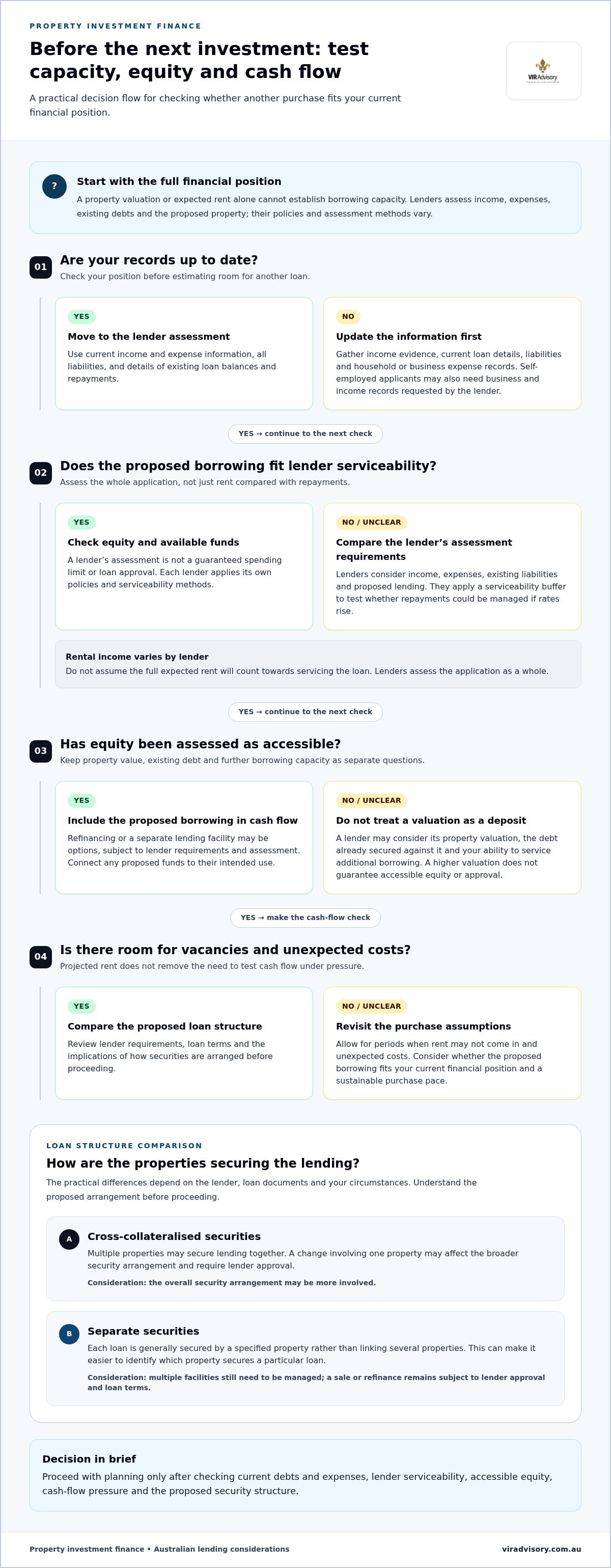
Each lender applies its own policies and serviceability methods. Rental income may be treated differently from one lender to another, so don’t assume the full expected rent will count towards servicing the loan. Lenders assess the application as a whole, not just the difference between rent and repayments.
Why one purchase does not guarantee capacity for the next
Your first investment loan adds a repayment commitment. Other debts, or changes to your income and expenses, can also affect a later assessment, even if the property is tenanted. A higher property valuation doesn’t automatically make equity available to borrow or guarantee approval for another loan.
Each new loan application is assessed against your full financial position. That means reviewing existing loan balances and repayments, other liabilities, income, expenses and the proposed purchase together. Treating a valuation as automatic funding, or focusing on property count instead of repayment capacity, can lead to an unrealistic purchase plan.
Before making an offer, update your household or business income and expense records, list all current debts and check your existing loan details. Then compare the proposed purchase with likely repayments and allow for periods when rent may not come in. This gives you a more useful basis for considering finance options than relying on an equity estimate alone.
How borrowing capacity, equity and loan structure shape portfolio growth
Portfolio growth depends on more than a property’s value or the deposit available. A lender assesses borrowing capacity using its own serviceability methods and policies, taking account of income, expenses, existing debts and proposed lending. The result is an assessment, not a guaranteed amount you can spend or a promise that a particular loan will be approved.
Equity may be one source of funds for another purchase, but it isn’t automatically accessible. A lender may consider its valuation of the property, the debt already secured against it and your ability to service additional borrowing. Refinancing or setting up a separate lending facility may be options to consider, subject to lender requirements and assessment.
Using equity without treating it as a guaranteed deposit
Hypothetical example: An investor owns a rental property and believes its value has increased. Before planning a second purchase, they need to understand the lender’s valuation, the current loan balance and whether their income and expenses support further repayments. Even if the valuation indicates equity, the lender may assess the proposed borrowing differently or find that the amount requested isn’t serviceable.
Keep three questions separate: what the property may be worth, what debt remains against it, and what additional borrowing a lender might approve. A valuation informs the first question, but doesn’t settle the other two. If you’re considering refinancing or accessing equity, link the proposed funds to their intended use and include the new repayments in your cash-flow assessment.
Comparing loan structures as a portfolio grows
With cross-collateralisation, multiple properties may secure lending together. With separate securities, each loan is generally secured by a specified property rather than linking several properties. The practical differences depend on the lender, loan documents and your circumstances. Understand the proposed structure and its implications before proceeding.
| Consideration | Cross-collateralised securities | Separate securities |
|---|---|---|
| Administration | May group lending against multiple properties, which can make the overall security arrangement more involved. | Can make it easier to identify which property secures a particular loan, although multiple facilities still need to be managed. |
| Flexibility | A change involving one property may affect the broader security arrangement and require lender approval. | A sale or refinance may be considered against the relevant security, subject to lender approval and the remaining loan terms. |
| Assessment and risk | The lender considers the linked securities and total lending. A change to one part can have implications for the others. | Properties are treated as distinct securities, but each application remains subject to lender policy and an assessment of your overall finances. |
Neither structure suits every borrower. Consider how the arrangement could affect a future sale, refinance or additional loan, and account for lender conditions. Keep each loan’s purpose and use of funds clearly documented. Loan purpose and structure can have tax implications, so discuss those with a qualified tax professional rather than relying on the loan arrangement alone.
For Building a Property Portfolio in Australia: From First Investment to Multiple Properties, compare options by looking at borrowing capacity, security, administration and the consequences of changing one part of the portfolio. The lender’s terms and your circumstances determine which structure is available and appropriate for assessment.
Which portfolio finance choices balance flexibility and risk?
A suitable finance structure accounts for repayments today and the options you may need later. Fixed and variable interest rates involve different trade-offs, while drawing on equity can increase debt and repayment exposure. The right comparison depends on your circumstances and the lender’s current terms, not on one structure being best for every investor.
A fixed rate can provide more repayment certainty during the fixed period, which may help with budgeting. Features and flexibility vary between products, and changes to your plans may be subject to lender terms. A variable rate can move over time, changing repayments. Compare the conditions and features of the specific loan rather than relying on general assumptions.
| Choice | Potential benefit | Risk to consider |
|---|---|---|
| Fixed rate | Greater repayment certainty during the fixed period. | Flexibility and available features may be more limited or subject to specific lender conditions. |
| Variable rate | Repayments may fall if the rate falls, and some products may offer flexible features. | Rates and repayments may rise, affecting cash flow. |
| Equity release | May provide funds towards another purchase without selling an existing property. | Adds debt and repayments, and remains subject to valuation, lender requirements and serviceability assessment. |
Assessing cash flow before adding another property
Build a budget for each property, then look at how the combined commitments affect household or business cash flow. Record expected rent, loan repayments, ownership costs and regular personal or business commitments. Include likely repairs and periods without a tenant, rather than assuming rent will arrive continuously.
Projected rent should not be treated as guaranteed cash available for repayments. A vacancy or repair can reduce the funds available, while a rate change may increase repayments. Consider whether you could meet commitments if rental income stopped temporarily and an expense arose at the same time. A suitable reserve depends on your income, debt, property condition and other commitments, so a universal buffer figure would be misleading.
Avoiding structures that can limit future flexibility
When properties secure loans together, a future sale or refinance may require the lender to reassess the broader security arrangement. The process and conditions depend on the lender and loan documents. Before proceeding, consider how the structure could affect those future options, and keep clear records of each loan’s purpose and how borrowed funds are used. This makes the arrangements easier to review as the portfolio changes.
Loan purpose and structure can have tax or legal implications. Keep finance records organised and get advice from qualified tax and legal professionals on those matters. Lending information alone can’t determine their consequences. For Building a Property Portfolio in Australia: From First Investment to Multiple Properties, weigh repayment resilience alongside flexibility and review the structure when your circumstances or lending needs change.
A step-by-step checklist for financing the next investment property
Before making an offer, work through a defined finance sequence. It can reveal gaps early, before you rely on an equity estimate, an assumed rental figure or an incomplete view of your debts. Use the steps below to organise your review. Lender requirements and approval depend on your application.
- Review your current position. List income sources, existing loan balances, credit limits, repayments, other liabilities and recurring household or business expenses. Include commitments that may not be obvious from a property estimate, such as personal or business debt.
- Define the purchase parameters. Set a realistic price range and estimate the funds required, including the deposit and other purchase costs. Consider expected rent alongside the possibility of vacancy and ongoing expenses.
- Assess finance. Review borrowing capacity, the proposed funding source and the lender’s assessment requirements. Don’t treat available equity as proof that a new loan will be approved.
- Compare structures. Consider how the loan, security and repayment features could affect cash flow and future borrowing or refinancing options. Check the lender’s current terms rather than assuming features are consistent across lenders.
- Apply with complete information. Provide accurate details and supporting documents, and respond to lender requests. Changes to income, debt, expenses or the property can affect an assessment, so update the application if your circumstances change.
Prepare a lender-ready snapshot of your finances
Bring your current financial information together before discussing a new application. Include loan balances, credit limits and repayments, income sources, regular expenses and other commitments. Organise the income evidence and property information the lender requests. Requirements vary by application, so keep records accurate and flag changes rather than relying on figures from an earlier assessment.
For a more useful estimate, review the factors that affect Australian borrowing capacity and lender assessment alongside your updated finances. A previous borrowing estimate may no longer reflect your position if your income, debts, expenses or lender policies have changed.
Set a clear go, pause or review decision
Use current evidence, not an optimistic forecast, to decide whether to proceed. Move forward with an application only when the lender’s assessment and your own cash-flow checks support the proposed borrowing. Pause if the plan relies on unconfirmed rent, immediate access to equity or continuous occupancy. Review the figures if your finances, lender terms or property circumstances change.
Finance readiness: decision points and documents
- Go: Income, liabilities, expenses and existing loans are up to date; property details are available; repayment capacity has been assessed.
- Pause: The plan depends on unconfirmed rent, uninterrupted occupancy or equity that hasn’t been assessed by a lender.
- Review: Income, debt, expenses, lender requirements or the proposed property have changed.
- Prepare: Income evidence, liability details, expense records, existing loan statements and information about the proposed property.
Common application errors are avoidable: assuming equity equals approval, applying before checking all liabilities, or treating expected rent as certain income. Building a Property Portfolio in Australia: From First Investment to Multiple Properties calls for a fresh review at each borrowing decision, not a repeat of assumptions made for the previous purchase.
Keep this snapshot current as you assess a purchase. If your financial position or the property details change, revisit the figures before proceeding with an application.
How VIR Advisory can help structure property investment finance
Planning another investment purchase involves more than arranging a new loan. A finance broker can review your existing lending and financial position, compare lender options and help organise the application information. This can clarify which finance structures may be relevant before you commit to a purchase, while keeping the focus on lending requirements and repayment capacity.
For Building a Property Portfolio in Australia: From First Investment to Multiple Properties, consider how each proposed loan fits with the borrowing already in place. An investment property loan may affect future borrowing capacity, while refinancing can change existing loan arrangements and repayments. Comparing options helps identify relevant trade-offs, but cannot ensure a particular lending outcome or investment performance.
What a finance discussion can cover
A useful finance discussion starts with a clear snapshot of your current loans, liabilities, income and intended purchase sequence. This frames the application around your full lending position rather than treating a new property in isolation. It can also cover how lender requirements and potential loan structures relate to your circumstances.
VIR Advisory is a mortgage and finance brokerage, not a lender or property adviser. Its finance services include reviewing existing lending, discussing investment loan and refinancing options across lenders, and helping organise application preparation. Raina Doshi brings over 15 years of banking and finance experience, including more than a decade with one of Australia’s leading banks.
Before a discussion, bring together current loan statements, income evidence, details of liabilities and expenses, and information about the proposed property. This makes it easier to organise application details and consider how lender policies may affect the options. It is particularly useful if your income sources, existing lending or planned purchase sequence have changed since your last application.
Book a conversation about your investment loan structure
A finance discussion can cover investment property finance, refinancing and how different lending structures relate to your current position. It can also help identify information needed for an application and questions to resolve before proceeding. The purpose is to assess finance options and requirements, not to treat an initial discussion as confirmation of borrowing capacity.
Any lender decision, loan terms and approval remain subject to the lender’s assessment and your individual circumstances. Outcomes can depend on the information provided, the proposed property and the lender’s current policies. A broker can present and organise finance options, but the lender makes the credit decision. VIR Advisory’s role is finance brokerage, not selecting property or providing investment, tax, legal or financial-planning advice.
If you’d like to review your existing lending and discuss options for a future purchase, book a conversation with Raina Doshi.
Make the next finance decision with clear conditions
Before taking on another loan, decide what would make you pause and reassess. For example, set a point at which a change in income, expenses, lending terms or rental assumptions would prompt you to revisit the numbers. A clear decision rule can help prevent purchase timing from driving a borrowing decision that no longer fits your circumstances.
Building a Property Portfolio in Australia: From First Investment to Multiple Properties is best treated as a sequence of finance decisions, each based on current information rather than assumptions carried over from an earlier purchase. A finance discussion can help you examine the lending options and application preparation relevant to your position. The lender retains responsibility for assessing and deciding any application.
When you’re ready to discuss your finance position and possible next steps, book a conversation with Raina Doshi.
A considered decision, including choosing to wait, can help keep future borrowing aligned with your financial capacity. Take the next step when the figures and finance requirements are clear.
Frequently Asked Questions
How many investment properties can you own in Australia?
There’s no single property-count limit that determines how many investment properties you can own in Australia. In practice, your ability to finance further purchases depends on your financial position, lender assessment and ownership arrangements. A borrower might own several properties but have limited capacity to borrow more, while another may qualify for a further loan. Building a Property Portfolio in Australia: From First Investment to Multiple Properties is about finance capacity, not a target number.
How long should you wait before buying another investment property?
There’s no set waiting period that suits every borrower. Consider another purchase when your current loan, income, expenses and available funds have been reviewed against the proposed borrowing. A change in employment or a new personal debt could affect an application, even if you’ve owned your first investment for some time. Check whether your circumstances and the lender’s current assessment requirements support applying now, rather than relying on a fixed timeline.
What happens if a lender values an investment property below the purchase price?
A lower valuation can affect how much the lender is prepared to lend against the property, potentially leaving a larger funding gap for you to meet. Don’t assume the original deposit will still be sufficient. Ask your broker to explain how the valuation affects the proposed loan, then review your available funds and repayments before proceeding. If you can’t manage the gap, seek advice from a qualified legal professional about your purchase contract and options.
What should you do if a lender declines finance for your next investment property?
First, find out the specific reason for the decline and whether it relates to serviceability, documentation, the property or another assessment factor. Avoid lodging several applications without addressing the issue, as lenders may assess your position differently. Correct missing or inconsistent information, update your financial snapshot and reconsider the purchase parameters if needed. A broker can help compare lender policies and prepare a revised application, but approval remains the lender’s decision.
Can a property portfolio grow if interest rates rise?
It can if your finances and cash flow continue to support the lending, but higher rates can increase repayments and reduce capacity for further borrowing. Check how existing and proposed repayments would affect your budget if rates rose, while allowing for vacancy periods and property expenses. Don’t base the decision only on current repayments or expected rent. The lender will assess the application under its applicable serviceability methods and policies.
Do lenders assess investment-property applications differently from owner-occupied home loans?
Yes. Lending purpose can affect product and assessment details, although lenders still consider your broader financial position. For an investment purchase, a lender may assess rental income and property information under its own policies, which can vary. Owner-occupied and investment loans may also have different terms or features. Compare the actual loan conditions and assessment requirements rather than assuming an existing home-loan approval means an investment application will be assessed in the same way.
Can you build a property portfolio while self-employed?
Yes. Self-employment doesn’t automatically prevent you from applying for investment-property finance. The lender will assess how your income is evidenced and whether it supports the proposed repayments alongside existing commitments. Be ready to provide the income and business records requested for your application, which can vary by lender and circumstances. Keep figures consistent across your documents, and allow time to respond to questions about income fluctuations or changes in business structure.

Article by
Raina Doshi
Raina Doshi has worked in banking and finance since 2011, including experience with major Australian lenders. She helps homeowners, property investors, business owners and professionals secure and structure lending solutions across home loans, refinancing, commercial finance and business lending.
Areas of expertise include residential lending, investment property finance, debt recycling, commercial property finance, equipment finance, construction finance and strategic debt structuring.
Drawing on extensive banking and finance experience, Raina helps clients navigate lender requirements, improve borrowing outcomes and structure effective finance solutions.
Disclaimer
The information in this article is general in nature and does not take into account your personal objectives, financial situation or needs. Before acting on any information, consider whether it is appropriate to your circumstances and seek professional advice.


