

A strong income doesn’t necessarily prevent a high debt-to-income ratio from affecting a home loan application. For a home loan in Australia, your DTI is your total debt divided by your gross annual income; APRA considers a ratio above six to be high. It’s an important measure, but it isn’t the only factor a lender assesses.
If you’re concerned that existing loans, credit limits or other liabilities could reduce your borrowing capacity, it’s worth understanding your debt-to-income ratio before applying for a home loan in Australia. This article explains how to calculate DTI, which debts and income lenders may include, and how the ratio can affect borrowing limits and approval. It also outlines why a higher ratio may leave less room in your budget if circumstances change.
Key Takeaways
- Calculate DTI by dividing total debt by gross annual income, then review which liabilities and credit limits a lender may count.
- A ratio above six is considered high in APRA’s framework, but lenders also assess income, expenses, repayment capacity and other application details.
- From 1 February 2026, APRA’s limit restricts banks to 20% of new home loans with a DTI of six or higher, measured separately for owner-occupier and investor lending.
- Reducing existing debt or unused credit limits can lower assessed DTI and may improve borrowing capacity.
- Consider whether repayments would remain manageable if costs rose or income changed, not just whether a lender might approve the loan.
Debt-to-income ratio: what does it mean?
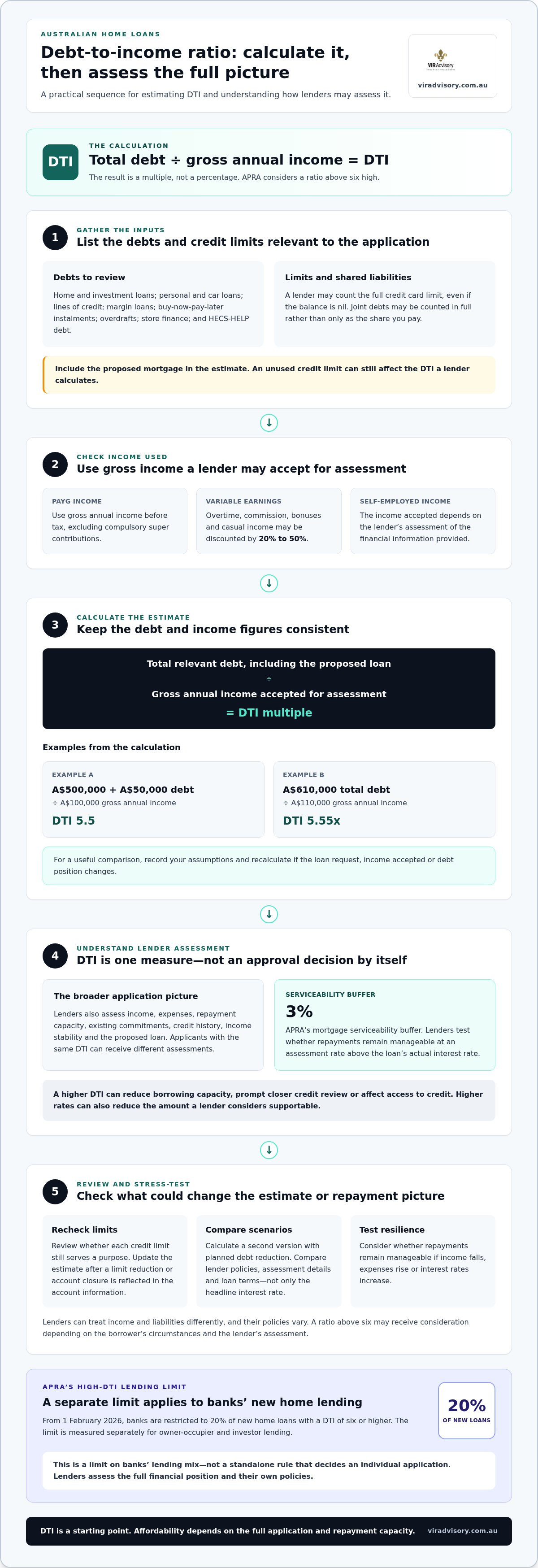
In Australia, DTI is total debt divided by gross annual income, and APRA considers a ratio above six high. For a debt-to-income ratio on a home loan in Australia, the figure gives lenders a snapshot of borrowing relative to income, not a complete picture of affordability.
Lender use of DTI in applications
DTI compares an applicant’s total debt with gross income. Lenders use it to assess how existing and proposed borrowing sits against income, as one part of their overall application review.
For example, a borrower with a A$500,000 home loan and a A$50,000 personal loan, earning A$100,000 gross annually, has a DTI of 5.5. For an Australian home loan application, this ratio frames the debt load alongside income, expenses, credit history and repayment capacity.
Assessing mortgage risk
Lenders consider DTI as one indicator of mortgage risk because higher debt can leave less income available for repayments and other costs. A higher ratio may also leave a borrower more exposed if income falls, expenses rise or interest rates increase.
DTI is not a standalone approval rule. Lenders assess it alongside the borrower’s financial position and proposed loan. For example, two applicants with the same ratio may have different expenses, income stability or credit records, leading to different assessments.
Effects on borrowers and credit access
A high DTI can reduce borrowing capacity, prompt closer review by a lender’s credit department or affect access to credit. Some Australian lenders consider applications above six, depending on the borrower’s circumstances and the lender’s assessment policies.
Lender flexibility doesn’t mean every application receives the same assessment. One lender may decline an application that another considers, and approved amounts or loan terms can differ. Comparing lender policies can help identify options for a debt-to-income ratio home loan application in Australia, rather than focusing on one threshold alone.
A mortgage broker can compare lender policies and identify options that better fit an applicant’s income, liabilities and loan request. This can help when DTI is above six or reducing existing debt could change the application. Compare the full assessment and loan terms, not just the headline interest rate.
How to calculate a debt-to-income ratio
To estimate DTI for a home loan, add the debts relevant to the application and divide the total by gross annual income. Include the proposed mortgage and consider how a lender treats each liability and income source, as these inputs can change the result.
Calculating the ratio
Use this formula: total debt ÷ gross annual income = DTI. The result is a multiple, not a percentage. For example, A$610,000 in total debt divided by A$110,000 gross annual income gives a DTI of 5.55x.
For a useful estimate, include the proposed loan, then calculate a second version that reflects any planned debt reduction. Comparing the figures shows how the change affects the ratio. Record your assumptions so you can compare lender assessments using the same starting information.
Debts and income in the calculation
List home and investment loans, personal and car loans, lines of credit, margin loans, buy-now-pay-later instalments, overdrafts, store finance and HECS-HELP debt. Include jointly held debts where relevant, as a lender may count the full liability rather than only the share you pay.
Use gross annual PAYG income before tax, excluding compulsory super contributions. Variable earnings such as overtime, commission, bonuses and casual income may be discounted by 20% to 50%. For self-employed borrowers, the income accepted for assessment depends on the lender’s assessment of the financial information provided.
Credit card limits in lender calculations
A lender may use the full credit card limit in its DTI calculation, even when the current balance is nil. An unused limit can therefore affect your estimate alongside loans with an outstanding balance.
Review each card and consider whether its limit still serves a purpose before applying. If you reduce a limit or close an account, update your calculation once the account information reflects the change. Otherwise, your estimate may differ from the information available to the lender.
Calculating DTI for a home loan
For a proposed mortgage, add the new loan to other relevant liabilities, then divide by gross annual income accepted for assessment. Use consistent figures on both sides of the calculation and include the same debts, so comparisons between loan scenarios are meaningful.
Before applying, prepare a simple worksheet listing each debt, credit limit, income source and proposed loan amount. Flag variable income and shared liabilities for careful review. Recalculate if the loan request or debt position changes, so the estimate matches the application you plan to submit.
How DTI can affect borrowing limits and loan approval
A higher DTI can reduce borrowing capacity or prompt closer review, but it doesn’t determine approval on its own. Lenders also assess income, expenses, existing commitments and whether repayments remain affordable under their assessment rate.
Borrowing capacity factors
Borrowing capacity is the amount a lender considers supportable after assessing income, debts and expenses. DTI matters because a larger proposed loan increases total debt, while accepted income and existing liabilities influence the ratio.
APRA’s mortgage serviceability buffer is 3 per cent. Lenders use this buffer when testing whether repayments remain manageable at an assessment rate above the loan’s actual interest rate. As a result, higher rates can reduce the amount you can borrow, even if current repayments fit your budget.
Capacity also depends on household expenses, dependants, credit commitments, income type and loan structure. A borrower with stable PAYG income may be assessed differently from a self-employed applicant with variable earnings. Consider these factors together, including whether repayments remain affordable if rates rise or income changes.
Non-bank lending for high-DTI borrowers
Non-bank lenders may offer another assessment option for borrowers whose DTI falls outside a bank’s preferred range. APRA’s high-DTI lending limit applies to banks, not non-ADI lenders, so their portfolio constraints differ.
That distinction doesn’t remove the need to assess repayment capacity. A non-bank application still depends on factors such as verified income, expenses, credit conduct, loan purpose and security. Compare the interest rate and full loan terms, since a different policy does not automatically make an option more suitable.
Non-bank lenders account for around 4 per cent of total residential mortgage credit in Australia. This means they represent a smaller part of the mortgage market, and their lending criteria and loan costs can differ from banks. Assess the proposed repayments against your budget, as well as the lender’s eligibility requirements.
DTI and lending risk
DTI helps lenders assess debt relative to income, which can indicate pressure on repayment capacity. A ratio above six or seven may prompt manual review by a bank’s credit department rather than an automatic decline.
For example, a larger proposed mortgage combined with personal debt can leave less room in a household budget. Inflation can add pressure through higher living costs, while an interest rate rise can increase repayments on variable-rate lending. Lenders consider these pressures when assessing whether the proposed loan remains serviceable.
Reducing existing debt, lowering unused credit limits or borrowing less can change an application’s liability profile. A smaller loan may also leave more room in the budget. Consider expected repayments alongside the ratio, because a lower DTI alone doesn’t show whether borrowing is affordable.
APRA's high-DTI lending limit
APRA considers a home loan DTI above six high, while its bank lending limit captures new loans at six or higher. This is a portfolio limit on banks, not an automatic borrowing cap or decline rule for individual applicants.
Reasons for the limit
APRA’s limit restricts the share of new bank mortgages written to borrowers with high DTI. It addresses lending risk by limiting how concentrated new lending can become among households carrying debt at six times income or more.
The rule took effect on 1 February 2026. Banks can write no more than 20% of new home loans to borrowers at or above the threshold, with the limit measured quarterly. This focuses the restriction on new lending rather than retrospectively changing existing mortgages.
APRA applies the 20% limit separately to owner-occupier and investor portfolios. A bank therefore assesses each category against its own lending mix; investor lending does not use up the owner-occupier allocation, or vice versa.
This distinction matters whether you’re buying a home to live in or borrowing for an investment property. The rule manages banks’ overall high-DTI lending, while each lender assesses individual applications according to its credit policies and the borrower’s circumstances.
High-risk DTI levels
A DTI above six is considered high by APRA, and the lending limit includes loans with a DTI of six or higher. For scale, a borrower earning A$100,000 gross annually reaches six times income with A$600,000 in total debt.
At A$120,000 income, the equivalent debt is A$720,000; at A$150,000, it is A$900,000. These examples show how the threshold changes with income, but they don’t establish how much a lender will approve. An individual assessment also considers serviceability and other application details.
APRA’s limit covers new lending, not existing borrowers’ current mortgages. It also exempts construction of new dwellings, purchases of newly built dwellings and owner-occupied bridging finance. These exemptions apply to the specified lending types, not every loan connected with property.
Non-ADI lenders aren’t subject to this APRA limit under the active macroprudential tools described. Their DTI policies can differ, but a high-DTI application is not automatically suitable or acceptable. The distinction is between a bank-level cap and an individual lender’s assessment: a bank can consider an application within the cap, while borrower eligibility remains subject to its criteria.
Implications of debt-to-income ratios for financial vulnerability
DTI shows debt relative to income, but not how much cash a household has left after regular costs. Two households with the same ratio can face different pressures if one has childcare expenses, variable earnings or little savings. For example, a borrower with irregular income may find a repayment increase harder to absorb than a household with steady earnings and fewer commitments.
Australian household debt-to-income statistics provide context, but they measure households differently from a lender’s assessment of an individual mortgage application. In 2021-22, the average Australian household DTI was about 1.88, while households in the lowest income quintile averaged 2.29. These figures use household-level data, so they shouldn’t be treated as a direct benchmark for an applicant’s home-loan DTI.
Repayment pressure also depends on the share of income used for housing costs. Mortgage stress is described as a household spending more than around 30% of its income on mortgage repayments. That share can leave less room for rising bills or reduced earnings, even where the household’s DTI doesn’t appear high. DTI measures debt against income; a cash-flow review shows what remains available after costs.
A larger deposit can reduce the amount borrowed, but using most of your savings may leave less cash for unexpected expenses. Compare the lower repayments from borrowing less with the reserves you’ll have after settlement. For example, a household expecting repairs after buying may need accessible savings as well as manageable mortgage repayments.
Repayment-resilience check
- Income: identify stable and variable earnings, and consider how the budget changes if income falls.
- Commitments: list mortgage repayments, household costs and other regular payments to see what remains.
- Cash reserves: compare the planned deposit with savings left for repairs, bills or an interruption to earnings.
- Rate pressure: test whether the household budget can absorb higher repayments and ongoing costs together.
This check highlights a risk a ratio alone can miss: a loan may meet lender criteria while leaving little flexibility in the household budget. Before committing, compare expected repayments with day-to-day expenses and remaining savings. Resilience means being able to meet obligations when income or costs change, not just managing today’s repayment.
VIR Advisory: Business Loans
VIR Advisory can help you assess how existing debts and a proposed home loan fit your broader financial position. If a high DTI, variable income or multiple commitments complicate your application, its mortgage broking and financial strategy guidance can help you compare lending options and understand the factors lenders assess.
For a home purchase, refinancing or investment property, the right borrowing structure depends on income, liabilities, cash flow and repayment capacity. Reviewing these together can clarify whether reducing debt, adjusting the loan amount or considering a different structure may better suit your circumstances. Business owners can also discuss how business commitments may interact with personal borrowing.
Contact VIR Advisory to discuss your lending requirements.
Set your borrowing boundaries before you apply
Before choosing a property or restructuring existing lending, decide what repayment level leaves room for regular household costs and financial priorities. For a home loan in Australia, include your debt-to-income ratio in that wider assessment, alongside the loan structure and cash flow you want to preserve. A lender’s maximum borrowing figure may not be the amount that best suits your circumstances.
Prepare a clear brief for your next lending discussion: the outcome you need, the commitments affecting your budget and the repayment level you’re comfortable maintaining. This helps focus the conversation on suitable options and practical trade-offs, rather than one ratio in isolation. If you have both business and personal borrowing, explain how they relate from the outset.
A considered borrowing decision starts with a clear view of what you can manage, giving you a firmer basis for your next step.
Frequently Asked Questions
What Is Considered a 'Good' DTI?
A DTI below 4 is generally considered strong, while a ratio from 4 to 6 can still be acceptable with stable income and good credit. These ranges are guides, not approval guarantees. For example, a borrower at 5 times income should also consider their regular expenses, income stability and remaining cash flow. A lower ratio can strengthen an application, but it doesn’t establish what a lender will approve.
Why Do Lenders Use DTI?
Lenders use DTI to compare existing and proposed borrowing with an applicant’s income. This helps them assess whether additional repayments could pressure the household budget. For example, two applicants requesting the same loan may receive different outcomes if one has ongoing personal debt or less stable earnings. Lenders assess DTI alongside expenses, credit conduct and repayment capacity, rather than treating one figure as the whole picture.
Can I still get a home loan if my DTI is above 6x?
Yes, a DTI above 6 doesn’t automatically prevent a home loan approval. Some lenders consider applications above that level, taking into account factors such as income stability, existing commitments, credit history and the proposed loan. APRA’s bank limit controls the share of new lending with high DTI; it isn’t an automatic decline rule for every applicant. Compare lender criteria and assess whether repayments fit your budget before applying.
DTI vs the serviceability buffer: what is the difference?
DTI compares total debt with gross annual income, while the serviceability buffer tests whether you could manage repayments at a higher assessment rate. APRA’s mortgage serviceability buffer is 3 per cent. For example, the lender assesses repayments above the loan’s actual interest rate, rather than relying only on the scheduled repayment. DTI describes the size of debt relative to income; the buffer tests repayment capacity under a higher-rate scenario.
Does a bank use my credit card balance or my credit card limit for DTI?
A bank may use the full credit card limit, not just the current balance, in its DTI assessment. A card with nothing owing can still affect the calculation if its limit remains open. Review every card before applying, including rarely used accounts. If you reduce or cancel a limit, allow time for lender records and application documents to reflect the change.
How Much Can You Safely Afford to Borrow?
There’s no single borrowing amount that’s safe for every household; it depends on income, expenses, existing repayments and cash reserves. Estimate the repayments on the proposed loan, then test your household budget at a rate 2% above the current rate. Include costs that can vary, such as utilities and transport, and consider how your budget would cope with reduced income. A lender’s maximum isn’t automatically a comfortable amount.
How Much Mortgage Can I Afford in Australia?
The mortgage you can afford depends on the income a lender accepts, your living costs, other debts, deposit and proposed loan repayments. Start by totaling regular household commitments and working out what remains for repayments and savings. Then consider whether that amount remains manageable if interest rates rise. Lenders apply their own serviceability criteria, so borrowing capacity can vary between lenders and applications.
How Much of Your Income Should Your Mortgage Be?
A common guide is to keep mortgage repayments around 28% to 30% of gross monthly income, but this isn’t a universal affordability rule. Consider take-home income, childcare, other debts and savings as well. A repayment share that looks manageable before expenses can leave too little room for household costs or unexpected changes.

Article by
Raina Doshi
Raina Doshi has worked in banking and finance since 2011, including experience with major Australian lenders. She helps homeowners, property investors, business owners and professionals secure and structure lending solutions across home loans, refinancing, commercial finance and business lending.
Areas of expertise include residential lending, investment property finance, debt recycling, commercial property finance, equipment finance, construction finance and strategic debt structuring.
Drawing on extensive banking and finance experience, Raina helps clients navigate lender requirements, improve borrowing outcomes and structure effective finance solutions.
Disclaimer
The information in this article is general in nature and does not take into account your personal objectives, financial situation or needs. Before acting on any information, consider whether it is appropriate to your circumstances and seek professional advice.


