

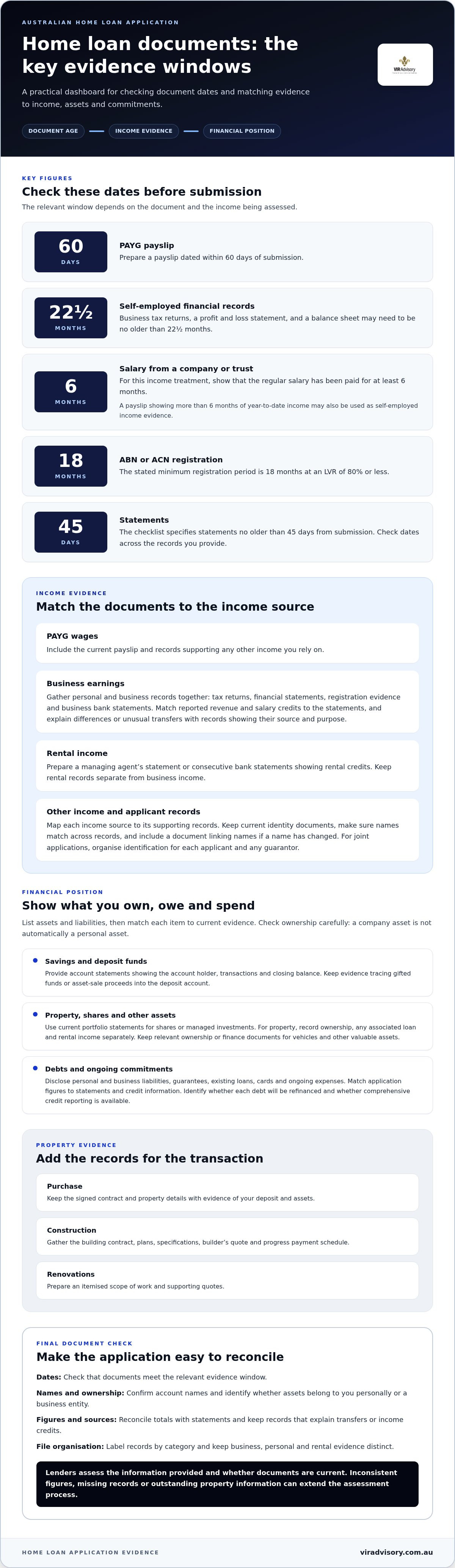
A home loan application checklist for Australia should cover income, assets, debts, living expenses and any rental income. For PAYG income, prepare a payslip dated within 60 days of submission; self-employed applicants may need business tax returns, a profit and loss statement and balance sheet no older than 22½ months. If you pay yourself a regular salary from a company or trust, it must have been paid for at least 6 months for that income treatment.
It’s easy to assume a payslip and deposit evidence will be enough, but lenders also assess existing commitments and the records supporting other income. Statements need to be current: the checklist specifies no older than 45 days from submission.
This article explains what to gather for employment and self-employed income, savings and other assets, loans and ongoing expenses, and rental or other income. It also shows how to organise your records and identify which evidence may apply, so you can prepare a clear application before it reaches a lender.
Key Takeaways
- Map your income to its source: PAYG wages, business earnings, commission and other income can require different supporting records.
- List your savings, assets, liabilities and any cash-out request so the lender can assess your financial position and supporting evidence.
- Sort statements for existing loans and cards according to whether each debt will be refinanced and whether comprehensive credit reporting is available.
- For rental income, prepare a managing agent’s statement or consecutive bank statements showing rental credits; the evidence must meet the relevant lender’s requirements.
- Keep records organised by category and check their dates before submission, as lenders assess both the information provided and whether documents are current.
Self-employed income documents
Self-employed applications need to show how your business earns income and how that income reaches you. Gather personal and business records together, especially if you’re a company director, trustee or sole trader. Lenders assess the business’s financial position alongside the income you rely on to make repayments. This home loan application checklist for Australia helps you separate business evidence from personal income records before submission.
- Collect your business tax returns, profit and loss statement, and balance sheet; these may need to be no older than 22½ months.
- Include evidence of your ABN or ACN registration; the stated minimum is 18 months at an LVR of 80% or less.
- If you draw a regular salary from a company or trust, show it has been paid for at least 6 months for this income treatment.
- A payslip showing more than 6 months of year-to-date income may be used as self-employed income evidence.
- Match business bank statements to reported revenue and salary credits; unexplained differences can prompt questions during assessment.
Organise files into tax records, financial statements, registration details and bank statements. Check that names and business identifiers match across the documents. For example, trace a company salary from the business account to your personal account. Explain unusual transfers with records showing their source and purpose. Your home loan application checklist for Australia will be easier to review when every document supports a specific figure in the application.
Whether you’re a new or existing customer, prepare current identity documents and make sure names match across your application, bank statements and business records. If your name has changed, include the document linking the two names. For joint applications, organise identification for each applicant and any guarantor so the lender can match each person to their financial records.
First home buyers, guarantors and applicants using government schemes may need additional identity, income, savings and eligibility evidence. A guarantor’s financial position may also be assessed. The First Home Owner Grant is a one-off payment, and its criteria and amount vary by state or territory.
For a purchase, organise the signed contract and property details alongside evidence of your deposit and assets. For construction, gather the building contract, plans, specifications, builder’s quote and progress payment schedule. For renovations, prepare an itemised scope and supporting quotes so the lender can understand the proposed work.
Pre-approval follows an initial assessment of your income, liabilities and supporting documents. Formal approval also involves assessing the specific property and contract. Missing records, inconsistent figures, complex business structures or outstanding property information can extend the process.
Before submission, check document dates, account names and totals, then label each file by category. Keep rental records separate from business income, and identify whether each asset belongs to you personally or to a business entity. This Australian home loan application checklist helps you present those details consistently and in an organised way.
Assets and liabilities
List every asset and liability in your application, including accounts, vehicles, property, investments and personal debts. Lenders use this snapshot to assess your deposit, available funds and existing financial commitments. Match each item to current evidence, then check ownership: a company asset is not automatically a personal asset. A clear schedule helps prevent omissions and gives the lender a consistent view of your financial position.
Prepare recent records showing each asset and its value or balance. For bank accounts, provide statements with the account holder, transactions and closing balance. For shares or managed investments, use a current portfolio statement. For property, record ownership, any associated loan and rental income separately. Your figures should match the supporting documents, not rely on estimates or an outdated spreadsheet.
- Cash savings: Gather statements confirming the balance and account ownership, including accounts used for the deposit.
- Property and investments: List each asset and provide current statements or ownership records supporting the details.
- Vehicles and valuable assets: Record relevant items consistently and retain supporting ownership or finance documents.
- Personal and business liabilities: Disclose outstanding debts, guarantees and business obligations that may affect your position.
- Credit records: Compare the liabilities in your application with your recent statements and credit information.
Your deposit funds need a traceable source. If a family member gives you a gift, keep evidence confirming who provided it and how it reached your account. If your deposit includes proceeds from selling an asset, retain the sale contract or transfer record and the bank statement showing the payment. For example, support a vehicle sale with records linking the buyer’s payment to your deposit account.
Separate personal funds from business funds, especially if you’re a company director or trust beneficiary. Label accounts accurately and explain transfers between them with transaction records. A transfer between accounts you own may be straightforward to trace; funds from another person or a business need a clear source. Keep consecutive statements that show how funds moved, rather than isolated pages without context. For jointly owned assets, identify each owner and the share shown in the supporting documents.
Cash-out requests can trigger additional evidence requirements. For an Australian home loan application with an LVR of 80% or less, cash out above $1m requires formal supporting documentation. Where the LVR is above 80% and up to 90%, cash out of $50k to ≤$100k requires formal supporting documentation. Keep records that explain the purpose and support the amount requested.
Before submission, compare your asset and liability list with the supporting documents, then flag any recent sale, gift or large transfer. Check that account balances are current and each debt appears once under the correct owner. This final review can reveal missing accounts or inconsistencies before the lender assesses your application.
Existing loans, cards and ongoing expenses
Include every existing loan, credit card, buy-now-pay-later account and regular expense in your application. Australian lenders assess these commitments alongside your salary and other income because repayments and household spending affect available cash flow. Ask your lender which statements to provide, and make sure your application matches the balances and repayments shown. A home loan application checklist for Australia should include both debts that will remain and those being refinanced.
For certain existing debts, the required statement period depends on whether you’re refinancing the debt and whether comprehensive credit reporting is available. The checklist requests one (1) month of statements for certain debts being refinanced when comprehensive credit reporting is available. For certain debts not being refinanced, it requests six (6) months when that reporting is available, or three (3) months when it isn’t.
- Home, personal and vehicle loans: Record each lender, balance, repayment and remaining obligation, because multiple commitments affect the assessment.
- Credit cards: Provide statements showing the account, balance and repayments; include cards you rarely use, not only those with recent transactions.
- Buy-now-pay-later accounts: List active accounts and their payment commitments, since omissions can make declared expenses inconsistent with statements.
- Business debts and guarantees: Identify obligations linked to your business, because business borrowing may affect your personal financial position.
- Tax commitments: Include relevant tax payment arrangements and supporting records, so declared liabilities align with your tax return and account activity.
Use recent transaction records to build a realistic monthly picture of your living expenses. Group spending into groceries, utilities, transport, childcare, education, medical costs, subscriptions and eating out. Include regular insurance premiums, such as health, vehicle or home cover, and convert annual expenses to their monthly equivalent. A budget that leaves out irregular bills may not match your bank statements.
List rental expenses separately. If you rent your home, show recurring rent payments. If you own an investment property, include related costs such as strata charges, council rates, repairs and insurance. Keep rental income separate from property expenses so the lender can assess their net effect on household cash flow.
Before submission, compare your expense summary with consecutive bank statements. Explain transactions that might be mistaken for ongoing commitments, such as a one-off appliance purchase or annual insurance renewal. Don’t omit an expense because another person contributes to it; record the arrangement clearly and show the payment pattern. Mark refinanced debts separately from those that will remain after settlement. An Australian home loan application checklist should make these differences easy to see.
Rental and other income evidence
Rental income, government payments and overseas earnings need records showing their source, amount and payment pattern. Use evidence that matches the income declared in your application. For an investment property, keep the managing agent’s statement separate from personal income documents so the lender can assess the rental figures against the property.
- Managing agent statement: Provide a rental statement dated within two months of application for a standard residential investment property, as its date and rent details support the current income assessment.
- Annual rental record: A managing agent’s statement showing 12 months of rental income can evidence the property’s income pattern and any interruptions.
- Rental bank credits: Provide three months of consecutive bank statements showing rental payments, so credits can be matched to the property and declared income.
- Bank of Melbourne rent evidence: A bank statement or transaction listing must show two payment cycles for a Bank of Melbourne application, demonstrating recurring rent receipts.
- Centrelink or equivalent income: Include the entitlement letter and a printout verifying payment credits into an account for a Bank of Melbourne application.
- Other income: Foreign income, superannuation, pension, annuity or other government income may need evidence covering the last 3 months.
Check that each rental statement identifies the property, managing agent, rent received and relevant period. If rent goes into a different account, include the statement showing the credits and explain how the account holder is connected to the property. Keep a record of vacant periods or rent changes so your evidence and application figures stay consistent.
For board payments, organise bank statements showing recurring credits and record who pays, how often and what the arrangement covers. For example, if a family member pays board into your account, distinguish those credits from salary and rental income. This clarifies the payment source during assessment and avoids presenting board as rent from an investment property.
For foreign income, retain documents identifying the income source and payment dates, alongside account records showing the receipts. Superannuation, pension and annuity evidence should identify the payer and payment frequency. For government income, keep entitlement correspondence together with matching account credits; a letter alone may not show that you’re receiving payments.
Before submission, match each declared income amount to its supporting statement and check that the dates cover the required period. For example, compare three months of rental credits with the agent’s statement, then note any difference due to fees or payment timing. Store each source in a labelled folder, such as “property rent”, “pension” or “foreign income”, to make the documents easier to review.
Proof of income for employees and self-employed applicants
Income evidence should identify who pays you, how much you receive and whether the income is ongoing. Lenders compare your declared income with supporting records during assessment, so check that the figures and pay periods align. For employees, organise documents by employer. For business owners, distinguish personal income from business receipts and other payments.
For PAYG employees, provide a payslip dated within 60 days of application submission. Full-time and part-time employees may also provide three months’ worth of bank statements as proof of income. Check that salary credits are identifiable and consistent with the payslip. If an account receives income from several sources, mark the salary deposits clearly in your records.
- Current PAYG income: Provide a payslip dated within 60 days of submission, showing the employer, gross income and year-to-date earnings.
- Bank evidence: Prepare three months of statements if using them to evidence full-time or part-time income.
- Commission or bonus income: For a Bank of Melbourne application, provide evidence covering the last 2 years.
- PAYG refinance: Applicants refinancing may need their last two consecutive payslips.
- Employment changes: Include records that explain a recent change in employer, role or salary when earlier deposits differ.
Variable income needs evidence of its payment pattern. For commission or bonuses, arrange records across the relevant period and identify the corresponding employer payments in your statements. A single bonus payment, for example, may not show how that income has varied over time. Keep recurring salary and variable earnings distinct so the application doesn’t treat them as the same income type.
If you’ve changed employers or recently altered your salary, put the relevant employment records alongside your payslips. A new employment agreement can help explain why your current income differs from earlier salary credits. Arrange documents by date and check that the employer name on your payslip matches the name shown in your bank transactions.
For self-employed applicants, keep personal income separate from business revenue. A deposit into a business account isn’t automatically personal income; show how payments are made to you and make sure the declared figures match the supporting records. Company directors should distinguish salary from dividends or other payments, and avoid counting the same earnings twice across personal and company documents.
Before lodging your application, compare every declared income figure with its payslip, tax record or bank credit. Confirm the employer or business name, the period covered and the type of income being evidenced. If a payment is irregular, label it accurately rather than presenting it as fixed salary. This gives the lender a clearer basis for assessing your eligible income.
VIR Advisory: Business Loans
VIR Advisory assists borrowers with Home Loans and Business Loans when personal and business finances overlap. For a company director or self-employed applicant, the priority is to present income, business commitments and personal borrowing clearly so lenders can assess the full financial position. If you’re buying a home, a Self-Employed Home Loan may be relevant; if the funds are for business purposes, Business Loans address a different borrowing need. Your application and supporting records should reflect the purpose of the finance, rather than treating business and personal funding as interchangeable. VIR Advisory also provides financial strategy guidance when existing debts or cash flow affect the proposed loan structure. Contact VIR Advisory to discuss your lending requirements.
Prepare your next lending decision
A useful document pack reflects the loan purpose and how your finances are structured. Before lodging an application, organise your records around the lender’s assessment needs, keep an updated copy and note any outstanding items. This makes it easier to respond to requests without losing track of changed figures or documents.
A home loan application checklist for Australia can also help you decide whether your next step is a purchase, a change to an existing loan or a separate funding need. VIR Advisory offers refinancing solutions for borrowers reviewing existing debt structures, alongside home and business lending support. The right option depends on the purpose of the borrowing and the information supporting your application.
Bring your current documents and a clear outline of what you’re applying for. A focused conversation can clarify the lending requirements that matter next.
Frequently Asked Questions
What’s next?
Use this sequence to prepare a lender-ready file: income sources → financial position → property details → application review. Before submission, check for recent changes, such as a new job, altered loan balance or amended purchase terms, and update the relevant records. Note anything that has changed since pre-approval so the lender can assess your current position, not rely on outdated information.
What documents are required for a home loan application in Australia?
Prepare records that identify each applicant, explain income, show financial commitments and support the proposed purchase. Add documents for unusual arrangements, such as a family guarantee or business ownership affecting personal finances. For a final check, compare the names, dates and figures across the application and attachments. If a document shows a different figure, clarify why before lodging rather than leaving the lender to reconcile it.
What proof of identity do Australian lenders accept for a home loan?
Accepted identity evidence depends on the lender’s verification process and your circumstances. Follow the lender’s requested document combination, and ensure scans or copies are clear, complete and unaltered. For joint applications, identify each applicant separately. If employment or banking records use a different name, provide evidence linking the names so the lender can match those records to the correct applicant.
What income documents do PAYG employees need for an Australian mortgage application?
PAYG employees should prepare records showing their employer, employment arrangement and income consistency. If your earnings include salary sacrifice, allowances or variable shifts, identify each component rather than relying on the gross total alone. For example, a nurse working rotating shifts can use employer records to distinguish base salary from shift-related pay. This helps the lender understand which income components are regular and how they relate to the applicant’s employment.
What documents do self-employed borrowers need to apply for a home loan in Australia?
Self-employed applicants should make the relationship between business and personal finances easy to follow. Identify the business structure, your role and any income drawn through salary, drawings or distributions. If ownership is shared, show how your interest is represented in the records. For example, a director with multiple business entities should label each entity’s documents clearly, rather than combining files in a way that obscures which business generated each figure.
How do Australian lenders assess credit history, debts and living expenses?
Lenders consider repayment conduct, current credit commitments and household spending when assessing whether repayments fit your cash flow. They may compare declared liabilities with credit information and account activity. An unused card can still matter because its limit represents an available commitment. Review your credit accounts before applying, resolve reporting errors through the relevant account process, and explain any obligation that appears under a different name.
What deposit and genuine savings evidence is needed for an Australian home loan?
Present your deposit so its ownership, availability and timing are clear. If the funds are spread across accounts, show how they can be brought together for settlement and distinguish accessible cash from assets that would need to be sold. Avoid moving money without keeping a clear transaction trail. For a first home purchase, also separate any grant-related funds from personal savings in your working records.
What documents are needed for the property being purchased, including the contract of sale?
Provide the purchase contract and supporting property information requested for the lender’s security assessment. Check that you’ve included any variations, special conditions or amended terms rather than relying on an earlier contract version. If the property is part of a strata scheme, keep relevant strata material available when requested. For a construction purchase, distinguish the land transaction from the building arrangements, as each relates to a different part of the proposed finance.

Article by
Raina Doshi
Raina Doshi has worked in banking and finance since 2011, including experience with major Australian lenders. She helps homeowners, property investors, business owners and professionals secure and structure lending solutions across home loans, refinancing, commercial finance and business lending.
Areas of expertise include residential lending, investment property finance, debt recycling, commercial property finance, equipment finance, construction finance and strategic debt structuring.
Drawing on extensive banking and finance experience, Raina helps clients navigate lender requirements, improve borrowing outcomes and structure effective finance solutions.
Disclaimer
The information in this article is general in nature and does not take into account your personal objectives, financial situation or needs. Before acting on any information, consider whether it is appropriate to your circumstances and seek professional advice.


