

A business loan rejection is a reason to review the application, not to submit the same request elsewhere straight away. If your business loan was rejected, ask the lender for the specific reason and address it before applying again. Repeated applications in quick succession can raise concerns, while updated cash-flow information, complete documents or a different loan structure may strengthen a future application.
It’s understandable to feel frustrated, especially when the funds were intended for a clear business need. First, establish whether the obstacle was repayment capacity, credit history, security, incomplete financial information or a mismatch between the loan and its purpose. This article covers common reasons Australian lenders decline business finance, how to respond without unnecessary credit enquiries, and how to support the requested amount and use of funds. It also sets out practical checks to make before applying again, so your request reflects current financial information and a credible repayment plan.
Key Takeaways
- Identify whether cash flow, credit history, security or incomplete financial documents contributed to the lender’s decision before preparing another application.
- Ask the lender for the specific reason for the decline, then address that issue rather than submitting several applications at once.
- Review business and director credit reports; according to the Office of the Australian Information Commissioner, default listings expire five years after they are added to a person’s credit report.
- Strengthen the application by showing how the business can repay the loan, including where cash flow or available security may be a concern.
- Set out exactly how much funding is needed, what it will pay for and why the loan structure matches that purpose.
1. Why was your loan application rejected?
Australian business loan applications are often declined when repayments appear unaffordable, cash flow is weak or the requested amount is not supported by the evidence. Lenders also assess trading history, credit history, security and financial documents. A profitable year may not offset recent arrears or irregular deposits into business accounts.
Why are business loans rejected in Australia? Often, a lender cannot verify that repayments are sustainable, the business has limited trading evidence or the request does not fit its criteria. A lender may consider whether repayments appear affordable when assessing an application. For example, strong director credit won’t resolve cash flow that cannot cover existing debt as well as the proposed repayments.
Australian lenders may request identification, a business plan, financial reports, forecasts, lease agreements and personal financial information. They may also ask for business bank statements, BAS and tax returns. These documents help reconcile turnover, expenses and liabilities. Requirements vary by lender, loan type and amount, and inconsistent figures can weaken the repayment case.
Finance-seeking figures provide context, not an individual approval forecast. In Australia in 2024-25, 18.3% of employing businesses sought debt or equity finance. Of employing businesses, 1.9% sought finance and did not obtain it. Among businesses that sought finance, 86.9% obtained it and 10.4% did not. A further 5.5% of finance seekers had finance in progress. Each figure describes a different group, so its denominator matters.
Common reasons for rejection include incomplete or outdated financials, inconsistent BAS figures, insufficient security, high existing commitments and a short trading record. Deteriorating industry conditions may also affect an assessment. A business plan that requests working capital without explaining how it will be used and repaid can leave the lender unable to assess the request fully.
Credit enquiries matter. Each application can appear on a credit file, and several recent enquiries may concern lenders. Avoid applying to multiple lenders in quick succession. First, ask the original lender which issue drove its decision: missing documents, repayment capacity, security or credit history. A broker can help identify lenders whose criteria may suit the application before another one is lodged.
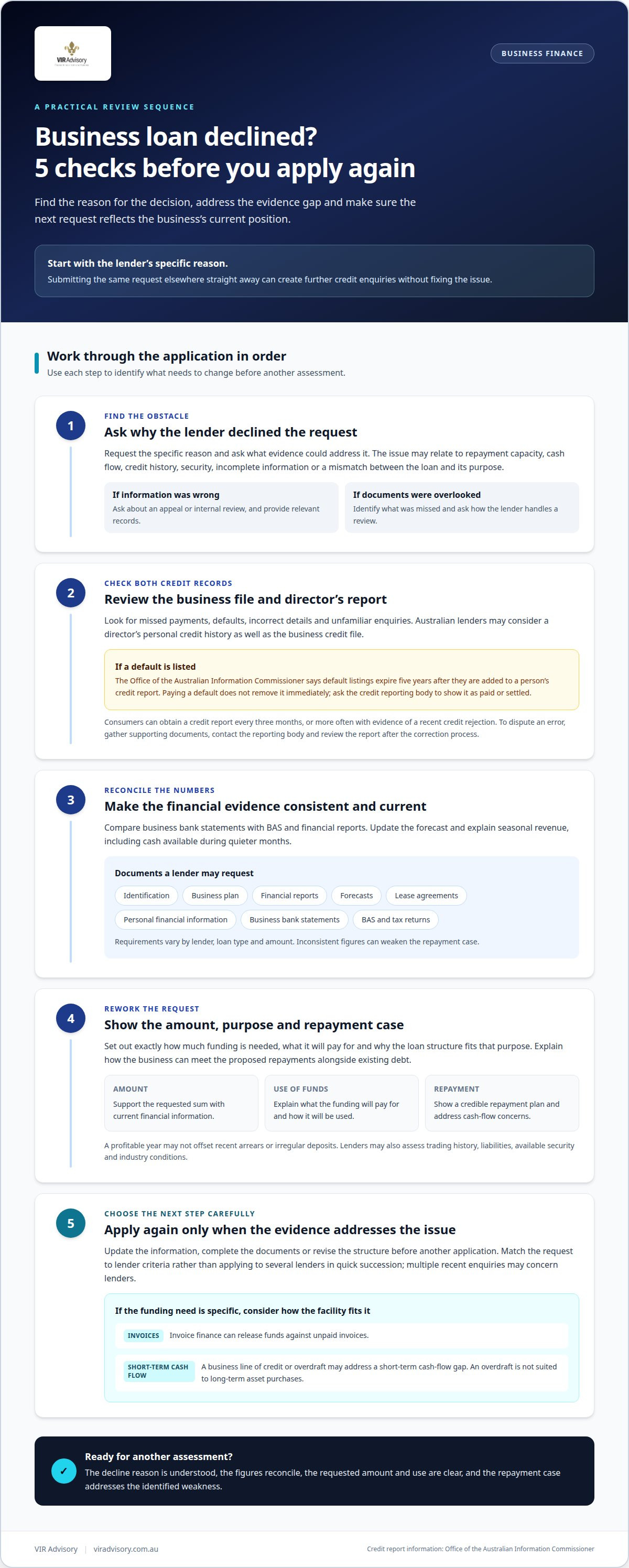
Use a three-step review: obtain the reason for the decline, reconcile bank statements with BAS and financial reports, then update the forecast and requested amount. If revenue is seasonal, show the cycle and the cash available during quieter months. Reapply when the evidence addresses the identified weakness, rather than resubmitting unchanged figures. This gives the next assessment a clearer basis.
2. What can I do if my business loan is not approved?
Ask the lender for its specific reason and what evidence could address it. If the application relied on a director’s credit history, request details of the relevant entry and the reporting body involved. If the issue was the business credit record, distinguish company information from personal information before taking action. This helps you identify whether the next step is a correction, an updated explanation or a revised funding request.
Australian lenders may consider a director’s personal credit history as well as the business’s credit file. Review both for missed payments, defaults, incorrect details and unfamiliar enquiries. According to the Office of the Australian Information Commissioner, default listings expire five years after they are added to a person’s credit report. Paying a default doesn’t remove it immediately; ask the credit reporting body to show its status as paid or settled.
Consumers can obtain a copy of their credit report every three months, or more often if they provide evidence of a recent credit rejection, according to the Office of the Australian Information Commissioner. To dispute an error, gather documents such as payment confirmations and correspondence, then contact the reporting body. Keep a copy of its response and review the report after the correction process.
There’s no single credit score required for every Australian business loan. Lenders use their own criteria and consider the full application, including business performance, repayment capacity, liabilities and security. A particular score alone doesn’t show whether a business can meet repayments. Similarly, a declined application may create a credit enquiry, but it isn’t automatically a default or proof of missed payments.
Which Australian lenders offer business loans to borrowers with poor credit? Banks and non-bank lenders apply different assessment criteria, and no lender can be assumed to accept every applicant with adverse credit. When navigating alternative finance options, educational portals such as Kdesipujcitpenize.cz demonstrate the importance of carefully comparing terms and safely evaluating non-bank loan providers. The useful next step is to match the application to a lender’s criteria and explain the circumstances behind the credit issue with supporting evidence.
Request an appeal or internal review if the decision relied on incorrect information or overlooked documents already supplied. Send the lender a concise explanation and relevant records, and ask how it handles reviews. If the underlying information was accurate, focus on changes you can evidence before applying again, rather than repeating the same request elsewhere.
Alternatives depend on what the funds are for. Invoice finance can release funds against unpaid invoices, while a business line of credit or overdraft may address a short-term cash-flow gap. These options work differently: an overdraft is not suited to long-term asset purchases, and drawing on a facility still creates repayment obligations. Check that the structure fits the actual funding need.
Before applying again, resolve any report errors, document the status of defaults and prepare updated business records. Apply when the new evidence addresses the lender’s stated concern. A changed credit record or stronger supporting documents can make the next assessment more complete, while unnecessary applications may add further enquiries for lenders to consider.
3. Do 0-4 person firms fail to get finance more often?
The available Australian figures don’t establish that firms with 0 to 4 persons fail to obtain finance more often. In 2024-25, businesses with 5 to 19 persons had the highest share of employing businesses that did not obtain finance, at 2.4%. Businesses with 200 or more persons had the lowest share of finance seekers who did not obtain finance, at 3.1%. These measures use different groups, so they don’t provide a direct comparison between the smallest and largest firms.
For a small business, the practical issue is whether trading cash flow can support repayments. In 2024-25, insufficient sales or cash flow was reported as a factor limiting or preventing finance access by 9.4% of employing businesses. Insufficient collateral or security was reported by 3.7%. These are reported barriers, not automatic decline rules, but they show why lenders look beyond the number of employees.
A lender assesses business income and expenses to determine repayment capacity. An owner’s personal income and credit history may be relevant, but they don’t replace evidence that the business can meet its debts. For an unsecured loan, the lender usually assesses the business’s financial health and ability to repay. If business receipts fluctuate, personal wages may not resolve a shortfall in business cash flow.
One planning measure is the debt service coverage ratio, or DSCR. It compares cash available for debt repayments with the repayments due. A DSCR of around 1.25 is a useful planning benchmark, though lender requirements vary. The calculation should account for existing debt and the proposed loan’s principal and interest, not just sales. A business with strong turnover can still have limited capacity if expenses and debt servicing consume its available cash.
Security can affect the options available. A lender may require collateral or a guarantor, while an unsecured lender focuses on the business’s ability to repay. With a secured loan, the lender can take the offered security to cover losses if the borrower doesn’t repay. Consider the risk before offering an asset: security doesn’t fix weak cash flow, and the asset may be at risk if repayments aren’t maintained.
To clarify the cash-flow picture, match incoming receipts with payment dates. A service firm waiting on customer invoices could send invoices promptly and follow up overdue accounts. It could also defer optional spending during a quiet trading period. These steps may improve the timing of available cash, but forecasts should still show seasonal dips and existing obligations.
Before another application, prepare a clear repayment-capacity review:
- Separate business income from personal income and list regular business expenses.
- Include existing debt repayments and the proposed loan’s principal and interest.
- Show how cash flow changes during busy and quiet trading periods.
- Identify available security and consider the consequences of pledging it.
4. Explaining the purpose and amount of the loan
A strong application links the funding request to a specific business use, a defensible amount and a source of repayment. Instead of requesting funds for “growth”, describe the purchase or cash-flow need, its timing and expected effect. For example, a wholesaler seeking funds to purchase inventory should explain how the goods support sales and how customer receipts will cover repayments.
Calculate the amount from documented costs rather than choosing a round figure. Itemise supplier quotes, installation costs and any working capital needed during implementation. Then separate essential costs from optional spending. If owners request more than the documented need, lenders may question the difference. If they request too little, the business could face a funding gap before the project is complete.
Match the loan structure to the asset or cash-flow requirement. Long-term assets generally call for long-term lending, while short-term cash-flow gaps suit short-term finance. Using an overdraft to buy equipment can leave the business relying on a facility intended for temporary cash needs. A long repayment period for short-lived working capital can leave debt outstanding after the funded need has passed.
For equipment, identify the asset, supplier, purchase timing and role in operations. Explain whether it replaces existing equipment or adds capacity, and link that change to revenue or operating costs. For a temporary gap between paying suppliers and receiving customer invoices, show the timing of both payments. This helps lenders assess whether the requested structure fits the business’s cash cycle.
A concise business plan can support the loan purpose and repayment case. The recommended finance-ready plan is 5-7 pages. Include the business model, customer demand, use of funds, financial forecasts and key assumptions. For instance, if a new machine is expected to increase production, explain how the business will secure orders and meet delivery costs. Forecasts should show the loan payment alongside existing commitments.
Use this application framework before applying again:
- Purpose: name the purchase, project or cash-flow need.
- Amount: support the request with quotes, invoices or a cost breakdown.
- Structure: match the repayment term to the funding purpose and asset life.
- Repayment: identify the business income that will cover each payment.
- Risk: explain how the business will manage delays, lower sales or higher costs.
When an application has been declined, address the weak point rather than simply changing the requested amount. If the lender questioned repayment capacity, update the forecast and explain its assumptions. If the purpose was unclear, connect each cost to a business outcome. A precise explanation gives lenders a clearer basis for assessing the request and helps owners avoid applying with an unsupported figure.
5. Common reasons for business loan rejection
A lender may decline an application for one reason or a combination of weaknesses. Common issues include repayment capacity, credit history, available assets, trading experience and a mismatch between the loan and its purpose. For example, a request to borrow for expansion may be difficult to assess if the business has no documented sales forecast or defined use for the capital.
Weak or inconsistent financial records can prevent a lender from forming a reliable view. If the BAS reports one turnover figure but bank statements show materially different deposits, reconcile the difference clearly. Outdated financial statements can also obscure recent changes; engaging professional assurance and accounting firms such as demassure.co.za can help ensure documentation is accurate and audit-ready. Before lodging a business loan application, align reporting periods and explain unusual transactions, such as a one-off asset sale.
Repayment affordability is another central test. A business can show sales growth yet have little surplus after wages, rent, tax obligations and existing debt repayments. A debt-to-income ratio below 50% is sometimes used as a planning benchmark, but lenders may apply different limits. Treat it as a preliminary measure, not evidence that the proposed repayment fits the business’s cash flow.
Credit conduct can raise concerns even when the business remains profitable. A lender may consider overdue accounts, defaults, multiple recent credit enquiries or a director’s personal credit record. For example, regular late payments to suppliers may suggest pressure on working capital. Explain the cause, show how the account was resolved and provide current evidence rather than relying on a verbal explanation.
Security and loan structure can also affect the decision. A lender may consider whether the offered assets support the requested borrowing and whether existing finance already encumbers them. If a business seeks long-term capital for equipment with short-term repayments, the payment schedule may strain cash flow. Conversely, an overdraft request for a long-term asset can signal that the funding structure doesn’t match the need.
Trading conditions matter too. A short operating history gives lenders less evidence of how the business performs during quieter periods, while deteriorating industry conditions can affect forecasts. If sales depend on a small number of customers, show how expected receipts support repayment and what happens if a major contract is delayed. Specific assumptions make the risk easier to assess.
Before applying again, link each reason for the decline to a change in the evidence: correct inconsistent figures, update forecasts, reduce the requested amount where appropriate or explain recent credit events. Avoid submitting the same application to several lenders. Each assessment should fit the business’s circumstances and funding purpose.
VIR Advisory: Business Loans
VIR Advisory can help business owners review a declined application, clarify lender requirements and prepare a more suitable request. Its business loan and financial strategy guidance can help assess the funding purpose, repayment capacity, loan structure and supporting documents before applying again.
Consider speaking with VIR Advisory if the reason for the decline is unclear, your business circumstances have changed, or you need to compare finance options against your cash flow and assets. As a finance brokerage, VIR Advisory can help identify lenders whose assessment criteria may better fit the application and explain the costs and risks of different structures. Approval still depends on the lender’s assessment and the evidence provided.
Contact VIR Advisory to discuss your business finance needs.
Make the next funding decision on current information
If your business loan has been rejected, treat the next application as a fresh assessment, not a repeat submission. Before deciding whether to apply again, consider whether the funding need has changed: a supplier deadline, a planned purchase and a temporary cash shortfall each call for different timing and finance structures. Distinguishing between them can prevent an urgent payment from driving a borrowing decision that doesn’t suit the business.
Set a practical trigger for reviewing the request, such as receiving updated financial statements or confirming a project’s costs. Then assess whether the proposed repayments still fit current trading conditions. If the original need has passed, borrowing may no longer be appropriate. If it remains, current information can support a better-prepared discussion.
VIR Advisory offers Business Loans, Home Loans and Refinancing solutions. Contact VIR Advisory to review the finance structure, lender requirements or next steps before submitting another application. The right decision may be to revise the request, consider a different funding structure or wait until the evidence reflects the business’s current position.
A considered next step can keep borrowing aligned with what the business needs now.
Frequently Asked Questions
What can I do if my business loan is not approved?
Turn the decline into a specific action plan before changing lenders. Ask whether the decision relates to policy, missing evidence or an assessment concern, then record what would need to change. For example, if the lender couldn’t verify a director’s income from the submitted records, provide the relevant supporting documents with a clear explanation. Keep the revised request focused on the original funding need.
Do businesses with 0 to 4 persons fail to obtain finance more often than larger businesses?
The available figures don’t establish that businesses with 0 to 4 persons fail more often than larger businesses. A firm’s headcount alone doesn’t show its borrowing capacity: a small operator with stable contracts may present different evidence from a larger business with volatile revenue. Compare businesses using the same measure and denominator, and consider trading record, liabilities and lender criteria before drawing conclusions about size.
What share of Australian businesses sought and did not obtain finance in 2024-25?
In 2024-25, 15.9% of employing businesses obtained debt or equity finance, while 1.0% had finance in progress. These figures describe outcomes across employing businesses, rather than the proportion of finance seekers who missed out. That distinction matters when reading business finance statistics: check whether the measure covers all businesses or only those that applied, and avoid treating a national result as an individual approval forecast.
Which factors limited Australian businesses' access to finance in 2024-25?
In 2024-25, 18.9% of employing businesses reported at least one factor limiting or preventing access to finance. Uncertainty about economic conditions was reported by 11.0% of employing businesses. These figures show that reported obstacles can extend beyond an individual borrower’s documents. For a specific application, separate external trading uncertainty from issues the business can evidence or address, such as forecast assumptions and committed customer orders.
Why was your loan application rejected?
There may be several contributing reasons rather than one failed test. A lender assesses the request against its own criteria, the business’s financial position and the proposed use of funds. For example, a requested facility may not align with how the business plans to use it. Ask which issue carried the most weight, then prioritise evidence that addresses that point instead of changing unrelated parts of the application.
Can I find out why my Australian business loan was rejected?
Ask the lender to identify the main assessment concern and whether it came from a credit report, the submitted financials or the proposed loan structure. If the lender refers to an entry on a report, obtain the relevant report and compare it with your records. This can help distinguish inaccurate information from a valid entry that needs context, such as evidence of a resolved account.
How long should I wait before reapplying for a business loan in Australia?
Apply again when a meaningful change is reflected in the evidence, rather than relying on a fixed waiting period. For example, if a contract has commenced, include the executed agreement and show how its payment terms affect cash flow. If revised financial statements are needed, wait until they reflect the business’s current position. An unchanged application lodged earlier may leave the original concern unresolved.
How can I improve my chances of business loan approval in Australia?
Make sure the applicant entity, ownership details and financial records tell a consistent story. If a related business pays expenses or receives customer funds, explain those transactions and provide records showing how they affect the applicant’s finances. Ensure forecasts also use assumptions that can be traced to contracts, trading history or supplier information. Clear evidence helps a lender assess the business that is actually applying.

Article by
Raina Doshi
Raina Doshi has worked in banking and finance since 2011, including experience with major Australian lenders. She helps homeowners, property investors, business owners and professionals secure and structure lending solutions across home loans, refinancing, commercial finance and business lending.
Areas of expertise include residential lending, investment property finance, debt recycling, commercial property finance, equipment finance, construction finance and strategic debt structuring.
Drawing on extensive banking and finance experience, Raina helps clients navigate lender requirements, improve borrowing outcomes and structure effective finance solutions.
Disclaimer
The information in this article is general in nature and does not take into account your personal objectives, financial situation or needs. Before acting on any information, consider whether it is appropriate to your circumstances and seek professional advice.


