

Your deposit can affect more than the size of your home loan: it can influence your LVR, Lenders Mortgage Insurance (LMI) and the interest rate available. Understanding LVR for home loans in Australia starts with a simple calculation: divide the loan amount by the property’s value, then multiply by 100. For example, a A$400,000 loan against a property valued at A$500,000 gives an LVR of 80%.
If you’re comparing deposit options, it’s reasonable to want a clear view of how each one affects the costs and borrowing choices ahead. Loans above 80% LVR are generally considered higher risk, and lenders may charge LMI; interest rates will often be higher too. LMI protects the lender, not you, and some lenders may add its premium to the loan.
This article explains how to calculate LVR, why a lender’s valuation can change the result, and how your deposit may affect upfront costs and borrowing capacity. A lower LVR does not automatically mean you can borrow more: lenders also assess income, expenses, debts and other application details.
Key Takeaways
- Calculate LVR by dividing the loan amount by the property’s value and multiplying by 100; the lender’s valuation can affect the result.
- A higher LVR may mean Lenders Mortgage Insurance and a higher interest rate, while LMI protects the lender rather than the borrower.
- Allow for upfront buying costs when working out how much of your savings can go towards the deposit.
- Eligible first-home buyers may be able to purchase with a deposit as low as 5% through the Home Guarantee Scheme, according to Housing Australia.
- LVR is only one part of borrowing capacity: lenders also assess income, expenses, debts, employment and the property.
What is home loan LVR?
For a home loan, LVR expresses the proposed loan as a percentage of the property value accepted by the lender. To calculate it, identify the loan amount and accepted property value, then use the calculation below.
Calculating the Loan-to-Value Ratio
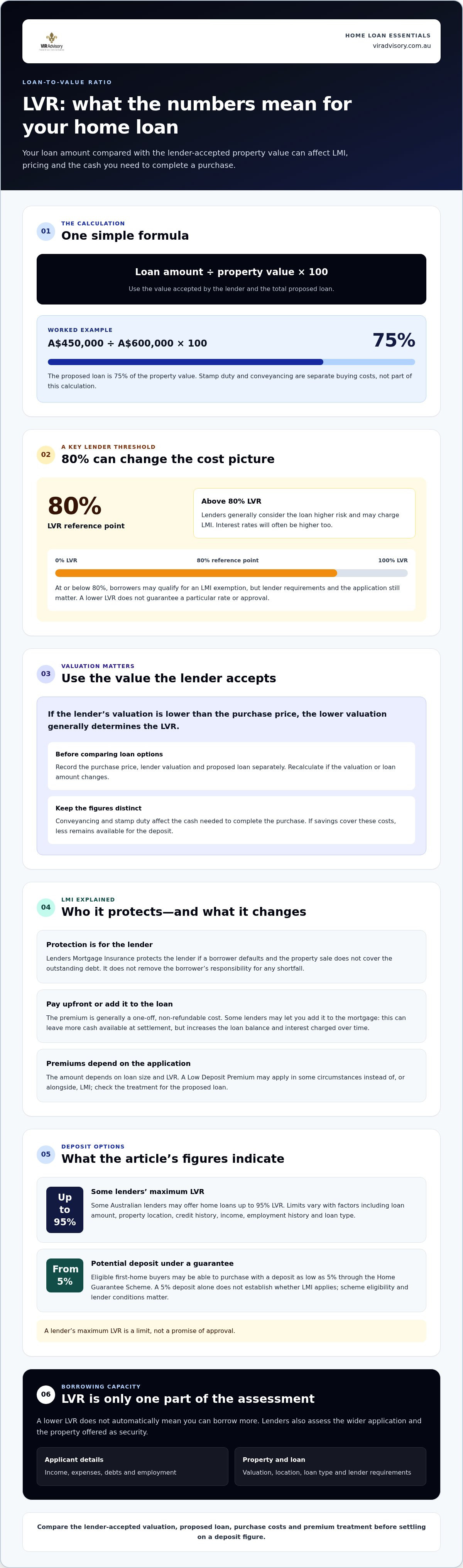
Divide the loan amount by the property value, then multiply the result by 100. For example, A$450,000 ÷ A$600,000 × 100 gives an LVR of 75%. The loan amount is the numerator; the property value is the denominator. This keeps the calculation focused on the amount secured against the property.
Start with the proposed loan amount and the property value the lender accepts. If the lender’s valuation is lower than the purchase price, the lower valuation generally determines the LVR. Recalculate using that figure rather than assuming the contract price will apply.
Use consistent inputs: the total proposed loan and the same property offered as security. Don’t divide the deposit by the purchase price, as that gives the deposit percentage, not the loan-to-value ratio. Check the result before comparing lending options.
Costs Excluded from the Calculation
Conveyancing and stamp duty are not included in the loan amount for an Australian home loan LVR calculation. They are separate purchase expenses, although they affect the cash you need to complete the transaction.
When preparing your figures, list the proposed loan separately from stamp duty and conveyancing. If you use savings to pay these costs, less remains for the deposit. LVR compares the loan with the property value; the remaining deposit determines how much you need to borrow.
Keep three figures separate: the property value, proposed loan and cash reserved for purchase costs. This helps prevent purchase expenses from being mistakenly added to the property value or counted as part of the deposit.
Examples of LVR Calculations
Consider a lender-valued property at A$600,000 and a proposed loan of A$450,000. Divide A$450,000 by A$600,000, then multiply by 100. The resulting LVR is 75%. This example shows how the calculation uses the loan and property value, not stamp duty or conveyancing expenses.
Before calculating, put the lender’s valuation and requested loan amount side by side. If either changes, recalculate with the updated figures. A higher loan increases LVR; a higher accepted property value lowers it, assuming the loan stays the same.
Before lodging an application, record the purchase price, lender valuation and proposed loan separately. This makes it easier to identify which figure changed if the lender’s assessment produces a different LVR.
LVR and Lenders Mortgage Insurance
For Australian home loans, LMI may apply when a lender accepts an application with a higher LVR. How the premium is handled affects the upfront cash required, total borrowing and amount owed over the loan term.
Some Australian lenders may offer home loans up to 95% LVR. Their limits vary with the loan amount, property location, credit history, income, employment history and loan type.
A 5% deposit doesn’t automatically mean a first-home buyer avoids LMI. Housing Australia’s Home Guarantee Scheme may help eligible buyers purchase with a deposit as low as 5% through a government guarantee; that deposit level alone doesn’t establish the LMI treatment.
Lenders Mortgage Insurance
Lenders Mortgage Insurance is a premium that protects the lender if a borrower defaults and the property sale does not cover the outstanding debt. It does not remove the borrower’s responsibility for any shortfall after the sale.
The premium is generally a one-off, non-refundable cost. Its amount depends on the loan size and LVR, so borrowing more or applying at a higher LVR can affect the premium. Lenders may allow you to add it to the mortgage instead of paying it from savings.
Adding LMI to the loan can leave more cash available at settlement, but increases the loan balance and interest charged over time. Compare both options by looking at the total loan and repayment structure, not only the upfront cash needed.
LMI and the 80% Threshold
Above 80% LVR, lenders generally treat a home loan as higher risk and may charge LMI. Borrowers at or below 80% may qualify for an exemption, although lender requirements and the application still matter.
Use this threshold when comparing deposit choices, not as a guarantee of a particular rate or approval. A valuation lower than expected can push the assessed LVR above 80%, even if the planned deposit was based on the purchase price.
LMI and Low Deposit Premiums
A Low Deposit Premium may apply in some lending circumstances instead of, or alongside, LMI. The terminology and treatment depend on the loan, so compare the premium shown for the proposed application rather than assuming every lender structures it the same way.
If you are eligible for a government guarantee, consider the scheme’s eligibility rules and lender conditions alongside your deposit. The potential benefit is purchasing with less saved; the trade-off is a larger loan relative to the property value and the associated repayment obligations.
LVR Limits Used by Banks
A lender’s maximum LVR is a limit, not a promise of approval. A lender may accept a higher ratio for one property and set a lower limit for another, based on factors such as location, loan type and its assessment of the security.
Before choosing a deposit target, compare the lender’s LVR limit with the property valuation, premium treatment and proposed loan balance. This helps you see whether you may need to contribute more or consider a different borrowing structure.
What is loan to value ratio (LVR)?
LVR measures the proposed loan against the property offered as security. Understanding LVR for home loans in Australia also means knowing what it does not tell you: the figure alone does not establish affordability, approval or whether a loan structure suits you.
LVR and Home Loan Rates
Use LVR as one point of comparison when reviewing loan offers, not as a complete measure of cost. Lenders may use the initial LVR when setting a new loan’s interest rate, and some products keep that rate even if the LVR later changes.
For a useful comparison, record each offer’s proposed loan structure, initial LVR and quoted interest rate. Then consider whether the product suits your expected cash flow and repayment preferences. Assess any rate difference alongside the other loan terms and your ability to make repayments.
Do not assume extra repayments will automatically move an existing loan into a different rate band. The lender’s product rules determine how an existing loan is priced, so distinguish a new application from a change to a current loan.
The First Home Guarantee, LVR and LMI
The First Home Guarantee is a government guarantee under the Home Guarantee Scheme for eligible buyers. Housing Australia says eligible first-home buyers may be able to buy with a deposit as low as 5% through the scheme.
Treat scheme eligibility and the lender’s LVR assessment as related but separate matters. A guarantee does not change the LVR calculation, and a deposit percentage alone does not determine the loan’s LMI treatment. Review the scheme requirements alongside the lender’s conditions before factoring the guarantee into your purchase budget.
This distinction helps avoid a common planning error: treating a government guarantee as extra deposit money or as a change to the property’s value. It is a guarantee arrangement; the proposed borrowing and accepted security still matter to the lender’s assessment.
Valuation Changes and LVR
If the lender changes its accepted property value during the application, consider what that means for your loan structure and the funds needed to complete the purchase. The key question is whether the revised assessment still supports the requested borrowing.
Keep the purchase contract, deposit evidence and loan request aligned in your application records. If the valuation creates a funding gap, possible responses include changing the requested loan or contributing more funds, subject to the lender’s assessment.
A bank valuation is an assessment for lending purposes, not a guarantee of the price a property would achieve in a sale. Base your funding calculations on the lender’s accepted figure, not an informal estimate treated as approval evidence.
Upfront home-buying costs and deposit size
For a given property value, your deposit affects the loan amount and therefore the LVR. Refinancing and investment property applications use the same comparison: the loan against the property value. Equity is the property value less the outstanding debt.
Upfront buying costs can leave less savings available for a deposit, increasing the amount you need to borrow. Eligible first-home buyers in Australia may be able to buy with a deposit as low as 5% through the Home Guarantee Scheme, an Australian Government guarantee, according to Housing Australia.
Increasing the Deposit to Reduce LVR
A larger deposit reduces the loan needed to buy a property, lowering its LVR if the property value stays constant. This can affect whether LMI applies and which lending terms are available.
The relationship is straightforward: a larger deposit means less borrowing against the same property value. Before committing your savings, allow for buying costs and retain funds for expenses after settlement.
For a practical estimate, subtract the intended loan from the lender’s property value, then compare the result with your available savings. Do not count every dollar saved as deposit money: stamp duty and conveyancing are excluded from the LVR calculation, but still affect the cash needed to complete the purchase.
Deposit Size and Property Value
The deposit percentage depends on both your cash contribution and the property value used by the lender. The same deposit can result in a higher LVR on a more expensive property because the loan represents a larger share of its value.
For instance, A$50,000 represents 10% of a A$500,000 purchase price, but the lender’s valuation determines the LVR calculation. If that valuation is lower than the purchase price, the ratio rises because the loan is measured against a smaller value.
Upfront costs can reduce the deposit available for your application. Budget separately for stamp duty, conveyancing and other purchase expenses, then calculate your remaining deposit and likely loan amount. This avoids assuming all your savings reduce the LVR.
The same principle applies to refinancing and accessing equity. An updated property valuation may reduce LVR, while a larger loan for equity release raises it. For an investment property loan, compare the proposed borrowing with that property’s value, and consider how the deposit affects cash reserves as well as lending terms.
Compare deposit options against the full cash requirement, not just the percentage. A smaller deposit can preserve savings for other costs, but may increase borrowing and affect LMI or interest rates. A larger deposit can reduce the loan while leaving less cash available.
LVR and borrowing capacity
LVR affects how much a lender may advance against a property, but it does not calculate borrowing capacity on its own. A lower ratio may expand your property options, while income, debts, expenses and employment also influence what a lender may approve.
Keep the two assessments distinct. Borrowing capacity considers whether your finances support the repayments; LVR compares the proposed loan with the property value. A strong valuation can support the security assessment, but does not replace a lender’s review of your ability to repay.
For example, on an Australian property valued at A$450,000, an 80% LVR corresponds to a A$360,000 loan. At 85% LVR, the loan would be A$382,500. The higher figure may expand the price range you can consider, but it also means borrowing more relative to the property value.
This distinction matters for first-home buyers, investors and self-employed applicants. When setting its permitted LVR, a lender assesses factors such as the loan amount, property location, credit history, income, employment history and loan type. A higher permitted limit does not mean your income supports that loan.
Treat the valuation as a funding constraint, not a substitute for assessing cash flow. If the lender’s valuation is below the purchase price, the property may support a smaller loan than expected. You may need a larger deposit or a different loan amount to cover the gap.
For an investment property, compare the proposed loan with the lender’s property value, then assess repayments against your other commitments. A lower LVR may broaden your property options and improve approval prospects, but the lender still assesses your financial position and the property’s location.
An updated valuation may reduce LVR and create more financial flexibility, such as scope to consider refinancing or accessing equity. The valuation alone does not establish how much extra borrowing is affordable; the lender also assesses your income, existing debt and proposed loan structure.
A family guarantee may help some buyers secure a home loan using a parent’s property, potentially reducing the LVR on the buyer’s property. It also creates risk for the guarantor: they are liable for the amount specified in the guarantee, and their own borrowing ability may be reduced. Independent legal advice before signing is important.
For a practical assessment, compare the lender’s valuation, proposed loan and available deposit, then consider repayments alongside your income, expenses and existing debts. This helps show whether the constraint is property security, cash flow or both before you settle on a purchase price.
VIR Advisory: Business Loans
VIR Advisory can help you consider home loan options alongside business finance requirements. For business owners and company directors, existing business debt, income structure and cash flow can affect how a lender assesses a home loan application, while property value and LVR shape the security assessment.
VIR Advisory arranges Business Loans and Home Loans, and provides refinancing solutions and financial strategy guidance. This can be relevant when business borrowing needs to be considered alongside a property purchase, or refinancing could change your loan structure and equity position. Look at repayments, income evidence, existing commitments and the lender’s property valuation, not LVR alone.
Contact VIR Advisory to discuss how your LVR and lending requirements fit together.
Plan the application around the full lending picture
Understanding LVR for home loans in Australia can help you prepare a more complete finance application, but you also need to align the property, loan structure and repayment commitments. Before applying, organise current income and debt information, confirm the funds available for the purchase, and consider how a change in valuation could affect your contribution.
This is especially important when personal and business finances overlap. VIR Advisory offers Home Loans, Business Loans and refinancing solutions, helping borrowers consider how these needs interact. For business owners, directors and investors, a lending assessment may account for household commitments and business cash flow, as well as the property security.
Bringing these details to the discussion can clarify which parts of your application need attention and how different borrowing choices may affect your cash position. A considered review can help you move forward with a clearer understanding of the lending structure that fits your circumstances.
Frequently Asked Questions
How to calculate your LVR?
Divide the proposed loan amount by the property value used for lending, then multiply by 100. For example, a A$500,000 loan against a property valued at A$600,000 gives an LVR of 83.3%. Use the lender’s valuation rather than assuming the advertised price will apply. If the loan includes a capitalised LMI premium, include that amount in the total loan figure used for the calculation.
What is LVR and why is it important?
LVR is a percentage showing the size of a mortgage relative to the property securing it. Lenders use it to assess security and set loan conditions; it can influence interest rates and whether LMI applies. It is one way to compare borrowing options: a lower ratio may reduce some lending costs, but does not show whether repayments fit your budget or determine borrowing capacity on its own.
How can I reduce my LVR?
You can reduce LVR by borrowing less, increasing your deposit, making additional repayments on an existing home loan or buying a less expensive property. An updated valuation may also lower the ratio if the lender accepts a higher property value. For a purchase, recalculate using the lender’s valuation and proposed loan amount. For an existing loan, additional payments reduce the balance over time.
How is the property value assessed when calculating the LVR?
A lender assesses the property’s value, often using an online valuation based on comparable sales and local market trends. It may arrange an onsite valuation if needed. The assessment can consider location, property attributes, zoning, public transport and schooling. If the bank valuation differs from the purchase price or another market estimate, lenders generally use the lower figure to calculate LVR.
Is there any benefit to paying LMI?
LMI does not directly protect the borrower; it protects the lender against loss if the borrower defaults. Paying the premium or adding it to the loan may allow a buyer to proceed with a smaller deposit instead of waiting to save more. The trade-off is that the borrower remains liable for any shortfall after a property sale, and adding the premium increases the amount owed.
I’m borrowing up to 80% LVR, what should I know?
An 80% LVR is a common point for assessing whether LMI may apply, but it doesn’t guarantee a particular interest rate or loan approval. Lenders still assess income, expenses, debts, credit history and property details. Leave room in your cash-flow calculations for buying costs excluded from the LVR formula, and remember that a valuation below the purchase price can push the assessed LVR higher.
What does LVR mean?
LVR stands for loan-to-value ratio. It expresses the mortgage as a percentage of the property value used by the lender, showing how much of the security’s value is being borrowed. A lower percentage means the loan is smaller relative to that value. LVR is one part of a lending assessment, alongside the borrower’s financial position and the property itself.
What does loan-to-value ratio (LVR) mean for Australian home loans?
For Australian home loans, LVR describes the relationship between the loan and the property value accepted by the lender. It can affect available lending terms, including the interest rate and potential LMI requirement. Lenders may set different maximum LVRs based on factors such as loan type, property location and borrower circumstances. A permitted LVR is a limit, not a promise of approval.

Article by
Raina Doshi
Raina Doshi has worked in banking and finance since 2011, including experience with major Australian lenders. She helps homeowners, property investors, business owners and professionals secure and structure lending solutions across home loans, refinancing, commercial finance and business lending.
Areas of expertise include residential lending, investment property finance, debt recycling, commercial property finance, equipment finance, construction finance and strategic debt structuring.
Drawing on extensive banking and finance experience, Raina helps clients navigate lender requirements, improve borrowing outcomes and structure effective finance solutions.
Disclaimer
The information in this article is general in nature and does not take into account your personal objectives, financial situation or needs. Before acting on any information, consider whether it is appropriate to your circumstances and seek professional advice.


