

Could a tax debt affect business funds before they reach your account? An ATO garnishee notice can require a third party, such as a bank, customer or payment provider, to pay money to the ATO under section 260-5 of Schedule 1 to the Taxation Administration Act 1953. A bank may transfer funds without first consulting the account holder.
An ATO garnishee notice can put pressure on cash flow, especially when incoming funds are already allocated to suppliers, operating costs or wages. The impact depends on the notice’s instructions and whether it requires a one-off payment or applies to future funds as they arrive.
This article explains how ATO garnishee notices work, when the ATO may issue one and what business owners need to know about affected funds. It also covers possible effects on trading obligations, ongoing payments and wages, including why a continuing notice can matter after the first funds are taken.
Key Takeaways
- Identify who received the notice and what funds it covers before assessing the effect on your business.
- Distinguish a one-off direction from a continuing notice, as future payments may also be affected.
- Map potential impacts on incoming revenue against trading costs, supplier payments and wages.
- Understand how wage and salary deductions differ from action against business funds.
- Consider the debt history and any prior communication with the ATO when assessing why a notice was issued.
What is a garnishee notice?
An ATO garnishee notice directs a third party holding or owing money to pay it to the Australian Taxation Office. It can affect business funds before they reach your account, so identify its recipient, scope and payment instructions promptly.
Who can receive a notice
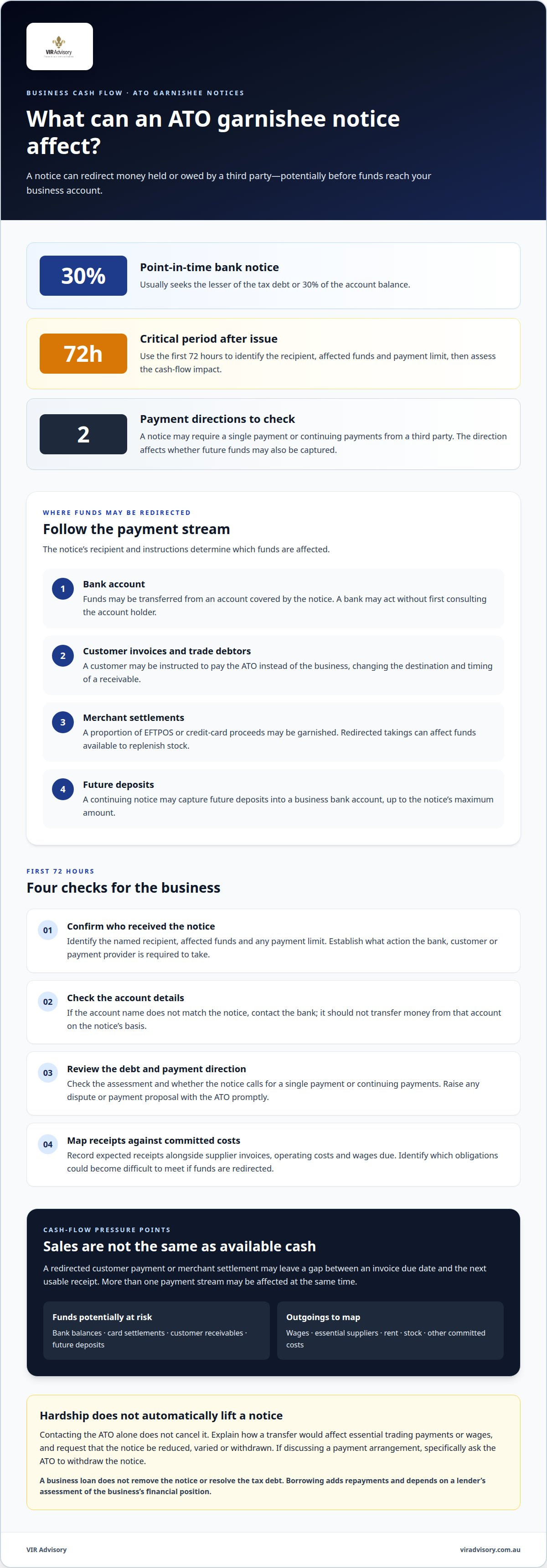
A notice may be sent to a bank, customer, payment provider or another third party holding money for a taxpayer. The recipient, not just the business with the tax debt, must follow the notice’s directions. For a business, this could mean a bank transfers funds or a customer redirects an invoice payment. A point-in-time bank notice usually seeks the lesser of the tax debt or 30% of the account balance.
When the ATO may issue a notice
The ATO issues garnishee notices under section 260-5 of Schedule 1 to the Taxation Administration Act 1953. The provision concerns amounts payable to the Commonwealth, whether or not the debt is due and payable. Before issuing a notice, the ATO sends a warning letter; earlier communication may include a Notice of Intended Legal Action or a Firmer Action Warning. A disputed tax debt or payment-plan discussion doesn’t itself stop a notice from being issued.
How an ATO notice differs from a court order
An ATO garnishee notice is issued under tax legislation, while a court garnishee order comes through a court process. An ATO notice is a debt-recovery measure, not a statutory demand, which is an insolvency step with strict deadlines. You can dispute an underlying assessment through the tax objection process, but deadlines vary depending on the assessment. Act promptly: the notice itself does not provide a universal appeal period.
Hardship protections and changing a notice
Hardship does not automatically cancel a notice, and contacting the ATO alone does not lift it. Explain the business circumstances, including how a transfer would affect essential trading payments or wages, and request that the ATO reduce, vary or withdraw the notice. If negotiating a payment arrangement, specifically ask the ATO to withdraw the notice. The ATO considers withdrawal under Practice Statement Law Administration 2011/18.
Act quickly after receiving a notice
The first 72 hours after issue are a critical period for a business. Start by identifying the named recipient, affected funds and any payment limit. Then:
- Give the recipient the notice details and establish what payment action it requires.
- If the account name doesn’t match the notice, contact the bank; it should not transfer money from that account on the notice’s basis.
- Review the assessment and debt, then raise any dispute or payment proposal with the ATO promptly.
- Map funds at risk against supplier invoices, operating costs and wages due.
A notice can require a single payment under section 260-5(4)(a), or continuing payments under section 260-5(4)(b). Check which direction applies before estimating the effect on cash flow.
Impact on business cash flow and trading obligations
A garnishee notice can redirect money a business expected to use for operating costs. The ATO may target bank accounts, trade debtors, future deposits or other incoming revenue, so the immediate effect depends on the payment stream covered. If a customer’s invoice payment is redirected, that money may no longer be available for the supplier invoice it was meant to fund.
Compare the notice with your business’s cash-flow cycle. A transfer from the main trading account can reduce funds available for payroll, rent, stock or creditor payments. A notice affecting one customer’s payment may instead leave a gap between the invoice due date and the next usable receipt. Record expected receipts alongside committed outgoings, then identify which obligations could become difficult to meet if the affected funds do not arrive.
Business merchant-card and trade facilities
Merchant facilities can also be affected: the ATO may garnish a proportion of funds processed through EFTPOS or credit-card payments. For a retailer using daily card settlements to replenish stock, redirected proceeds can disrupt purchasing even while sales continue. Trade debtors are affected differently: a customer may be instructed to pay the ATO instead of the business, changing the timing and destination of that receivable.
These effects can overlap. A business, for example, might have card takings redirected while a large customer’s invoice is also covered by a notice. Model the remaining cash against dated obligations rather than treating total sales as money available for trading. Directors can brief the staff responsible for accounts payable and payroll, too, so payments are not scheduled against funds that may be redirected.
- Identify affected accounts, merchant settlements and customer receivables.
- Match expected receipts against wages, essential suppliers and other committed costs.
- Contact affected customers or payment processors about the payment instructions they received.
- Keep a record of payment dates and any resulting shortfall for discussions about the tax debt.
Do not assume a business loan will remove the notice or resolve the tax debt. Borrowing may provide working capital, but it also adds repayments and depends on a lender’s assessment of the business’s financial position. Any funding review should account for the notice’s effect on cash flow and the repayments the business can sustain. Lenders also assess whether documented income can support existing and proposed commitments.
Continuing or enduring garnishee notices
A continuing garnishee notice directs a third party to make payments over time, rather than one transfer only. Under section 260-5(4)(b) of Schedule 1 to the Taxation Administration Act 1953, the ATO can require continuing payments from a third party. For a business bank account, this may capture future deposits, up to the notice’s maximum amount.
The notice’s terms determine how long the direction applies. An ongoing bank notice may nominate a period, such as three months from its issue date. A continuing notice may also remain in effect until the specified debt is cleared, unless the ATO varies or withdraws it. Distinguish the nominated period from the amount limit: one sets the timeframe, while the other caps recovery under the notice.
This distinction matters when customer receipts arrive in instalments or sales proceeds vary between trading periods. If future deposits are covered, the business may have less cash for wages, suppliers and other commitments after each deposit. Businesses relying on regular customer payments should map expected receipts against the notice period, then assess which obligations fall due while the direction remains active.
A payment arrangement doesn’t automatically end an existing notice. Contacting the ATO also doesn’t, by itself, lift the direction. If the business is negotiating an arrangement, it should specifically ask the ATO to withdraw or vary the notice and explain how continued deductions affect its ability to trade. The ATO’s Practice Statement Law Administration 2011/18 addresses when it will agree to withdraw a notice.
Earlier warnings and later recovery steps are separate matters. A warning of intended legal action may precede recovery, while a director penalty notice concerns potential director liability for certain company tax debts. Neither proves that a continuing garnishee notice will end or change. Establish which notices have been issued and what each one requires.
- Read the notice for its payment instructions, maximum amount and any nominated period.
- Identify whether it captures future bank deposits or payments from another third party.
- Match expected receipts with wages, supplier invoices and other due commitments.
- If seeking a payment arrangement, request variation or withdrawal expressly and explain the cash-flow effect.
These checks clarify the practical effect of an ongoing direction and support a clear discussion with the ATO. While the notice remains in force, keep records of affected deposits and obligations, and note any response about a proposed change. Unless you receive written confirmation that the notice has been varied or withdrawn, the third party may continue following its existing instructions.
Deductions from wages and salary
A garnishee notice can direct an employer to deduct money from an employee’s wages and pay it towards that person’s unpaid tax debt. The employee is the debtor in this situation, not necessarily the employer. For wage and salary garnishee action in Australia, employers may usually be required to deduct up to 30 cents in the dollar of an individual’s post-tax income. The notice explains the direction the employer must follow.
This differs from a notice affecting a company’s bank account or customer receipts. If an employee has a personal tax debt, their employer may have to redirect part of their pay, even though the business is not the debtor. Payroll staff should read the notice carefully and distinguish the employee’s pay from business funds, including money owed to the business by its debtors.
The stated percentage applies to post-tax income, so payroll calculations must use the correct pay figure. For example, where tax has already been withheld, the employee’s gross salary is not the basis under this description. Follow the notice’s terms and the employee’s pay records when calculating the deduction. Do not treat it as an ordinary payroll adjustment or assume it can be stopped informally.
For the business, the practical task is to meet employer obligations while keeping payroll records accurate. The person handling payroll should record the amount withheld, the relevant pay period and the payment made to the ATO. If the employee’s hours or pay change, the deduction may affect the amount they receive, so clear records help explain each payslip and remittance.
An employee who disputes the unpaid tax or cannot meet the debt from reduced take-home pay should contact the ATO directly. They can discuss the assessment or propose a payment plan, but the employer should not assume this automatically changes the existing notice. The employee should ask the ATO whether it will vary or withdraw the direction and tell the employer about any formal change.
- Read the notice to identify the employee, deduction instructions and payment details.
- Apply the stated deduction to post-tax income, not gross salary.
- Keep payroll records showing each deduction and payment to the ATO.
- If the employee raises a dispute or payment plan, don’t treat that discussion as a change to the notice.
For an employer, complying with the direction and explaining the payslip entry are separate tasks. The ATO’s notice sets out the required action; the payroll record shows how the employer applied it. If an employee believes the amount or debt is wrong, they need to raise the issue with the ATO. Do not promise that a call or proposed arrangement will stop deductions before the ATO changes its instructions.
When can the ATO issue a garnishee notice?
The ATO issues garnishee notices under section 260-5 of Schedule 1 to the Taxation Administration Act 1953. Section 260-5(1) applies to amounts payable to the Commonwealth by an entity, whether or not the debt is due and payable. The power therefore isn’t limited to tax debts already overdue. For a business, the relevant issue is whether an amount is payable to the Commonwealth and what funds a third party holds or owes.
Before issuing a notice, the ATO sends a warning letter advising the taxpayer to pay the debt. Earlier contact may include a Notice of Intended Legal Action or a Firmer Action Warning letter. These communications signal that the ATO is seeking payment, but a warning letter and a garnishee notice are different documents. Read each one for its specific instructions and any requested response.
The ATO may consider whether the taxpayer has made reasonable efforts to work with it to manage the debt. The ATO Practice Statement Law Administration 2011/18 sets out matters considered when deciding whether to issue a notice. For example, a business that has responded and proposed a payment arrangement has taken a different course from one that has not engaged. That history is relevant to the ATO’s consideration, but doesn’t itself prevent a notice.
Disputing an assessment or discussing repayment does not automatically stop recovery action. Consider the assessment, the ATO’s communications and the taxpayer’s responses together. Keep copies of warning letters, payment proposals and ATO replies together so the sequence of contact is clear. If the business has missed a letter, respond promptly and explain the situation rather than assuming the notice will wait.
Company status can also matter. In Bell Group Limited (in liq) v DCT, a 2015 decision, the court authority cited says the ATO cannot issue a garnishee notice once a company is in liquidation. A company in liquidation should not treat this as a general rule for every debt or recovery step; the decision concerns the ATO’s power to issue that notice in that circumstance.
To understand why a notice was issued, organise the record in this order:
- Identify the tax debt and the assessment or account it relates to.
- Put ATO warning letters and notices in date order.
- Record each response, payment proposal and arrangement discussion.
- Note any liquidation status and the date it began.
This timeline helps separate the ATO’s decision to issue a notice from later discussions about payment or withdrawal. It also makes communication gaps and unresolved assessment issues easier to identify when responding.
VIR Advisory
An ATO garnishee notice can affect available cash flow and existing finance commitments. When redirected receipts leave a gap for wages, suppliers or operating costs, assess the funding pressure and how it affects the business’s ability to meet its commitments.
For example, a business may need to assess whether its working capital needs have changed and whether existing borrowing commitments remain manageable alongside the tax debt. Review the business’s financial position and available finance options. Direct questions about disputing an assessment or changing a notice to the ATO.
Contact VIR Advisory to discuss your business’s finance position.
Set your next finance decision in context
Before making a funding decision, consider how business cash flow, existing commitments and personal finances interact. An ATO garnishee notice is part of the debt-recovery picture; assess any borrowing separately, taking repayments and business trading needs into account.
Home loans and refinancing may be relevant when household lending forms part of the overall financial picture. Keep discussions about the tax debt and notice with the ATO, and assess any finance commitments on their own merits.
Reviewing repayments alongside business trading needs can help you avoid treating new finance as a substitute for addressing the tax debt. VIR Advisory can help assess finance options in light of the business’s position, including where personal and business commitments overlap.
Frequently Asked Questions
Can the ATO take all of your income?
Not necessarily; the amount depends on the type of funds and the notice’s terms. For a point-in-time bank garnishee, the amount sought is usually the lesser of the full tax debt or 30% of the account balance. For wage and salary action, an employer may usually be required to deduct up to 30 cents in the dollar of post-tax income. These are different measures, so don’t apply one calculation to both.
How do I know if a notice has been sent by the ATO?
The notice should identify the taxpayer, the third party directed to pay, and the payment instructions. Under section 260-5(6) of Schedule 1 to the Taxation Administration Act 1953, the Commissioner must send the debtor a copy of a notice sent to a third party. If a bank account name doesn’t match the notice, contact the bank promptly; it should not transfer funds from that account on the notice’s basis.
Is it a one-off or an ongoing garnishee?
Read the payment direction to tell the two types apart. A one-off notice requires a single payment, while a continuing notice can apply to future payments from a third party. For example, a bank may be directed to transfer funds from later deposits, subject to the notice’s terms and maximum amount. Do not assume the notice has ended after the first transfer: check for a nominated period or confirmation that it has been varied or withdrawn.
What are my next steps?
First, match the notice to the affected funds: a bank account, customer invoice, merchant settlement or wages. Then identify the payment instructions and assess which business commitments depend on those funds. If you dispute the assessment or want to propose an arrangement, contact the ATO and explain the issue clearly. Keep the notice, assessment details and written correspondence together so each discussion refers to the same debt and direction.
What is the third party required to do?
The third party named in the notice must follow its payment directions. For instance, a customer may need to redirect an amount it owes, while a bank may be instructed to transfer funds from an account. A third party that fails to comply may face a fine of 20 penalty units. If the recipient believes the notice identifies the wrong person or account, it should address the discrepancy rather than disregard the notice.
What should I do if I receive a notice?
If you receive an ATO garnishee notice, establish whether you are the taxpayer or the third party instructed to pay. A business named as the debtor should identify the affected income and consider how the direction affects essential commitments. A bank, customer or employer receiving the notice should follow its instructions and resolve any mismatch with the relevant institution or the ATO. Discussing a payment plan alone does not automatically stop the direction.
What is an ATO garnishee notice in Australia?
An ATO garnishee notice is a direction under Australian tax law requiring a third party to pay the Australian Taxation Office money it holds for, or owes to, a taxpayer. It may apply to a bank account, a customer’s debt to a business or payments processed through merchant facilities. The wording determines which funds are covered, who must act and whether payment is one-off or continuing.
Who can the ATO send a garnishee notice to, such as banks or employers?
The ATO may direct a third party that holds money for a taxpayer or owes money to them. Recipients can include banks, customers, payment providers and employers. An employer may be directed to deduct money from an employee’s salary for that employee’s tax debt; this does not automatically make the employer the debtor. The recipient’s role depends on the funds involved and the instructions in the notice.

Article by
Raina Doshi
Raina Doshi has worked in banking and finance since 2011, including experience with major Australian lenders. She helps homeowners, property investors, business owners and professionals secure and structure lending solutions across home loans, refinancing, commercial finance and business lending.
Areas of expertise include residential lending, investment property finance, debt recycling, commercial property finance, equipment finance, construction finance and strategic debt structuring.
Drawing on extensive banking and finance experience, Raina helps clients navigate lender requirements, improve borrowing outcomes and structure effective finance solutions.
Disclaimer
The information in this article is general in nature and does not take into account your personal objectives, financial situation or needs. Before acting on any information, consider whether it is appropriate to your circumstances and seek professional advice.


