

The lowest advertised rate isn’t automatically the best home loan for you. To compare home loans in Australia, assess offers from at least two lenders and weigh the rate against fees, features and how you plan to use the loan. The right choice depends on more than the headline figure.
When comparing loans, it’s easy to focus on repayments. But borrowing capacity and loan structure also affect what’s suitable. Compare the total value of your options, whether you’re buying a home to live in or an investment property.
Lender assessments, offset and redraw features, fixed-rate changes and lenders mortgage insurance (LMI) can all affect your decision. Use a consistent comparison framework to identify trade-offs, assess cash-flow impacts and shortlist loans that fit your plans.
Key Takeaways
- Compare a loan’s comparison rate as well as its advertised variable rate, then account for fees and features that affect the overall cost.
- Estimate borrowing capacity using your income, expenses, debts and deposit, and understand how the 5% Deposit Scheme may apply to eligible first home buyers.
- Review your options before a fixed-rate term ends, including how a change in repayments could affect your cash flow.
- Factor LMI into the cost of borrowing with a smaller deposit, and weigh that cost against the benefit of buying sooner.
- Match the loan structure to the property’s use, because owner-occupier and investment lending can involve different priorities and assessment considerations.
Why should I compare home loans?
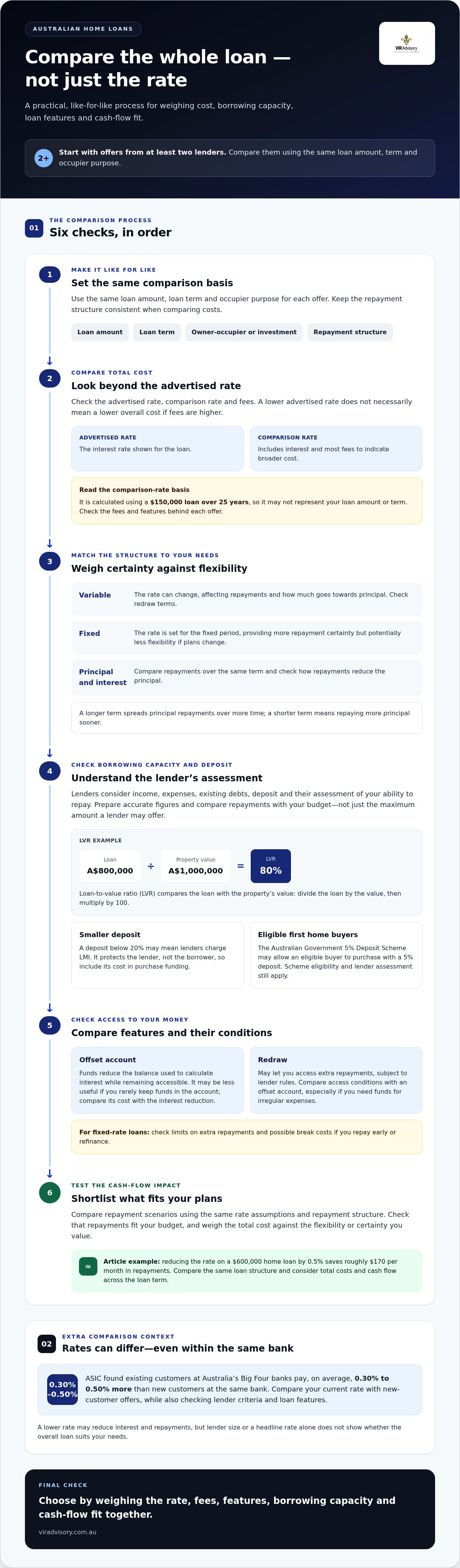
Compare offers from at least two lenders, weighing rates, fees and features against your borrowing needs. A lower rate can reduce interest and repayments, but the loan structure and conditions also affect its value.
Variable and fixed home loan rates
A variable rate can change, affecting your repayments and how much goes towards principal. Redraw may let you access extra repayments, subject to the loan terms. A fixed rate provides more certainty during the fixed period, but may offer less flexibility if your plans change. Compare both options against your cash flow and comfort with repayment changes.
There’s no single best home loan for every first home buyer. The right option depends on your deposit, borrowing capacity and repayment needs, as well as whether you value flexibility or repayment certainty more.
Big Four and smaller lenders
Compare offers from the Big Four banks with smaller lenders on the same loan amount, term and occupier purpose. ASIC found existing customers at Australia’s Big Four banks pay, on average, 0.30% to 0.50% more than new customers at the same bank. That makes reviewing your current rate alongside new-customer offers worthwhile, while lender criteria and loan features remain part of the decision.
A 0.2% lower interest rate could save thousands of dollars over time. Compare the same loan structure, rather than choosing by lender size or a headline rate alone.
Advertised and comparison rates
An advertised rate shows the interest rate for a loan, while a comparison rate accounts for interest and most fees to indicate its broader cost. The comparison rate is calculated using a $150,000 loan over 25 years, so it may not represent your loan amount or term. Check the fees and features behind each offer; they can change how useful the comparison is.
To compare home loans in Australia, assess rates alongside fees, repayment flexibility and redraw conditions. A lower advertised rate may not mean a lower overall cost if the fees are higher.
| Option | Rate movement | Cost comparison | Feature to assess |
|---|---|---|---|
| Variable | Can change | Compare advertised and comparison rates | Redraw terms |
| Fixed | Set for the fixed period | Compare rate and applicable fees | Flexibility during the term |
| Principal and interest | Depends on rate type | Compare repayments over the same term | How repayments reduce principal |
Repayments across loan amounts and terms
Repayments depend on the amount borrowed, interest rate, repayment type and loan term. A longer term spreads principal repayments over more time, while a shorter term means repaying more principal sooner. Compare scenarios using the same rate assumptions and repayment structure, then check that the resulting repayments fit your budget.
For example, reducing the rate on a $600,000 home loan by 0.5% saves roughly $170 per month in repayments. Choose by comparing total costs and cash flow across the loan term, not the headline rate alone.
How much can I borrow for a home loan?
Borrowing capacity depends on your income, expenses, existing debts, deposit and the lender’s assessment of your ability to repay. Compare the amount you can borrow with the repayments and total interest over the loan term, not just the maximum a lender may offer.
For an Australian home loan, lenders assess your income and regular commitments alongside the proposed loan and property. Prepare accurate details of your earnings, living costs, debts and savings so you can compare offers using consistent figures. Employed applicants should have evidence of their income ready; self-employed applicants should organise records showing business income and existing financial commitments.
Loan-to-value ratios and interest costs
Loan-to-value ratio (LVR) compares the loan with the property’s value: divide the loan amount by the value, then multiply by 100. For example, an A$800,000 loan against a property valued at A$1,000,000 has an 80% LVR. Compare LVR alongside the interest rate and term, as the amount borrowed and time taken to repay affect total interest.
To compare total interest costs, use the same loan amount, repayment type, interest rate assumptions and term for each option. This shows how a different LVR or loan structure affects the overall cost.
Deposits and lenders mortgage insurance
A larger deposit reduces the amount borrowed and usually lowers the LVR. Australian lenders may charge lenders mortgage insurance (LMI) when your deposit is below 20% of the property value. LMI protects the lender, not the borrower, so include its cost when comparing the funds needed to complete a purchase.
Eligible Australians can use the Australian Government 5% Deposit Scheme to buy a first home with a 5% deposit, according to Housing Australia. Scheme eligibility and lender assessment still matter, so compare the available deposit options against repayments and other purchase costs.
Loan features also affect how you manage your cash. An offset account holds funds that reduce the balance used to calculate interest, while keeping the money accessible. An offset may be less useful if you rarely keep funds in the account, so compare its cost with the interest reduction.
Redraw may let you access extra repayments, subject to the lender’s rules. Compare its access conditions with those of an offset account, particularly if you need funds available for irregular expenses. Variable and fixed rates may offer different flexibility, so review how extra repayments are treated before choosing.
For a fixed-rate loan, check the contract for limits on extra repayments and possible break costs if you repay early or refinance. These terms affect whether making additional payments or changing loans fits your plans.
Refinancing can reduce repayments or change loan features, but compare potential savings with discharge and setup costs. Those costs can outweigh the benefit, and a new loan may change repayment terms or introduce timing risks.
Before deciding, compare the deposit, LVR, loan features and total costs in one place. Check that the proposed repayments leave room in your budget for regular and unexpected expenses, rather than relying only on the lender’s maximum borrowing figure.
Fixed-rate changes at the end of a fixed term
A fixed rate gives repayment certainty during the agreed period, but that rate doesn’t continue indefinitely. In Australia, fixed home loan interest rates are usually set for 1 to 5 years, according to the Australian Securities and Investments Commission. Before expiry, compare the lender’s next rate and repayment with alternatives, including a variable rate.
Prepare for the rate change
Start by finding the fixed-rate expiry date in your loan documents. Ask your lender for the rate and estimated repayments that would apply afterwards, then compare them with your current payments. A higher rate can increase repayments; a lower rate may change how much goes towards interest and principal.
Before the fixed period ends, compare three options: staying with your lender, switching to a new fixed rate or moving to a variable rate. Assess each using the same remaining balance and repayment term. A variable rate can change, while a new fixed rate provides certainty only for its agreed period.
Set aside time to assess your cash flow before the fixed period expires. For example, if the next estimated repayment would leave less room for household costs, review the loan structure and alternatives early. Comparing only the initial fixed repayment can obscure the impact of a rate change.
Early repayments and changes during the fixed period
Extra repayments can reduce your balance, but fixed loans may limit how much you can pay without a charge. Check the contract for the additional repayment limit and rules. If you plan to sell, refinance or repay a large amount early, ask your lender how it calculates any break cost before making the change.
Break costs can depend on factors such as the remaining fixed period, the amount being repaid and changes in interest rates. They can affect whether refinancing or paying down the loan early makes financial sense. Compare the estimated cost with potential interest savings over the same period.
Offset accounts and rate locks
Check whether the fixed loan includes an offset account and how much of its balance reduces the amount used to calculate interest. Offset conditions can differ between fixed and variable loans. If the fixed option lacks a suitable offset feature, compare it with a variable or split structure and consider the value of keeping your savings accessible.
A rate lock may be relevant if you select a fixed rate before settlement. Compare whether the lender offers this option, the lock period, any fee and the circumstances that affect the fee. Include these details alongside the rate, as the lock and its cost can affect the loan’s overall value.
Before the fixed period expires, use this checklist: confirm the end date, get an estimate of the next repayment, compare fixed and variable alternatives, review offset access and check early repayment terms. These steps help you weigh certainty against flexibility and potential costs.
What is lenders mortgage insurance (LMI)?
Lenders mortgage insurance is a policy that protects a lender if a borrower defaults and the property sale doesn’t cover the outstanding debt. The borrower pays the premium, but LMI doesn’t insure the borrower against missed payments or a fall in property value. Australian lenders may charge LMI when the deposit is below 20% of the property value.
How LMI affects the loan
LMI can help a lender approve a loan with a smaller deposit, but it adds to the purchase cost. Depending on the lender’s arrangements, you may pay the premium upfront or add it to the mortgage. If it’s added to the loan, the balance rises and may accrue more interest over time.
The premium depends on factors such as the loan amount, deposit and lender’s assessment. Use a lender’s calculator to estimate it, then compare the result with how much you’d need to save for a larger deposit. Treat the calculator as a starting point, not a substitute for reviewing the lender’s full offer.
For example, compare two scenarios using the same property value: one with a smaller deposit and LMI, and another with a larger deposit and no LMI. Include the extra time needed to save, as well as the resulting loan balance and repayments. A smaller deposit may let you buy sooner, while a larger one may reduce borrowing and avoid the premium.
Ways to reduce or avoid LMI
A deposit of at least 20% of the property value may avoid LMI, although lenders assess applications under their own criteria. You could also consider a lower-priced property, which reduces the loan required for the same deposit. Check how each option affects your cash reserves, repayments and borrowing capacity before deciding.
Some eligible borrowers may qualify for a government-backed deposit scheme that helps avoid LMI, subject to eligibility rules and participating lenders. Compare this route with a standard loan by assessing the required deposit, lender criteria and loan features. Don’t assume all low-deposit loans have the same conditions.
Questions to ask lenders or mortgage brokers
Before choosing, ask for the LMI premium, how it will be paid and whether it will be added to the loan. Find out how the lender calculated the amount and whether it changes with the deposit or property value. These details help you compare actual loan balances, not just rates.
- Ask whether LMI applies to your deposit and proposed loan amount.
- Ask how the premium affects repayments if added to the mortgage.
- Ask whether refinancing later could involve new LMI charges.
- Compare the total cost of LMI against saving a larger deposit.
Review the answers alongside repayments and total interest. A refinance may involve new costs, so include those charges when deciding whether a lower rate offsets them.
Owner-occupier and investment loans
Choose a loan based on how you’ll use the property, as lenders may assess owner-occupier and investment applications differently. They consider the purpose, income, expenses, deposit and proposed repayments. State the intended use accurately: an owner-occupied home and a rental property have different cash-flow roles, even at similar purchase prices.
Compare the purpose and lender assessment
For an owner-occupied loan, assess repayments against household income and regular living costs. For an investment loan, include expected rental income alongside existing commitments and property expenses. A lender may assess rent differently from the full amount you expect to receive, so don’t base affordability on rent alone.
For example, compare applications for two properties with similar values. One is the applicant’s home, supported by salary income. The other is intended for tenants, so the assessment includes rental income and property costs. The deposit, loan amount and value ratio still matter, but each application presents a different income and cash-flow picture.
Compare the comparison rate and repayment structure for the intended property use. Then check the lender’s eligibility criteria and required documents for that purpose. This helps avoid comparing an owner-occupied rate with an investment rate as if the loans had identical conditions.
Choose repayments to match cash flow
Principal-and-interest repayments reduce the loan balance over time. With an interest-only arrangement, repayments cover interest during the agreed period, leaving the principal outstanding. An Australian investment loan may have an initial interest-only period of five years. This can preserve cash flow during that period, but the principal remains and later repayments may be higher.
Compare both structures using the same loan amount and assessment assumptions. Consider whether your budget can manage principal-and-interest payments from the outset or whether interest-only payments better fit the investment’s planned cash flow. Lower initial payments don’t mean a lower total borrowing cost.
Before submitting an application, organise these comparison points:
- Confirm whether the property is owner-occupied or an investment.
- List income, existing debts and property expenses relevant to the application.
- Compare deposit, loan amount, value ratio and lender criteria.
- Assess principal-and-interest and interest-only payments against cash flow.
- Check how the proposed facility fits alongside any existing home loan.
If you already have a home loan, assess a new investment loan alongside your existing commitments, not in isolation. Separate loan structures can make each property’s borrowing and cash flow clearer, but add another repayment obligation. Compare affordability across all loans, not just the proposed investment loan.
Before applying, make sure the application, supporting income information and stated property use are consistent. Clear, accurate details help the lender assess the proposed loan against your full financial commitments.
VIR Advisory: Business Loans
VIR Advisory can help you assess Home Loans and Refinancing solutions when lender criteria, loan structures or property plans make comparisons less straightforward. This can be especially useful for business owners and self-employed borrowers, whose income, business commitments and household cash flow all affect a home loan application.
If residential borrowing sits alongside business funding needs, VIR Advisory can discuss Business Loans and financial strategy guidance as part of your wider financial picture. The focus is on understanding how repayments and existing commitments interact, then considering lending options in light of your circumstances.
Contact VIR Advisory to discuss your home loan or business finance needs.
Turn your shortlist into a confident decision
Before choosing, turn your shortlist into a clear decision record. Note the loan purpose, proposed structure, repayment assumptions, key fees and features, then compare each option against the same circumstances. This makes trade-offs easier to spot and gives you a practical reference when discussing an application or reviewing an existing loan.
When comparing home loans in Australia, keep your assumptions consistent and consider how your income, existing commitments and plans could change. A loan that fits your budget today should also make sense if your cash flow, property use or business commitments change. Clear figures and organised documents can make discussions about borrowing capacity and lender requirements more focused.
Use your comparison to identify what still needs clarification, then decide which loan structure best fits your priorities. A considered next step can help you move forward with greater clarity.
Frequently Asked Questions
What is a comparison rate?
A comparison rate is a standardised figure designed to help borrowers assess the cost of credit beyond the headline interest rate. Use it as a screening tool, not a personalised repayment quote. Before relying on it, confirm it applies to the exact product and repayment arrangement you’re considering. Then review the lender’s offer to understand the payments and charges that apply to you.
Which interest rate should I choose?
Choose a rate structure that fits your ability to manage changing repayments and your plans for the property. If you have stable cash flow and value predictable payments, you may prioritise certainty; if you need repayment flexibility, you may give that greater weight. Compare the impact of different rate movements on your household or business budget, and choose a trade-off you can manage without relying on optimistic income assumptions.
Can I buy a property with an LVR over 80%?
Yes, an application with an LVR above 80% can be considered, but approval depends on the lender’s criteria and your full financial position. A strong income assessment may not overcome concerns about existing debts, irregular earnings or the property itself. Before making an offer, test the proposed borrowing against your documented income, regular expenses and other commitments, then allow room in your budget for costs beyond repayments.
Can you avoid LMI?
Some borrowers can avoid LMI with a larger deposit or an eligible guarantee arrangement, subject to the scheme’s rules and lender participation. Another option is to adjust your purchase budget to reduce the required borrowing. Compare that change with the property features you need and the cash you want to retain after purchase. Using all your available funds can leave little room for unexpected expenses.
How much does LMI cost?
There’s no standard premium for every Australian borrower. The lender calculates the amount for the proposed application, and it can affect how much you need at settlement or how much you borrow. Request an estimate based on the specific property and loan structure, then compare the resulting balance and repayments with an alternative purchase budget. Don’t treat a generic calculator result as a final amount.
How do variable and fixed home loan rates compare in Australia?
The practical difference comes down to how much uncertainty you’re prepared to manage in your repayments. If your monthly budget has little room, you may place greater weight on predictable payments; if you expect your circumstances to change, you may value flexibility. Assess your likely cash flow and property plans before choosing. Also consider what happens if you need to sell, repay early or change the loan during its term.
Which Australian lenders offer offset accounts and redraw facilities, and how do they compare?
These features are available on various Australian home loans, but availability and conditions depend on the lender and specific product. Compare access rules, account charges and how each feature works with your repayment structure. A feature is useful only if it fits how you manage savings and repayments. Review the product terms in writing so you can compare like-for-like offers rather than relying on a feature name.
How much deposit is needed for an Australian home loan, and when does LMI apply?
The deposit required depends on the purchase price, lender criteria and any eligible deposit support. Calculate it separately from other purchase costs so it doesn’t use your entire cash reserve. LMI may apply if the lender accepts a smaller deposit. Ask for the lending assessment to show the required contribution and how the proposed loan affects your available funds after settlement.

Article by
Raina Doshi
Raina Doshi has worked in banking and finance since 2011, including experience with major Australian lenders. She helps homeowners, property investors, business owners and professionals secure and structure lending solutions across home loans, refinancing, commercial finance and business lending.
Areas of expertise include residential lending, investment property finance, debt recycling, commercial property finance, equipment finance, construction finance and strategic debt structuring.
Drawing on extensive banking and finance experience, Raina helps clients navigate lender requirements, improve borrowing outcomes and structure effective finance solutions.
Disclaimer
The information in this article is general in nature and does not take into account your personal objectives, financial situation or needs. Before acting on any information, consider whether it is appropriate to your circumstances and seek professional advice.


