

The deposit is only one part of the cash you’ll need to buy a commercial property. In Australia, buyers typically need a commercial property deposit of 20%-35% of the property’s value, with the amount shaped by the property and the lender’s assessment of your finances.
It’s natural to focus on the commercial property deposit first, but purchase costs can increase the total funds required at settlement. Your borrowing capacity, credit history, existing debts and the property’s income potential can also affect how much a lender is willing to finance.
This article explains how deposit requirements can vary, why some properties or borrowers may need to contribute more, and which additional costs to plan for. You’ll also learn how lenders assess an application, helping you estimate the funds needed before committing to a purchase.
Key Takeaways
- Use the lender’s loan-to-value ratio to estimate the cash contribution, then allow for the possibility that property type and location may change the borrowing limit.
- Budget for purchase costs as well as the deposit, including stamp duty, settlement costs and GST where applicable.
- Assess how your credit history, existing debts, income and business finances may influence lender approval and the contribution required.
- Use a structured checklist to account for the property valuation, upfront costs and available funds before committing to a purchase.
- Consider how finance options fit the property’s income potential, your cash flow and the wider structure of your business or investment.
How much deposit for a Commercial Property?
In Australia, a commercial property deposit commonly falls between 20% and 35%, depending on the lender and property. Before paying, review the contract’s deposit and refund terms, and assess whether the property’s value, condition and intended use support the purchase.
Loan-to-value ratios
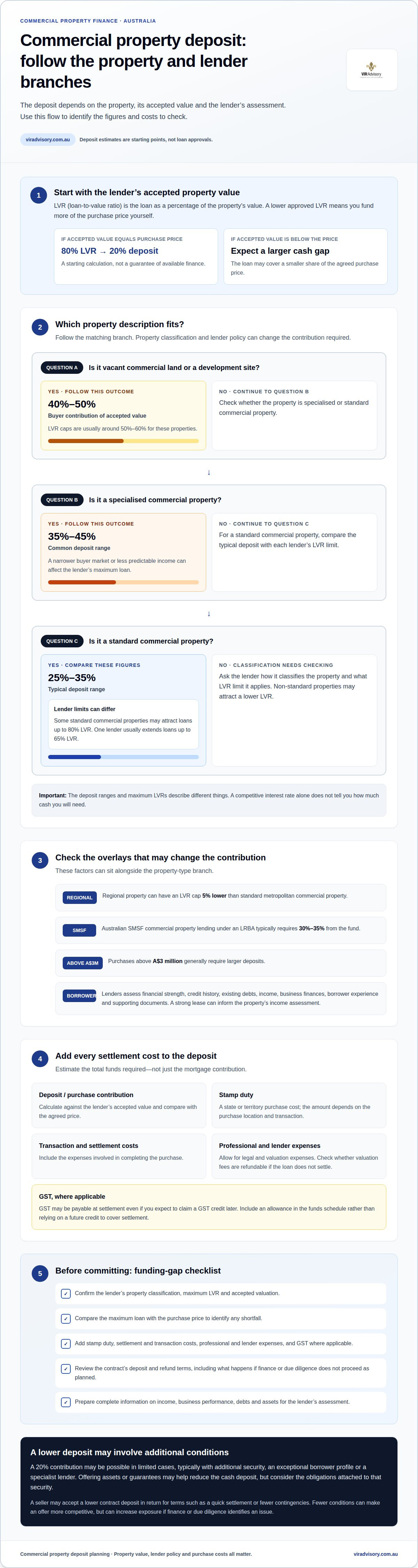
A loan-to-value ratio (LVR) expresses the loan amount as a percentage of the property’s value. It matters because a lower approved LVR means you must fund more of the purchase price yourself.
If a lender accepts the purchase price as the property value, an 80% LVR corresponds to a 20% deposit. That relationship is a starting calculation, not a guarantee of the amount available. If the lender’s accepted value is below the agreed price, the loan may cover a smaller share of the purchase price, increasing the cash contribution required.
Lender policies by property type
Lender policies set the maximum LVR they will consider for each property type. Standard commercial properties may attract loans up to 80% LVR, while one lender usually extends loans up to 65% LVR against standard commercial properties. Those limits produce very different deposit requirements, so a competitive rate alone doesn’t show how much cash you’ll need.
Property classification also matters: lenders may offer a lower LVR for non-standard or specialised properties. Vacant commercial land and development sites usually have LVR caps around 50% to 60%, meaning the buyer funds the remaining 40% to 50% of the accepted value. Regional properties can also have an LVR cap 5% lower than standard metropolitan commercial property.
For a A$1 million purchase, compare each lender’s maximum loan against its accepted valuation, then calculate the shortfall from the price. Confirm how the contract handles the deposit if finance or due diligence does not proceed as planned. These checks help identify funding gaps and contract risks before you commit.
Typical commercial property deposit requirements
For a standard commercial purchase in Australia, a typical deposit is 25% to 35% of the purchase price; specialised properties commonly require 35% to 45%. The sale contract sets the purchase deposit terms, and cash deposits are held in trust until settlement, so understand the payment conditions before committing.
Factors affecting deposit requirements
The required contribution depends on the property’s value and type, its income potential, and the lender’s assessment of risk. A specialised property may have a narrower buyer market or less predictable income, which can affect the lender’s maximum loan. Australian SMSF commercial property lending under an LRBA typically requires 30% to 35% from the fund.
Purchases above A$3 million generally require larger deposits. Lenders also assess business experience, financial strength and supporting documentation, alongside the property’s income-generating potential. A strong lease can inform the income assessment, while a weaker financial profile or higher perceived investment risk may increase the contribution needed.
Negotiating lower requirements
Negotiating a lower deposit means seeking different terms from the seller or lender, not assuming a smaller contribution will be approved. A seller may agree to a lower purchase deposit in return for favourable terms, such as a quick settlement or fewer contingencies. Fewer conditions can make an offer more competitive, but may increase your exposure if finance or due diligence reveals an issue.
For lender negotiations, offering additional assets or guarantees as security may help reduce the cash deposit required. A 20% contribution may be possible in limited cases, typically with additional security, an exceptional borrower profile or a specialist lender. Compare the amount required with the security offered and the obligations attached to it.
Support the assessment with complete documentation covering income, business performance, debts and assets. Commercial lending criteria differ from residential criteria: lenders consider the property’s income potential, your experience as a borrower and the investment risk. These factors help explain why buyers seeking finance for similar properties may be offered different deposit terms.
Deposit calculator and additional purchasing costs
Estimate settlement funds by adding the deposit, stamp duty, transaction costs and any GST payable. A calculator gives you a planning figure, but the lender’s valuation and sale agreement can affect the final funding gap.
Using a deposit calculator
A deposit calculator estimates your contribution from the property value and loan-to-value ratio, then adds purchase costs. Use the breakdown to distinguish the loan from the cash required at settlement.
Stamp duty and settlement costs
Stamp duty is a state or territory purchase cost, while settlement costs cover expenses involved in completing the transaction. These figures show how costs increase the cash needed beyond the deposit, but duty depends on the purchase location and transaction.
Include professional and lender expenses in your estimate. Valuation fees can be an upfront cost, so check whether they are refundable if the loan does not settle.
GST and upfront purchase costs
GST may be payable at settlement for an Australian commercial property purchase, even if you expect to claim a GST credit later. Where GST applies, include an allowance in your funds schedule rather than relying on a future credit to cover settlement. GST treatment affects the cash required under the purchase agreement.
Plan for the whole funding requirement, not just the mortgage deposit. A calculator estimate should separate your purchase contribution, stamp duty, legal and valuation expenses, and any applicable GST.
How deposits are paid and held
The sale agreement sets out the deposit arrangements for the purchase. A cash deposit is held in trust until settlement, so it forms part of the funds you commit before the transaction is complete. Review the payment timing and conditions before committing, and account for the deposit separately from other settlement funds.
Typical deposits for standard commercial property
For standard premises, a useful deposit range leaves enough funds for settlement and ongoing operations. Rather than treating a single percentage as a target, compare lender scenarios against the property’s accepted value and your business’s available cash.
Typical deposit percentages
A calculator example uses a 70% LVR as a planning benchmark for a commercial purchase. Use that scenario to test how the proposed borrowing sits alongside your available contribution, without treating the calculator result as a lender decision. The accepted valuation and credit assessment still shape the final loan offer.
For a standard property, compare the amount needed under the benchmark with the cash you can contribute without disrupting business operations. If you use retained business funds, consider the effect on working capital; if you’re an investor, consider how much cash will remain for other commitments. The right deposit figure depends on the acquisition and its funding structure.
Typical deposit ranges
Ranges help you compare funding scenarios, but the lower end may depend on a different assessment from the upper end. Test what changes if the valuation, loan structure or available cash differs from your initial assumptions. This helps you see whether the purchase remains workable without relying on a single optimistic estimate.
Keep the lender’s contribution separate from the cash deposit payable under the sale contract. They serve different purposes: the lender’s assessment determines the finance available, while the contract sets out your payment obligations. A tenant’s lease security is separate again. Treating these amounts distinctly avoids assuming that one source of funds automatically satisfies another requirement.
Before deciding on an offer, compare the lender’s indicative borrowing, your contribution, the contract deposit timing and the cash retained for operations. Then consider how each scenario could affect the business if income changes or expenses arise after settlement. This turns the deposit range into a practical decision tool, rather than just a percentage attached to the property.
Borrower financial strength and credit history
A lender assesses the borrower’s ability to repay, not just the property’s purchase price. Financial statements, stable income, credit history and existing commitments influence approval and the cash contribution required. Buyers with weaker financial histories may need to contribute more than the typical 20%-35% range, even when the property itself appears suitable.
Credit history helps lenders assess how a borrower has managed previous commitments. A record of timely repayments and an established lending relationship may support more favourable deposit terms. Conversely, borrowers with bad credit may need a deposit of 40%-50% or more. The lender also weighs the circumstances behind credit issues and the borrower’s current financial position.
Servicing capacity matters alongside credit. Lenders assess living expenses and business and personal debts, applying sensitised rates to other debt when calculating capacity. For a company director, personal liabilities can therefore affect the assessment of a business purchase. Existing loans, credit facilities and cash flow all influence how much repayment capacity remains.
Financial statements showing stability, stable income and a good credit history may strengthen your position as a buyer. Complete records help the lender assess earnings and commitments consistently. If you’re self-employed, clear business documentation can explain income patterns; fluctuating revenue or substantial existing debt may reduce borrowing capacity and increase the cash contribution required.
Commercial property lending above 80% may be possible when the borrower’s financials show they can comfortably service a higher loan. That can reduce the cash needed for the purchase price, but it increases the debt to be serviced. A lender weighs repayment capacity against the borrower’s overall liabilities and the property’s investment risk, rather than relying on the deposit alone.
Before finance assessment, organise current financial statements, income evidence, a schedule of personal and business debts, and details of repayment history. This gives lenders a clearer view of cash flow and credit conduct. Addressing unexplained liabilities or inconsistent figures in the application can reduce avoidable questions and help the lender assess the proposed loan accurately.
Common mistakes when estimating a commercial property deposit
A reliable estimate takes more than applying a percentage to the asking price. You may miscalculate the cash required if you overlook lender assumptions, contract timing or funds needed to keep the business operating after settlement.
A common mistake is treating an indicative borrowing figure as approved finance. Another is putting every available dollar towards the purchase, leaving too little liquidity for payroll, stock or property expenses. Your deposit estimate should separate purchase funds from working capital and account for the purchase’s effect on cash flow.
Use this sequence to test your estimate before making a commitment:
- Separate the figures. Record the asking price, lender’s indicative loan and buyer contribution as distinct amounts.
- Match the property to the assessment. Note its intended use, condition and income profile so the lending scenario reflects the actual premises.
- Map payment timing. List when the contract requires funds and when finance is expected to be available.
- Protect operating cash. Identify business expenses and commitments that continue after settlement, then exclude those funds from the purchase budget.
- Test a changed assumption. Rework the estimate if the valuation, loan amount or settlement timing differs from the initial plan.
Deposit estimate: four checks
- Valuation: Does the lender’s assessed value support the borrowing estimate?
- Property: Does the lending scenario reflect the premises and intended use?
- Contract: Are payment dates aligned with available funds?
- Cash flow: Will funds remain for business costs after settlement?
This framework can reveal a funding gap before it affects the transaction. Revisit your estimate if contract terms, lender assumptions or business cash flow change. A figure that worked under the original assumptions may no longer cover both purchase commitments and operating needs.
VIR Advisory
Before committing to a commercial property purchase, assess how it fits your borrowing capacity, existing commitments and cash flow. Deposit planning should account for the lender’s assessment and the funds you’ll need after settlement.
Lenders may assess documented income, business and personal debts, available funds and the property’s intended use. For company directors and self-employed borrowers, reviewing business cash flow alongside personal obligations can clarify what information may be needed. Each lender applies its own criteria, and preparation does not guarantee approval.
When a purchase involves several funding arrangements, consider how existing repayments affect servicing capacity and whether changes to debt arrangements would alter costs and repayment commitments. Weigh these obligations against the working capital your business needs to keep operating.
For a finance assessment, organise financial statements, income evidence, current liabilities, purchase terms and settlement timing. For an investment property, expected income can also inform the lending discussion. A clear summary helps distinguish available cash from purchase costs and ongoing business expenses.
Before making an offer, check whether the expected lender contribution is uncertain, your income is complex, or existing property debt affects borrowing capacity. Compare how each funding structure changes repayments and cash reserves. A lower upfront cash contribution may preserve liquidity but increase debt, while using more cash may reduce borrowing and leave less for business needs.
Before seeking finance, gather current business and personal financial records, debt details and proposed purchase terms. This provides a practical starting point and can help identify cash flow or documentation issues. Contact VIR Advisory to discuss your commercial property finance position.
Frequently Asked Questions
Are deposits refundable?
Whether a deposit is refundable depends on the sale contract and the circumstances of the transaction. A cash deposit is held in trust until settlement, but that does not automatically mean it will be returned if the purchase ends. Before signing, understand what the contract says about deposit release, finance conditions and withdrawal. For example, a buyer who exits after a finance decline may have a different outcome from one who withdraws without relying on a contract condition.
Can I use equity from my home or another property to buy business premises?
Yes, equity in another property may help fund a commercial purchase, subject to the lender’s assessment and available security. For example, a A$1 million property with A$400,000 existing debt may provide around A$400,000 of usable equity at an 80% LVR. Using equity can reduce the cash needed upfront, but it increases debt secured against the property and may put that asset at risk if repayments aren’t met.
How much of a deposit do you need for a A$300,000 loan?
The required deposit depends on what the A$300,000 represents and the lender’s approved LVR. As a guide, a 20% deposit on a A$300,000 commercial property loan is A$60,000, while a 30% deposit is A$90,000. If A$300,000 is the borrowing amount rather than the purchase price, calculate the deposit using the property value and approved loan amount, then budget separately for purchase costs.
How much deposit do Australian banks require for a commercial property loan?
Australian commercial lenders commonly assess deposits in the 20% to 35% range, although the requirement depends on the property and borrower. A standard property may attract different terms from a specialised asset, vacant land or development site. The lender’s valuation, accepted security and assessment of repayment capacity also influence the loan amount. Compare the required cash contribution with the full funds needed to complete the transaction.
What affects the deposit percentage for commercial property in Australia?
Property type, location, valuation and income potential can all affect the deposit percentage. Lenders also assess your credit history, financial strength, business experience, existing debts and ability to service repayments. For example, vacant commercial land generally attracts lower LVR limits than standard commercial property, so buyers need more equity. A weaker financial profile can also mean a larger contribution, even for an otherwise suitable property.
Are commercial property deposits different for owner-occupiers and investors in Australia?
They can be. Some Australian lenders may offer owner-occupier commercial buyers an LVR improvement of about 5%, which may reduce the cash contribution if the buyer and property meet the lender’s criteria. Investors are assessed with attention to the property’s income and investment risk, including lease strength. Owner-occupier status alone doesn’t determine the deposit: property type, valuation and the borrower’s finances remain relevant.
Can buyers negotiate the deposit amount or payment date for commercial property in Australia?
You can negotiate contract terms with the seller, including the deposit amount and payment timing. A seller may accept a lower deposit in return for favourable terms, such as a quick settlement or fewer contingencies. Record the agreed terms in the sale contract, since timing affects how much cash must be available before settlement. A smaller contract deposit does not necessarily reduce the lender’s required equity contribution.
What happens to a commercial property deposit if the buyer withdraws or finance is declined?
The contract terms and the reason for ending the purchase determine what happens to the deposit. If finance is declined, a relevant finance condition may affect your options, but the agreement’s wording and deadlines matter. Withdrawing without meeting a contract condition can put the deposit at risk. Review the contract’s finance provisions and notice requirements before paying, and keep written records of lender decisions and communications.
For help assessing your commercial property finance options, contact VIR Advisory.

Article by
Raina Doshi
Raina Doshi has worked in banking and finance since 2011, including experience with major Australian lenders. She helps homeowners, property investors, business owners and professionals secure and structure lending solutions across home loans, refinancing, commercial finance and business lending.
Areas of expertise include residential lending, investment property finance, debt recycling, commercial property finance, equipment finance, construction finance and strategic debt structuring.
Drawing on extensive banking and finance experience, Raina helps clients navigate lender requirements, improve borrowing outcomes and structure effective finance solutions.
Disclaimer
The information in this article is general in nature and does not take into account your personal objectives, financial situation or needs. Before acting on any information, consider whether it is appropriate to your circumstances and seek professional advice.


