

A lower repayment can still leave a business paying more overall. Refinancing for business debt may make sense when a new loan offers a more suitable rate or repayment structure, or combines several obligations into one facility. But extending the loan term can ease cash flow while increasing the total interest paid.
When cash flow is tight, it’s understandable to focus on the regular repayment. The decision also depends on the full cost of switching, including establishment fees, early exit costs and any fixed-rate break costs. A lower advertised rate alone doesn’t show whether refinancing will leave the business in a stronger position.
This article explains why Australian businesses refinance, how to assess the effect on cash flow and what to compare across loan offers. You’ll also learn how lender assessments, loan terms and repayment features can affect the outcome, helping you weigh short-term repayment relief against the total cost and risks of the new debt.
Key Takeaways
- Refinancing can replace one loan or combine several obligations, but a simpler repayment structure is only useful if the full cost and terms suit the business.
- Assess whether cash-flow pressure is temporary or reflects an underlying profitability issue before taking on new debt.
- Compare the interest rate alongside establishment costs, exit fees, fixed-rate break costs and loan features.
- Prepare financial statements, cash-flow forecasts and repayment history information, as lenders assess the business’s capacity to service the proposed debt.
- Consider whether a changed repayment structure, consolidated debts or more predictable repayments would address the business’s specific financing need.
Why refinance a business loan?
A business may refinance one existing loan or combine several obligations if another structure better suits its finances. Consider interest, repayments, flexibility and the full cost of replacing the facility before deciding.
Comparing loan structures and rates
A loan structure determines how the business borrows, repays and accesses funds. The interest rate is only one part of the cost. Compare whether the facility is secured or unsecured, whether repayments are fixed or variable, and whether extra repayments or redraw suit the business’s capital needs. A lower rate may be less useful if the structure restricts access to working funds or adds costs elsewhere.
Balancing repayments and total interest
The loan term determines how repayments are spread, so extending it can reduce each payment while increasing total interest. According to the Australian Securities and Investments Commission (ASIC), a A$20,000 debt refinanced to a lower interest rate over a longer term could reduce weekly repayments but increase the total cost. Compare the proposed repayment schedule with the total amount payable, then decide whether short-term cash-flow relief justifies the added interest.
Checking fees and payout figures
The payout figure shows what the business must pay to close its current loan, including applicable charges. Request the current lender’s full payout figure, then compare it with the new lender’s establishment costs and any early exit or fixed-rate break costs. This clarifies how much needs to be refinanced and helps reveal whether switching costs outweigh potential savings from a lower advertised rate.
Refinancing may be worth considering when the current interest rate or repayment structure no longer fits the business’s position. For example, a business with predictable revenue may prefer fixed repayments for budgeting, while one with changing cash needs may value variable-rate flexibility. A business reviewing its debt every 12 to 18 months can identify whether its existing facility still suits its cash flow and capital requirements.
A standard broker whose work centres on residential mortgages may not assess complex business lending needs in the same way as a specialist in commercial finance. Business applications can involve trading income, existing liabilities, business financial statements and security, alongside the borrower’s repayment history. The right assessment needs to connect the proposed loan structure with the business’s purpose, cash flow and capacity to meet repayments.
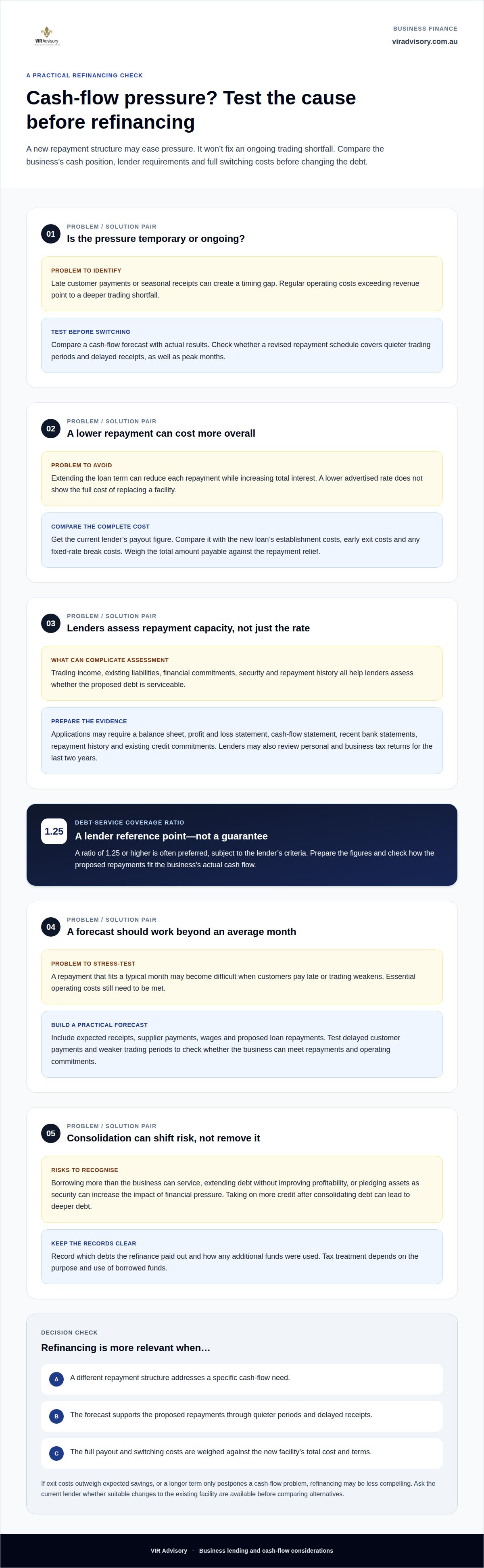
Before applying, ask the current lender whether it can offer suitable changes to the existing facility, then compare any alternative against the full payout figure. Refinancing is less compelling if exit costs outweigh the expected savings, or if a longer term only postpones a cash-flow problem. It may be more relevant when a different structure can improve repayment management without placing unsustainable demands on the business.
Assessing whether refinancing will solve cash-flow problems
Refinancing may ease repayments, but it won’t fix a recurring trading shortfall. Test the proposed repayments against the business’s cash receipts and operating commitments.
Business and financial factors
Lenders assess whether the business’s earnings and repayment conduct support the proposed facility. They also consider other borrowing and financial commitments, which affect the cash available for repayments.
Australian banks and non-bank lenders offer business debt refinancing. Suitable options depend on the business’s financial position, loan purpose and any security. For example, a business with seasonal receipts needs a repayment structure that remains workable during quieter periods, not just peak trading months.
Separate temporary timing gaps from ongoing losses. If customers pay invoices late, a forecast can show whether a revised repayment schedule addresses the gap. If operating costs regularly exceed revenue, lower repayments may postpone pressure without addressing its cause.
The refinancing assessment process
A lender assesses financial evidence alongside the proposed loan and its purpose. Clear records help the lender compare trading performance with future repayment commitments.
Applications may require a balance sheet, profit and loss statement, cash-flow statement and recent bank statements. Lenders may also review personal and business tax returns for the last two years, repayment history and existing credit commitments. A debt-service coverage ratio of 1.25 or higher is often preferred, subject to the lender’s criteria.
Before lodging an application, prepare a cash-flow forecast showing expected receipts, supplier payments, wages and proposed loan repayments. Test it against delayed customer payments and weaker trading periods. This reveals whether the business can repay the new facility while meeting essential operating costs, rather than relying on an average month.
Risks and tax implications
Key risks include borrowing more than the business can service, extending debt without improving profitability, and pledging assets as security. ASIC’s Moneysmart warns that debt consolidation can lead to deeper debt if it results in taking on more credit.
Tax treatment depends on the purpose and use of borrowed funds. Keep records showing which debts the refinance paid out and how any additional funds were used, so the business’s tax records accurately reflect the transactions.
If a business needs another loan soon after restructuring an overdraft, that may indicate ongoing cash-flow pressure rather than a one-off repayment mismatch. Compare the cash forecast with actual results and identify recurring shortfalls before relying on a new facility. This helps distinguish a financing issue from a trading problem that needs a different response.
Comparing interest rates, fees and prepayment penalties
Compare each offer’s total cost, not just its advertised interest rate. A lower rate can still cost more once exit charges, new fees and the repayment schedule are included.
Exit fees may apply when repaying the current loan early, and a fixed-rate facility can incur break costs before its fixed period ends. New lending may also involve establishment, application, documentation or valuation charges. Request the current lender’s full payout figure and include it in your comparison, alongside every fee attached to the proposed facility.
Refinancing costs can total 1% to 2% of the loan amount. Establishment or application fees can range from a few hundred to several thousand Australian dollars, while origination fees may range from 1% to 5% of the loan amount. These are separate cost measures, so compare the actual written offer and payout amount rather than adding broad ranges as though every charge applies.
For a repayment comparison, place the current and proposed facilities side by side. Include the interest rate, loan term, repayment amount, total interest and all switching costs. A move from an 8.5% variable rate to a 6.8% rate may look attractive, but the outcome depends on the principal, term and fees. Model the same repayment frequency and show how cash flow changes under each option.
Security affects both risk and price. A secured loan uses collateral, and the lender may sell that asset to recover the debt if repayments aren’t met. Secured business loans typically have lower interest rates. Unsecured loans don’t use business assets as collateral, but can cost more, be harder to obtain and require a very good credit history. Compare the assets at risk with the potential benefits to repayments and rate.
Prepare recent financial statements, a cash-flow forecast and a business plan explaining how refinancing could improve the company’s position. These records help the lender assess affordability and whether the new facility supports working capital or simply extends existing pressure. Include current loan balances and payout figures so the proposed borrowing reflects the debts being replaced.
Before deciding, check whether exit fees and penalties outweigh expected savings, then include the new lender’s costs and any future prepayment fees. This matters if the business may refinance again or repay early. A cost-benefit comparison should show the break-even point, when projected savings have covered the switching costs.
Potential benefits of consolidating business loans
Consolidation replaces several debts with one loan used to repay the existing obligations. It can simplify payments and cash-flow management, but the new facility still needs to suit the business’s finances.
Cash-flow benefits of consolidation
A cash-flow benefit means more operating funds remain available after debt payments. One regular repayment can be easier to manage than separate payments to several lenders.
For example, a business paying a term loan, equipment finance and an overdraft could combine those obligations into one facility. This can reduce administration and give the owner a clearer view of regular commitments. But if the new loan extends the repayment term, lower payments may mean more interest over the life of the debt. Weigh the cash-flow relief against the total amount payable.
Consolidating multiple business debts
Consolidating multiple debts means using a new loan to repay several existing business credit obligations. It matters when separate repayment dates and balances make it harder to track liabilities and plan working capital.
A business might combine a business loan and overdue supplier debt into one repayment schedule. The lender assesses the proposed facility, the business’s financial position and the debts being paid out. A single lender can simplify administration, but confirm that each obligation is included in the payout plan. Otherwise, an overlooked balance may remain due alongside the consolidated repayment.
Business debt refinancing and consolidation
Refinancing replaces an existing loan, while consolidation uses refinancing to combine several debts into one facility. The distinction matters: a business with one unsuitable loan can refinance without consolidating anything.
For instance, a company could replace one business loan with a facility offering a more suitable repayment structure. Another could consolidate multiple loans and credit obligations through a single lender. Consolidation may also include additional borrowing for business needs, but that increases the amount owed and the repayments. Compare the new balance with the debts being cleared, rather than treating extra funds as savings.
Debts that can be refinanced
Business debts considered for refinancing can include existing business loans, credit obligations, ATO tax debt and overdue supplier debt. Identifying each liability’s purpose and balance helps the lender assess the requested facility.
Prepare a debt schedule listing each lender, balance, repayment and payout figure. For example, a company seeking to clear tax debt and supplier arrears should distinguish those amounts from funds requested for working capital. The new lender assesses the business’s ability to service the combined borrowing against its lending criteria. Consolidation isn’t suitable if the resulting repayments or total cost weaken the business’s position.
Reasons to refinance business debt
Businesses refinance when their current loan no longer fits their funding needs, repayment capacity or trading pattern. A decision about refinancing for business debt should have a defined purpose, such as changing the repayment structure, replacing a loan or addressing a specific liability. Without a clear outcome, a new facility may add complexity without improving the business’s position.
A lower interest rate may reduce repayments or total interest if the business keeps a comparable loan term. A different structure may also better match revenue patterns. For example, a company with predictable income may prefer fixed repayments for budgeting, while one with fluctuating receipts may value greater flexibility. Refinancing for business debt makes the strongest case when the new terms meet a practical need and the full costs remain worthwhile.
Debt consolidation can combine separate business loans and credit obligations into one facility. Businesses may also refinance to repay overdue supplier debt or ATO tax debt, bringing those liabilities into a planned repayment structure. Be clear about each debt’s purpose and balance. A new facility may still cost more if its interest or fees exceed those of the obligations being replaced.
Some businesses seek additional capital as part of a refinance, for equipment or working capital, for example. That borrowing increases the repayment commitment, so the business needs to show how the funds support operations and fit its cash flow. A business whose revenue increased by 40% while its loan interest rate stayed unchanged could reassess whether the existing loan still suits its trading position.
Approval depends on the lender’s assessment, not just the reason for applying. Lenders consider income, repayment history, other loans and financial commitments, alongside their eligibility and suitability criteria. Weak cash flow, inconsistent financial records, arrears or limited repayment capacity can make an application harder to support. A director’s guarantee on an unsecured business loan can also put personal assets at risk if the business fails to repay.
Before applying, prepare a focused review:
- State the purpose, such as replacing a loan or clearing supplier debt.
- Compare current and proposed repayments against cash flow and existing commitments.
- Review business and personal credit scores, including repayment history.
- Prepare financial statements, recent bank statements and personal and business tax returns for the last two years.
- Separate any additional borrowing and explain its intended business use.
If the business cannot service the proposed commitment, refinancing or consolidation won’t resolve the underlying shortfall. Assess the facility against trading performance, liabilities and operating costs before taking on new debt.
VIR Advisory: Business Loans
VIR Advisory helps business owners assess refinancing options against lender requirements, repayment capacity and the purpose of the debt. Its Business Finance and Commercial Lending services may suit owners reviewing an existing facility or several debts together. As a finance brokerage, VIR Advisory provides guidance to help you compare possible structures with your business’s cash-flow needs.
The assessment considers the current loan structure, payout costs, business financials and proposed repayments, so you can weigh potential savings against added costs and risks. Financial strategy guidance can also help clarify whether refinancing addresses the pressure or simply shifts repayments into the future. If you’re considering a change to your business debt, contact VIR Advisory to discuss your options.
Set clear terms for your next financing decision
A decision about refinancing for business debt should start with a defined outcome, such as more manageable repayments, a simpler facility or funding aligned with planned business activity. Set out what the new arrangement needs to achieve, which trade-offs are acceptable and what would make you keep the existing loan. This gives the lender discussion a clear purpose and helps prevent a lower repayment from becoming the only measure of success.
VIR Advisory offers Business Loans, Home Loans and Refinancing solutions. If you’re weighing a change to business lending, the next step is to discuss how your objectives, financial position and preferred loan structure fit together. A considered comparison can help turn a complex financing decision into a set of practical options.
A clear brief gives you a stronger basis for deciding what to do next.
Frequently Asked Questions
Is a fixed or variable interest rate better for refinancing?
Neither rate type is automatically better. The right choice depends on revenue patterns and the need for repayment flexibility. A business with predictable income may value fixed repayments for budgeting, while a variable rate may suit a business that wants to make extra repayments or access redraw. A split-rate structure can divide the facility between fixed and variable portions, combining repayment certainty with flexibility on part of the debt.
What are the benefits of refinancing?
Refinancing can change a loan’s rate, term or repayment features to better suit the business’s finances. It may also combine several obligations into one facility, simplifying payment administration. For example, a business could replace a loan that restricts extra repayments with a structure better suited to fluctuating cash receipts. Compare these practical benefits with switching costs and total interest: a lower scheduled repayment alone doesn’t establish a lower overall cost.
Does refinancing hurt my credit?
Lenders assess credit information as part of a refinancing application, so the business’s and relevant individuals’ credit profiles may be reviewed. Before applying, check for errors and make sure existing repayment information is accurate. Lenders also consider payment conduct alongside income, financial commitments and the ability to service the proposed facility. Credit history is one part of the assessment, not a substitute for showing that repayments are affordable.
What are the options for refinancing?
Options include replacing one existing loan, consolidating several debts, negotiating a revised facility with the current lender, or applying to a new lender. The replacement may be secured or unsecured, with a fixed, variable or split rate. For example, a business seeking lower scheduled payments may compare a longer term with a shorter term and higher repayments. The choice depends on the funds required, available security and repayment capacity.
What are current Australian business loan refinancing interest rates and fees?
Australian business refinancing has no single rate or fee schedule for every borrower. Lenders price applications based on factors such as security, loan structure and the business’s financial position. Costs can include establishment or application charges, documentation and valuation expenses, and existing-lender exit or fixed-rate break costs. Compare formal offers using the actual payout figure and total repayment schedule, not just the headline rate.
How much can an Australian business save by refinancing debt?
There’s no universal savings amount. Calculate it by comparing the current facility with the proposed loan over the same period. Include repayments and interest, then subtract exit charges, establishment costs and other switching expenses. For example, a lower rate may deliver little net benefit if break costs are high or the replacement term is much longer. Also distinguish cash-flow relief from a genuine reduction in total borrowing cost.
What eligibility criteria do Australian lenders use for business debt refinancing?
Lenders commonly assess business income, repayment history, other loans, financial commitments and the proposed facility’s affordability. They may review profit and loss statements, balance sheets, cash-flow statements, bank statements and tax returns. A debt-service coverage ratio of 1.25 or higher is often preferred. The lender also applies its own eligibility and suitability criteria, so complete records and a clear explanation of the refinance purpose help establish how repayments will be serviced.
How do secured and unsecured business refinancing loans compare in Australia?
A secured facility uses collateral, which can support a lower interest rate but puts the nominated asset at risk if repayments aren’t met. An unsecured facility doesn’t use business assets as collateral, but can be harder to obtain and may require a very good credit history. Some unsecured lending also involves a director’s guarantee, which can put personal assets at risk. Compare security terms and guarantee obligations, not just the repayment offer.

Article by
Raina Doshi
Raina Doshi has worked in banking and finance since 2011, including experience with major Australian lenders. She helps homeowners, property investors, business owners and professionals secure and structure lending solutions across home loans, refinancing, commercial finance and business lending.
Areas of expertise include residential lending, investment property finance, debt recycling, commercial property finance, equipment finance, construction finance and strategic debt structuring.
Drawing on extensive banking and finance experience, Raina helps clients navigate lender requirements, improve borrowing outcomes and structure effective finance solutions.
Disclaimer
The information in this article is general in nature and does not take into account your personal objectives, financial situation or needs. Before acting on any information, consider whether it is appropriate to your circumstances and seek professional advice.


