

Can a business with strong turnover still struggle to qualify for a home loan? Yes. A home loan for business owners is assessed on the income a lender can recognise for personal repayments, not simply the money flowing through the business. That distinction can make an application feel confusing, especially when income varies or business expenses reduce reported profit.
If you’re self-employed, a company director or a business owner, it’s understandable to wonder which figures count and what records you’ll need. Lenders may assess business profit, income changes and existing business debts differently. A decline from one lender doesn’t automatically mean another lender will assess your circumstances the same way.
This article explains how lenders may assess business-owner income, which documents could support an application and how business structure can affect the evidence required. It also covers practical preparation steps, common risks such as unresolved tax debt, and the difference between a residential mortgage and business finance, so you can compare options with a clearer understanding of what to check.
Key Takeaways
- A home loan for business owners is assessed on lender-recognised income and liabilities, not business turnover alone.
- Check which income records a lender accepts. Requirements may vary with your business structure and financial history.
- Compare full-document and alternative verification options carefully, including eligibility requirements and potential trade-offs.
- Before applying, clarify the loan purpose, map your income, list business and personal debts, and organise consistent supporting records.
- Check lender criteria before submitting an application. Don’t rely on turnover alone, overlook liabilities or provide incomplete information.
Home loan for business owners: what lenders assess before considering an application
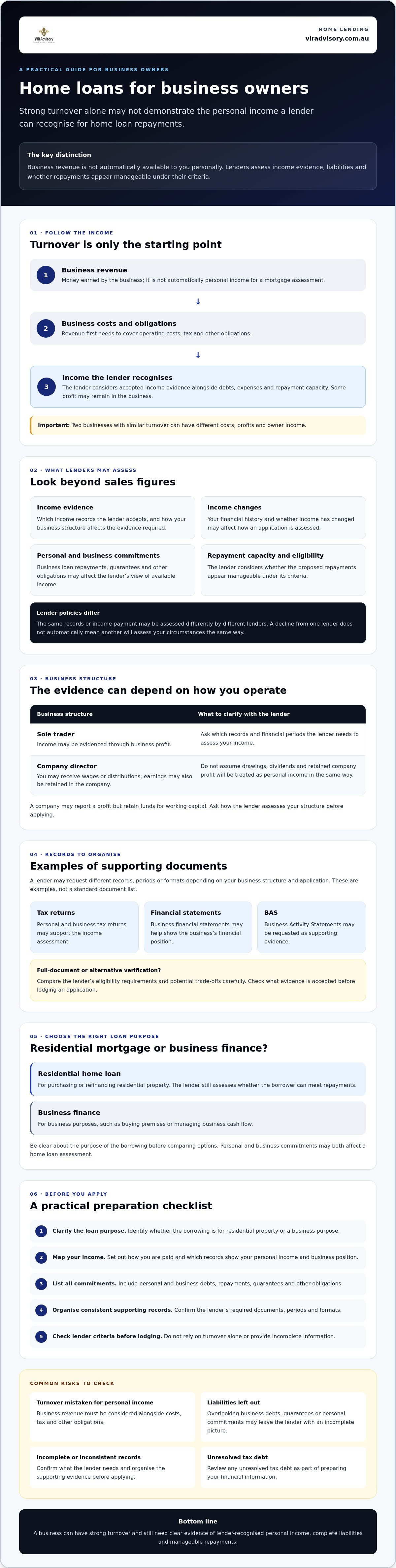
Business owners can apply for a home loan, but approval depends on the lender’s assessment of income, liabilities and eligibility. A home loan for business owners is residential finance assessed using evidence of the applicant’s personal income and financial commitments. Lenders don’t treat business turnover as money automatically available for mortgage repayments. Revenue first needs to cover operating costs, tax and other obligations, and some profit may stay in the business.
In brief: business revenue is the money a business earns; lender-assessed personal income is the income a lender accepts as available to support an individual’s home loan repayments. The distinction matters because two businesses with similar turnover can have different costs, profits and owner income. A mortgage loan is secured against property, but the lender still needs to assess whether the borrower can meet the repayments.
The following video discusses lender credits and closing costs in its own market. It isn’t guidance on Australian home loan costs or lender assessments.
Business owner, sole trader or company director: why structure matters
Your business structure affects how income is recorded, but it doesn’t automatically make an application easier or harder. A sole trader’s income may be evidenced through business profit, while a company director may receive wages or distributions. Lenders may not treat drawings, dividends and earnings retained in a company in the same way. Policies differ, so the same payment could be assessed differently by different lenders.
For example, a company may report a profit but retain funds for working capital rather than pay them to its director. Don’t assume the full profit will count as personal income. Ask how the lender assesses your structure and which records it requires before applying.
Residential home loan or business finance: which application are you considering?
A residential home loan is for purchasing or refinancing residential property. Business finance is intended for business purposes, such as buying premises or managing business cash flow. Be clear about the purpose of the borrowing before comparing options. If you’re purchasing business premises, review commercial property finance guidance.
Personal and business commitments can both affect a home loan assessment. Business loan repayments, guarantees and other obligations may influence the lender’s view of your available income and repayment capacity. Make a complete list of these commitments and ask how the lender will account for them. Don’t assume business debts sit outside your personal application.
How Australian lenders assess business-owner income and home loan applications
For a self-employed applicant, a lender needs to understand more than the business’s sales. It considers the available income evidence, business and household expenses, existing debts and whether the proposed repayments appear manageable under its criteria. Policies differ, so different lenders may treat the same records differently.
Possible supporting records include personal and business tax returns, business financial statements and Business Activity Statements (BAS). These are examples, not a standard document list. Depending on the business structure and application, a lender may ask for different periods, formats or additional evidence. Check the current requirements before lodging. A bank’s own guide, such as Westpac’s how to apply for a self-employed home loan, can illustrate one lender’s process, but it doesn’t establish requirements across the market.
Infographic: what the lender is checking
- Income evidence: Tax returns, financial statements or BAS, where requested. What income can be verified and used in the assessment?
- Business cash flow: Revenue, operating expenses and funds retained in the business. What income is available to support personal repayments?
- Personal liabilities: Existing loans, credit commitments and household living costs. What ongoing obligations reduce repayment capacity?
- Proposed home loan: Requested repayments considered alongside the applicant’s overall finances. Does the application meet this lender’s criteria?
What income documents might a lender request?
One lender may ask for a particular set of financial records, while another may require different documents or a different period of evidence. Don’t assume that one year of accounts, a BAS or a tax return will be enough. Before applying, confirm the required documents, dates and formats. Then check that figures are consistent across the records you provide. Resolve discrepancies or explain them clearly rather than leaving the lender to guess.
How borrowing capacity connects to business-owner finances
Borrowing capacity depends on the income a lender accepts, your living costs, existing debts and the repayments on the proposed loan. For example, strong sales won’t necessarily support a larger application if operating costs are high or business debt repayments reduce available cash flow. A large deposit may reduce the amount you need to borrow, but it doesn’t establish that the repayments are affordable under the lender’s assessment.
For a closer explanation of the factors in the calculation, see Australian borrowing capacity calculations. Before submitting an application, organise your records and ask the lender how it will treat business income and liabilities.
Business-owner home loan options: compare income evidence, debts and lending risks
A different lender assessment approach may be worth exploring if your income is complex, business records vary between periods or your income isn’t straightforward to show through conventional documents. That doesn’t mean you’ll qualify for another option. Full-document and alternative verification approaches are available only where a lender offers them and confirms that your circumstances meet its criteria.
A full-document assessment may rely on records such as tax returns and financial statements. An alternative verification process may allow other evidence, but the accepted documents, eligibility rules and assessment method are lender-specific. More flexibility in the evidence process doesn’t necessarily mean fewer checks or a better overall loan fit. Compare the required records, loan features, conditions and potential costs, and confirm what the lender will assess before proceeding.
Comparison summary: “A suitable home loan for business owners depends on the evidence available, business structure, liabilities and the lender’s current policy, not on a simplified document list alone.”
When could a different lender assessment approach matter?
It may be relevant if your income fluctuates, your financial records don’t fit a standard pattern or the way you receive business income needs further explanation. Ask each lender which documents it accepts, how it assesses income and what eligibility conditions apply. Don’t choose an option solely because an advertisement promises fewer documents. A shorter list doesn’t show whether the lender’s assessment suits your finances or what other conditions apply.
- Evidence: Confirm which records are accepted and whether additional documents may be requested.
- Assessment: Ask how income changes and business commitments are considered.
- Loan fit: Review relevant features, conditions and costs alongside the verification process.
Keep your information complete and consistent. If figures differ between records, identify why and be ready to explain the difference. A lender may ask for clarification, and incomplete or inconsistent information can make assessment more difficult.
How to weigh business debt against a personal home loan
Business loans, credit facilities and guarantees may affect a personal home loan assessment, but how they’re treated depends on the lender and the details of the obligation. Irregular business cash flow may also lead to closer questions about whether income can support both business commitments and proposed home loan repayments. Disclose relevant liabilities accurately, including obligations that may not appear as a regular personal repayment, and discuss them before submitting an application.
If you already have a home loan, refinancing may be one option to review. Compare the full loan terms and costs rather than assuming a new structure will resolve business debt pressures. See these home loan refinancing considerations when assessing whether refinancing is relevant to your circumstances.
Prepare a business-owner home loan application with this practical checklist
A clear application starts with consistent information, not a large stack of documents. Before applying for a home loan for business owners, use the steps below to identify what you need to explain, which records you have and what to confirm with each lender. Requirements vary, so treat this as a preparation checklist, not a universal document list.
Application preparation: five stages
- 1. Clarify the purpose: Identify whether you’re buying or refinancing a residential property, and gather available details about the intended property.
- 2. Map your income: Separate personal income from business revenue. Note how you’re paid and how income changes across the records you have.
- 3. List liabilities: Record personal and business debts, credit commitments, guarantees and other obligations relevant to the application.
- 4. Check your evidence: Organise available personal and business income records, then check dates, figures and explanations for consistency.
- 5. Compare lender requirements: Confirm acceptable evidence, eligibility criteria, relevant loan features and potential costs before applying.
Documents and financial details to organise before enquiring
Prepare the income records you already hold, a current list of liabilities and details of the residential property you intend to purchase or refinance. Keep personal and business figures distinct. For example, label business revenue separately from wages, drawings or distributions paid to you, so the lender can see what each figure represents.
Don’t assume one lender’s document list applies elsewhere. Ask each lender which documents it requires, what periods they must cover and whether it needs a particular format. If records don’t match, identify the reason and prepare a clear explanation before submitting them.
Questions to ask before choosing a lender
Check how the lender assesses your business structure, income evidence and business debts. Ask which eligibility conditions apply, whether further verification may be requested, and what loan features and costs to compare. Don’t rely on turnover alone, overlook liabilities or lodge an application before checking the lender’s criteria. A complete, consistent application makes it easier to assess your circumstances, but it doesn’t guarantee approval.
How VIR Advisory can help business owners compare home loan options
For business owners, comparing home loan options means looking beyond the interest rate or the number of documents on a lender’s checklist. Income definitions, the treatment of business commitments and eligibility criteria can differ between lenders. The relevant question is which assessment approach fits your verified circumstances and borrowing requirements.
VIR Advisory is an Australia-wide mortgage and finance brokerage, not a direct lender. It can help you outline your circumstances, compare criteria across its lender network and clarify what evidence may be needed before an application proceeds. This doesn’t guarantee approval or a particular rate. The lender makes its own decision under its current policies.
What to expect from a finance brokerage discussion
An initial discussion can clarify the purpose of the home loan, how your business is structured, how you receive income and what personal or business commitments you have. It can also identify questions to resolve, such as whether your records match the evidence a prospective lender requests.
Raina Doshi has over 15 years of banking and finance experience, including more than a decade with one of Australia’s leading banks. That experience informs practical discussions about how lender assessment criteria may apply. The lender’s current requirements and your verified information remain decisive. Read more about Raina Doshi’s finance experience.
The purpose is to clarify possible next steps, not to assume that a particular lender or verification option will be available. You can use the discussion to understand what to confirm, organise relevant records and compare potential loan features and conditions alongside assessment requirements.
Discuss your home loan options with VIR Advisory
If you’re considering a home loan for business owners and want to compare lender criteria, come prepared to discuss your income structure, existing commitments, loan purpose and available financial records. These details help frame the questions to ask, including what further evidence may be required and which eligibility conditions need checking. Options depend on lender policy and your circumstances, and no outcome can be guaranteed.
VIR Advisory’s banking and finance experience spans residential lending and business finance, providing context for discussions about how business obligations and personal borrowing interact. The firm acts as an intermediary, helping compare potential options rather than lending directly.
Prepare your application with clear lender comparisons
A home loan for business owners is assessed on income a lender can verify for personal repayments, alongside living costs and existing personal and business commitments. Business turnover alone doesn’t show what income is available to meet a mortgage repayment.
Before applying, organise your income records, separate personal and business figures, list liabilities and confirm each lender’s current evidence and eligibility requirements. Lenders can assess business structures and income differently, so a decision from one bank doesn’t necessarily reflect how another lender may consider the application. Compare the assessment approach, conditions and loan features, not just the document list.
VIR Advisory is an Australia-wide home loan and business finance brokerage, not a direct lender. Raina Doshi brings over 15 years of banking and finance experience to discussions about your circumstances, lender criteria and possible next steps. Approval and loan terms remain subject to the lender’s assessment.
With organised records and a clear view of your commitments, you can approach lender comparisons with greater confidence. To talk through your circumstances and possible next steps, book a finance discussion with VIR Advisory.
Frequently Asked Questions
Can a business owner get a home loan in Australia?
Yes, business owners can apply for a home loan in Australia, but approval depends on the lender’s criteria and assessment of the application. For a home loan for business owners, the lender considers evidence of personal income, living costs and existing commitments, including relevant business liabilities. Requirements vary, so check which income records the lender accepts and how it assesses your business structure before applying.
How do lenders calculate income for a business-owner home loan?
Lenders use their own policies to assess income evidence, business and household expenses, liabilities and the proposed repayments. Depending on your structure, they may review information such as business profit, wages or distributions, using records they consider suitable for verification. They may also assess whether income is consistent and how business commitments affect available cash flow. Ask how the lender will treat your specific income sources rather than assuming turnover or profit will be counted in full.
What documents do self-employed borrowers need for a home loan?
There isn’t one document list that applies to every self-employed borrower or lender. Possible examples include personal or business tax returns, business financial statements and Business Activity Statements (BAS). A lender may request different periods, formats or additional evidence depending on your circumstances and its assessment process. Before lodging an application, confirm the current requirements, organise the records you have and check that figures are consistent or any differences are clearly explained.
Does business turnover count as income for a home loan?
Business turnover doesn’t automatically count as personal income available for home loan repayments. It represents business revenue before expenses and other obligations are accounted for. For example, a business may have substantial sales but also significant operating costs or funds retained for business use. A lender assesses income using evidence and its own criteria, so clarify how it will distinguish revenue from income it may recognise for your personal borrowing assessment.
Can existing business debts affect a personal home loan application?
Yes, business debts or guarantees may be relevant to a personal home loan assessment, although lender treatment depends on the obligation and the lender’s current policy. Repayments or other commitments could affect how the lender assesses your available income and capacity to meet proposed repayments. Disclose business liabilities accurately and discuss them before applying. Include facilities and guarantees in your financial summary, even if you’re unsure how the lender will treat them.
Should I apply for a home loan through my business or personally?
The right borrowing structure depends on the property’s purpose, intended ownership and lender requirements. A residential home loan is different from business finance, which is intended for business purposes. Don’t assume a company should borrow simply because it operates the business, or that business funds are automatically personal income. Before choosing a structure, clarify the purpose with the lender and consider getting independent tax or legal advice about ownership and obligations.
How can I improve my chances of getting a home loan as a business owner?
Prepare before applying: clarify the loan purpose, map how you receive income, list personal and business liabilities, and organise available financial records. Check that figures are consistent and prepare explanations for discrepancies. Then ask prospective lenders how they assess your structure, income evidence and commitments, and confirm eligibility and document requirements before lodging. Avoid relying on turnover alone or applying before checking lender criteria. Preparation can make your circumstances clearer, but it can’t guarantee approval.

Article by
Raina Doshi
Raina Doshi has worked in banking and finance since 2011, including experience with major Australian lenders. She helps homeowners, property investors, business owners and professionals secure and structure lending solutions across home loans, refinancing, commercial finance and business lending.
Areas of expertise include residential lending, investment property finance, debt recycling, commercial property finance, equipment finance, construction finance and strategic debt structuring.
Drawing on extensive banking and finance experience, Raina helps clients navigate lender requirements, improve borrowing outcomes and structure effective finance solutions.
Disclaimer
The information in this article is general in nature and does not take into account your personal objectives, financial situation or needs. Before acting on any information, consider whether it is appropriate to your circumstances and seek professional advice.


