

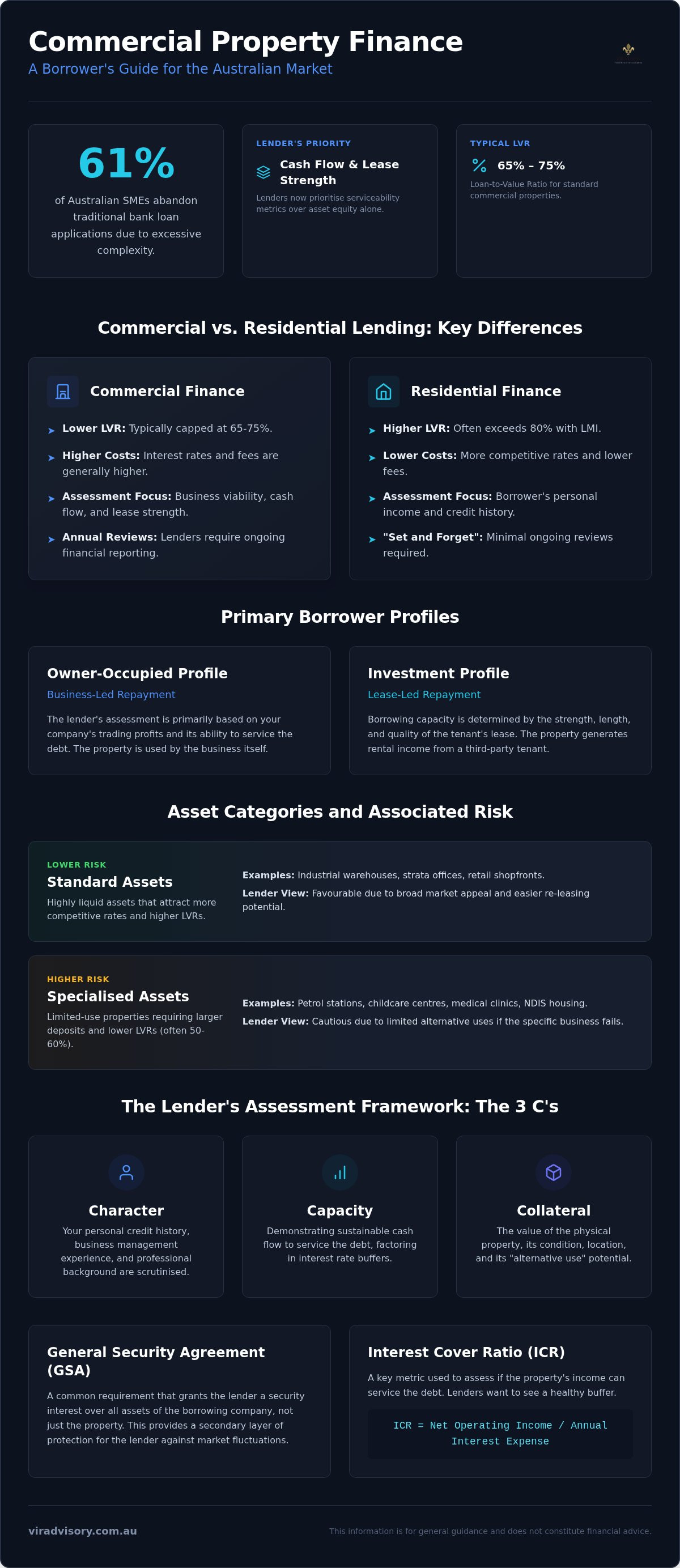
Did you know that 61% of Australian SMEs have abandoned loan applications with traditional banks because the documentation requirements were too complex? In a market where the RBA cash rate sits at 4.35%, securing commercial property finance requires more than just a valuable asset. Lenders now prioritise serviceability metrics and lease strength over equity alone. To successfully secure funding, you typically need a loan-to-value ratio (LVR) between 65% and 75%, along with a clear demonstration of cash flow that can withstand current serviceability buffers.
Lending environments are increasingly restrictive, and the complexity of cross-collateralisation often creates unnecessary hurdles for established businesses. This guide provides a methodical breakdown of commercial lending assessment criteria and funding structures to help you identify the most cash-flow efficient setup. We'll examine how to calculate your borrowing capacity, compare bank and non-bank lender requirements, and provide a practical checklist to ensure your application meets strict approval standards.
Key Takeaways
- Understand why lenders prioritise sustainable cash flow and lease strength over physical asset value when assessing commercial property finance applications.
- Identify when to utilise non-bank lending structures to gain the flexibility required for complex SME tax profiles and varying credit histories.
- Recognise the role of General Security Agreements (GSA) and how strategic debt structuring can protect your business from the risks of cross-collateralisation.
- Prepare for the rigorous valuation and approval process by identifying the specific documentation requirements for industrial, retail, and office assets.
- Learn to navigate high interest rate environments by applying serviceability buffers that ensure your property acquisition supports long-term business stability.
Defining Commercial Property Finance in the Australian Market
Commercial property finance is a specialised lending facility used to purchase, refinance, or develop non-residential real estate. While residential lending focuses primarily on the borrower's personal income, commercial lending evaluates the interplay between the business operations and the physical asset. Key asset classes within this market include industrial warehouses, retail shopfronts, office suites, and specialised assets such as childcare centres or medical clinics. Unlike short-term business lines of credit, these loans typically offer terms between 15 and 30 years, providing the stability needed for long-term capital growth.
Lenders distinguish between two primary borrower profiles: owner-occupied and investment. An owner-occupied profile is business-led, meaning your company's trading profits are the primary source of debt repayment. In contrast, an investment profile is lease-led, where the strength and duration of the tenant's lease determine your borrowing capacity. Understanding these distinctions is critical, as they dictate the lender's appetite and the overall finance strategy required for approval.
To better understand the broader context of securing your financial position, watch this helpful video:
Commercial vs. Residential Lending Differences
The transition from residential to commercial lending introduces stricter assessment criteria. Lenders typically cap the Loan-to-Value Ratio (LVR) between 65% and 75% for standard assets, whereas residential loans often exceed 80%. This lower cap reflects the perceived market volatility and the longer timeframes required to sell commercial assets. Interest rates and application fees are generally higher to compensate for these liquidity risks. Additionally, commercial facilities are rarely "set and forget" products; lenders often mandate annual reviews, requiring you to submit updated financial statements to ensure the business remains a viable credit risk.
Common Asset Categories for Finance
Lender appetite varies significantly based on the asset's category. Standard assets like industrial units and strata offices are highly liquid and generally attract more competitive rates and higher LVRs. Specialised assets, including petrol stations or NDIS-compliant housing, are viewed as higher risk because their utility is limited to a specific industry. If a specialised business fails, the property may sit vacant for longer, leading lenders to require larger deposits, often capping LVRs at 50% to 60%. Choosing the right asset type is the first step in determining your required capital contribution and the likely funding solutions available to you.
How Lenders Assess Commercial Loan Applications
Lenders approach commercial property finance with a focus on risk mitigation and sustainable repayment capacity. While the physical asset provides essential security, the primary assessment revolves around the "three Cs": Character, Capacity, and Collateral. For SME owners, this means your personal credit history and professional experience are under the microscope. Lenders also scrutinise the property's "alternative use" potential. If the building is highly specialised, such as a cold-storage facility, the lender will assess how easily it could be re-let to a standard industrial tenant if the current occupant vacates.
A common requirement in business-led finance is the General Security Agreement (GSA). This legal document grants the lender a security interest over all the assets of the borrowing company. It acts as a secondary layer of protection, ensuring the lender has recourse to business trading profits or equipment if property values fluctuate. This methodical approach to security ensures that the loan remains stable even during periods of market volatility.
Interest Cover Ratio (ICR) and Debt Service Cover
Most lenders use the Interest Cover Ratio (ICR) to determine if the asset produces enough income to service the debt. This is calculated by dividing the Net Operating Income (NOI), which is the gross rent minus outgoings like rates and land tax, by the annual interest expense. For example, a property with an NOI of $150,000 and interest costs of $100,000 has an ICR of 1.5x. Banks typically stress-test these figures by applying a buffer of 1.5% to 2.0% above current market rates to ensure you can manage potential RBA cash rate increases. A higher ICR often leads to more favourable loan terms and lower risk margins.
Lease Strength and WALE
For investment-led applications, the Weighted Average Lease Expiry (WALE) is the defining metric. A longer WALE, typically exceeding three to five years, provides the lender with certainty regarding future cash flow. High-quality "Blue Chip" tenants, such as government agencies or national franchises, often allow for more aggressive LVRs and lower interest margins compared to local small businesses. Lenders factor in the risk of vacancy periods, especially in regional areas, and may reduce the borrowing capacity if the lease is nearing expiry. If you are unsure how your current lease profile affects your borrowing capacity, you can book a consultation to review your debt structure. This ensures your application is presented with the necessary precision to meet strict bank assessment criteria.
Comparing Commercial Funding Structures: Bank vs. Non-Bank
The choice between a traditional bank and a non-bank lender is often a trade-off between cost and flexibility. Major Australian banks provide the most competitive commercial property finance rates, typically using indicator rates near 7.85% plus a risk margin. However, their assessment process is rigid, often taking up to 10 weeks for credit approval. Non-bank lenders, while charging higher interest rates, offer a more agile approach, with some able to settle facilities within 21 business days. This speed is often essential for business owners who need to secure a property quickly in a competitive market.
In the current 2026 economic environment, where the RBA cash rate is held at 4.35%, selecting the right rate structure is a critical decision. Variable rates offer flexibility for future refinancing, but fixed rates provide the certainty needed for tight cash flow management. Many business owners now opt for a split facility to hedge against potential rate hikes forecast by some major institutions, while maintaining some exposure to potential cuts in 2027.
Full Doc vs. Low Doc Commercial Loans
Full Doc loans remain the gold standard for established businesses that can provide two years of certified financial statements and tax returns. These facilities offer the lowest margins because the lender has a comprehensive view of the entity's financial health. For self-employed professionals or businesses with recent structural changes, Low Doc options allow for assessment based on 12 months of BAS statements or an accountant’s letter. If the property is already tenanted with a strong lease, a 'Lease Doc' loan may be the most efficient route, as the lender relies primarily on the property's rental income to satisfy serviceability requirements.
SMSF Lending for Commercial Property
A significant trend in the Australian market is the use of Self-Managed Super Funds (SMSF) to acquire "Business Real Property." By using a Limited Recourse Borrowing Arrangement (LRBA), you can purchase your business premises through your super fund and lease it back to your operating entity at market rates. This structure offers substantial tax advantages, including a 15% tax rate on rental income and potential capital gains tax exemptions in the pension phase. Because SMSF lending involves strict regulatory compliance and specific SMSF loan structures, obtaining professional debt advisory is essential to ensure the arrangement meets the Australian Taxation Office (ATO) "sole purpose" test.
Approval Requirements and Common Obstacles
Securing commercial property finance requires a high level of transparency and documentation. Data from August 2026 indicates that 61% of Australian SMEs have abandoned loan applications with traditional banks because the documentation requirements were too complex. A methodical approach to your application is essential to avoid these delays. One of the most frequent hurdles is the "valuation gap," which occurs when the lender's appraiser values the property below your agreed purchase price. This gap often arises in volatile markets where comparable sales are limited, forcing you to either contribute more equity or negotiate a lower price with the vendor.
Lenders also evaluate the broader industry outlook. If your business operates in a sector facing structural decline, such as certain brick-and-mortar retail categories, the bank may perceive a higher risk regardless of your personal credit history. Common reasons for rejection include inadequate cash flow buffers or a debt service cover ratio (DSCR) that fails to meet the lender's stress-test requirements, which are typically 1.5% to 2.0% above current market rates.
The Application Checklist for 2026
Lenders expect a comprehensive submission that details both your business health and the asset's potential. Your documentation should include:
- Detailed Profit and Loss statements and Balance Sheets for the last two financial years to demonstrate sustainable profitability.
- Current lease agreements and a verified schedule of outgoings, including council rates, insurance, and land tax.
- A clear business plan or investment strategy that outlines the purpose of the acquisition and how it supports your long-term operational stability.
Providing this information upfront reduces the risk of back-and-forth queries that can extend bank approval times beyond the standard 6 to 10 week window.
Navigating Valuation and Environmental Risks
Commercial valuations are significantly more complex and expensive than residential appraisals, often costing approximately $1,500 or more. For industrial assets, lenders frequently mandate a 'Phase 1' environmental report to check for soil or groundwater contamination. If a site has a history of chemical storage or heavy manufacturing, the potential for remediation costs represents a major security risk. Zoning also plays a critical role; a property with flexible "General Industrial" zoning is more attractive to lenders than one with highly restrictive use cases. To improve your approval prospects, you might consider reducing personal debt or providing additional security through a General Security Agreement (GSA) over other business assets.
Strategic Finance Planning with VIR Advisory
A methodical approach to debt structuring is essential for maintaining business stability, especially when market conditions fluctuate. Securing commercial property finance is not merely about obtaining an approval; it's about ensuring the funding structure aligns with your company's specific cash flow requirements. With over 15 years of banking experience, VIR Advisory applies deep knowledge of lender assessment policies to navigate the complexities of both major banks and non-bank institutions. This expertise ensures that your debt profile remains sustainable while supporting long-term growth objectives without compromising operational liquidity.
Accessing a broad network of lenders allows for a more precise match between your financial position and the available credit products. While a major bank might offer the lowest rate, a non-bank lender might provide the interest-only period or flexible covenant structure required for a capital-intensive expansion. By managing the entire application process, we alleviate the administrative burden that often leads to application abandonment. We focus on presenting your financial data in a format that speaks directly to credit managers, highlighting serviceability strengths and mitigating perceived risks before they become obstacles.
Custom Lending Strategies for Professionals
Tailoring loan facilities requires a clear understanding of business growth cycles and tax planning. For example, a professional services firm may choose to refinance an existing commercial portfolio to unlock equity for a new office acquisition or equipment purchase. This process involves a meticulous review of current LVRs and serviceability metrics to ensure the new debt does not hinder operational liquidity during seasonal downturns. You can learn more about our specialised services to see how we structure facilities for diverse asset classes and investment profiles.
The VIR Advisory Difference
The core of our approach is clarity and precision. We prioritise honest communication throughout the procedure, ensuring you understand the risks and benefits of each funding solution before you commit to a term sheet. Whether you are navigating a complex SMSF purchase or a high-LVR industrial acquisition, you receive direct access to Raina Doshi for expert guidance. This level of individual attention ensures that every detail, from valuation management to environmental risk assessment, is handled with professional oversight. If you are ready to review your current debt position or explore new funding options, please contact our team for a confidential discussion.
Securing Your Commercial Asset with Precision
Successful acquisition of non-residential real estate depends on a clear understanding of lender assessment criteria and the strategic alignment of your debt structure. Whether you are navigating the complexities of an SMSF purchase or refinancing an industrial warehouse, the focus must remain on sustainable cash flow and lease longevity. By addressing documentation requirements and valuation risks early, you can avoid common approval obstacles that frequently hinder SME lending applications.
VIR Advisory provides a methodical approach to commercial property finance, leveraging over 15 years of banking and finance expertise to navigate both bank and non-bank lender requirements. Our national service for Australian business owners ensures that every facility is structured with the precision needed to support long-term operational stability. We specialise in complex commercial and SMSF lending, providing the professional oversight required to manage your debt facilities with complete confidence.
We look forward to helping you establish a stable and efficient funding structure for your next commercial asset.
Frequently Asked Questions
What is the maximum LVR for a commercial property loan in Australia?
Standard maximum LVRs for commercial property finance typically range between 65% and 75% for well-located assets. While major banks often prefer to cap lending at 50% to 65% to mitigate risk, non-bank lenders frequently extend to 70% or 75% for tenanted industrial or retail properties. Your specific LVR depends on the asset category; specialised properties like childcare centres or petrol stations usually require a larger deposit, often capping the loan at 50% to 60%.
Can I use my residential property as security for a commercial loan?
You can use the equity in your residential property to support a commercial acquisition, either by refinancing your home loan to release a deposit or through cross-collateralisation. However, cross-collateralisation links your family home directly to business debt, which increases your personal risk profile. A methodical approach often involves a standalone structure where equity is pulled as a separate facility, keeping your residential and commercial assets independent for better risk management and future flexibility.
What is a General Security Agreement (GSA) and why do lenders require it?
A General Security Agreement (GSA) is a legal document that provides a lender with a security interest over all the assets of a borrowing company. Lenders require this to provide an additional layer of protection beyond the physical property, particularly for business-led loans where trading profits service the debt. It ensures the lender has recourse to business equipment, inventory, and debtors if the property value fluctuates or the business encounters significant cash flow challenges during the loan term.
How long does the commercial loan approval process typically take?
The approval timeframe varies significantly between traditional banks and non-bank lenders. Major Australian banks typically take between 6 and 10 weeks to provide a formal credit approval due to their rigorous "Full Doc" assessment processes. In contrast, non-bank and private lenders can often settle facilities within 7 to 21 business days. Providing a complete documentation package, including two years of financial statements and current lease agreements, is essential for maintaining momentum during the valuation and credit review stages.
Is it possible to get a commercial loan with a low deposit?
Securing commercial finance with a low deposit is difficult, as most lenders require a minimum 25% to 35% equity contribution. Unlike residential lending, there is no Lenders Mortgage Insurance (LMI) to cover high-LVR commercial applications. You can achieve a lower cash contribution by using the equity in existing property assets or through a "Lease Doc" structure if the tenant is a high-quality national brand. However, lower deposits often result in higher risk margins and more stringent serviceability requirements.
What are the tax implications of commercial property finance?
Interest payments on commercial property finance are generally tax-deductible when the property is used for income-producing purposes. You may also be eligible to claim depreciation on the building and its fixtures, which can significantly improve your after-tax cash flow. GST is typically payable on the purchase price of commercial assets, though many business owners can claim this back as an input tax credit. You should always consult a qualified tax professional to confirm how these rules apply to your specific entity structure.
What is the difference between a commercial loan and a business loan?
A commercial property loan is a specific facility used to purchase or refinance non-residential real estate, such as a warehouse or office. A business loan is a broader term covering facilities for working capital, equipment finance, or business acquisition. While both require serviceability assessments, commercial property loans use the real estate as the primary security. Business loans may be unsecured or secured by a General Security Agreement (GSA) over the company's operating assets rather than a specific title.
How does a 'Lease Doc' loan work for property investors?
A 'Lease Doc' loan allows property investors to secure finance based primarily on the rental income of the asset rather than their personal or business tax returns. The lender assesses whether the net rental income covers the interest payments, typically requiring an Interest Cover Ratio (ICR) of 1.5x or higher. This structure is ideal for investors with complex tax profiles or those who have reached their personal borrowing capacity but hold assets with strong, long-term leases and high-quality tenants.

Article by
Raina Doshi
Raina Doshi has worked in banking and finance since 2011, including experience with major Australian lenders. She helps homeowners, property investors, business owners and professionals secure and structure lending solutions across home loans, refinancing, commercial finance and business lending.
Areas of expertise include residential lending, investment property finance, debt recycling, commercial property finance, equipment finance, construction finance and strategic debt structuring.
Drawing on extensive banking and finance experience, Raina helps clients navigate lender requirements, improve borrowing outcomes and structure effective finance solutions.
Disclaimer
The information in this article is general in nature and does not take into account your personal objectives, financial situation or needs. Before acting on any information, consider whether it is appropriate to your circumstances and seek professional advice.


