

A lender’s main concern may not be how much your business earns, but whether the evidence shows it can repay the loan. Understanding small business loan requirements starts with that distinction. Australian lenders may assess trading history, cash flow, existing debts, credit information, loan purpose and any security, alongside records such as financial statements, business bank statements and recent BAS. The information requested varies with the lender, loan structure, business circumstances and how the funds will be used.
It can be difficult to know what to prepare, particularly if cash flow fluctuates, your business has a shorter trading history or you’re already managing other debts. A complete application won’t guarantee approval, but clear, consistent records help a lender understand the business’s capacity to meet repayments and identify any points that need explanation.
This article explains what lenders may ask for, the factors they commonly consider and practical ways to prepare. It also covers why requirements differ between lenders and what to review before applying, so you can anticipate questions and present a clear picture of your business finances.
Key Takeaways
- Small business loan requirements vary by lender, loan purpose, business structure and amount sought. Prepare for an individual assessment, not a fixed checklist.
- Set out cash flow, operating costs and existing commitments together to show how proposed repayments could fit the business’s finances.
- Organise identity and business details, financial records, liabilities and information about how you’ll use the funds. Label documents clearly and check that figures are consistent.
- If trading has been uneven or records are incomplete, prepare an explanation and supporting evidence. Don’t assume finance is automatically out of reach.
- A finance broker can help organise an application and consider options across a lender network. The lender’s assessment and requirements still apply.
Small business loan requirements in Australia: what lenders commonly assess
For a small business loan, lenders commonly assess the business’s capacity to repay, its circumstances and the evidence supporting the application. Small business loan requirements aren’t a universal checklist or set of automatic approval thresholds. They vary with the lender, finance purpose, business structure, amount sought and proposed security.
A lender may look at how the requested finance fits the business, its cash flow, existing commitments and trading records, rather than judging one figure in isolation. These factors help frame the application, but no single factor guarantees approval or determines every lender’s decision.
For a step-by-step overview of preparing an application, watch this video:
Definition: A business loan is finance provided to a business that must be repaid under agreed terms. It may be secured against assets or unsecured. For a high-level introduction to what is a business loan, see the overview of common loan types.
In brief: Lenders commonly assess the loan’s purpose, expected repayment capacity, cash flow, trading records, current liabilities, business structure and any proposed security. The evidence they request depends on the application.
What does a lender usually want to understand?
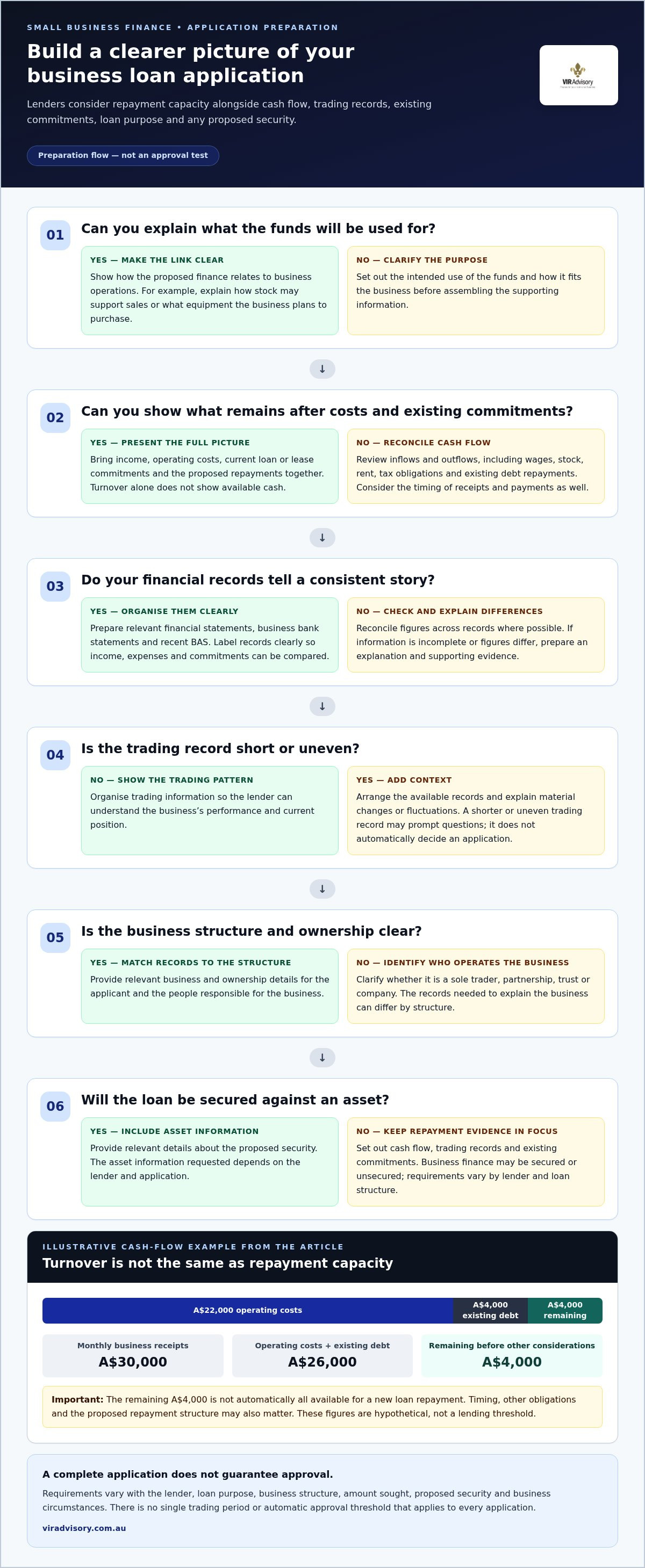
A lender will want to understand what the funds are for and how the business expects to repay them. Make the link between the proposed use and business operations clear. For example, a retailer seeking funds to purchase stock could explain how the stock supports sales and how repayments are expected to fit alongside normal operating costs.
Cash flow, existing loan or lease commitments, trading information and business structure all provide relevant context. Strong revenue alone doesn’t show what remains after expenses and debt repayments. A short or uneven trading record doesn’t automatically decide an application either, but it may prompt questions about the business’s current position and available evidence.
Why requirements differ between business loan applications
Requested information can change with the purpose, facility type and security. An equipment finance application may call for details of the purchase, while a working capital application may need a clearer view of cash flow pressures and the timing of receipts and payments. If security is proposed, information about the asset may also be relevant.
Business structure affects which records explain who operates and is responsible for the business. A sole trader’s records differ from those of a partnership, trust or company, which may involve additional business or ownership documents. For example, a café run by a company seeking equipment finance could explain the planned purchase and provide records showing the company’s trading position. The supporting evidence depends on the lender and application, rather than one rule applying to every business.
How Australian lenders assess cash flow, trading records and repayment capacity
Lenders may assess repayment capacity by considering income alongside operating costs, existing debts and the cash left to meet new repayments. Turnover shows sales coming into the business, but it isn’t the same as available cash. Wages, stock, rent, tax obligations and loan commitments all affect what remains.
Consistent financial and bank records help a lender compare reported income, expenses and existing commitments over time. This gives a clearer basis for assessing whether the business may be able to service proposed repayments. For further preparation guidance, the Australian Banking Association and CPA Australia explain what lenders commonly assess.
Cash flow, existing debt and the proposed repayments
Regular inflows and outflows can show how the business manages commitments through different trading periods. Lenders may consider the pattern of customer receipts, operating expenses and repayments on existing finance together. A strong sales month by itself doesn’t prove ongoing repayment capacity.
Illustrative example only: If a business receives A$30,000 in a month, spends A$22,000 on operating costs and pays A$4,000 on existing debt, the remaining A$4,000 isn’t automatically all available for a new loan. Timing, other obligations and the proposed repayment structure may also matter. These figures are hypothetical, not a lending threshold.
Assessing borrowing capacity from turnover alone can give an incomplete picture. Before applying, reconcile figures across bank statements and financial reports, then list existing loan, lease and other regular commitments. This lets the proposed repayment be considered in context.
Trading history, credit information and business structure
Trading records show how the business has performed, but lenders may assess the length and pattern of trading in light of the application. There’s no single trading period that applies to every lender or business loan. If records cover a shorter period or show fluctuations, organise the figures and be ready to explain material changes.
Depending on the lender and application, business or director credit information may also be considered. Business registration and ownership details can help identify the borrower and clarify who is responsible for the facility. An Australian Business Number (ABN) record may help identify a business, while relevant Australian Taxation Office records, such as BAS or tax information, may support the financial picture if requested. These are possible evidence sources, not universal requirements.
Read small business loan requirements in context. A lender may consider cash flow, commitments, trading records, credit information and business structure together. Keep these details organised and note relevant context so you can respond clearly to follow-up questions.
Small business loan documents: a practical Australian application checklist
There’s no single document pack for every business loan. Small business loan requirements depend on the lender, loan purpose, business structure and circumstances, so use the records below as preparation, not as a list of universally mandatory items. A lender may request different periods, formats or supporting evidence for your application.
Group records by what they help explain. This makes gaps easier to spot and helps you respond to requests without assuming every item will be required.
Application documents at a glance
Who is borrowing? Identity, business structure and ownership details
How is the business performing? Financial statements, bank records and relevant tax or BAS information
What does it owe? Existing facilities and repayment commitments
What is the funding for? A clear purpose, supported by relevant quotes, contracts or invoices where available
Financial records and evidence of business performance
Financial documents help explain how the business earns and uses money. Depending on the application, commonly useful records may include:
- Financial statements: Profit and loss reports, balance sheets and cash flow information, where available.
- Business bank statements: These help reconcile reported income with deposits, operating expenses and other account activity.
- Tax and activity records: Relevant tax records or recent Business Activity Statements (BAS), if requested.
- Forecasts: Cash flow projections or a business plan may help explain a request for growth funding.
Check that reporting periods align where possible. If figures differ between a statement and bank records, note the reason and gather supporting context. Requested periods and formats vary, so don’t assume one set of accounts will suit every lender.
Business details, liabilities and the purpose of funds
Commonly useful supporting information may include identification for relevant applicants, business registration and ownership details, and records of existing loans, leases or credit facilities. For equipment or a specific business purchase, a quote, contract or invoice may support the stated purpose. Other funding requests may need a clear explanation of how the funds will be used.
Before submitting, compare names, dates and figures across the application and supporting documents. Check that applicant and business details are consistent, and account for existing commitments. If a transaction or trading movement needs context, include a brief explanation and relevant evidence.
Common small business loan application obstacles and how to address them
Incomplete records or uneven trading don’t automatically make finance impossible, but they can make an application harder to assess. Missing information, unexplained changes in revenue or conflicting figures may lead to follow-up questions. Cash flow pressure and existing debt can also affect how a lender views repayment capacity. The outcome depends on the full application and the lender’s assessment.
Common preparation issues include an unclear loan purpose, liabilities missing from the application or figures that don’t match across records. Addressing these points won’t guarantee approval, but it can help present the business’s position clearly. Borrowing capacity depends on how the lender assesses income, expenses, commitments and proposed repayments together.
What can make an application harder to assess?
A lender may need clarification if reported income differs between financial statements and bank records, or if trading changes sharply without explanation. For example, quieter months may be normal for a seasonal business. A brief explanation supported by relevant records can help distinguish a usual fluctuation from a change that affects cash flow.
Unlisted loan repayments, leases or other commitments can also leave the lender with an incomplete view of the business’s obligations. An issue may prompt further questions or influence the assessment, but it doesn’t determine the outcome on its own.
Steps to make the application clearer before submission
Use this review process to identify gaps before sending an application:
- Review the records. Check that the information requested for the application is complete and covers the relevant periods.
- Reconcile key figures. Compare income, expenses and balances across financial reports and bank records. Note differences and gather context for unusual movements.
- Map commitments. List existing facilities, leases and repayment obligations so they’re not overlooked.
- Define the purpose. State the amount sought and intended use. If funding equipment, connect the purchase to the business need and include supporting evidence where available.
- Prepare for lender questions. Note any uncertainty about requested documents, the proposed facility or information needed to explain the business’s circumstances.
Commercial property finance may involve additional information about the property and proposed transaction. Requirements depend on the lender, facility and circumstances. Before submitting, use this review to check that the funding purpose, supporting documents and repayment picture are consistent across the application.
Prepare your business loan application with VIR Advisory
A clear application starts with four practical steps: define what the funds are for, assemble records that explain the business’s financial position, map existing commitments and prepare for lender-specific information requests. These steps put small business loan requirements in context, but the documents and assessment depend on the lender, finance purpose, business structure and circumstances.
VIR Advisory is a finance brokerage, not a direct lender. It connects businesses with lenders and can help organise an application and consider finance options across a lender network. The aim is to present the business’s position clearly to prospective lenders. VIR Advisory is led by Raina Doshi, who has over 15 years of banking and finance experience, including more than a decade with one of Australia’s leading banks.
What to have ready for an initial finance discussion
You don’t need every document assembled before discussing your finance needs. It can help to outline:
- the purpose of the funding and how it relates to business operations
- the approximate amount required and preferred timing
- available financial records, such as statements, bank records and BAS, if relevant
- existing loans, leases and repayment commitments
- the business structure and relevant ownership details.
This information gives an initial view of the request and the business’s circumstances. Further documents and next steps depend on the finance purpose and lender assessment. An initial discussion doesn’t establish that a loan will be approved or determine its terms.
Discuss your business finance requirements
VIR Advisory connects applicants with lenders for business and commercial finance, helping organise applications and consider options across a lender network. If the funding involves buying or refinancing commercial property, explore commercial property finance guidance alongside the broader business finance discussion.
To discuss your requirements, bring the funding purpose, available records and existing commitments to a conversation with VIR Advisory.
Prepare a clearer application and discuss your options
Make it easier for a lender to understand your business’s ability to repay by clarifying the funding purpose, organising relevant financial and business records, mapping existing commitments and preparing for lender-specific requests. Small business loan requirements vary by lender, finance purpose, business structure and circumstances, so a complete application doesn’t guarantee approval.
Consider cash flow alongside turnover, operating costs and current repayments. Consistent figures, a clear explanation of how funds will be used and supporting records can help present the business’s position and reduce avoidable questions.
VIR Advisory provides business lending and commercial finance brokerage services across Australia, connecting applicants with lenders and helping organise applications across a lender network. The brokerage is led by Raina Doshi, who has over 15 years of banking and finance experience, including more than a decade with one of Australia’s leading banks.
Preparing clear records and a realistic repayment picture is a practical first step before applying.
Frequently Asked Questions
What documents do I need for a small business loan in Australia?
Lenders commonly request business financial information, bank statements, tax or BAS records, business and ownership details, existing liabilities, and evidence of how you plan to use the funds. These are common examples, not a universal checklist. Small business loan requirements vary by lender, business structure and loan purpose. Prepare consistent records and account for lender-specific requests as the application progresses.
How long does a business need to trade before applying for a loan?
There’s no single trading-history period that applies to every Australian lender or business finance product. A lender may consider available financial records, cash flow, the funding purpose and the business’s overall circumstances. Organise the trading information you have and explain any gaps or changes clearly. This gives the lender context to assess your position.
Can a small business get a loan without providing security?
Some business finance may be unsecured, while other facilities may involve security. Availability and assessment depend on lender policies and the application, so unsecured finance isn’t assured or suitable for every business. Before accepting an offer, review repayment obligations, costs and risks, including any guarantees or other commitments required. Consider how proposed repayments fit with existing business obligations.
Do lenders check a business owner’s personal credit history?
Personal credit information may be relevant to a business finance assessment, but whether it’s checked and how it’s considered depends on the lender, business structure and facility. Don’t assume every lender follows the same process. Provide accurate information about existing commitments and respond clearly if asked about credit details. Knowing what information may be requested can help you prepare.
Can I apply for a small business loan if my cash flow is irregular?
Irregular cash flow doesn’t automatically determine the outcome, but it may make repayment capacity more complex to assess. A lender may review income patterns, expenses, existing commitments and supporting records together. Prepare an explanation of seasonal or other fluctuations, supported by relevant financial information, and outline a repayment plan that reflects the business’s position. Approval still depends on the full application and lender assessment.
Does a small business loan application require BAS and tax returns?
Some lenders may request BAS or tax records, but neither is a universal requirement for every business loan application. Document requests vary with the lender, funding purpose and business circumstances. Organise the records available to you and check that figures align with your financial statements and other information. The lender can specify which records are needed as the application is assessed.
How can I improve my chances of a small business loan being approved?
No preparation guarantees approval, but complete, consistent records and a clearly explained funding purpose can make an application easier to assess. Before applying, review cash flow, existing debt and how proposed repayments may fit alongside business expenses. Lender criteria differ, so the relevant information depends on your circumstances and loan purpose. A finance broker can help organise an application and consider options across a lender network.

Article by
Raina Doshi
Raina Doshi has worked in banking and finance since 2011, including experience with major Australian lenders. She helps homeowners, property investors, business owners and professionals secure and structure lending solutions across home loans, refinancing, commercial finance and business lending.
Areas of expertise include residential lending, investment property finance, debt recycling, commercial property finance, equipment finance, construction finance and strategic debt structuring.
Drawing on extensive banking and finance experience, Raina helps clients navigate lender requirements, improve borrowing outcomes and structure effective finance solutions.
Disclaimer
The information in this article is general in nature and does not take into account your personal objectives, financial situation or needs. Before acting on any information, consider whether it is appropriate to your circumstances and seek professional advice.


