

A lower monthly repayment can make business debt more expensive overall. To refinance business debt effectively, compare the full cost and structure of the new facility, not just the amount due each month. This can matter when several repayments are squeezing cash flow, existing loan terms no longer fit, or ATO debt is accruing interest.
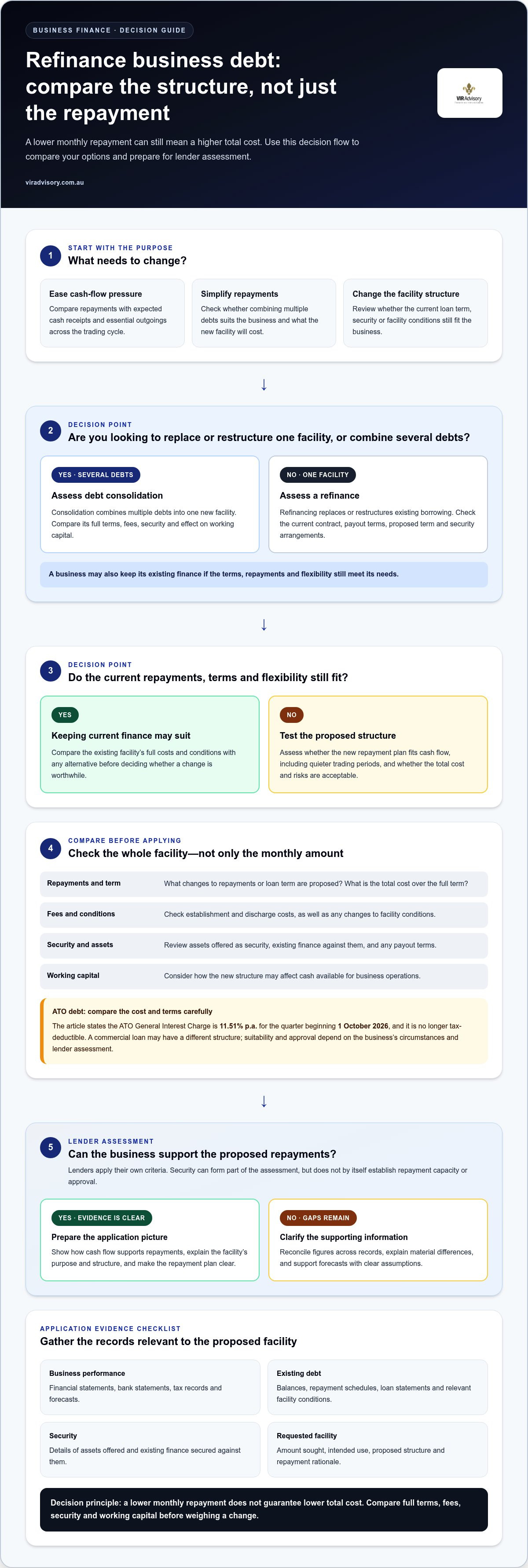
Consolidating loans or tax debt can extend the repayment period, add fees or put property at risk as security. The ATO’s General Interest Charge is 11.51% p.a. for the quarter beginning 1 October 2026, and it’s no longer tax-deductible. A commercial loan may have a different structure, but suitability and approval depend on the business’s circumstances and lender assessment.
This article explains when refinancing may help, what lenders commonly assess and which documents they may request. It also shows how to compare interest, fees, repayment terms and security, so you can weigh potential cash-flow relief against the total cost and risks before applying.
Key Takeaways
- Refinancing can change repayments, loan terms, security or facility structure, but it doesn’t guarantee lower costs.
- Before you refinance business debt, clarify whether the priority is easing cash flow, simplifying repayments or changing the loan structure.
- Lenders may assess repayment capacity, cash flow, existing liabilities and security, with supporting financial and tax records.
- Compare refinancing, debt consolidation and keeping existing finance by looking beyond repayments to total cost, fees, security and working capital.
- Prepare by listing each debt’s balance, repayments, remaining term, security, fees and relevant facility conditions.
What does it mean to refinance business debt in Australia?
To refinance business debt is to replace or restructure existing borrowing with new finance, subject to lender approval. The new arrangement may change repayments, the loan term, security or facility structure. It doesn’t automatically reduce the total cost or guarantee savings, so compare the full terms, fees and risks with your current contract.
Refinancing differs from taking on fresh working capital. A business might seek additional funds for operating expenses while keeping an existing facility, or apply to refinance and borrow more if the lender’s assessment supports it. Consolidation has a separate purpose: it combines multiple debts into one new facility, as explained in this overview of debt consolidation.
For a general overview of the process, watch this video:
Which business debts might be reviewed for refinancing?
Businesses may review existing business loans, equipment finance or commercial property finance. Whether a facility can be refinanced depends on its contract, outstanding balance, asset security and the proposed lender’s criteria. Equipment finance linked to a specific asset may have different conditions from a general business loan, so compare the payout terms and security arrangements before considering alternatives.
For borrowing secured against commercial property, the property and existing facility structure are also relevant to the assessment. See commercial property finance options for further information.
When might a business consider changing its debt structure?
A change in trading cash flow, business plans or funding needs can prompt a review, but it isn’t by itself a reason to refinance. Compare scheduled repayments with expected cash receipts and essential outgoings across the trading cycle. If repayments fall due before customer income arrives, consider whether the facility structure still fits. Assess any alternative against its full cost, term, security and effect on available working capital.
How do lenders assess a business debt refinance application?
Lenders assess refinance applications against their own criteria. They may consider the business’s capacity to meet repayments, cash flow, existing liabilities, the purpose and structure of the proposed facility, and any security offered. Collateral can form part of the assessment, but it doesn’t establish on its own that the business can afford repayments or qualify for approval.
The application should give a consistent picture of the business’s financial position. Gaps between financial statements, tax records and bank activity, limited repayment capacity, or an unclear explanation of how the new facility will be used can make assessment more difficult. Requirements depend on the lender, business entity and application, so prepare the evidence relevant to the proposed facility.
What financial information may a lender request?
Depending on the application, a lender may request business financial statements, bank statements, tax records, current facility statements and business forecasts. The period covered and exact documents required can differ. Check that figures are complete and reconcile across documents. Explain material differences and support forecasts with clear assumptions, so the lender can assess current trading performance and the proposed repayment plan.
How do cash flow, security, and existing liabilities affect assessment?
A lender may compare available cash flow with proposed repayments and existing commitments. For example, a business with seasonal receipts may need to show how it can maintain repayments during quieter trading periods. Existing debts matter too: their balances, repayment schedules and security can affect the overall assessment. This relates to borrowing capacity, or how much a business can reasonably support based on its financial position.
Security may influence the facility structure, but offering an asset doesn’t remove the need to demonstrate repayment capacity. Before applying, make the requested amount, intended use and repayment plan clear. Moneysmart also outlines the risks of debt consolidation, including why borrowers should compare full terms rather than focus only on a lower repayment.
Application evidence checklist
- Business performance: financial statements, bank statements, tax records and forecasts.
- Existing debt: current balances, repayment schedules, loan statements and relevant facility conditions.
- Security: details of assets offered and existing finance secured against them.
- Requested facility: amount sought, intended use, proposed structure and repayment rationale.
Business debt refinancing versus consolidation: compare the real trade-offs
Refinancing or consolidating business debt isn’t automatically cheaper or better. Refinancing replaces or restructures an existing facility; consolidation combines multiple debts into a new facility. Keeping current finance may still suit the business if its terms, repayments and flexibility meet current needs. Compare the complete costs and conditions, not only the proposed repayment.
| Option | Repayments and total cost | Fees, security and flexibility | Working capital |
|---|---|---|---|
| Refinance one facility | May change repayments or term; total cost depends on the new terms and charges. | Check establishment and discharge costs, security and any changes to facility conditions. | May preserve cash flow through a changed structure, but doesn’t necessarily provide extra funds. |
| Consolidate multiple debts | Combines debts into one repayment; a longer term may increase total interest. | Review fees and whether previously separate security or conditions change. | Fewer repayments may simplify cash-flow planning, but can reduce flexibility or tie up security. |
| Retain current finance | Existing repayment schedule and total cost remain subject to current contract terms. | Avoids replacing the facility, though existing conditions and charges still apply. | Preserves current access to facilities, which may suit trading needs. |
Could lower repayments cost more over the full term?
Yes. Imagine a business replaces a facility with one that has a longer repayment term. Scheduled repayments may fall and ease monthly cash-flow pressure, while interest accrues for longer and the debt remains in place. Weigh that potential relief against the total amount repayable, fees and length of the commitment. A lower repayment alone doesn’t show whether the change is cost-effective. For a deeper comparison, see the article on debt consolidation versus refinancing.
What risks should be checked before changing facilities?
Before you refinance business debt, review the existing contract and proposed terms. Check for applicable break, establishment, discharge or other charges, and compare them with the expected benefit. Look for changes to guarantees, collateral, covenants or access to revolving facilities. For example, consolidating debts secured against different assets may change which assets support the new borrowing. Understand the lender’s requirements and contract conditions before relying on projected savings or improved cash flow.
Compare proposals on the same basis: repayment amount, total cost over the full term, fees, security, flexibility and working capital available after the change. This helps distinguish short-term cash-flow relief from an improvement in the overall debt structure.
A practical checklist for preparing a business debt refinance
A well-prepared refinance request starts with a clear picture of current facilities and a specific reason for changing them. Use this process to organise information, compare options consistently and avoid focusing on a lower repayment while overlooking other costs or conditions.
1. Inventory each debt. Use current statements and signed loan documents to create a facility-by-facility schedule. Record each balance, repayment amount and frequency, remaining term, applicable fees, security and conditions that may affect payout or replacement. Include business loans, equipment finance, tax debt and other liabilities where relevant. If you have several facilities, distinguish consolidating them into one from refinancing a single loan.
2. Define the objective. Specify what the proposed structure needs to address, such as aligning repayments with trading cash flow, simplifying several due dates or replacing a facility that no longer fits business plans. Document when receipts and major operating outgoings are expected, then explain how the proposed repayment profile would fit. State whether you want to replace existing debt only or also seek additional funds.
3. Collect supporting evidence. Gather records relevant to the application, which may include financial statements, bank statements, tax records, forecasts and current facility information. Check that balances and repayments agree with lender statements, and account for all liabilities. Omitting a debt or submitting inconsistent figures can make assessment harder. Organise the evidence around the proposed facility and lender’s requirements.
4. Compare written proposals side by side. Review repayment amounts and timing, total cost over the term, fees, security, flexibility and conditions. Check settlement timing and the steps needed to discharge or replace current facilities. A lower repayment can reflect a longer term, so assess the debt’s duration as well as its cash-flow impact.
5. Review contracts before making changes. Check existing and proposed documents for charges, guarantees, collateral, covenants and access to revolving facilities. Don’t cancel or discharge existing finance simply because an application is underway. Wait until replacement terms, approval requirements and settlement steps are clear, so the business doesn’t lose access to a facility before replacement finance is ready.
These checks keep the application focused on the business’s funding need. Before you refinance business debt, make sure the proposed structure addresses that need without overlooking liabilities, costs or conditions.
How VIR Advisory can help assess business debt refinancing
Assessing whether to refinance business debt means reviewing existing facilities alongside the business’s objectives, cash flow, security and lender requirements. VIR Advisory is a finance brokerage, not a direct lender. It assesses the borrowing need and connects businesses with lenders whose criteria may align with the application.
Raina Doshi brings over 15 years of banking and finance experience, including more than a decade with one of Australia’s leading banks. That experience informs a practical review of current debt and the proposed structure, but it doesn’t guarantee lender approval, a particular rate or savings.
What to prepare for an initial refinancing discussion
Bring current loan statements and facility agreements, along with recent financial information available for the business. Set out the main objective, such as reviewing repayment pressure, restructuring facilities or assessing an upcoming funding need. Note changes in trading or business plans that could affect cash flow, and list any property or other assets offered as security.
A clear summary helps focus the discussion on the amount and structure being considered, the timing of cash-flow needs and the evidence a lender may require. An initial review can help assess application readiness and potential options, but it isn’t a promise of approval or savings.
Discuss your business debt refinancing options
VIR Advisory assesses business finance and refinancing needs, then facilitates access to lenders rather than providing loans directly. The review considers how existing balances, repayment schedules and security relate to the business’s objective, and whether the proposed facility structure warrants further assessment. Lender criteria and required documents differ, so assess each option against the application and its terms.
Read about VIR Advisory’s business finance and refinancing services to understand the brokerage offering. If you’re ready to discuss your current facilities, objectives and application readiness, submit a business finance enquiry.
Assess your business debt structure before making a change
Deciding whether to refinance business debt starts with a clear objective. Identify whether the priority is to adjust repayment timing, replace an existing facility or bring several debts together. Then compare the proposed terms with current borrowing, including total cost, fees, security and any effect on working capital.
Lender assessment matters as much as the proposed repayment. Present consistent financial information, disclose existing liabilities and explain how the requested structure fits the business’s cash flow. A lower repayment may ease short-term pressure, but a longer term can increase total interest, so assess both outcomes before committing.
VIR Advisory provides nationwide finance brokerage and refinancing assessments, connecting businesses with lenders rather than lending directly. Raina Doshi brings over 15 years of banking and finance experience to the assessment of existing facilities, business objectives and lender requirements. This experience doesn’t guarantee approval or savings, but can inform a careful comparison of available options.
A clear view of the costs, terms and risks can help you decide on a suitable next step.
Frequently Asked Questions
Can I refinance business debt if my business cash flow has changed?
A change in cash flow doesn’t automatically qualify or disqualify an application. Lenders may review current trading, financial records, existing liabilities, repayment capacity and the proposed facility. If customer payments now arrive later in the trading cycle, explain the timing and show how repayments could be managed. Prepare recent financial evidence and forecasts, noting that documentation and assessment requirements differ between lenders.
Is refinancing business debt the same as debt consolidation?
No. Refinancing replaces or changes existing borrowing, while debt consolidation combines multiple debts into a new facility. The two can overlap if several loans are replaced by one facility, but refinancing can also apply to a single loan. Compare fees, term, security, repayment profile and total cost. The article’s debt consolidation versus refinancing comparison explains these differences in more detail.
What documents do lenders need to refinance a business loan?
There’s no universal document list. Requirements depend on the lender, business structure, facility and any security involved. A lender may request financial statements, bank statements, tax records, current loan statements and facility documents. Before submitting an application, check that balances and repayments align across the records, and disclose relevant liabilities. Complete, consistent information helps the lender assess the business’s financial position and proposed repayments.
Will refinancing business debt reduce my repayments?
Repayments may change if the borrowed amount, interest rate, term or repayment structure changes, but a reduction isn’t guaranteed. Extending the term may lower scheduled repayments while increasing total interest or keeping the debt in place longer. Compare written offers with your current facility, considering both cash-flow impact and total cost over the term, including applicable fees. A lower regular repayment alone doesn’t establish that refinancing is cheaper.
Can I refinance business debt with more than one lender?
A finance broker can assess your requirements against options from different lenders, each with its own criteria. Depending on the business’s debts, cash flow, security and objectives, the appropriate structure may involve replacing one facility, combining debts or retaining separate facilities. Comparing lenders doesn’t guarantee approval or better terms. Understand each application’s evidence requirements, costs and potential effect before proceeding.
What happens if a lender declines my business refinance application?
A decline from one lender doesn’t determine how every lender will assess the application, as criteria can differ. First, understand the reason and review the information submitted. Incomplete records, existing liabilities or limited repayment capacity may need attention before considering another application. Avoid applying repeatedly without assessing lender feedback, required evidence and timing, including how additional applications may be treated.

Article by
Raina Doshi
Raina Doshi has worked in banking and finance since 2011, including experience with major Australian lenders. She helps homeowners, property investors, business owners and professionals secure and structure lending solutions across home loans, refinancing, commercial finance and business lending.
Areas of expertise include residential lending, investment property finance, debt recycling, commercial property finance, equipment finance, construction finance and strategic debt structuring.
Drawing on extensive banking and finance experience, Raina helps clients navigate lender requirements, improve borrowing outcomes and structure effective finance solutions.
Disclaimer
The information in this article is general in nature and does not take into account your personal objectives, financial situation or needs. Before acting on any information, consider whether it is appropriate to your circumstances and seek professional advice.


