

Why does one lender calculate a maximum loan of $800,000 while another limits the facility to $650,000? In Australia, your borrowing capacity is not a fixed figure; it is a variable result of how specific lenders assess your financial profile against the current 3.0% serviceability buffer required by APRA. Lenders calculate this by scrutinising your gross income, applying tax adjustments, and subtracting either the Household Expenditure Measure (HEM) or your actual living costs. They also factor in the total limits of your credit cards and HECS repayments to determine your net monthly surplus. With the RBA cash rate at 4.35% as of August 2026, these formulas are applied with significant precision to manage lender risk.
It is often confusing when generic calculators produce inconsistent results that fail to account for the complexities of self-employed income or professional debt structures. This guide explains the technical variables Australian banks use to determine your loan limit and offers practical strategies to optimise your financial position. We will examine how debt-to-income (DTI) ratios and specific lender policies influence your approval prospects and funding solutions, providing a clear framework to identify the right lender for your specific profile.
Key Takeaways
- Understand that borrowing capacity is a variable outcome of specific lender policies and the mandatory 3.0% APRA serviceability buffer rather than a fixed financial figure.
- Learn how banks categorise diverse income streams and why the Household Expenditure Measure (HEM) is used to benchmark your living expenses against your actual costs.
- Identify how self-employed borrowers and company directors can utilise "add-backs" like depreciation to provide a more accurate reflection of their true repayment ability.
- Discover practical methods to increase your loan limit, including the strategic reduction of unused credit card limits and the consolidation of high-interest personal finance.
- Recognise the value of using a broker’s software panel and 15 years of industry experience to navigate complex approval requirements and non-standard income assessments.
Defining Borrowing Capacity in the Australian Lending Market
Borrowing capacity is the maximum loan amount a lender will approve based on your ability to meet repayments while maintaining a standard of living. While consumers often use the term borrowing power to describe their potential loan size, finance specialists focus on serviceability. Serviceability is the technical calculation of your net income surplus after all expenses, existing debts, and interest rate stress tests are applied. A bank calculator result is rarely the same as a formal credit assessment because online tools use simplified inputs that don't account for specific lender assessment criteria or complex tax structures. The regulatory environment, governed by the Australian Prudential Regulation Authority (APRA), dictates these limits to ensure systemic stability. These regulations are among the significant factors contributing to the Australian property market and its long-term resilience.
To better understand how these technical variables interact, watch this helpful video:
The Role of the Serviceability Buffer
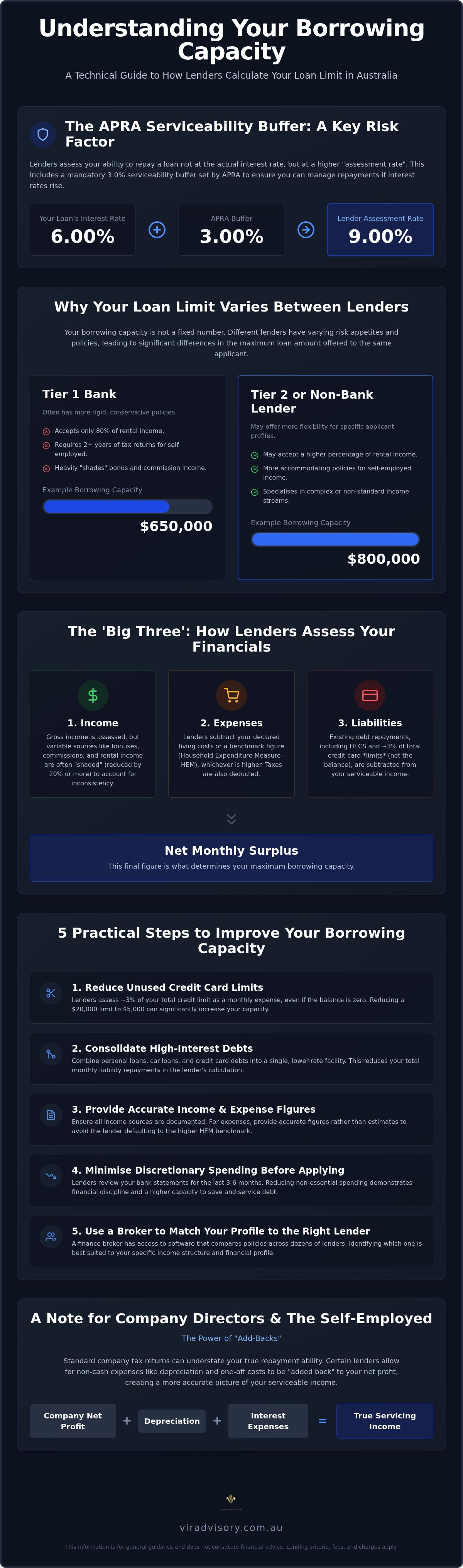
Lenders don't assess your application based on the interest rate you'll actually pay. Instead, they apply a 3% serviceability buffer as mandated by APRA. If you apply for a loan at a competitive 6% variable rate, the lender assesses your capacity to repay at 9%. This buffer, combined with a "floor rate" that acts as a minimum assessment level, prevents over-borrowing during periods of low interest rates. For a professional or business owner, this 3% gap can represent a significant reduction in total funding. It's a risk management tool designed to ensure you can still manage repayments if the RBA increases the cash rate in the future.
Why Capacity Varies Between Lenders
Your borrowing capacity isn't a static number across the industry. Tier 1 banks often maintain rigid policies regarding income types, such as only accepting 80% of rental income or requiring two years of tax returns for self-employed applicants. Tier 2 and non-bank lenders might offer more flexibility, which can lead to variations of $100,000 or more in borrowing limits for the same applicant. These differences stem from varying risk appetites and internal funding structures. One lender might be conservative with business directors while another specialises in complex income streams. Matching your financial profile to the right credit policy is the most effective way to optimise your total facility limit.
The Big Three: Income, Expenses, and Liabilities
Lenders use a formulaic approach to assess your financial stability by categorising your financial profile into three distinct pillars: income, expenses, and liabilities. Understanding how banks calculate borrowing capacity requires a look at how these pillars are weighted. While you might see your total salary as your primary driver, credit teams apply specific discounts to different income streams to account for potential volatility. This conservative approach ensures that your loan remains manageable even if your circumstances fluctuate.
Income Shading and Rental Yields
Lenders rarely accept 100% of your total earnings if they come from variable sources. Shading is a risk management tool used by credit teams to discount income that isn't guaranteed, such as bonuses, commissions, or overtime. Typically, banks only count 80% of your rental income to allow for maintenance costs and vacancy periods. For investors, the impact of negative gearing is also factored in, as it can reduce your taxable income while simultaneously increasing your out-of-pocket costs. If you receive a significant portion of your pay via bonuses, some lenders might only recognise 50% to 80% of that figure, which directly lowers your borrowing capacity.
Understanding the HEM Benchmark
When assessing your living costs, banks use the Household Expenditure Measure (HEM) as a baseline. This benchmark estimates the standard cost of living based on your location, family size, and number of dependants. Even if you live a frugal lifestyle, banks will usually adopt whichever is higher: your actual declared expenses or the HEM floor. This means having more children or a non-working spouse mathematically reduces your borrowing limit, as the lender assumes a higher non-discretionary spend to maintain the household. If your actual expenses are significantly higher than the HEM, perhaps due to private school fees or luxury memberships, the bank will use those higher figures instead.
The "Credit Card Trap" remains a common obstacle for many applicants. Lenders assess your credit cards based on the total limit rather than the balance you owe. A $10,000 limit might be assessed as a $300 to $400 monthly commitment, regardless of whether you pay the balance in full every month. Similarly, HECS or HELP debt is a significant factor. Unlike other debts, HECS is deducted from your gross income, reducing your net take-home pay and your serviceability surplus. If you are unsure how your specific debt profile affects your position, you can discuss your current liabilities with a specialist to see which limits should be reduced before you lodge a formal application.
Lender Assessment Criteria for Business Owners and Investors
Self-employed individuals often find that their borrowing capacity is calculated differently compared to PAYG employees. While a standard employee is assessed on their gross salary, a business owner’s income is determined by the net profit of their trading entity. Most major Australian lenders adhere to the "two-year rule," which involves averaging the last two years of taxable income to ensure stability. However, certain lenders specialise in "one-year" assessments, accepting the most recent year's figures if the business has shown consistent growth. This flexibility is essential for directors who have recently scaled their operations or transitioned from a salary to a dividends-based structure.
Company directors can often boost their serviceability by identifying "add-backs" during the application process. These are non-cash expenses or one-off costs that reduced your taxable profit but don't impact your actual repayment ability. Common examples include:
- Depreciation on equipment, vehicles, or property.
- One-off professional fees, such as legal costs or rebranding expenses.
- Interest paid on existing business loans that are being refinanced or closed.
- Extraordinary personal superannuation contributions above the mandatory limit.
The logic behind commercial lending differs fundamentally from residential assessments. In residential finance, the focus remains on your personal ability to service debt from your after-tax income. In contrast, commercial assessments often prioritise the "Debt Service Coverage Ratio" (DSCR). This looks at whether the business’s cash flow or the property’s rental income can cover the loan repayments by a specific margin, often 1.2 to 1.5 times. Strategic use of commercial property finance allows business owners to leverage their own lease payments to secure a facility, effectively using their business as the primary security for growth.
Self-Employed Income Verification
Business owners have two primary pathways for income verification: Full Doc and Alt Doc. Full Doc applications require two years of personal and company tax returns to provide a comprehensive view of your financial health. For those with complex tax structures or recent changes in income, Alt Doc options allow for verification via Business Activity Statements (BAS) or an accountant's declaration. While Alt Doc loans may carry slightly higher interest rates, they provide essential funding solutions when traditional tax returns don't reflect current cash flow or recent business success.
Investment Property Portfolios
Managing an investment portfolio requires a deep understanding of how lenders "stress" existing debt. When you apply for a new loan, the lender doesn't just look at your actual repayments. They assess all existing debts at a higher assessment rate, typically around 9%. This can quickly exhaust your borrowing capacity if your portfolio isn't structured correctly. The benefits of refinancing can be significant here, as it allows you to consolidate debt or unlock equity to fund your next acquisition. Lenders also calculate "Net Rental Income" by shading the gross rent by 20% to account for management fees and vacancies, ensuring the property remains self-sustaining under stress.
5 Steps to Improve Your Borrowing Capacity
Increasing your borrowing capacity requires a proactive approach to your financial presentation. It isn't just about earning more; it's about reducing the friction points that lenders identify during their credit assessment. Small adjustments to your debt profile can lead to significant increases in your total loan limit. By refining your financial position before you apply, you can often secure a much higher facility than a generic online calculator suggests.
- Step 1: Reduce or close unused credit card limits. Lenders assess the full limit as a monthly commitment, regardless of whether you pay the balance in full each month.
- Step 2: Consolidate high-interest personal loans or car finance. Moving multiple small debts into a single, lower-interest structure can drastically improve your monthly surplus income.
- Step 3: Review and optimise your discretionary spending three months before applying. Banks scrutinise your recent bank statements to verify your actual living costs against the HEM benchmark.
- Step 4: Ensure all income sources are documented and consistent. Providing 12 months of overtime or allowance history prevents lenders from shading these variable earnings.
- Step 5: Consult a broker to identify lenders with favourable policies for your specific profession or business structure.
Debt Consolidation as a Capacity Tool
Moving a high-repayment car loan into a mortgage structure is a common strategy to free up monthly cash flow. Because mortgage repayments are spread over 30 years at lower interest rates, the impact on your serviceability is substantial. However, you must consider the risks of paying long-term interest on short-term debt. Lenders calculate the "Monthly Commitment" by applying a specific percentage of the debt's limit or the actual monthly repayment to your expenses to ensure you aren't over-leveraged.
Professional Packages and LMI Waivers
Certain professions, such as doctors, lawyers, and accountants, have access to exclusive lender deals that aren't available to the general public. These packages often allow for a 90% Loan-to-Value Ratio (LVR) without the need for Lenders Mortgage Insurance (LMI). Waiving LMI can save you tens of thousands of dollars and preserve your cash for other investments. Identifying these industry niches is critical, as some lenders are far more aggressive with their capacity calculations for high-income professionals with stable career trajectories.
Navigating Approval Requirements with VIR Advisory
Walking into a local bank branch provides access to only one set of credit policies, which may not align with your specific financial profile. VIR Advisory utilises a sophisticated software panel to assess your borrowing capacity across dozens of Tier 1, Tier 2, and non-bank lenders simultaneously. This comparison is essential because, as established, different lenders apply varying shades to income and different benchmarks for living expenses. By accessing a broad range of funding solutions, we can identify which institution's formula provides the most favourable outcome for your circumstances.
Raina Doshi brings 15+ years of banking and finance experience to the assessment process. This depth of knowledge allows us to identify non-standard approval pathways that a standard bank officer might overlook, particularly for company directors and self-employed professionals with complex tax structures. We focus on the technical precision of your application, ensuring that "add-backs" and variable income streams are presented in accordance with specific lender requirements. This methodical approach ensures that your application is positioned for a high probability of approval from the outset.
A pre-submission assessment is a critical component of our service. We conduct a thorough review of your financial position before any formal application is lodged with a lender. This proactive step protects your credit file from unnecessary marks that can occur when an application is rejected due to a policy mismatch. Our goal is to create a seamless experience where every technical variable is managed with professional oversight, allowing you to move forward with complete confidence in your funding position.
Personalised Finance Strategy
We move beyond generic online calculators to develop a bespoke lending framework tailored to your professional or investment goals. Our team manages every stage of the application process, providing professional oversight from the initial inquiry through to final settlement. This ensures that your loan structure remains stable and supports your long-term finance strategy. To understand more about our methodology and professional background, you can read more about us here.
Next Steps for Your Application
To begin a formal assessment, you should gather your "finance-ready" documents. Having these items organised allows for a more accurate calculation of your current standing. We recommend preparing the following:
- Your two most recent payslips and your latest PAYG summary.
- Two years of personal and company tax returns if you are self-employed.
- The most recent six months of Business Activity Statements (BAS).
- Current statements for all existing credit cards, personal loans, and mortgages.
Once your documents are ready, we recommend scheduling a strategy session to review your debt management and current loan structures. When you are ready to identify the right lender for your specific profile, you can submit an enquiry for a comprehensive capacity assessment.
Optimising Your Position for Lender Approval
Understanding that your borrowing capacity is a variable outcome of specific credit policies rather than a fixed number allows you to take control of your financial presentation. By proactively addressing the 3.0% serviceability buffer and managing liabilities like credit card limits before you apply, you can significantly influence the final assessment result. VIR Advisory brings 15+ years of banking expertise to every application, specialising in the complex income and company structures often used by business owners and professionals. With access to a broad panel of Australian lenders, our team ensures your income is weighted correctly and your debt is structured for long-term stability.
Navigating the technical variables of the Australian lending market requires precision and a deep understanding of current regulatory requirements. Whether you're looking to unlock equity for an investment or secure funding for a new commercial property, matching your profile to the right lender is the most effective way to achieve a favourable outcome. With a methodical approach and professional oversight, you can move forward with complete clarity and confidence.
Frequently Asked Questions
How much can I borrow for a home loan in Australia?
Most lenders allow you to borrow between five and six times your gross annual income, though this is subject to the 3.0% serviceability buffer required by APRA. For a single applicant earning $100,000 with minimal debt, this might equate to a loan of approximately $500,000 to $600,000. However, your specific borrowing capacity depends on your living expenses, dependants, and existing liabilities like credit cards or personal loans.
Does a credit card limit affect my borrowing capacity if the balance is zero?
Yes, lenders assess the total credit limit rather than your actual balance. A $10,000 credit card limit is typically calculated as a monthly repayment of approximately $300 to $400, even if you never use the card. This perceived liability directly reduces your net monthly surplus, which in turn lowers your total loan facility. Closing unused cards or reducing their limits is a practical strategy to improve your financial position before applying.
Can I increase my borrowing capacity by closing personal loans?
Closing personal loans or car finance is one of the most effective ways to increase your borrowing capacity. Lenders view the monthly repayments on these short-term debts as significant commitments that reduce your ability to service a mortgage. By removing a $500 monthly personal loan payment, you could potentially increase your borrowing limit by tens of thousands of dollars, as that cash flow is redirected toward your home loan serviceability.
How do lenders calculate borrowing capacity for self-employed borrowers?
Lenders typically calculate capacity for self-employed borrowers by averaging the net profit from the last two years of tax returns. They may also consider "add-backs" such as depreciation, one-off expenses, or additional superannuation contributions to provide a more accurate reflection of your true income. Some specialist lenders may offer Alt Doc options or use only the most recent year's profit if the business has shown substantial and consistent growth.
Does HECS/HELP debt reduce how much I can borrow?
HECS or HELP debt significantly reduces your borrowing capacity because it lowers your net take-home pay. Lenders don't view it as a standard percentage-based debt; instead, they deduct the mandatory repayment amount from your gross income based on your salary bracket. This reduction in disposable income means you have less surplus cash to put toward mortgage repayments, which leads to a lower maximum loan approval from the credit team.
What is the maximum debt-to-income ratio lenders allow?
APRA restricts authorised deposit-taking institutions to issuing no more than 20% of their new residential lending to borrowers with a debt-to-income (DTI) ratio of six or more. While some lenders may still consider a DTI above six in exceptional circumstances, most prefer to stay below this threshold to manage risk. A DTI of seven or eight is generally considered high risk and may lead to a direct rejection unless there are significant mitigating factors.
How often should I review my borrowing capacity?
You should review your capacity every six to twelve months or whenever your financial circumstances change. Significant life events, such as a salary increase, a new job, or the birth of a child, will alter your serviceability profile. Additionally, changes to the RBA cash rate or APRA's serviceability buffers can impact your position. Regular reviews ensure your finance strategy remains aligned with current lender policies and broader economic shifts in the Australian market.
Why do different banks give me different borrowing estimates?
Different banks use unique credit policies and risk appetites to assess your application. One lender might shade your bonus income by 20% while another shades it by 50%. Similarly, variations in how banks calculate living expenses using the Household Expenditure Measure (HEM) or how they treat rental yields can result in differences of $100,000 or more between estimates. Accessing a broad panel of lenders through a broker helps identify the institution most favourable to your profile.

Article by
Raina Doshi
Raina Doshi has worked in banking and finance since 2011, including experience with major Australian lenders. She helps homeowners, property investors, business owners and professionals secure and structure lending solutions across home loans, refinancing, commercial finance and business lending.
Areas of expertise include residential lending, investment property finance, debt recycling, commercial property finance, equipment finance, construction finance and strategic debt structuring.
Drawing on extensive banking and finance experience, Raina helps clients navigate lender requirements, improve borrowing outcomes and structure effective finance solutions.
Disclaimer
The information in this article is general in nature and does not take into account your personal objectives, financial situation or needs. Before acting on any information, consider whether it is appropriate to your circumstances and seek professional advice.


