

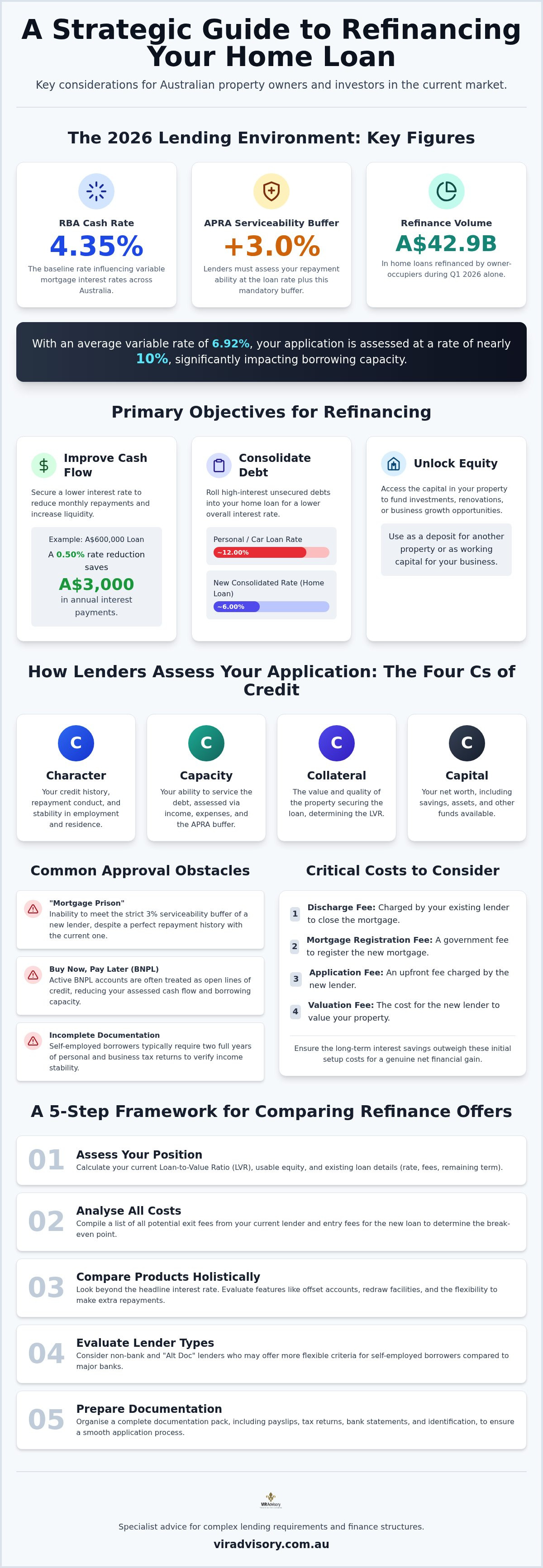
With over A$42.9 billion in home loans refinanced by owner-occupiers in the first quarter of 2026 alone, it's clear that Australian borrowers are no longer accepting the loyalty tax imposed by major lenders. You've likely noticed that rising interest rates, with the RBA cash rate holding at 4.35%, are placing significant pressure on your monthly cash flow and borrowing capacity. When you refinance home loan structures in this environment, you aren't just chasing a lower headline rate; you're executing a calculated move to reclaim liquidity and improve your overall financial position.
This guide provides the technical requirements and strategic frameworks needed to master the refinancing process and optimise your debt structure. We'll examine current APRA serviceability buffers, lender assessment criteria for self-employed professionals, and the mechanics of accessing equity for further investment. By the end of this analysis, you'll understand how to navigate the complex range of non-bank lending options and consolidate high-interest debt into a more efficient, cost-effective facility that supports your long-term commercial or residential objectives.
Key Takeaways
- Understand how the 4.35% RBA cash rate and APRA's 3.0% serviceability buffer dictate your borrowing capacity when you refinance home loan facilities in 2026.
- Master the lender assessment criteria, specifically the "Four Cs", to improve your approval prospects as a self-employed borrower or company director.
- Identify the critical exit and entry costs, such as discharge fees and mortgage registration, to ensure your debt optimisation strategy delivers a genuine net financial gain.
- Implement a methodical framework for comparing non-bank lending options and "Alt Doc" solutions that offer more flexible terms than traditional major banks.
- Learn how to leverage existing home equity to consolidate high-interest debt or fund further property acquisitions through strategic finance structures.
Optimising Your Debt Structure: Why Refinance Your Home Loan in 2026?
What is refinancing? At its most fundamental level, it's the process of retiring an existing mortgage to establish a new facility with terms that better align with current market conditions or your specific financial objectives. In the current Australian climate, where the RBA cash rate remains at 4.35%, the primary motive to refinance home loan structures is to mitigate the impact of rising interest costs on your monthly cash flow. We recommend a comprehensive mortgage health check every 24 months. This ensures your debt structure hasn't become outdated compared to new market offers, which often feature rates 0.30% to 0.50% lower than those held by long-term existing customers.
Beyond simple rate reduction, refinancing serves as a tool for strategic capital management. For property investors and business owners, this process often involves unlocking equity to fund further acquisitions or provide essential business growth capital. By restructuring debt, you can ensure your finance facilities are not just a monthly expense, but a precisely tuned component of your broader investment strategy.
Improving Cash Flow and Reducing Interest Costs
Securing even a modest rate reduction can yield substantial results for your household budget. For instance, reducing the interest rate on a A$600,000 loan by 0.5% decreases your annual interest expense by A$3,000, which immediately improves your liquidity. Many borrowers who secured low fixed rates during the pandemic have recently transitioned to variable rates exceeding 6.90%. Deciding to refinance home loan facilities allows you to assess whether a new variable product or a short-term fixed rate, starting from 5.99% p.a. as of August 2026, offers better stability. While extending your loan term can further lower monthly commitments, it increases the total interest paid over the life of the loan. This requires a careful balance between immediate cash flow needs and long-term debt reduction.
Consolidating High-Interest Debt through Equity
Strategic refinancing often involves using accumulated property equity to restructure expensive unsecured debts. By rolling personal loans or vehicle finance, which may carry rates of 12% or higher, into a home loan at approximately 6%, you can significantly lower your total monthly debt servicing obligations. This approach is particularly effective for professionals and company directors looking to streamline their liabilities. However, this strategy carries the risk of converting a five-year debt into a 30-year commitment if you don't maintain a disciplined repayment schedule. Lenders typically require clear evidence of the debts being closed and will assess your capacity based on the consolidated total. They often limit the loan-to-value ratio (LVR) to 80% for these applications, though some non-bank lenders offer more flexibility for those with strong equity positions. You can view our full range of refinancing solutions to see how these structures are assessed.
How Lenders Assess Refinance Applications in the Current Market
Lenders apply a methodical lens to every application, focusing on the core pillars of character, capacity, collateral, and capital. When you apply to refinance home loan facilities, the most significant hurdle is often the Australian Prudential Regulation Authority (APRA) serviceability buffer. Lenders must assess your ability to repay at an interest rate at least 3.0 percentage points above the actual loan rate. With average variable rates sitting around 6.92% p.a., you're being assessed at nearly 10%, which can sharply contract your borrowing capacity compared to previous years. This requirement remains a primary reason why some borrowers find themselves in a "mortgage prison," unable to switch lenders despite having a perfect repayment history.
Beyond income, lenders scrutinise your credit file for any irregularities. Active "buy now, pay later" accounts are often treated as open lines of credit, which directly reduces your available cash flow in the lender's eyes. To explore your refinance options effectively, you'll need to present a professional documentation pack. For PAYG employees, this typically includes the two most recent payslips and a year-to-date income summary; self-employed borrowers generally require two years of personal and business tax returns to verify income stability.
Borrowing Capacity and Serviceability Ratios
Capacity is measured through the Net Serviceability Ratio (NSR), a calculation of your surplus income after all living expenses and debt obligations are met. Major banks often apply stricter expense benchmarks than non-bank lenders, who may offer more flexibility for complex income streams. If you hold investment properties, be aware that lenders "shade" rental income, typically only counting 80% of the gross rent to account for potential vacancies and management fees. To improve your prospects before an application, consider the following actions:
- Close unused credit cards and BNPL facilities to lower your total credit limits.
- Minimise discretionary spending for at least 90 days to provide a cleaner expense profile.
- Ensure all existing loan repayments are made on time without exception.
- Consolidate small, high-interest debts to improve your monthly surplus cash flow.
The Role of Property Valuation and LVR
The Loan-to-Value Ratio (LVR) is the fulcrum of your application. Crossing the 80% threshold usually triggers Lender's Mortgage Insurance (LMI), which can cost thousands of dollars and negate the financial benefits of switching. A "short valuation", where the bank's valuer assesses your home at less than your estimate, is a common obstacle in shifting markets. To prepare for a valuation, ensure the property is well-presented, provide a list of recent capital improvements, and have a record of comparable sales in your immediate area ready for the valuer. If you're concerned about how your current equity position affects your approval prospects, you can book a technical review to discuss your specific scenario.
Critical Costs and Approval Obstacles to Consider
While the motivation to refinance home loan facilities often stems from a desire to reduce costs, the transition itself requires an upfront capital outlay that must be quantified. To determine if a move is financially sound, you must calculate the breakeven point; this is the duration it takes for your monthly interest savings to exceed the total cost of switching lenders. A comprehensive guide to mortgage refinancing suggests that if you plan to sell the property or move within a short window, the setup costs may outweigh the interest benefits. Most standard variable refinances in Australia involve total costs between A$500 and A$2,000, assuming you remain under the 80% loan-to-value ratio (LVR) threshold.
Typical exit costs include discharge fees, which most major Australian banks set between A$350 and A$600 per loan account. You'll also face government charges, such as mortgage registration and deregistration fees, which vary by state but generally total around A$300 to A$400. If you're exiting a fixed-rate loan before the term expires, break costs can be significant. These are calculated based on complex formulas involving current market interest rates and can fluctuate daily, potentially reaching several thousand dollars if market rates have dropped since you locked in your loan.
Understanding Discharge Fees and LMI Risks
Lenders Mortgage Insurance (LMI) presents a significant hurdle if your property value hasn't increased or if you've borrowed more than 80% of the home's value. It's a common misconception that LMI is transferable; in reality, it's a policy that protects the specific lender, and you'll almost certainly need to pay a new premium if you switch institutions with an LVR above 80%. To avoid this, we recommend conducting a desktop valuation to confirm your current equity position before a formal application is lodged. Keeping your new loan amount within 80% of the property's bank-assessed value is the most effective way to ensure the refinance home loan process remains cost-effective.
Approval Obstacles for Self-Employed Borrowers and Directors
Self-employed individuals and company directors often face more rigorous assessment due to the perceived volatility of business income. Lenders typically require the two most recent years of personal tax returns and full financial statements for the trading entity to establish an income average. A key strategy for improving your position involves identifying "Add-backs". These are non-cash or one-off expenses, such as depreciation, one-off equipment purchases, or significant voluntary superannuation contributions, that can be added back to your net profit to demonstrate a higher borrowing capacity. For those with complex tax structures or only one year of trading history, alternative documentation (Alt-Doc) loans provide a solution, though these often require a larger deposit or a lower LVR limit to offset the lender's perceived risk.
A Step-by-Step Framework for Comparing Refinance Offers
Navigating the competitive lending market requires a structured approach to ensure you select a facility that enhances your financial position. When you look to refinance home loan structures, you should follow this five-step framework to identify the most efficient debt solution:
- Step 1: Conduct a mortgage health check. Review your current loan statement to identify your actual interest rate, annual fees, and which features you currently utilise.
- Step 2: Calculate equity and target LVR. Use a conservative desktop valuation to estimate your current equity. Aiming for a loan-to-value ratio (LVR) below 80% is critical for avoiding unnecessary LMI costs.
- Step 3: Focus on the comparison rate. Advertised headline rates can be deceptive. The comparison rate accounts for the interest rate plus most fees and charges, providing a truer reflection of the loan's cost.
- Step 4: Weigh features against fees. Many "professional packages" carry annual fees of approximately A$395. Ensure the interest savings from features like an offset account justify this ongoing cost.
- Step 5: Review future borrowing policy. Assess how the lender treats equity releases. Some institutions are more supportive of property investors looking to pull out capital for future acquisitions.
Fixed vs Variable Rate Structures for Professionals
Professionals often balance the need for repayment certainty with the desire for flexibility. Fixed rates provide a hedge against market volatility but typically restrict your ability to make large additional repayments or access offset accounts. Conversely, variable rates allow for full feature utility and generally do not carry break costs. A "Split Loan" strategy is a common risk management tool; by fixing a portion of your debt and leaving the remainder variable, you can secure a level of certainty while still using an offset account to reduce interest on the variable component. Before switching, always request a formal break cost quote if you are currently in a fixed term, as these costs can make a refinance home loan move unviable if they exceed the projected interest savings.
Essential Features: Offset Accounts and Redraw Facilities
While often used interchangeably, offset accounts and redraw facilities have distinct technical and tax implications. An offset account is a separate transaction account where the balance is subtracted from your loan principal before interest is calculated. A redraw facility allows you to withdraw extra repayments you've made directly into the loan. For property investors, redraw facilities can be problematic; withdrawing funds for personal use from an investment loan can change the loan's purpose, potentially impacting tax deductibility. Multiple offset accounts can be particularly useful for categorising savings for tax, business expenses, or renovations while ensuring every dollar works to reduce your interest expense.
Schedule a technical framework review
Strategic Finance Structures with VIR Advisory
VIR Advisory specialises in managing the technical nuances that define a successful refinance home loan application for clients with complex requirements. While major banks often rely on rigid automated scoring systems, our approach involves a detailed analysis of your debt architecture to ensure it supports your specific commercial or investment objectives. By accessing a broad panel of lenders, including non-bank institutions and specialist credit providers, we identify funding solutions that offer greater flexibility than standard retail products. This breadth of choice is essential for professionals and business owners whose income structures may not fit the narrow assessment criteria of traditional lenders.
Our methodology, informed by over 15 years of experience in the Australian banking and finance sector, focuses on precision and longevity. Managing the end-to-end application process requires more than just submitting paperwork; it involves pre-empting lender concerns and presenting a credit case that highlights your financial strengths. This proactive oversight ensures a smooth transition between facilities, allowing you to focus on your core business or investment activities while we handle the intricate negotiations with credit departments.
Navigating Complex Lending for Investors
Property investors often face significant restrictions due to cross-collateralisation, a common structure where multiple properties secure a single loan facility. This gives a single lender excessive control over your assets and can complicate future sales or equity releases. During a restructure, we prioritise "un-crossing" these assets to provide you with greater control and individual property portability. We also ensure that your loan accounts are structured to maintain a clear separation between private and investment debt, which is critical for protecting the tax deductibility of your interest expenses. This portfolio-wide debt optimisation is a standard part of our investment loan structuring service.
Next Steps: Securing Your Mortgage Health Check
A proactive review of your current lending is the first step toward reclaiming cash flow and improving your borrowing capacity. A professional assessment, particularly for self-employed borrowers or company directors, can reveal opportunities to lower your total interest burden and unlock capital for growth. We recommend a technical review of your facilities every 24 months to ensure you are not paying a loyalty tax to your current institution. You can submit your enquiry to begin a technical assessment of your current facilities. Our team, led by Raina Doshi, will evaluate your existing mortgage health and recommend a finance structure aligned with your long-term capital requirements.
Executing Your 2026 Debt Optimisation Strategy
Successfully executing a refinance home loan strategy in the current market requires a technical understanding of APRA serviceability buffers and a methodical approach to lender selection. By focusing on your net financial gain and managing the critical entry and exit costs, you can transition from restrictive facilities to more efficient debt structures that support your investment objectives. Securing a competitive outcome involves maintaining a clean credit profile and managing your loan-to-value ratio to avoid unnecessary LMI premiums. For professionals and company directors, aligning these structures with long-term capital requirements ensures your debt works as a strategic asset. Raina Doshi provides a national brokerage service with over 15 years of banking and finance experience, and her expertise in complex professional and investment structures ensures every detail of your application is handled with precision.
We look forward to helping you optimise your current lending arrangements and improve your total borrowing capacity through a professional mortgage health check.
Frequently Asked Questions
How long does the home loan refinancing process typically take?
Standard refinancing usually takes between two and four weeks from the initial application to the final settlement. If your situation involves complex company structures or multiple investment properties, the timeline can extend to six weeks. This period accounts for the property valuation, the new lender's credit assessment, and the time required for your existing bank to process the discharge of the mortgage. Ensuring all documentation is accurate before submission prevents unnecessary delays.
Can I refinance if I am self-employed with only one year of tax returns?
While major banks typically require two years of tax returns, you can refinance home loan facilities with only one year of income evidence through specialist lenders. These "Alt-Doc" solutions often rely on Business Activity Statements (BAS) or an accountant's declaration to verify your servicing capacity. Be aware that these products may carry slightly higher interest rates or require a lower loan-to-value ratio to offset the lender's perceived risk profile.
What is the difference between a basic variable loan and a full-feature loan?
A basic variable loan offers a lower headline interest rate but lacks flexible features like an offset account. In contrast, a full-feature loan, often part of a professional package, provides multiple offset accounts and redraw facilities for an annual fee, typically around A$395. For borrowers with significant savings, the interest saved through an offset account frequently outweighs the annual fee, making the full-feature option a more cost-effective choice for debt management.
Is it possible to refinance my home loan with a low credit score?
Refinancing with a low credit score is possible through non-bank lenders who specialise in non-conforming loans. These institutions assess your application based on your current income and equity position rather than relying solely on automated credit scoring. While the interest rates are generally higher than standard market offers, these facilities can serve as a short-term solution to consolidate debt and improve your credit profile over a twelve to twenty-four month period.
How much equity do I need in my property to refinance without paying LMI?
To avoid paying Lender's Mortgage Insurance (LMI), you generally need a loan-to-value ratio (LVR) of 80% or less, meaning you require at least 20% equity in the property. If your refinance home loan application exceeds this 80% threshold, the lender will likely charge a new LMI premium because these policies are not transferable. However, certain professionals, such as medical specialists, may be eligible for LMI waivers with as little as 10% equity.
Can I consolidate my business debt into my residential home loan?
You can consolidate business debt into a residential mortgage if you have sufficient equity and the lender's policy allows for business-purpose cash-outs. This strategy can significantly reduce your interest expense by moving debt from high-interest commercial facilities to a lower residential rate. It's essential to maintain separate loan splits for business and personal debt to ensure your accountant can accurately track tax-deductible interest and comply with all Australian Taxation Office requirements.
What happens to my fixed rate if I decide to refinance early?
If you exit a fixed-rate loan before the term expires, the lender will likely charge break costs to recover their perceived financial loss. These costs are calculated using a formula based on current market interest rates compared to the rate when you initially fixed the loan. Because these fees can reach several thousand dollars, you should always request a formal break cost quote before proceeding with a refinance to ensure the move remains financially viable.
Will refinancing my home loan affect my credit rating?
Applying to refinance home loan structures will trigger a "hard enquiry" on your credit report, which may cause a temporary, minor dip in your score. This is a standard part of the credit assessment process and is generally not a concern for borrowers with a strong repayment history. However, making multiple applications with different lenders in a short timeframe can signal financial stress and more significantly impact your credit rating in the long term.

Article by
Raina Doshi
Raina Doshi has worked in banking and finance since 2011, including experience with major Australian lenders. She helps homeowners, property investors, business owners and professionals secure and structure lending solutions across home loans, refinancing, commercial finance and business lending.
Areas of expertise include residential lending, investment property finance, debt recycling, commercial property finance, equipment finance, construction finance and strategic debt structuring.
Drawing on extensive banking and finance experience, Raina helps clients navigate lender requirements, improve borrowing outcomes and structure effective finance solutions.
Disclaimer
The information in this article is general in nature and does not take into account your personal objectives, financial situation or needs. Before acting on any information, consider whether it is appropriate to your circumstances and seek professional advice.


