

Paying cash for equipment may seem simple, but it can leave your business with less working capital for wages, stock and other operating costs. Finance equipment for business when the repayments fit your cash flow and the asset’s expected useful life, and you may preserve more cash for day-to-day needs.
Be cautious about judging affordability by a typical month. Revenue can fluctuate, and repayments still fall due when other costs arise. The right structure depends on the equipment, how long you expect to use it, the funding terms and your business’s capacity to repay.
This article compares equipment finance with paying cash, general business borrowing and leasing. It explains how chattel mortgages, finance leases and hire purchase can differ, what lenders may assess, and how to prepare an application. You’ll also find a checklist for comparing total costs, repayment terms and risks before committing.
Key Takeaways
- Match equipment finance repayments to expected cash flow and the period the asset is likely to remain useful.
- Compare equipment finance, cash, general business borrowing and leasing by ownership, security, flexibility and repayment commitments.
- Before applying, organise the equipment details, supplier quote, cash flow information, current debts and repayment estimates.
- Trading history, financial records, credit profile and asset details may affect lender assessment. Criteria vary between lenders.
- A finance broker can assess equipment funding alongside broader business lending needs, but cannot guarantee approval or specific terms.
Finance equipment for business: what it covers and when it may fit
Equipment finance is funding used to acquire business equipment, subject to lender policy and the facility terms. Instead of paying the full purchase price from cash reserves, a business repays the amount over an agreed term. This may leave more cash available for operating needs, but it also creates a debt commitment and borrowing costs.
In brief: equipment finance is generally linked to the purchase of an asset. A cash purchase uses existing funds, while a general business loan may provide funds for a wider range of purposes. Security and ownership arrangements depend on the facility and contract.
In a chattel mortgage, the asset is generally owned by the business and used as security for the loan. Under a finance lease, the financier generally owns the equipment during the lease term. Hire purchase arrangements commonly transfer ownership after the required payments are made. The contract sets out the actual ownership, security and end-of-term obligations, so check those terms rather than relying on the product name. For an overview of a chattel mortgage, see this reference.
This video discusses equipment finance in Australia:
What types of business equipment might be financed?
Examples may include a work vehicle, production machinery or specialised equipment used to deliver a service. These are productive assets acquired for business operations, rather than general funds for wages, rent, stock or other working capital needs. VIR Advisory offers equipment finance as part of its broader business finance services.
Not every asset or application will meet a lender’s criteria. Eligibility can depend on the asset’s type and condition, its intended use, the supplier and the proposed facility. A used machine, for example, may be assessed differently from new equipment. Clear asset details and a supplier quote help define what the funding is for.
When could equipment finance be worth considering?
Consider how directly the equipment supports business activity, how long it is expected to remain useful and when the business receives income. A delivery vehicle that enables regular work has a clear operational role. Financing may help avoid using a large share of available cash upfront, while repayments can be planned against expected income.
However, retaining cash does not remove the purchase cost. Repayments continue if revenue dips or the equipment is used less than expected. Compare the proposed term with the asset’s expected service life, and consider whether the business could face maintenance or replacement costs before the finance is repaid.
Lenders may assess established businesses and newer enterprises differently, depending on the information available and their eligibility criteria. Consider both the asset’s business use and whether repayments remain manageable under less favourable cash-flow conditions. A common mistake is to base the decision on projected extra revenue alone, without checking whether existing income can support the repayments if that revenue takes time to arrive.
How equipment finance works: repayments, security and ownership
After identifying the equipment, the business applies for a facility and the lender assesses the proposal. If approved, the agreement sets out the amount financed, repayment schedule, security arrangements and ownership terms. These vary by lender and structure, so review the complete obligations rather than judging an offer by its repayment amount alone.
Regular repayments spread the purchase cost over time and may leave more cash available for wages, suppliers and other operating needs than a cash purchase. But finance does not make the asset cheaper: repayments, interest and any applicable fees remain business obligations. A lender may assess the business’s financial position and the equipment details as part of the application.
What happens between applying and receiving equipment finance?
The process usually involves defining the equipment need, providing application information, undergoing lender assessment and reviewing the proposed terms. A lender may request financial information about the business and details of the asset, such as its type, condition and purchase documentation. Requirements differ by lender and application, so another business’s process or outcome is not a reliable guide to yours.
Before accepting an offer, check whether the repayment schedule fits the timing of business income. Consider the total obligations and the effect of existing debts, not just whether the instalment appears manageable in a typical month.
How do security and ownership depend on the finance structure?
The facility terms determine how repayments, security and ownership apply. Some arrangements use the financed asset as security, while ownership rights can vary across structures and over the term. Read the contract to confirm what security is granted, who owns or controls the asset, which fees apply, what repayments are due and what happens at the end of the agreement. Do not assume every equipment finance facility works like a cash purchase.
Equipment finance at a glance
- 1. Select the asset: Define the business need and gather accurate equipment details.
- 2. Apply: Provide the lender’s requested business and asset information.
- 3. Review assessment: The lender considers the application against its criteria.
- 4. Check facility terms: Confirm repayments, security, ownership and end-of-term obligations.
- 5. Monitor cash flow: Review repayments alongside operating costs and income as circumstances change.
Equipment finance compared with cash, business loans and leasing
When financing equipment for business use, compare more than the repayment amount. Consider the effect on available cash, who owns or uses the asset, what security is required and what obligations apply over the term. Terms vary by lender and contract, so use this comparison as a starting point and check the specific offer.
| Option | Cash-flow impact | Ownership and security | Flexibility and obligations |
|---|---|---|---|
| Equipment finance | Spreads the cost into repayments, which may help retain cash for operations. | Ownership and security depend on the facility structure and contract. | Repayments, interest, fees and other terms apply. Flexibility depends on the agreement. |
| Cash purchase | Avoids finance repayments but uses reserves that may be needed elsewhere. | The business buys the asset outright, without a loan secured against it. | There is no finance contract, but funds spent are no longer available for other needs. |
| General business borrowing | Can fund broader business needs, with repayments due under the loan terms. | Security may vary according to the loan and lender’s requirements. | Funds may be used for different business purposes, but the borrowing remains repayable. |
| Leasing | Usually involves payments over an agreed period rather than an upfront cash purchase. | The lessor may retain ownership during the term. The contract sets out use and end-of-term arrangements. | Payments and end-of-term obligations depend on the lease terms. |
Equipment finance or paying cash: what changes for cash flow?
Hypothetical example: A business needs equipment before its busiest trading period. Paying cash avoids a new loan and its borrowing costs, but reduces reserves available for suppliers, wages or unexpected expenses. Financing may preserve more cash initially, but creates scheduled repayments and may add interest and fees.
The better fit depends on when revenue is expected, which other commitments fall due and how much cash the business needs to keep accessible. Do not compare the cash purchase with finance using only the upfront amount. Consider the full contractual cost and whether repayments remain manageable if income arrives later than expected.
Equipment finance, business loans or leasing: how do they differ?
Equipment finance is arranged to acquire an asset, while general business borrowing can fund a wider range of needs. Leasing provides use of equipment under a contract, with ownership and end-of-term arrangements set out in its terms. Security can differ between facilities. Before committing, check fees, repayments, early exit provisions and what happens at the end of the term. Also consider whether payments could continue after the asset’s usefulness or value has declined.
How to prepare for equipment finance and improve application readiness
A well-prepared application connects the equipment purchase to the business’s capacity to repay. Before applying to finance equipment for business use, set out what the asset is, how it will be used and how repayments fit alongside existing commitments. Preparation can help reduce avoidable questions, but it cannot guarantee approval or a particular facility.
What may lenders assess for equipment finance?
Lenders may consider the business’s financial performance, trading history, current liabilities and capacity to meet the proposed repayments. They may also assess the asset’s details and suitability for the facility, along with any security being offered. Assessment criteria and information requirements vary between lenders and applications.
Repayment capacity needs to be considered alongside the business’s other commitments, not in isolation. This Australian borrowing capacity guide explains how lenders can assess the ability to service borrowing.
Which preparation steps can help address common approval obstacles?
Inconsistent financial records can make it harder to assess business performance. An unclear explanation of the equipment’s purpose can also leave the funding request difficult to evaluate. Existing debts matter too: proposed repayments need to fit alongside them, using realistic cash-flow expectations rather than an optimistic forecast.
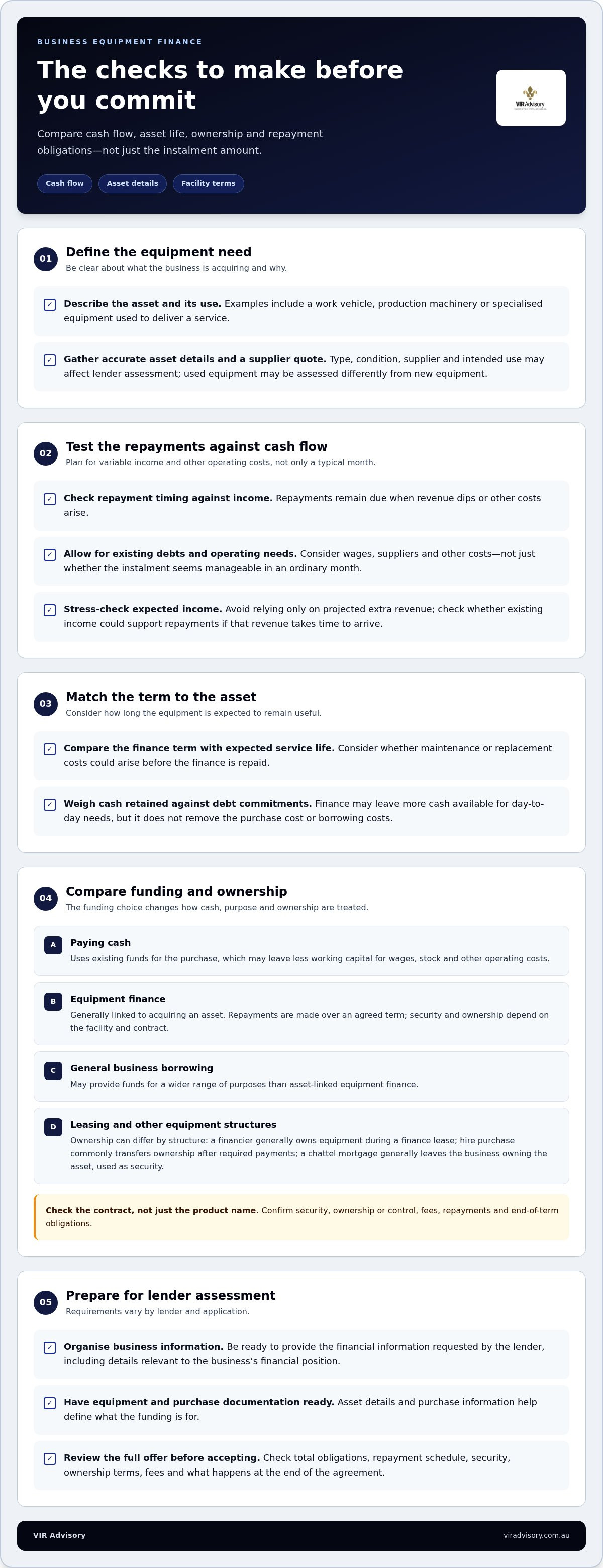
Consistent financial records and a clearly defined asset purpose make an application easier to assess. Use this checklist to organise the information and review key terms before signing.
Equipment finance application checklist
- Application information: Gather current business financial records, trading details, a supplier quote and accurate asset information. Explain what the equipment will do in the business.
- Lender assessment factors: Be ready to discuss financial performance, existing debts, repayment capacity, credit profile, trading history and asset suitability. The lender’s criteria determine what applies to your application.
- Before signing: Compare proposed repayments with cash flow after existing commitments. Check the security, fees, repayment obligations and any conditions that apply at the end of the facility.
Check that the records present a consistent picture of the business and that the asset’s purpose is specific. For example, explain how a machine will be used in production rather than stating only that it is needed for growth. Review repayments against cautious cash-flow expectations, including periods when income may be lower or expenses higher. If the figures look tight, reconsider the funding amount or proposed structure before committing.
How VIR Advisory can help assess business equipment finance
Choosing how to fund equipment involves more than comparing repayments. A finance broker can consider the asset, the business’s cash flow and existing borrowing together, then assess lender options that may fit the application. VIR Advisory connects businesses with lenders and does not lend directly. Approval and facility terms depend on the lender’s assessment.
Led by Raina Doshi, VIR Advisory brings over 15 years of banking and finance experience to equipment finance and broader business lending discussions. This experience is relevant when considering how an equipment facility may sit alongside other business commitments and what financial information could support an application. It does not guarantee approval or a particular outcome.
What to expect from a finance brokerage discussion
A discussion can clarify what equipment the business needs, how the asset will be used and what the funding is intended to achieve. For example, the focus may be on preserving operating cash, replacing essential equipment or assessing proposed repayments alongside other business debt. These details help define the funding requirement clearly.
A broker can then review relevant lender options and explain differences in facility structure, security and repayment obligations. Comparing those terms can help identify what information may be needed for an application and whether a proposed structure fits the business’s requirements. See VIR Advisory’s business and equipment finance services for related information.
What information can help make the discussion useful?
Having the core details ready can make it easier to assess the request. Consider gathering:
- Equipment details and a supplier quote, if available.
- Current business financial information and a summary of expected cash flow.
- Details of existing loans and other repayment commitments.
- A concise explanation of the equipment’s role in business operations.
This information connects the asset to the business’s financial position and provides context for considering repayment capacity. Be clear about expected changes in revenue or operating costs that could affect cash flow. If the business has broader funding needs, assessing equipment finance alongside those commitments can provide a more complete view of the funding requirement.
Any facility remains subject to lender assessment, eligibility criteria and agreed contract terms. Before proceeding, review the proposed repayments, security and other obligations carefully, and consider whether they remain manageable alongside existing commitments. The consultation link below is available for businesses considering equipment finance.
Choose equipment finance that fits your cash flow
Deciding how to finance equipment for business use means weighing the effect on working capital against the cost and obligations of borrowing. Equipment finance can spread payments and preserve some cash reserves, while paying cash avoids a new loan but reduces funds available for other operating needs. Business loans and leasing work differently, so compare ownership, security, repayment commitments and end-of-term conditions before deciding.
Repayment fit matters as much as the asset itself. Review the equipment’s expected use, the timing of business income and existing debts. Prepare clear financial information and explain the asset’s role in operations. Lender assessment criteria vary, and approval and terms depend on the lender.
VIR Advisory is a finance brokerage that arranges funding through a lender network, not a direct lender. Raina Doshi brings over 15 years of banking and finance experience to assessing equipment funding needs alongside broader business lending requirements.
To compare equipment finance options with your cash flow and existing commitments, book a 30-minute finance consultation with VIR Advisory.
Frequently Asked Questions
Can a business finance equipment without paying the full cost upfront?
Yes. Equipment finance can let a business spread the purchase cost through repayments instead of paying the full amount from cash reserves upfront. The amount financed, any contribution required and repayment schedule depend on lender assessment and facility terms. This may preserve cash for operating expenses, but borrowing adds repayment obligations and may involve interest and fees. Check the full cost and commitments before accepting an offer.
What equipment can a business finance in Australia?
Businesses may be able to finance assets such as work vehicles, production machinery or specialised equipment used in their operations. Eligibility is not automatic: it can depend on the asset type and condition, lender policy and proposed facility. A supplier quote and explanation of how the item will be used help define the request. General working capital, such as funds for wages or stock, is a different funding need.
How do lenders assess an equipment finance application?
Lenders may review the business’s financial information, trading history, current liabilities and capacity to meet repayments. They may also consider the asset details, its suitability for the facility, the applicant’s credit profile and any security offered. Requirements differ between lenders, so prepare accurate records and a realistic view of cash flow. A clear explanation of the equipment’s purpose helps show how the asset relates to business operations.
Is equipment finance better than using business cash?
Neither option is automatically better. Paying cash avoids a new loan and its borrowing costs, but reduces reserves available for wages, suppliers and unexpected expenses. Equipment finance can retain some working capital, but creates scheduled repayments and may add interest and fees. Compare the finance terms with existing debts, expected revenue timing and available reserves. Then assess whether repayments remain manageable if cash flow is weaker than expected.
Can a new business get equipment finance?
A new business can apply, but approval depends on the lender’s criteria and assessment. A shorter trading history may mean less operating information is available, so lenders may consider the financial details provided, existing commitments, repayment capacity, credit profile and asset information. Prepare a clear account of how the equipment will be used and how repayments could be met. Approval and terms are not guaranteed.
What should I check before signing an equipment finance agreement?
Read the agreement carefully before committing. Confirm the repayment amount and schedule, total obligations, applicable fees, security arrangements and who owns or controls the asset during the term. Check early exit provisions and end-of-term conditions, as these vary by facility. Compare repayments with business cash flow and existing debt commitments. If a term is unclear, get an explanation before signing rather than relying on assumptions.

Article by
Raina Doshi
Raina Doshi has worked in banking and finance since 2011, including experience with major Australian lenders. She helps homeowners, property investors, business owners and professionals secure and structure lending solutions across home loans, refinancing, commercial finance and business lending.
Areas of expertise include residential lending, investment property finance, debt recycling, commercial property finance, equipment finance, construction finance and strategic debt structuring.
Drawing on extensive banking and finance experience, Raina helps clients navigate lender requirements, improve borrowing outcomes and structure effective finance solutions.
Disclaimer
The information in this article is general in nature and does not take into account your personal objectives, financial situation or needs. Before acting on any information, consider whether it is appropriate to your circumstances and seek professional advice.


