

Can an SMSF borrow to buy a commercial property? Yes. An SMSF can use a limited recourse borrowing arrangement (LRBA) to acquire eligible business real property, subject to superannuation rules and lender criteria. With SMSF lending Australia, the property is generally held in a separate holding trust until the loan is repaid. That structure affects ownership and the lender’s rights, so the arrangement is different from a standard investment loan in the fund’s name.
Approval depends on more than the deposit and repayments. Lenders may assess the property, the fund’s financial position and the loan structure. Before committing, compare expected rent with repayments, contributions, cash reserves and ongoing property costs. Also consider compliance requirements, including commercial terms for related-party leases, and whether members may be asked to provide personal guarantees. These checks help you understand the risks and requirements before using fund assets to buy property.
Key Takeaways
- SMSF lending Australia involves fund-specific borrowing rules and lender policies. Review current requirements before committing to a purchase.
- Map the roles of the SMSF trustees, lender and any holding trust, then prepare the fund and property information a lender may request.
- Weigh potential investment benefits against added complexity, concentrated exposure and the effect repayments can have on fund liquidity.
- Use a readiness check to clarify the purchase purpose, review the fund’s position, test cash flow and organise application documents.
- VIR Advisory can help organise finance information and compare lender requirements for an SMSF lending application.
What SMSF lending in Australia means for a fund and its members
An SMSF may borrow only within applicable superannuation rules and a lender’s criteria. As at October 2026, new limited recourse borrowing arrangements (LRBAs) can still be used to acquire eligible business real property, while new LRBAs for residential property are not permitted. Existing residential LRBAs are not affected by that change.
SMSF lending is finance arranged by the fund’s trustee to acquire an asset for the fund, generally using a separate holding trust under an LRBA. It is not a personal investment loan taken out by a member. The borrower, property ownership arrangements and permitted purpose all matter. Lender approval is separate from compliance with superannuation rules.
What is an SMSF loan and who borrows?
An SMSF isn’t a separate legal person in the same way an individual is. The fund’s trustee, or corporate trustee, generally enters into the borrowing arrangements in its capacity as trustee of the SMSF. Members are not automatically the borrowers because they belong to the fund, although a lender may require personal guarantees as part of its credit conditions.
That distinction matters if the fund cannot meet repayments. An LRBA limits recourse to the asset acquired under the arrangement, but a personal guarantee may expose a guarantor’s personal assets if the borrower defaults. The precise obligations depend on the loan documents and lender terms. The same structure may not suit every fund, property or purchase.
How an LRBA is generally described
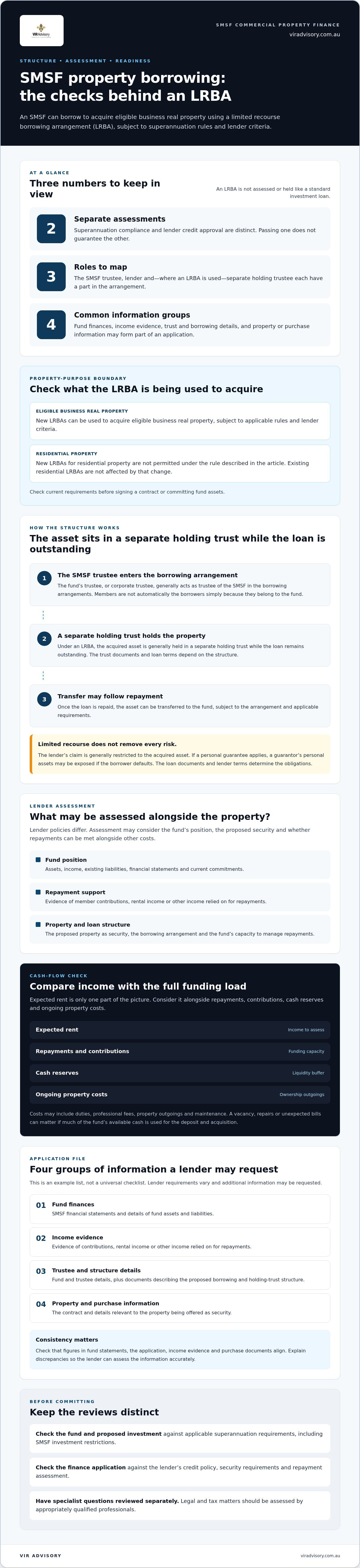
Under an LRBA, the asset is held in a separate holding trust while the loan remains outstanding. The SMSF makes payments towards the borrowing and, once the loan is repaid, the asset can be transferred to the fund, subject to the arrangement and applicable requirements. The limited-recourse feature generally restricts the lender’s claim against the SMSF to the asset acquired with the loan. It does not remove every risk, particularly if guarantees apply.
For example, an SMSF seeking to buy commercial premises needs to consider whether the property and its proposed use meet the relevant rules, how the holding trust will be established and whether the fund can meet lender requirements. Loan approval does not establish that the arrangement is compliant, and compliance does not guarantee finance.
The trust documents, loan terms and superannuation rules interact. Have legal and tax questions assessed independently by appropriately qualified professionals. Review current rules and lender policy before signing a contract or committing fund assets.
How an SMSF property loan is structured and assessed
An SMSF property loan application may involve the fund’s trustee, the lender and, where an LRBA is used, a separate holding trustee. The SMSF trustee acts for the fund, while the holding trustee holds the property under the borrowing arrangement. The legal roles and documents depend on the structure, so have them reviewed before signing a contract.
Superannuation compliance and lender credit approval are separate assessments. Lender approval does not confirm that an arrangement meets SMSF rules, and compliance does not guarantee loan approval. Assess the fund’s proposed investment against applicable requirements, including the ATO SMSF investment restrictions. Separately, the lender assesses the application under its own credit policy.
What may lenders assess?
Assessment varies by lender, but may cover the fund’s assets, income, existing liabilities and cash flow. A lender could review financial statements, evidence of member contributions or rental income, and current fund commitments. It may also assess the proposed property as security, the loan structure and the fund’s capacity to meet repayments alongside other expenses.
Projected rent may support a repayment assessment, but the fund also needs liquidity for settlement costs and ongoing ownership expenses. These may include duties, professional fees, property outgoings and maintenance. If most available cash goes towards the deposit and acquisition, the fund may have little left to manage a vacancy, repairs or unexpected bills.
Which documents may form part of an application?
Depending on lender requirements, an application may call for:
- SMSF financial statements and details of fund assets and liabilities
- Evidence of contributions, rental income or other income relied on for repayments
- Trustee and fund details, plus documents describing the proposed borrowing and holding-trust structure
- Property and purchase information, such as the contract and details relevant to the security
This is an example list, not a universal document checklist. Policies differ, and lenders may request additional information. Check that figures in the fund statements, application, income evidence and purchase documents align. If an amount or liability is recorded differently, explain the discrepancy so the lender can assess the information accurately.
Organising complete, consistent finance information helps clarify what a lender needs to assess. It does not replace legal, tax or accounting advice about the fund, property or structure. Keep those specialist reviews separate from the lender’s credit assessment.
SMSF lending benefits, limitations and the risks trustees should weigh
Borrowing may allow an SMSF to acquire an eligible property without using existing cash to fund the full purchase price. It also adds debt, costs and structural requirements. Whether that trade-off suits the fund depends on its investment approach, repayment capacity and ability to retain enough liquidity for other obligations. SMSF lending Australia is not automatically suitable just because a lender is prepared to consider an application.
A commercial property may provide rental income to the fund, including, in some cases, rent from a related business on commercial terms. But income is not guaranteed, and borrowing does not guarantee stronger returns. Repayments continue if the property is vacant, rent is delayed or repairs are needed. The fund must also meet its other expenses, so using most available cash for a purchase can leave little room for unexpected outgoings.
When might borrowing warrant closer consideration?
First, check whether the proposed property and borrowing purpose fit the fund’s documented investment approach. Do not treat lender approval as the deciding factor. Then test cash flow under less favourable conditions, such as lower rental income, a vacancy, repairs and loan repayments occurring together. If the fund would struggle to meet its commitments without optimistic assumptions, the structure may put undue pressure on its finances.
Risks and common mistakes to avoid
Two assumptions can cause problems: that finance approval confirms compliance with SMSF rules, and that expected rent will cover every cost. Keep those assessments separate, use prudent income assumptions and include ongoing property and fund expenses. Also consider concentration risk. If a large share of the fund is tied to one property, the fund may have less flexibility to respond to changes in income or investment needs.
Changing an established borrowing or holding-trust arrangement can have legal, tax or lending consequences. Do not alter the structure, lease or ownership arrangements without having the implications reviewed by appropriately qualified professionals. This is especially relevant before making changes that affect the asset, borrower or related-party arrangements.
Infographic brief: SMSF borrowing trade-offs
- Potential benefit: Borrowing may help the fund acquire an eligible property while retaining some capital for other needs. Question to review: Will the fund still have sufficient liquidity after purchase?
- Key risk: Debt repayments continue through vacancies or unexpected repairs. Question to review: Can the fund manage a period of reduced income?
- Compliance consideration: Credit approval and SMSF compliance are separate. Question to review: Have the investment structure and proposed changes been independently assessed?
A practical SMSF lending readiness checklist before applying
A clear preparation process can show whether an SMSF property purchase is ready for lender assessment or needs more work. For SMSF lending Australia, treat fund readiness, compliance review and lender eligibility as connected but separate checks. Rules and lender policies can change, and document requirements vary, so review them before relying on an earlier assessment or submitting an application.
Five checks before applying
- 1. Clarify the purpose. Identify why the fund is considering the property and how the proposed investment fits its documented investment approach. Check the intended asset and borrowing structure against current SMSF requirements.
- 2. Review the fund position. Gather current financial statements and details of fund assets, liabilities, income and available cash. Review the governing documents and investment approach with appropriately qualified professionals.
- 3. Test cash flow. Set out expected repayments, rental income and ongoing fund and property expenses. Model a period with reduced or no rent, as well as repairs, so the assessment does not rely on uninterrupted income.
- 4. Assess the proposed structure. Document the intended borrower, property ownership and any holding-trust arrangements. Identify legal, tax and accounting questions for review by relevant specialists before proceeding.
- 5. Prepare and verify lender information. Organise fund records, income evidence, liability details and property documents. Compare lender criteria and confirm current eligibility and document requirements rather than assuming one lender’s policy applies across the market.
Consistency matters. The proposed purchase details, fund financial information and application should describe the asset and ownership structure in the same way. If figures differ, resolve or explain the difference before submission. Keep finance preparation distinct from professional reviews of compliance, legal and tax matters.
Common mistakes to avoid
- Submitting incomplete or outdated fund records. Prepare current supporting information and check that key figures reconcile.
- Relying on optimistic rental assumptions. Test repayments and expenses against a vacancy or lower income.
- Treating lender approval as compliance clearance. Keep credit approval and SMSF compliance review as separate decision points.
Infographic brief: SMSF lending readiness
- Ready: Purpose, fund position and cash-flow assumptions are documented.
- Prepare: Supporting fund, income, liability and property information is organised.
- Pause for review: Structure, compliance questions or lender requirements remain unresolved.
Use a neutral checklist layout with these three decision points. Keep the graphic focused on preparation, documents and review, without promotional claims.
How VIR Advisory can support an SMSF lending application
VIR Advisory is a finance brokerage that connects clients with lenders for SMSF commercial property finance. For SMSF lending Australia, broker support can help organise fund and property information, present the proposed structure clearly and compare relevant lender criteria. Each lender sets its own assessment requirements, and eligibility, terms and approval remain subject to that lender’s policy.
Led by Raina Doshi, VIR Advisory brings over 15 years of banking and finance experience, including more than a decade with one of Australia’s leading banks. This experience informs practical application preparation, including identifying information a lender may need and helping present the fund’s financial position, proposed asset and borrowing request consistently. VIR Advisory arranges finance; it is not the lender and does not provide legal, tax, accounting or investment advice.
What finance brokerage support can cover
A broker can help organise supporting finance information, outline relevant lender requirements and compare available lending criteria with the fund’s circumstances. This can clarify what needs further preparation before an application is submitted. It does not determine whether the SMSF structure complies with superannuation rules or guarantee a lending outcome.
For an overview of the brokerage’s relevant offering, see commercial and SMSF finance services. Lender decisions and conditions depend on the application and the lender’s current policy.
What to prepare for an initial finance discussion
Start with a clear outline of the fund, its current commitments, the proposed asset and the finance objective. Have fund and financial records, relevant income and liability details, and information about the property and intended ownership structure ready. If the purchase is still being assessed, note what is known and what remains undecided.
This information helps focus the finance discussion on borrowing requirements and lender assessment. Legal, tax, accounting and SMSF compliance conclusions require review by appropriately qualified professionals. Material on commercial property finance and borrowing capacity can also help frame questions to consider alongside the fund’s circumstances.
Assess the fund before committing
SMSF lending Australia requires more than checking whether a lender may approve a loan. The borrowing structure must meet applicable requirements, and repayments need to fit alongside rental income, property expenses and the fund’s other commitments.
Before proceeding, clarify the intended investment, review the fund’s financial position and test cash flow under less favourable conditions, such as a vacancy or unexpected repair. Keep lender credit assessment separate from SMSF compliance review. Approval does not establish that the investment structure is compliant or suitable for the fund.
VIR Advisory arranges finance through lender connections and does not lend directly. Led by Raina Doshi, the brokerage brings over 15 years of banking and finance experience, supporting practical preparation of finance information and consideration of lender criteria. Have legal, tax and compliance questions assessed by appropriately qualified professionals.
Review the structure, cash flow and lender requirements in sequence before deciding on the fund’s next steps.
Frequently Asked Questions
Can an SMSF borrow money to buy property in Australia?
Yes. An SMSF may borrow to buy property when the borrowing structure and investment comply with applicable rules and meet a lender’s criteria. As at October 2026, new LRBAs can be used to acquire eligible business real property, but not new residential property. Existing residential LRBAs are not affected. SMSF lending Australia involves separate fund compliance and lender credit assessments, so review current requirements before the fund signs a contract or commits cash.
What is a limited recourse borrowing arrangement for an SMSF?
An LRBA is a borrowing structure under which an SMSF acquires an asset held in a separate holding trust while the loan remains outstanding. The lender’s recourse is generally limited to the asset acquired under that arrangement, rather than other SMSF assets. However, a lender may require member guarantees, which can create personal exposure. Have the documents and legal implications reviewed independently.
Can an SMSF borrow to buy a commercial property?
Yes. An SMSF can use an LRBA to acquire eligible business real property, subject to fund compliance and lender approval. The property must meet the applicable definition, which generally requires it to be used wholly and exclusively in one or more businesses. An SMSF may lease qualifying commercial property to a related-party business, provided the arrangement is on commercial terms. Have the property use and proposed lease assessed before proceeding.
How much can an SMSF borrow for a property?
There is no single borrowing amount that applies to every SMSF. It depends on the fund’s financial position, available deposit and cash reserves, the property and the lender’s serviceability and security policies. For commercial SMSF property loans, lenders typically cap loan-to-value ratios (LVRs) at around 60% to 80%, but policies vary. Include purchase costs and ongoing expenses when assessing how much the fund can sustainably borrow.
What do lenders assess for an SMSF loan application?
Lenders may review the fund’s assets, income, liabilities and capacity to meet repayments, as well as the property and proposed loan structure. Depending on lender policy, supporting information may include SMSF financial statements, evidence of contributions or rental income, existing commitments and property documents. Prepare current records and ensure figures are consistent across the application and supporting documents. Credit approval does not confirm that the borrowing arrangement complies with SMSF rules.
Can an SMSF loan be used for any property or investment?
No. An LRBA must meet specific requirements, including the single acquirable asset rule, and the asset must be permitted under SMSF rules. As at October 2026, new LRBAs can be used for eligible business real property, not new residential property. Borrowed funds under an LRBA cannot be used to improve an asset the fund already owns. Check the proposed asset, its use and the borrowing purpose against current requirements before making an offer.
What happens if an SMSF cannot meet its loan repayments?
If the fund falls behind, it may face lender action under the loan documents, which could include enforcement against the property securing the borrowing. The fund’s position may be affected, and trustees should act promptly rather than assume other SMSF assets are available to resolve the shortfall. If members have provided personal guarantees, the lender may also have recourse against guarantors under those terms. Review the loan documents and obtain appropriate professional advice promptly.

Article by
Raina Doshi
Raina Doshi has worked in banking and finance since 2011, including experience with major Australian lenders. She helps homeowners, property investors, business owners and professionals secure and structure lending solutions across home loans, refinancing, commercial finance and business lending.
Areas of expertise include residential lending, investment property finance, debt recycling, commercial property finance, equipment finance, construction finance and strategic debt structuring.
Drawing on extensive banking and finance experience, Raina helps clients navigate lender requirements, improve borrowing outcomes and structure effective finance solutions.
Disclaimer
The information in this article is general in nature and does not take into account your personal objectives, financial situation or needs. Before acting on any information, consider whether it is appropriate to your circumstances and seek professional advice.


