

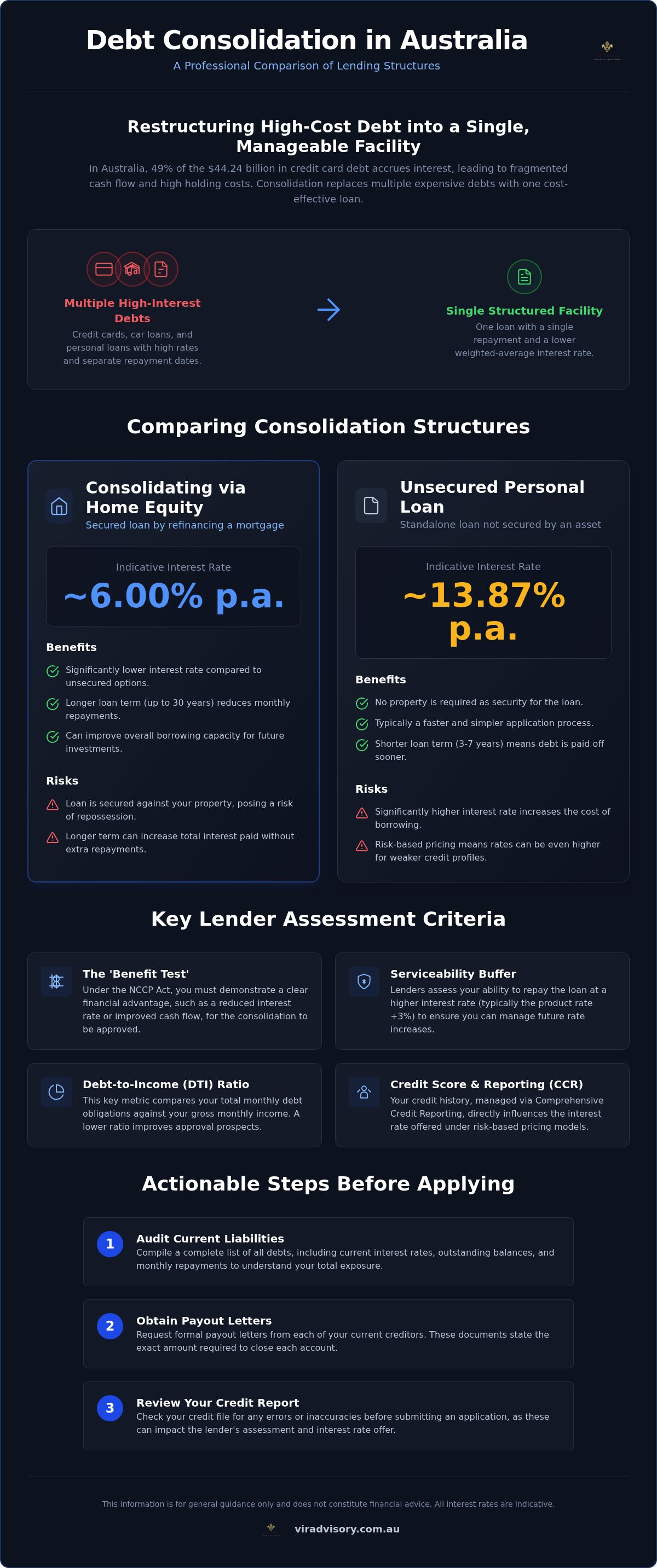
Approximately 49% of Australia's $44.24 billion in credit card debt is currently accruing interest, which often leads to fragmented cash flow and high interest costs. To consolidate debt Australia wide, you must restructure multiple high-interest liabilities into a single, lower-rate facility, such as a secured personal loan or a mortgage refinance. Lenders assess these applications based on your debt-to-income ratio and a 3% serviceability buffer, with the goal of reducing your total interest expense. Effectively, you are replacing several expensive credit facilities with one cost-effective loan that simplifies your monthly management and improves your long-term borrowing capacity.
Managing various repayment dates and opaque interest rates across multiple lenders often creates unnecessary financial friction. You likely recognise that high monthly outgoings are currently limiting your ability to scale your property portfolio or invest in your business operations. This article explains how to use professional lending strategies to simplify your cash flow and regain control over your financial position. We will examine current lender assessment criteria, interest rate benchmarks for 2026, and the specific frameworks required to move from high-cost debt to a structured, cost-effective facility.
Key Takeaways
- Learn how to restructure high-interest liabilities into a single, cost-effective facility to reduce weighted-average interest rates and simplify monthly cash flow.
- Understand how lenders use the NCCP Act and risk-based pricing to evaluate your application when you look to consolidate debt Australia wide.
- Compare the benefits and risks of using home equity versus unsecured personal loans to ensure your debt management strategy aligns with your long-term borrowing capacity.
- Discover the essential steps to audit your current liabilities and identify credit report errors before submitting an application to a credit committee.
- Leverage professional banking insights to navigate complex assessment criteria and present your financial position effectively to both major and non-bank lenders.
What is Debt Consolidation and How Does it Work in Australia?
Debt consolidation is a strategic debt-restructuring exercise aimed at improving cash flow and reducing the total cost of credit. Essentially, What is debt consolidation? It involves taking out a single new loan facility to pay off multiple existing liabilities, such as high-interest credit cards, personal loans, or car finance agreements. For many professionals, the decision to consolidate debt Australia wide is driven by a need to simplify monthly obligations into a single, predictable repayment while securing a lower weighted-average interest rate.
In the Australian market, borrowers typically access this through an unsecured personal loan, a secured asset loan, or by refinancing an existing mortgage. While the average unsecured personal loan rate sits around 13.87% p.a. as of mid-2026, consolidating via home equity can often access rates closer to 6% p.a., provided the borrower meets the lender's serviceability buffer and equity requirements. This manoeuvre allows you to replace high-cost, short-term debt with more manageable, long-term funding structures.
To better understand this concept, watch this helpful video:
The Mechanism of Debt Restructuring
The process begins with "payout letters," which are formal documents from your current creditors stating the exact amount required to close your accounts. When you consolidate, your new lender usually pays these creditors directly. This ensures the funds are used for their intended purpose rather than being deposited into your transaction account, which provides the lender with additional security regarding the loan's purpose.
Australian law requires lenders to display a comparison rate alongside the advertised interest rate. While the interest rate covers the cost of borrowing the principal, the comparison rate includes most upfront and ongoing fees, providing a more accurate reflection of the loan's true cost. It's also vital to consider the loan term. Extending a 5-year car loan into a 30-year mortgage might lower your monthly repayment, but it significantly increases the total interest paid over the life of the loan unless you make additional repayments to offset the term extension.
Consolidation vs. Refinancing: Key Differences
While often used interchangeably, these terms represent different lending strategies. Refinancing typically involves changing the terms, interest rate, or lender for a single existing loan, such as a home loan. In contrast, consolidation specifically targets the aggregation of multiple, disparate debt facilities into one new account. Deciding which option is better depends on your current loan structure and your long-term investment goals. For property investors, consolidation is often a tactical move to clear high-interest liabilities and improve borrowing capacity for future acquisitions.
How Australian Lenders Assess Consolidation Applications
Lenders operate under the National Consumer Credit Protection (NCCP) Act, which mandates strict "responsible lending" obligations. This framework ensures a lender doesn't provide a facility that is unsuitable for your specific financial circumstances. In 2026, credit committees have shifted toward a rigorous "Benefit Test." To consolidate debt Australia wide, you must prove the new structure offers a tangible financial advantage, such as a reduced weighted-average interest rate or improved monthly cash flow. Lenders won't approve an application that simply moves debt around without a clear benefit to your net position.
Risk-based pricing is now the standard across both major and non-bank lenders. Your credit score, managed through Comprehensive Credit Reporting (CCR), dictates the interest rate offer you receive. Borrowers with excellent scores may access rates below 10%, while those with impaired files might see offers starting from 16.99% p.a. Beyond the score, lenders scrutinise the last 90 days of bank statements for account conduct irregularities. Frequent late fees, undisclosed buy-now-pay-later (BNPL) commitments, or excessive discretionary spending can lead to a decline, regardless of your income level.
Borrowing Capacity and NDI Calculations
Lenders determine your eligibility by calculating your Net Disposable Income (NDI). This is the surplus remaining after accounting for tax, living expenses, and all existing debt commitments. Lenders apply a 3% serviceability buffer to your proposed loan rate to ensure you can manage repayments if rates rise. While the Household Expenditure Method (HEM) acts as a baseline for living costs, lenders will use your actual bank statement data if your spending exceeds these benchmarks. Understanding how borrowing capacity is actually calculated in Australia is essential for professionals with complex income streams.
Comprehensive Credit Reporting (CCR) Nuances
Your credit report now includes "repayment history information" (RHI), showing every payment made or missed over the last 24 months. Consistent, on-time payments are viewed favourably, whereas "credit shopping" is a significant red flag. Multiple hard enquiries in a short period suggest financial distress and often trigger automatic system declines. For self-employed borrowers, demonstrating stable income requires Business Activity Statements (BAS) or accountant-verified profit and loss statements. Reviewing Australian government advice on debt consolidation can help you identify potential pitfalls before you apply. If you require a professional review of your account conduct, you can arrange a technical debt assessment to evaluate your approval prospects.
Comparing Consolidation Structures: Home Equity vs. Personal Loans
Lenders generally offer two distinct avenues for debt restructuring: leveraging existing property equity or utilising unsecured personal facilities. To consolidate debt Australia wide, you must evaluate which structure aligns with your immediate cash flow needs and your long-term wealth objectives. Home equity consolidation typically offers the lowest interest rates, often reflecting standard residential mortgage pricing, while unsecured personal loans provide agility and speed for those who don't wish to encumber their property further.
Unlocking Equity for Debt Optimisation
Property owners can often access significant interest savings by increasing their mortgage to absorb high-interest liabilities. This process requires a clear understanding of your current Loan-to-Value Ratio (LVR). Maintaining an LVR below 80% is critical to avoid the unnecessary cost of Lenders Mortgage Insurance (LMI), which can negate the benefits of the restructure. For a detailed breakdown of this strategy, see our Refinance Home Loan Guide: Strategic Debt Optimisation for 2026.
The primary risk with this approach is "extending the term." While a mortgage rate of 5.90% p.a. is substantially lower than a 20% credit card rate, amortising that debt over 30 years can lead to a higher total cost of credit. Strategic borrowers mitigate this by maintaining their previous repayment levels, effectively paying down the consolidated amount over a much shorter period. For investors, this manoeuvre can also facilitate debt recycling, where non-deductible personal debt is replaced with deductible debt used for income-producing assets.
Specialist Personal Lending for Professionals
Unsecured facilities are often more appropriate when speed is paramount or when a borrower's property equity is already fully utilised. These loans don't require collateral, protecting your home if your circumstances change. In the 2026 market, fixed-rate personal loans starting from 5.67% p.a. offer a hedge against further RBA cash rate increases, providing certainty for your monthly budget.
When selecting an unsecured facility, prioritise lenders that offer zero early-repayment penalties. This flexibility allows you to apply bonuses or surplus business cash flow directly to the principal without incurring additional charges. As noted in Moneysmart's guide to debt consolidation, comparing the total cost of credit, including setup fees and ongoing charges, is essential before committing to a new facility. This ensures the restructure remains a cost-effective solution rather than a short-term cash flow fix.
Actionable Steps to Prepare Your Consolidation Strategy
Before you attempt to consolidate debt Australia wide, a meticulous audit of your current financial position is required. Start by documenting every outstanding liability, noting the current balance, the interest rate, the minimum monthly repayment, and any potential exit fees or break costs. This data allows for a precise calculation of the potential interest savings. Simultaneously, obtain a copy of your credit report from providers like Equifax or Experian. Identifying reporting errors early is critical, as inaccuracies can lead to an immediate decline from a credit committee during the assessment process.
One often overlooked strategy is the reduction of unused credit card limits. When calculating borrowing capacity, Australian lenders assess the total credit limit available to you, not the actual balance you owe. For example, a $20,000 limit with a zero balance is still treated as a $20,000 debt commitment by most major banks. Reducing these limits before applying can significantly enhance your serviceability profile. Finally, ensure your documentation is current. PAYG professionals generally require three months of payslips, while self-employed borrowers must provide two years of tax returns and Business Activity Statements (BAS) to verify income stability.
Common Approval Obstacles and How to Avoid Them
Non-disclosure of existing debts is a primary cause for application rejection. Lenders use Comprehensive Credit Reporting (CCR) to verify your liabilities, so honesty is the only viable policy during the submission phase. High discretionary spending on bank statements also presents a risk to your approval prospects. It's advisable to moderate discretionary outgoings for at least 90 days prior to your application to present a cleaner conduct profile. Additionally, "Buy Now, Pay Later" (BNPL) accounts are viewed as credit facilities and directly impact your debt-to-income ratio, even if the balances are small.
Checklist for a Professional Broker Consultation
A successful consultation requires clarity on your objectives and current commitments. Use the following checklist to prepare for a technical discussion regarding your finance strategy:
- Document the specific "purpose of funds" for each debt facility being restructured to meet lender compliance requirements.
- Prepare an itemised list of actual living expenses to compare against Household Expenditure Method (HEM) benchmarks.
- Identify future borrowing goals, such as business expansion or property acquisition, that could be influenced by the structure of this new loan.
Navigating Complex Debt Structures with VIR Advisory
VIR Advisory provides technical brokerage services designed to navigate the complex assessment criteria of both major and non-bank lenders. When you look to consolidate debt Australia wide, the way your application is presented to a credit committee is as important as the raw data itself. Our approach is rooted in over 15 years of banking experience, including a decade spent within a Big Four Australian bank. This insider knowledge allows us to anticipate lender objections, manage the 3% serviceability buffer requirements, and structure your facility to meet the rigorous "Benefit Test" standards that 2026 regulations demand.
We don't just focus on the immediate reduction of interest rates; we prioritise your long-term finance strategy. A poorly structured consolidation loan can inadvertently restrict your borrowing capacity for future property acquisitions or business expansions. We ensure that your debt management plan aligns with your broader investment goals, protecting your credit file from the damage of multiple hard enquiries. Direct access to Raina Doshi provides a methodical, professional-to-professional communication style that respects the time constraints of busy company directors, medical professionals, and self-employed investors.
The Broker Advantage in 2026
The Australian lending market is increasingly segmented, with different lenders showing varying risk appetites for debt restructuring. A specialist broker provides access to a broad panel of lenders, including those that offer bespoke solutions for complex income scenarios. We have particular expertise in "low-doc" applications for self-employed borrowers who may not have traditional financial statements ready but possess strong Business Activity Statements. Our commitment to clarity means we explain the technical difference between interest rates and comparison rates in plain English, ensuring you aren't caught by hidden fees or unfavourable terms.
Securing Your Financial Strategy
We utilise a streamlined digital application process to ensure efficiency for our clients. This allows for a comprehensive assessment of your home, business, and personal finance needs without the friction of traditional banking delays. By evaluating your entire debt portfolio, we can identify opportunities for debt recycling or equity release that a single-product lender might overlook. This level of precision is essential for maintaining financial stability and improving cash flow in a fluctuating interest rate environment. We provide the technical oversight required to ensure every detail of your restructure is handled with professional precision.
Strategic Debt Management for Long-Term Growth
Effective debt restructuring is a technical manoeuvre that requires more than just finding a lower interest rate. It's about optimising your weighted-average interest exposure while prioritising your future borrowing capacity for property or business investment. By passing the lender's benefit test and meticulously managing your credit limits, you create a stable foundation for your broader financial objectives. When you consolidate debt Australia wide with professional oversight, you transform fragmented liabilities into a single, cost-effective facility that respects your cash flow requirements.
Raina Doshi provides a national brokerage service backed by over 15 years of banking and finance expertise. Specialising in complex lending for professionals and self-employed borrowers, VIR Advisory ensures your application is presented with the precision required by modern credit committees. This methodical approach allows you to move forward with complete confidence in your financial structure.
We look forward to helping you secure a more efficient and manageable financial position.
Frequently Asked Questions
How much can I borrow for debt consolidation in Australia?
You can typically borrow between $5,000 and $100,000 for an unsecured facility, while secured options depend on your property's equity. When you consolidate debt Australia wide, lenders apply a 3% serviceability buffer to ensure you can manage repayments if rates rise. Your total limit is restricted by your Net Disposable Income (NDI), which is the surplus remaining after tax, living expenses, and existing commitments are deducted from your gross earnings.
Will consolidating my debt affect my credit score?
Consolidating your debt initially triggers a hard enquiry on your credit report, which can cause a minor, temporary reduction in your score. However, the long-term impact is often positive as you reduce the number of open credit facilities and improve your repayment history information (RHI). Under Comprehensive Credit Reporting, consistently meeting your new single monthly repayment demonstrates reliability to future lenders and helps rebuild your borrowing capacity for property or business investment.
Can I consolidate business debt with personal debt?
You can consolidate business and personal debt, provided the new facility is structured correctly for your tax and liability requirements. Many directors use residential equity to clear high-interest business credit cards or equipment finance. This approach often requires evidence of business trading through Business Activity Statements (BAS). It's essential to consult a specialist to ensure the new structure doesn't negatively impact your commercial borrowing capacity or business tax deductibility.
What is the average interest rate for a consolidation loan in 2026?
As of mid-2026, the average quoted interest rate for an unsecured consolidation loan is 17.95% p.a. Borrowers with excellent credit scores can access fixed rates from 5.67% p.a. or variable rates from 6.24% p.a. If you choose to consolidate debt Australia wide using your home's equity, the rates are significantly lower, currently averaging 5.90% p.a. for variable products, reflecting the lower risk associated with secured residential lending.
How long does the debt consolidation process take?
The timeframe depends on the loan structure you select for the restructure. Unsecured personal loans are often approved and funded within 24 to 48 hours, provided your documentation is ready. If you are consolidating through a mortgage refinance, the process typically takes between 14 and 30 days. This period allows for a formal property valuation, the discharge of your current mortgage, and a detailed assessment by the new lender's credit committee.
Can I consolidate debt if I am self-employed?
Self-employed borrowers can consolidate debt by providing alternative documentation to verify their income stability. While PAYG employees provide payslips, you'll generally need two years of tax returns or recent Business Activity Statements (BAS). Lenders evaluate your net profit and add-backs to calculate your borrowing capacity. If your tax records aren't finalised, specialist brokers can often access "low-doc" facilities that use accountant letters or bank statement audits to confirm your NDI.
Are there fees for paying off my original loans early?
Many lenders charge early termination fees or break costs, particularly on older car finance contracts or fixed-rate personal loans. You should request a formal payout letter from each existing creditor to identify these charges before you commit to a new facility. These costs must be factored into your financial assessment to ensure the consolidation provides a genuine benefit by reducing your total interest expense over the remaining term.
What is the difference between a debt agreement and debt consolidation?
Debt consolidation involves taking out a new loan to pay off creditors, whereas a debt agreement is a formal act of insolvency under the Bankruptcy Act. Consolidation is a standard lending product that doesn't default your credit file if managed correctly. A Part 9 Debt Agreement is only for those in severe hardship, with 2026 thresholds limiting eligibility to those with unsecured debts under $150,950.80 and after-tax income below $113,213.10.

Article by
Raina Doshi
Raina Doshi has worked in banking and finance since 2011, including experience with major Australian lenders. She helps homeowners, property investors, business owners and professionals secure and structure lending solutions across home loans, refinancing, commercial finance and business lending.
Areas of expertise include residential lending, investment property finance, debt recycling, commercial property finance, equipment finance, construction finance and strategic debt structuring.
Drawing on extensive banking and finance experience, Raina helps clients navigate lender requirements, improve borrowing outcomes and structure effective finance solutions.
Disclaimer
The information in this article is general in nature and does not take into account your personal objectives, financial situation or needs. Before acting on any information, consider whether it is appropriate to your circumstances and seek professional advice.


