

With owner-occupiers refinancing a record $42.9 billion in home loans in the March quarter of 2026, many Australians are discovering that the "loyalty tax" on existing debt is costing them up to 1% in unnecessary interest. Managing high interest rates on unsecured debt while balancing complex cash flow across multiple lenders can quickly exhaust your monthly surplus and stifle your future investment potential. Choosing between debt consolidation vs refinancing depends primarily on your asset security and overall finance strategy. While refinancing involves restructuring a mortgage to incorporate other liabilities at a lower rate, debt consolidation typically uses a new, separate facility to streamline repayments without necessarily involving property equity.
You'll gain a technical understanding of how these options differ so you can choose the most effective approach for your specific lending requirements. We will examine how lenders assess serviceability buffers, the impact of each method on your borrowing capacity, and the practical steps to improve your approval prospects in the current high-rate environment.
Key Takeaways
- Distinguish between restructuring a single facility and merging multiple liabilities to optimise monthly cash flow and reduce total interest costs.
- Evaluate the technical merits of debt consolidation vs refinancing to determine which finance strategy best preserves your borrowing capacity for future property or business acquisitions.
- Learn how to leverage property equity for debt restructuring while maintaining a Loan-to-Value Ratio (LVR) below 80% to avoid the additional cost of Lender's Mortgage Insurance.
- Understand the critical role of account conduct and the Household Expenditure Method (HEM) in how Australian lenders assess your application for a new loan structure.
- Follow a methodical framework to audit your current liabilities and secure up-to-date asset valuations before approaching lenders for a funding solution.
Defining the Mechanics: Refinancing vs Debt Consolidation
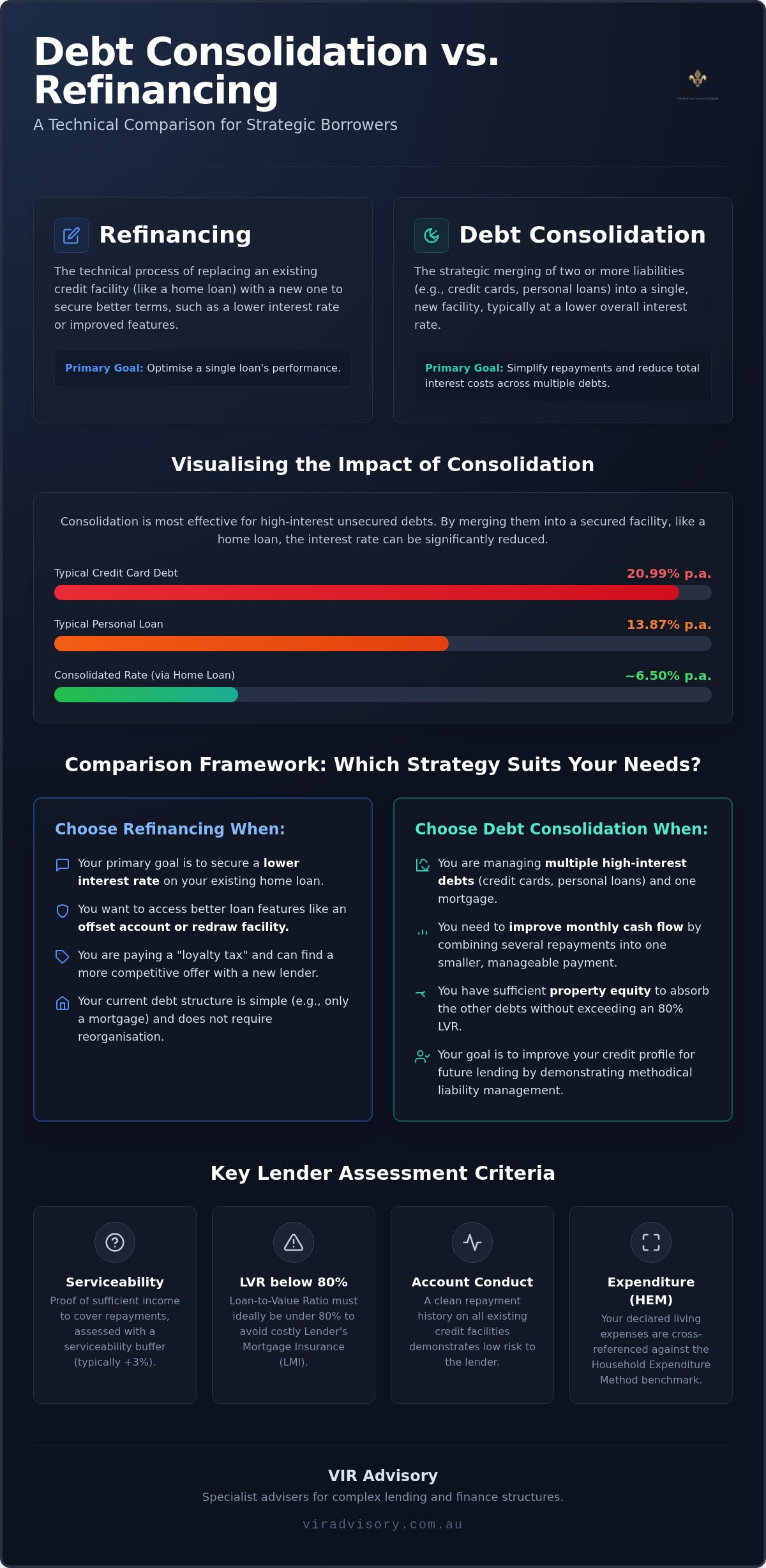
Refinancing and debt consolidation are distinct concepts that often overlap within the Australian mortgage market. While the terms are frequently conflated, understanding the technical differences between debt consolidation vs refinancing is critical for any borrower looking to optimise their finance strategy. Refinancing is the technical act of replacing an existing credit facility with a new one to secure better terms; whereas debt consolidation focuses on the strategic merging of two or more liabilities into a single facility. Many borrowers use these terms interchangeably because the most common way to restructure debt in Australia is to refinance a home loan to absorb smaller, higher-interest debts.
The core distinction lies in the target of the finance strategy. Refinancing targets the specific facility to improve its individual performance, such as reducing the interest rate or changing the loan term. Consolidation targets the overall debt structure to simplify management and reduce the total interest expense across all liabilities.
To better understand the technical differences between these two strategies, watch this helpful video:
The Technical Process of Refinancing
Refinancing involves closing an existing loan and opening a new one, either with your current bank (internal) or a new lender (external). With the RBA cash rate held at 4.35% as of August 2026, many property owners are switching lenders to avoid the "loyalty tax," where existing customers pay up to 0.50% more than new applicants. This process allows you to access different loan features, such as offset accounts or redraw facilities, which can significantly alter how you manage your long-term interest costs. External refinancing often incurs discharge fees between $300 and $700, yet the long-term savings from a lower interest rate usually outweigh these upfront costs.
The Structural Logic of Debt Consolidation
Debt consolidation focuses on the structural reorganisation of multiple liabilities. This strategy is particularly effective when you hold high-interest unsecured debt, such as credit cards with average rates of 20.99% p.a. or personal loans averaging 13.87% p.a. By merging these into a single facility with a lower rate, you improve monthly cash flow and simplify your repayment structure. This approach can also assist in credit score management by reducing the number of active credit enquiries and facilities on your file. Lenders often view a consolidated debt structure more favourably during future assessments because it demonstrates a methodical approach to liability management and reduces the risk of missed payments across multiple accounts.
Understanding the nuance between debt consolidation vs refinancing is essential for selecting the right funding solutions. Choosing the wrong structure can lead to higher fees or an unintended reduction in your future borrowing capacity.
Comparison Framework: When to Refinance vs Consolidate
Determining whether to pursue debt consolidation vs refinancing requires a technical evaluation of your current debt-to-income (DTI) ratio and long-term investment objectives. For professionals and company directors, the decision often hinges on how a specific structure impacts their overall borrowing capacity. Lenders assess risk differently depending on whether you're seeking a lower rate on a single facility or merging multiple high-interest liabilities to improve your serviceability profile.
Evaluation criteria must include more than just the headline interest rate. You need to account for upfront fees, which typically range from $500 to $2,000 for a mortgage refinance, and ongoing monthly costs. For business owners, understanding the nuances of Refinancing Vs. Consolidating Business Debt is essential to ensure that your finance strategy doesn't inadvertently limit your access to working capital or equipment finance. The choice of loan features, such as offset accounts versus redraw facilities, also plays a pivotal role in maintaining liquidity for future investments.
Refinancing for Interest Rate Optimisation
A rate reduction of at least 0.50% is generally the threshold where the cost of switching lenders becomes financially viable. If you're currently on a fixed-rate facility, you must calculate potential break costs before proceeding, as these can reach thousands of dollars depending on the remaining term. For property investors, refinancing provides an opportunity to shift from principal and interest (P&I) to interest-only (IO) repayments. This tactical move can significantly improve cash flow for future acquisitions, provided your long-term finance strategy accounts for the eventual transition back to P&I.
Consolidating for Cash Flow Management
Consolidation is the preferred strategy when high-interest unsecured debt begins to erode your serviceability. Multiple repayment dates across different lenders can complicate cash flow management, particularly for self-employed borrowers who need to maintain steady business liquidity. While using home equity to absorb these debts often yields the lowest rate, a separate personal loan for consolidation might be more appropriate if you intend to keep your mortgage structure separate for future equity releases. This prevents your long-term home loan from being cluttered with short-term debt repayments.
If you're unsure which structure suits your current portfolio, you can book a technical review to analyse your specific lending requirements and approval prospects.
Leveraging Home Equity for Strategic Debt Restructuring
Using property equity is often the most cost-effective way to execute a debt restructuring plan. By accessing a 'top-up' facility or performing a full mortgage refinance, you can absorb external liabilities into your home loan at a significantly lower interest rate. A technical understanding of debt consolidation vs. refinancing explained through the lens of asset security reveals that property-backed debt remains the cheapest form of credit in the Australian market. However, you must adhere to the 'Equity Rule' by maintaining a Loan-to-Value Ratio (LVR) below 80%. Exceeding this threshold typically triggers Lender's Mortgage Insurance (LMI), which can negate the financial benefits of the restructure.
Taxation requirements also dictate how you should organise these facilities. For property investors and company directors, it's vital to keep investment-related debt separate from personal debt to protect interest deductibility. Mixing these funds can lead to complex accounting issues and potential audits. For a deeper dive into these technicalities, refer to our Refinance Home Loan Guide: Strategic Debt Optimisation for 2026.
The Benefits of Secured Consolidation
Securing your debt against property allows you to access variable rates starting from approximately 5.84% p.a., which is a stark contrast to the average standard credit card rate of 20.99% p.a. This strategy offers several technical advantages for sophisticated borrowers:
- Structure Simplification: Merging multiple facilities into one reduces the administrative burden for professionals managing diverse portfolios.
- DSR Optimisation: Spreading repayments over a longer term improves your Debt Service Ratio (DSR), which can enhance your borrowing capacity for future business or property acquisitions.
- Cash Flow Liquidity: Lowering the total monthly repayment amount frees up working capital for self-employed borrowers.
The Risks of Rolling Short-Term Debt into a Mortgage
The primary risk of this finance strategy is the 'Term Trap.' While a lower interest rate is attractive, moving a five-year car loan into a 30-year mortgage can result in higher total interest costs over the life of the loan if you only make minimum repayments. You can mitigate this risk by adopting a methodical approach to debt management:
- Use a separate loan split for the consolidated amount to track its progress independently from your main mortgage.
- Utilise offset accounts to park surplus cash, which reduces the interest charged while keeping funds accessible.
- Maintain the original, higher repayment amount from your previous debts to clear the consolidated portion within its original timeframe.
Lender Assessment Criteria: Why Applications Get Approved or Declined
Australian lenders apply rigorous standards when assessing applications for debt consolidation vs refinancing. One of the most critical factors they evaluate is 'Conduct'. Lenders scrutinise your transaction accounts and existing credit facilities for the last six months to identify any missed payments, late fees, or overdrawn accounts. Even a single dishonoured payment can lead to an immediate decline, as it signals a lack of methodical financial management and increases the lender's perceived risk.
Borrowing capacity is also heavily influenced by the Household Expenditure Method (HEM). Lenders use this benchmark to estimate your living expenses based on your family size and location. If your actual spending is higher than the HEM, they'll use your higher figures, which often reduces your maximum loan amount. Additionally, many Australian banks now enforce strict Debt-to-Income (DTI) limits, typically capping total debt at six or seven times your gross annual income. Understanding these internal benchmarks is essential for a successful finance strategy. For more detail on these variations, read our guide on Why One Bank Says No and Another Says Yes: Understanding Australian Lending Policies.
Serviceability and Interest Rate Buffers
The Australian Prudential Regulation Authority (APRA) requires lenders to apply a 3% serviceability buffer. This means if you're applying for a funding solution at a rate of 6%, the bank assesses your ability to repay at 9%. This 'Assessment Rate' is a significant hurdle for many borrowers in the current high-rate environment. Lenders also 'shade' different income types to account for volatility. While 100% of a base salary is usually accepted, they might only count 80% of your bonuses, commissions, or rental income. Self-employed professionals must typically provide two years of full tax returns to demonstrate income stability, though some alternative documentation options exist for those with clean conduct but complex company structures.
Common Approval Obstacles in Consolidation
The 'Credit Limit' trap is a frequent cause of application decline. Lenders assess your borrowing capacity based on the total limits of your credit cards, not the balance you actually owe. A $30,000 limit with a zero balance still reduces your borrowing capacity as if it were fully drawn. Another obstacle is 'enquiry fatigue'. Making multiple credit enquiries in a short period can damage your credit score and suggest financial distress to a potential lender. To improve approval prospects, you should close unused facilities and ensure your bank statements are clean for at least six months before submitting a formal application. This methodical preparation demonstrates a commitment to risk management and financial stability.
Request a serviceability assessment
Executing a Finance Strategy: Steps to Successful Restructuring
Successfully navigating the choice between debt consolidation vs refinancing requires a disciplined, multi-step framework. It begins with a comprehensive audit of all current liabilities, where you document every interest rate, term, and associated fee. This data provides the baseline for measuring the effectiveness of any proposed funding solution. Next, you must obtain up-to-date valuations for your property or business assets to accurately determine your available equity. Without a precise understanding of your Loan-to-Value Ratio (LVR), you cannot effectively negotiate with lenders for the most competitive rates.
Once you've established your equity position, compare your current bank's internal refinance options against the broader market. A finance broker is essential here, as they can access products from over 30 lenders that may not be available to the general public. Before signing any new agreement, review the proposed loan structure for tax efficiency and future flexibility. This is particularly important for company directors and property investors who need to maintain clear boundaries between personal and investment debt. Finally, implement disciplined repayment habits from day one to ensure the restructured debt is cleared as fast as possible.
Avoiding Common Restructuring Mistakes
Many borrowers fall into the trap of cashing out equity without a clear purpose, which unnecessarily reduces their future borrowing capacity. Another frequent error is ignoring the total cost of credit in favour of the lowest monthly repayment. While a lower monthly figure improves cash flow, extending a short-term debt over a 30-year mortgage term can significantly increase the total interest paid if you don't maintain a higher repayment pace. Crucially, you must close old credit facilities immediately after consolidation. Failing to do so often leads to 'limit creep', where unused credit limits continue to hinder your serviceability and may tempt further unsecured borrowing.
The Role of Professional Guidance
Navigating the varied policies of Australian lenders requires professional oversight to avoid unnecessary credit enquiries and application declines. VIR Advisory organises complex applications for professionals and investors by matching their specific requirements with the right lender niches. With over 15 years of banking and finance expertise, our approach ensures that every detail of your finance strategy is handled with precision. By identifying the technical differences in how debt consolidation vs refinancing applications are assessed, we help you secure a structure that supports your long-term objectives.
Submit your enquiry for a strategic finance assessment
Optimising Your Debt Structure for Future Growth
Choosing between debt consolidation vs refinancing requires a technical assessment of your current equity position and long-term liquidity needs. Refinancing allows you to secure more competitive rates on existing facilities; meanwhile, debt consolidation offers a structural solution to merge high-interest liabilities and improve monthly cash flow. Both strategies demand a methodical approach to lender requirements to ensure your borrowing capacity remains intact for future property or business acquisitions.
Raina Doshi provides over 15 years of Australian banking expertise to help you navigate these complex approval obstacles. By accessing a broad network of residential and commercial lenders, VIR Advisory develops personalised finance structures tailored to the specific requirements of professionals and company directors.
Securing a more efficient loan structure is a decisive step toward improved risk management and long-term financial stability.
Frequently Asked Questions
Is debt consolidation better than refinancing for my credit score?
Debt consolidation vs refinancing affects your credit score based on application frequency and how the new structure changes your credit utilisation. Refinancing a single facility is generally neutral, while merging high-interest debts can lower your overall utilisation ratio, which is a positive factor. However, multiple credit enquiries in a short period can temporarily lower your score. A methodical approach involves reviewing your credit file and ensuring all repayments are up to date before applying.
Can I consolidate my business loans into my home mortgage?
You can consolidate business loans into your home mortgage if you have sufficient property equity and meet the lender's serviceability requirements. This strategy often secures a lower interest rate, as home loan rates are typically lower than commercial finance rates. However, you must consider the tax implications and ensure that investment-related interest remains deductible. Keeping a separate loan split for the business portion is a standard finance strategy to maintain clean accounting records for your business.
What are the typical costs associated with refinancing a home loan in Australia?
Typical costs for refinancing a home loan in Australia range from $500 to $2,000, depending on your current lender's discharge fees and the new lender's establishment costs. Major expenses include a discharge fee (usually $300 to $700), government mortgage registration fees (approximately $100 to $300), and potential property valuation fees. If you are breaking a fixed-rate contract, you may also face significant break costs. It's essential to calculate whether the interest savings justify these upfront outlays.
How much equity do I need in my property to consolidate other debts?
Lenders generally require you to maintain a Loan-to-Value Ratio (LVR) of 80% or less to consolidate debts without paying Lender's Mortgage Insurance (LMI). For example, if your property is valued at $1,000,000, your total debt including the consolidation amount should ideally not exceed $800,000. While some lenders may allow an LVR up to 90%, the added cost of LMI and stricter serviceability buffers often make this a less effective finance strategy for many borrowers.
Will refinancing help me if I have been declined by my current bank?
Refinancing can be a successful strategy even if your current bank has declined your application, as lender requirements vary significantly across the Australian market. Different banks have varying risk appetites for self-employed income or specific debt-to-income (DTI) ratios. A methodical assessment of debt consolidation vs refinancing options with a broker allows you to identify lenders whose policies align with your specific financial profile, improving your approval prospects despite a previous decline.
What is the difference between a debt consolidation loan and a balance transfer?
A debt consolidation loan is a structured personal or home loan with a set term, whereas a balance transfer is a credit card feature offering a low or 0% interest rate for a limited period. Balance transfers are short-term tools often lasting 6 to 24 months, while consolidation loans provide a long-term finance strategy for larger amounts. Consolidation loans offer more stability through fixed monthly repayments, which helps in managing cash flow for professionals and business owners.
How long does the refinancing and consolidation process usually take?
The refinancing and consolidation process typically takes between two and six weeks from the initial application to settlement. This timeframe depends on the complexity of your loan structure, the speed of property valuations, and the responsiveness of your current lender in processing discharge paperwork. Self-employed borrowers or those with multiple investment properties may require additional time for lenders to assess complex income documents. Meticulous preparation of your bank statements and tax returns can help expedite approval.
Should I choose a fixed or variable rate when consolidating debt?
Choosing between a fixed or variable rate depends on whether you prioritise repayment certainty or flexibility. Fixed rates protect you against interest rate hikes, which is useful for strict cash flow management, but they often lack features like offset accounts and redraw facilities. Variable rates offer more flexibility for additional repayments, allowing you to clear consolidated debt faster. Many borrowers choose a split loan structure to gain the benefits of both rate types within their finance strategy.

Article by
Raina Doshi
Raina Doshi works with homeowners, property investors, business owners and professionals to secure and structure lending solutions across home loans, refinancing, commercial finance and business lending. Areas of expertise include investment property finance, debt recycling, commercial property finance, equipment finance and strategic debt structuring.
Disclaimer
The information in this article is general in nature and does not take into account your personal objectives, financial situation or needs. Before acting on any information, consider whether it is appropriate to your circumstances and seek professional advice.


