

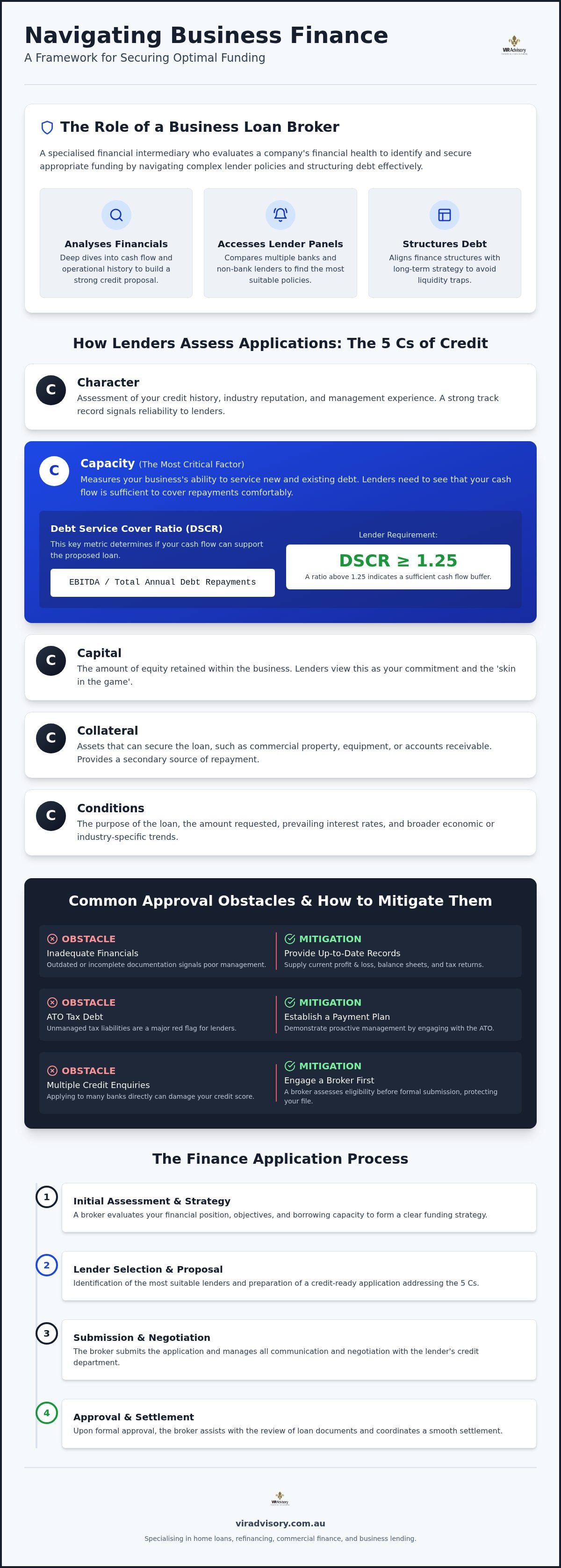
If you believe securing the right finance is simply about finding the lowest interest rate, you might be overlooking the structural risks that could stall your business growth. A professional business loan broker acts as a sophisticated intermediary, translating your financial position into a credit-ready proposal that aligns with specific bank policies. By navigating complex lender assessment criteria and managing debt structures, they identify the most appropriate funding solutions to optimise your borrowing capacity. This process ensures your application meets the 5 Cs of credit, which include character, capacity, capital, collateral, and conditions, before it reaches a credit officer's desk.
It's understandable to feel overwhelmed by the divergence in lender requirements and the pressure of managing working capital alongside growth. You'll gain expert insights into how a specialist broker navigates approval criteria and debt management to secure optimal funding for your enterprise. We examine the mechanics of lender assessments, the differences between secured and unsecured options, and the practical strategies used to improve your approval prospects in the current Australian market.
Key Takeaways
- Understand how a professional business loan broker bridges the gap between your financial position and complex lender policies to secure optimal funding terms.
- Learn how Australian lenders apply the "Five Cs of Credit" framework, with a specific focus on cash flow as the primary driver for loan approval.
- Discover how to match debt structures to your business needs, including the strategic use of asset finance and working capital solutions to manage growth.
- Identify common approval obstacles, such as inadequate financial documentation and ATO tax debt, and the practical steps required to mitigate these risks.
- Gain a clear overview of the finance application process, from the initial debt structure assessment through to lender selection and final settlement.
What Does a Business Loan Broker Do? A Practical Definition
A business loan broker is a specialised financial intermediary who evaluates a company's financial health to identify and secure appropriate funding. Unlike a direct lender, a broker doesn't provide the capital themselves. Instead, they operate across a broad panel of banks and non-bank lenders to find a facility that matches the borrower's specific operational requirements. Their core responsibilities involve analysing cash flow patterns, structuring debt to avoid liquidity traps, and managing the entire negotiation process with lender credit departments.
Using a brokerage like VIR Advisory provides access to a diverse network of funding solutions that aren't always visible to the public. While a single bank can only offer its own products, a broker compares multiple credit policies simultaneously. This is vital because lender appetite for certain industries or risk profiles changes frequently. A broker's job is to know which lender is currently active in your specific sector, whether you're seeking a simple equipment loan or complex commercial property finance.
The Intermediary Role in Commercial Finance
Brokers bridge the gap between a business owner's immediate capital needs and the rigid, often opaque, credit policies of major institutions. Many SMEs make the mistake of applying directly to multiple banks, which results in several hard enquiries on their credit file. This can inadvertently damage their credit score and signal risk to lenders. A professional business loan broker, particularly one with over 15 years of banking experience, performs a detailed assessment first. They ensure your application is positioned correctly before a formal submission is made, protecting your credit profile while maximising the likelihood of a first-time approval.
Key Financial Products Managed by Brokers
The scope of a broker extends beyond simple term loans. They manage a wide range of facilities designed to address specific balance sheet requirements. This includes working capital finance to manage seasonal cash flow gaps, debtor finance for businesses with long payment cycles, and asset finance for essential machinery or vehicles. For more complex needs, they facilitate commercial property finance and SMSF lending, ensuring the debt structure aligns with the long-term finance strategy. You can view the full scope of available VIR Advisory services to see how these products integrate into a broader business strategy.
How Lenders Assess Business Loan Applications: The Framework
Lenders in Australia follow a structured methodology known as the Five Cs of Credit to evaluate risk and determine borrowing capacity. Unlike residential lending, which is heavily formulaic and driven by credit scores, commercial assessment involves a qualitative deep dive into the business's operational history. A business loan broker prepares your application by addressing each of these pillars: character, capacity, capital, collateral, and conditions. Character refers to your credit history and industry reputation, while capital assesses the equity you've retained in the business. Conditions cover external factors like market trends or the specific purpose of the funds.
Capacity is the most critical element of this framework. Lenders use the Debt Service Cover Ratio (DSCR) to determine if your cash flow can support new debt repayments. For example, if your business generates $250,000 in EBITDA and your proposed annual debt repayments are $180,000, your DSCR is 1.38. Most Australian lenders require a minimum ratio of 1.25 to ensure a safety buffer against interest rate fluctuations or revenue dips. If your ratio falls below this threshold, you may need to provide additional collateral or reconsider the loan structure.
Capacity and Cash Flow Analysis
Lenders prioritise historical financial statements and Business Activity Statements (BAS) to verify revenue consistency over time. They focus on EBITDA (Earnings Before Interest, Taxes, Depreciation, and Amortisation) to understand the true cash-generating power of the enterprise. A business loan broker works to identify "add-backs" that can improve your borrowing capacity. These are non-cash expenses or one-off costs, such as director bonuses or non-recurring legal fees, that can be added back to your profit to show a more accurate picture of your ability to service debt.
Collateral and Security Requirements
Collateral remains a significant factor in determining both the loan structure and the interest rate. Secured loans, often backed by commercial or residential property, typically offer lower rates, ranging from 6.8% to 9.5% p.a. as of September 2026. Unsecured options are available for businesses with strong cash flow but no tangible assets to pledge, though these carry higher risk for the lender, resulting in rates between 9.5% and 18% p.a. While the specifics of Australian credit policy differ, the underlying principles of risk assessment often mirror the rigorous standards found in international frameworks like SBA loan programs.
If you're unsure how your current financials align with these criteria, you can book a preliminary assessment to review your position before approaching a lender.
Comparing Business Finance Structures: Choosing the Right Solution
Selecting the correct finance structure requires a precise alignment between the loan duration and the useful life of the asset being funded. A professional business loan broker ensures that short-term requirements, such as purchasing inventory or covering seasonal payroll gaps, aren't funded with long-term debt that carries unnecessary interest costs. Conversely, long-term investments like warehouse acquisitions should be structured with facilities that provide stability over several years. For those unfamiliar with the strategic scope of these services, understanding What Is A Business Loan Broker? helps clarify how they act as a filter across these diverse products.
Matching the debt lifecycle to the business lifecycle prevents liquidity traps. While a term loan provides a lump sum for specific expansion projects, working capital facilities like overdrafts or lines of credit offer the flexibility needed for day-to-day operations. As of September 2026, with the RBA cash rate at 4.35%, the cost of capital remains a significant consideration in these structural choices. A broker's role is to ensure the chosen facility doesn't just provide funding, but does so in a way that supports the company's broader finance strategy and risk management profile.
Asset and Equipment Finance
Asset finance is a critical tool for preserving working capital for daily operations. By utilising a chattel mortgage or a finance lease, you can acquire essential machinery, technology, or vehicles without a significant upfront cash outlay. Lenders typically offer fixed rates for equipment finance, which as of September 2026, start from approximately 7.49% p.a. for borrowers with strong credit profiles. These structures are often more accessible than general business loans because the asset itself serves as collateral, reducing the lender's risk and often resulting in faster approval times for essential equipment.
Commercial Property and SMSF Lending
Purchasing business premises is a sophisticated strategy that can provide long-term stability and potential tax advantages. A business loan broker can facilitate commercial lending through a Self-Managed Super Fund (SMSF), allowing you to use retirement savings to acquire the property your business operates from. This process requires navigating complex compliance frameworks and specific lender assessment criteria that differ significantly from standard commercial loans. For a deeper dive into these requirements, see our Commercial Property Finance Guide.
Managing seasonal fluctuations and the pressure of "payday super" obligations, which commenced on 1 July 2026, often requires cash flow solutions like debtor finance. With invoice finance rates starting from approximately 9.75% as of May 2026, these facilities allow you to access capital tied up in unpaid invoices. This ensures that your business maintains managed momentum even when client payment cycles are extended, allowing for a smooth and frictionless experience during growth phases.
Common Approval Obstacles and How to Avoid Them
Securing approval for commercial finance often depends more on the quality of your presentation than the strength of your balance sheet alone. Inadequate financial documentation remains the primary reason for application rejection in the Australian market. Lenders require absolute transparency to assess your debt serviceability, and missing or outdated records can lead to an immediate decline. A professional business loan broker ensures that your financial statements are credit-ready, identifying potential red flags in your profit and loss statements before they reach a lender's desk.
The presence of ATO tax debt is another significant hurdle that can stall an application. With the General Interest Charge (GIC) at 11.43% for the July to September 2026 quarter, and the fact that this interest is no longer tax-deductible, lenders view outstanding tax liabilities as a major risk to cash flow. While some non-bank lenders may consider businesses with tax debt, most major banks require a formalised payment plan or complete clearance of the debt before they'll approve a new facility. Managing your credit file is equally vital; excessive credit enquiries over a short period can signal financial distress, even if your intentions were simply to compare rates.
The Application Readiness Checklist
- Step 1: Organise up-to-date Profit and Loss statements and Balance Sheets, ensuring they reflect the last two years of trading and the current year-to-date position.
- Step 2: Clear or disclose all outstanding tax liabilities, including GST and PAYG, or provide evidence of an ATO-approved payment plan that has been maintained for at least six months.
- Step 3: Review both your personal and business credit reports to identify and correct any errors or defaults that might negatively impact your borrowing capacity.
Risk Management for Borrowers
Prudent debt management involves more than just obtaining an approval; it requires a strategy to mitigate long-term financial risks. Over-leveraging, particularly in an environment with variable interest rates, can place immense pressure on your working capital if revenue fluctuates. A business loan broker helps you assess the impact of rate rises on your Debt Service Cover Ratio to ensure your business remains resilient. Additionally, lenders often look for "Key Person" insurance for SME loans to protect the enterprise against the loss of a director or essential manager, which can be a critical requirement for certain high-value facilities.
By diversifying lender selection, a broker reduces the risk of being tied to a single institution's changing credit appetite. This managed momentum allows your business to maintain its growth trajectory while ensuring that your debt structure remains stable and aligned with your broader finance strategy.
The Loan Application Process: From Assessment to Settlement
The transition from identifying a funding need to receiving capital follows a methodical sequence designed to ensure the chosen facility supports long-term stability. A professional business loan broker begins with a comprehensive assessment of your current debt structures and future enterprise goals. This initial consultation allows for the identification of the most appropriate finance strategy, ensuring that new debt doesn't create liquidity constraints or breach existing bank covenants. By reviewing your historical cash flow and balance sheet strength, the broker prepares a credit-ready proposal that speaks directly to lender assessment criteria.
Once the strategy is defined, the broker navigates a diverse panel of bank and non-bank lenders to identify those with a current appetite for your specific industry. This comparison is vital because lender policies shift frequently; a bank that was active in commercial property finance last month may have reached its sector cap this month. Your broker advocates for favourable terms, negotiating not only the interest rate but also the flexibility of repayment schedules and the stringency of ongoing reporting requirements. This advocacy is essential for securing a solution that remains fit for purpose as your business scales.
What to Expect During the Process
Standard timelines for commercial loan approvals in the 2026 market typically range from two to six weeks, depending on the complexity of the file and the security involved. For facilities involving commercial property or high-value machinery, independent valuations are a critical part of the process and can influence the final Loan-to-Value Ratio (LVR). During this period, your broker manages the communication between valuers, solicitors, and lender credit officers to maintain managed momentum. For a personalised assessment of your borrowing capacity, you can contact Raina Doshi directly to discuss your specific requirements.
Why Expertise Matters in Australian Finance
Navigating the Australian lending landscape requires a deep understanding of bank credit policy that only comes with significant industry tenure. With over 15 years of banking and finance experience, VIR Advisory provides the intellectual weight of a top-tier consultancy while maintaining a local, approachable service. Our national service coverage ensures that businesses across Australia can access sophisticated debt advisory and funding solutions, regardless of their location. We focus on delivering precision in loan structuring and risk management to ensure your enterprise is positioned for sustainable growth.
Submit your enquiry for a strategic assessment
Optimising Your Business Finance Strategy
Securing the right funding requires a deliberate approach to debt structure and credit positioning. By aligning your loan facilities with your business lifecycle and ensuring your financial documentation meets the rigorous standards of bank credit policies, you protect your enterprise's cash flow. A professional business loan broker provides the technical oversight needed to navigate these variables, leveraging deep industry knowledge to identify lenders that are actively supporting your sector.
Led by Raina Doshi with over 15 years of banking expertise, VIR Advisory provides a comprehensive range of business and residential finance solutions. As a national brokerage serving clients across Australia, we focus on delivering precise funding outcomes through a managed momentum that prioritises your borrowing capacity and risk management.
Submit your enquiry for a professional finance assessment Establishing a stable financial foundation allows your enterprise to scale with confidence, knowing every detail of your debt management is handled with professional oversight and precision.
Frequently Asked Questions
How much does a business loan broker charge for their services?
Most brokers receive a commission from the lender upon the successful settlement of the facility, which is disclosed in the credit proposal. For complex commercial files or debt advisory services, an engagement or mandate fee might apply to cover the extensive credit analysis and structural positioning required. It's essential to discuss the specific fee structure during your initial consultation to ensure complete transparency before the application process begins.
Can I get a business loan if I am self-employed with limited financials?
Yes, self-employed borrowers can often access capital through low-doc or alt-doc lending solutions that don't require full tax returns. These products typically use alternative evidence of income, such as six months of Business Activity Statements (BAS) or accountant-verified declarations, to verify revenue consistency. A business loan broker identifies which non-bank lenders have the specific credit appetite for these profiles while managing the associated interest rate implications for the borrower.
What is the difference between a secured and an unsecured business loan?
A secured loan is backed by tangible assets, such as commercial property or equipment, which reduces the lender's risk and generally results in lower interest rates. An unsecured loan relies on the business's cash flow and a director's guarantee without requiring physical collateral. While unsecured options offer faster access to capital, they typically carry higher interest rates, often ranging from 9.5% to 18% p.a., and feature shorter repayment terms.
How long does it typically take to get a business loan approved?
Approval timelines vary significantly based on the complexity of the debt structure and the chosen lender. While some fintech lenders provide conditional approval within 48 hours for small working capital facilities, traditional bank approvals generally take between two to six weeks. This timeframe accounts for internal credit assessments, independent property valuations, and the verification of all financial documentation. A broker manages these moving parts to maintain momentum throughout the process.
Do I need a business plan to apply for a commercial loan?
While not every facility requires a formal business plan, lenders expect a clear explanation of the loan's purpose and how it will support future cash flow. For startups or significant expansions, a detailed plan demonstrates the viability of the enterprise and helps mitigate perceived operational risk. Providing this context allows your broker to build a stronger case for approval by addressing specific lender concerns regarding market conditions and your repayment capacity.
Can a broker help if my bank has already declined my application?
Yes, a broker can often assist by identifying the specific reason for the decline and matching your profile with a lender that has a different credit appetite. A rejection from one institution often simply means you didn't fit their current policy, rather than your business being unfinanceable. By accessing a broad panel of non-bank lenders, a business loan broker finds alternative institutions that may be more comfortable with your industry or financial position.
Is it possible to refinance an existing business loan to a better rate?
Refinancing is a strategic tool used to optimise debt structures and reduce interest costs as your business matures or market conditions shift. If your financial position has improved or your property equity has increased since the original loan was settled, you may qualify for more favourable terms. A broker performs a comprehensive assessment to ensure the long-term interest savings outweigh any break costs or establishment fees associated with moving the facility.
What are the current interest rates for commercial property loans in Australia?
As of September 2026, secured commercial property loan rates from major banks typically range from 6.8% to 9.5% p.a., depending on the borrower's credit profile and the property type. These rates are influenced by the RBA cash rate of 4.35% and the lender's assessment of the asset's risk. It's important to review both variable and fixed options, as the chosen structure can significantly impact your cash flow management during different economic cycles.

Article by
Raina Doshi
Raina Doshi has worked in banking and finance since 2011, including experience with major Australian lenders. She helps homeowners, property investors, business owners and professionals secure and structure lending solutions across home loans, refinancing, commercial finance and business lending.
Areas of expertise include residential lending, investment property finance, debt recycling, commercial property finance, equipment finance, construction finance and strategic debt structuring.
Drawing on extensive banking and finance experience, Raina helps clients navigate lender requirements, improve borrowing outcomes and structure effective finance solutions.
Disclaimer
The information in this article is general in nature and does not take into account your personal objectives, financial situation or needs. Before acting on any information, consider whether it is appropriate to your circumstances and seek professional advice.


