

A rent vs buy calculator is a financial tool that compares the total costs and outcomes of renting a property versus purchasing one over a specific period. It works by analysing key inputs, including your deposit, property price, loan interest rate, and expected weekly rent. The calculator then models the long-term financial position of both scenarios, accounting for costs like stamp duty, maintenance, and council rates for buyers, against the ongoing rental payments for tenants.
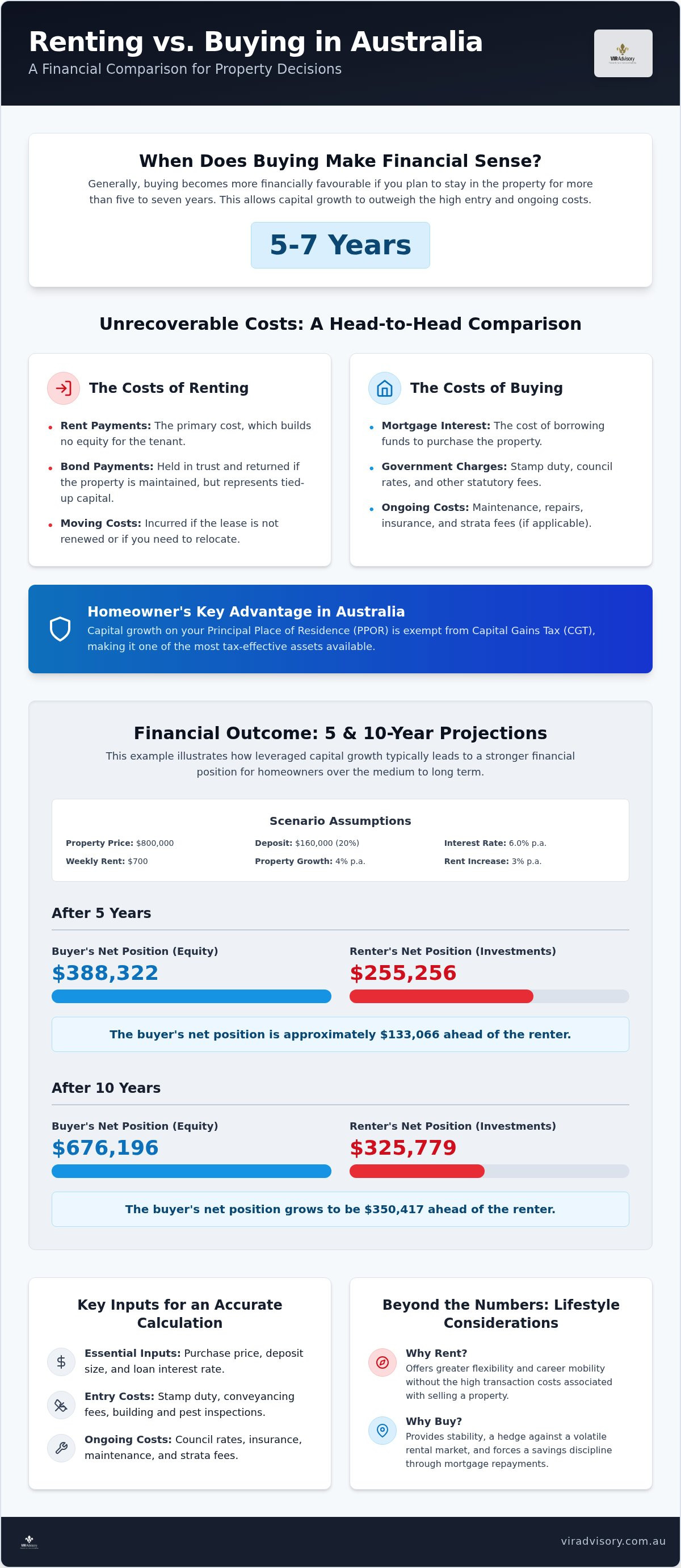
Generally, buying becomes more financially favourable if you plan to stay in the property for more than five to seven years, allowing capital growth to outweigh the high entry and ongoing costs. Renting may be more beneficial if you require flexibility, anticipate moving for work, or if your deposit could generate higher returns in other investments.
Comparing Renting vs Buying in the Australian Property Market
The decision to rent or buy a home in Australia hinges on a financial tipping point: buying is the superior option when the property's capital growth, combined with the Principal Place of Residence (PPOR) tax exemption, exceeds the unrecoverable costs associated with ownership. These costs include mortgage interest, stamp duty, council rates, and maintenance.
To make an accurate comparison, it's essential to identify the distinct costs for each choice:
- Unrecoverable Costs for Renters: The primary cost is rent itself, which builds no equity. Other expenses include bond payments and potential moving costs if the lease is not renewed.
- Unrecoverable Costs for Owners: These include mortgage interest (the cost of borrowing money), government charges like stamp duty and council rates, strata fees for apartments, and ongoing maintenance.
The significant advantage for homeowners in Australia is the tax treatment of their PPOR. Any capital growth on the home you live in is exempt from Capital Gains Tax (CGT), making it one of the most tax-effective assets available.
Lifestyle Factors vs The Numbers
While a calculator focuses on the financial data, the decision also involves personal and lifestyle considerations. Professionals often value the flexibility of renting, which allows for greater career mobility without the high costs of selling a property. Conversely, home ownership provides stability and a hedge against a volatile rental market, where rent increases and lease terminations can be disruptive. A useful approach is to assess your financial and personal objectives over a 5-year and 10-year timeframe to align your property decision with your long-term plans.
Current Market Considerations
The economic environment plays a crucial role in the rent vs buy outcome. Fluctuations in interest rates directly influence the cost of a mortgage, affecting the point at which buying becomes cheaper than renting. Similarly, property supply constraints can drive capital growth, while a tight rental market can lead to significant rent increases. A sound financial strategy, developed before starting a property search, is essential to navigate these market dynamics effectively.
Rent vs Buy Calculator Example
To illustrate how the numbers work in a real-world scenario, let's compare renting and buying a property in Australia over 5 and 10 years. This example uses simplified figures and assumptions to provide a clear comparison.
Assumptions:
- Property Purchase Price: $800,000
- Deposit (20%): $160,000
- Loan Amount: $640,000
- Interest Rate: 6.0% p.a. (Principal & Interest)
- Equivalent Weekly Rent: $700 per week ($36,400 per year)
- Upfront Buying Costs (Stamp Duty, etc.): $40,000
- Annual Ownership Costs (Rates, Insurance, Maintenance): $8,000 (1% of property value)
- Annual Property Growth: 4%
- Annual Rent Increase: 3%
- Investment Return on Deposit (if renting): 5% p.a.
5-Year Outcome
Buying Scenario:
- Property Value: Approx. $973,322 (after 4% annual growth)
- Remaining Loan: Approx. $585,000
- Total Costs Paid (Interest, Ownership Costs, Upfront Costs): Approx. $268,000
- Net Position (Equity): $973,322 (Value) - $585,000 (Loan) = $388,322
Renting Scenario:
- Total Rent Paid: Approx. $193,000
- Initial Deposit Invested ($160k + $40k saved on upfront costs): $200,000
- Value of Investment Portfolio: Approx. $255,256 (after 5% annual growth)
- Net Position: $255,256
After 5 years, the buyer's net position is approximately $133,066 ahead of the renter.
10-Year Outcome
Buying Scenario:
- Property Value: Approx. $1,184,196 (after 4% annual growth)
- Remaining Loan: Approx. $508,000
- Total Costs Paid (Interest, Ownership Costs, Upfront Costs): Approx. $496,000
- Net Position (Equity): $1,184,196 (Value) - $508,000 (Loan) = $676,196
Renting Scenario:
- Total Rent Paid: Approx. $417,000
- Value of Investment Portfolio: Approx. $325,779
- Net Position: $325,779
After 10 years, the buyer's net position is significantly stronger, standing approximately $350,417 ahead of the renter, primarily due to leveraged capital growth on the property.
Key Inputs for a Rent vs Buy Calculation
An effective rent vs buy calculator requires more than just the purchase price. To get an accurate picture, you must account for all associated costs and variables. These inputs form the foundation of a reliable financial comparison.
- Essential Inputs: The core data points are the property's purchase price, the size of your deposit, and the current variable interest rate for a home loan.
- Entry Costs: These are the one-off expenses of buying a property. They include stamp duty (which varies by state), conveyancing fees, and building and pest inspection costs. These can add up to 5% of the purchase price.
- Ongoing Ownership Costs: Beyond the mortgage, owners must budget for council and water rates, building insurance, and potential land tax if it's not their primary residence. A standard buffer of 1% of the property’s value per year is recommended for maintenance.
- The 'Rentvesting' Alternative: This strategy involves renting in a desired location while purchasing an investment property elsewhere. This allows you to enter the property market sooner and is a key variable to consider in your calculations.
Calculating the Real Cost of Borrowing
The structure of your loan significantly impacts the overall cost. An interest-only loan will have lower initial repayments but won't reduce the principal, changing the long-term calculation compared to a standard principal and interest (P&I) loan. If your deposit is less than 20%, you will likely need to pay Lenders Mortgage Insurance (LMI), a significant upfront cost that must be factored in. Using a detailed loan repayment calculator helps model these different scenarios accurately.
Capital Growth and Inflation Adjustments
The assumptions you make about the future can completely alter the outcome. A conservative estimate of 3% annual capital growth versus a more optimistic 5% will produce vastly different results over a decade. Likewise, you must adjust for rental increases over time, typically tied to inflation. Using realistic, data-driven assumptions for both property growth and rental inflation is critical for a meaningful comparison.
The Opportunity Cost: What Else Could Your Deposit Do?
A crucial element often missed by simple calculators is opportunity cost. This refers to the potential return you forgo by using your capital for one purpose over another. For example, a $200,000 deposit used for a home could have been invested in a diversified portfolio of shares or ETFs.
- Leveraged vs Unleashed Returns: A share portfolio is 100% equity, meaning a 7% return on $200,000 yields $14,000. Property, however, is a leveraged asset. A 5% capital growth on a $1,000,000 property (purchased with a $200,000 deposit) yields $50,000, demonstrating the power of leverage.
- Tax Treatment: The returns from different assets are taxed differently. Dividends from shares may come with franking credits, while property investors can benefit from negative gearing. Most importantly, the sale of your primary home (PPOR) is exempt from Capital Gains Tax.
- Capital Flexibility: Tying up capital in a property reduces liquidity. However, using a loan structure with an Offset Account vs Redraw facility can help maintain access to your funds for future investments or emergencies.
The Risks of Leverage
While leverage amplifies gains, it also magnifies risk. In a market with fluctuating interest rates, the cost of servicing a large loan can increase significantly, putting pressure on your cash flow. If the property's value decreases, you could find yourself in a position of negative equity, where your loan is larger than the asset's worth. Managing cash flow and maintaining a financial buffer are essential when using high levels of leverage.
How Lenders Assess Your Application: Rent vs Mortgage
When you switch from renting to buying, lenders assess your financial position differently. They need to be confident that you can service a mortgage, which is often a larger commitment than your current rent.
- Borrowing Capacity Calculation: Lenders calculate your borrowing capacity by analysing your income against your existing debts and living expenses. Your rental payments are considered a living expense, but when you apply for a loan, this is replaced by the projected mortgage repayment, plus a "buffer" of around 3% to ensure you can handle future rate rises.
- Household Expenditure Measure (HEM): Lenders use a benchmark like HEM to estimate your living costs. If your declared expenses are lower than this benchmark, the lender will use the higher figure, which can reduce your borrowing capacity.
- Approval Obstacles: Self-employed directors and contractors often face greater scrutiny from lenders, who require more extensive documentation to verify income stability.
- Improving Approval Prospects: You can improve your chances of approval by reducing existing debt (like credit cards and car loans), saving a consistent deposit, and maintaining a clean credit history.
The Role of a Mortgage Broker
Navigating the policies of over 30 different lenders in Australia can be complex. Each has a different appetite for risk and different criteria for assessing serviceability. A mortgage broker can assess your financial situation against various lender policies to identify which ones are most likely to approve your application on favourable terms. Securing a pre-approval before making an offer provides confidence and a clear budget for your property search.
Renting vs Buying Checklist
This checklist helps clarify which option might be better suited to your current personal and financial circumstances.
Renting May Suit You If:
- You expect to move within 5 years: The high entry and exit costs of buying (stamp duty, agent fees) often make short-term ownership financially inefficient.
- You need flexibility: Renting allows you to relocate easily for career opportunities or lifestyle changes without the commitment of a mortgage.
- Your deposit is limited: If you have not yet saved a substantial deposit (ideally 20% to avoid LMI), continuing to rent while saving can be a prudent strategy.
- Your career location may change: For professionals in industries that require frequent relocation, renting provides the necessary mobility.
Buying May Suit You If:
- You plan to stay long term: Staying in one location for 7+ years typically allows enough time for capital growth to offset the initial purchase costs.
- You have a stable income: A secure and predictable income is crucial for meeting mortgage repayments and managing ongoing property expenses.
- You have a suitable deposit: A deposit of 20% or more strengthens your application, helps you avoid LMI, and reduces your loan-to-value ratio.
- You want to build equity: Each mortgage repayment increases your ownership stake in the asset, contributing to your long-term net worth.
- You are comfortable with mortgage repayments: You have budgeted for repayments, including a buffer for potential interest rate increases, and are prepared for the financial responsibility.
Conclusion: Making an Informed Decision
The rent vs buy decision is a complex balance of cash flow management, tax implications, and potential capital growth. While online calculators provide a useful starting point, they cannot replace a bespoke assessment tailored to your financial situation, risk tolerance, and long-term objectives. Effective risk management, such as maintaining a cash buffer for rate rises or unexpected maintenance, is a critical component of successful home ownership. The next logical step is to accurately assess your current deposit position and borrowing capacity to understand what is realistically achievable.
Avoiding Common Mistakes
- Mistake 1: Ignoring entry and exit costs. Stamp duty, legal fees, and agent commissions can significantly impact your net return.
- Mistake 2: Overestimating capital growth. Assuming high short-term growth can lead to poor financial planning. It's wiser to use conservative, long-term averages.
- Mistake 3: Underestimating ongoing costs. Failing to budget for council rates, insurance, and a 1% maintenance fund can cause significant financial stress.
Securing the Right Finance Structure with VIR Advisory
Making the right decision between renting and buying requires a clear understanding of your financial position and how lenders will assess it. At VIR Advisory, we specialise in helping professionals, first-home buyers, and investors navigate the complexities of the Australian lending market.
Our focus is on providing clarity around your borrowing capacity, explaining lender requirements, and identifying the most suitable loan structures for your goals. With over 15 years of banking and finance experience, Raina Doshi provides expert guidance on everything from deposit requirements to complex lending scenarios for self-employed borrowers. For a detailed assessment of your finance options and a clear lending strategy, contact VIR Advisory.
Secure a professional finance assessment with VIR Advisory
Frequently Asked Questions
Is it better to rent or buy in Australia in 2026?
The answer depends on your timeframe and financial goals. Buying is generally better if you plan to hold the property for over 7 years, as capital growth and the PPOR tax exemption can create significant wealth. Renting may be better for those who need short-term flexibility or wish to invest their deposit in other asset classes.
How much deposit do I really need to buy a home?
While a 20% deposit is ideal to avoid Lenders Mortgage Insurance (LMI), some lenders offer loans with deposits as low as 5%. However, a smaller deposit means a larger loan, higher repayments, and the additional cost of LMI.
What are the hidden costs of buying a house in Australia?
Beyond the purchase price, you must budget for stamp duty, conveyancing fees, building and pest inspections, loan application fees, and LMI if your deposit is under 20%. Ongoing costs include council rates, insurance, strata fees (for apartments), and maintenance.
Can I use my rent history to help get a home loan?
Yes, a consistent history of paying rent on time can be used as evidence of genuine savings with some lenders. This demonstrates your ability to manage regular, large payments and can strengthen your home loan application.
Does a rent vs buy calculator account for stamp duty?
A comprehensive calculator should absolutely include stamp duty, as it is one of the largest upfront costs of buying a property. Always check that this is an input field in any tool you use.
What is rentvesting and is it a good strategy for professionals?
Rentvesting is a strategy where you rent in your desired location (often an expensive inner-city area) and buy an investment property in a more affordable area. It can be an excellent strategy for professionals who want to enter the property market without sacrificing their lifestyle or location flexibility.
How does borrowing capacity change when switching from renting to buying?
When you apply for a home loan, lenders replace your rental expense with the proposed mortgage repayment, plus a serviceability buffer (usually 3%). This means your assessed expenses increase, which can reduce your maximum borrowing capacity compared to what you might expect.
Should I pay off debt or save for a deposit first?
Generally, it's best to pay off high-interest debt like credit cards or personal loans first. This reduces your financial commitments, improves your credit score, and increases your borrowing capacity, making it easier to get approved for a home loan.

Article by
Raina Doshi
Raina Doshi has worked in banking and finance since 2011, including experience with major Australian lenders. She helps homeowners, property investors, business owners and professionals secure and structure lending solutions across home loans, refinancing, commercial finance and business lending.
Areas of expertise include residential lending, investment property finance, debt recycling, commercial property finance, equipment finance, construction finance and strategic debt structuring.
Drawing on extensive banking and finance experience, Raina helps clients navigate lender requirements, improve borrowing outcomes and structure effective finance solutions.
Disclaimer
The information in this article is general in nature and does not take into account your personal objectives, financial situation or needs. Before acting on any information, consider whether it is appropriate to your circumstances and seek professional advice.


