

Securing the right funding is critical for managing cash flow, investing in equipment, or financing expansion. For many Australian small and medium-sized enterprises (SMEs), navigating the complex landscape of lenders and products can be challenging. Business funding options are financial products designed to provide capital for operational needs or growth initiatives. These include traditional business loans, flexible working capital finance, asset finance for equipment purchases, debtor finance to unlock cash from invoices, and commercial property finance for acquiring premises. Understanding these options is the first step toward building a capital structure that supports your business objectives.
Navigating the Australian Funding Landscape: Beyond the Big Banks
For Australian SMEs, the business funding landscape extends far beyond the "Big Four" banks. A growing market of non-bank lenders, private financiers, and specialist institutions offers a diverse range of products tailored to specific business needs. This shift provides greater choice but also requires a more strategic approach to selecting and structuring finance.
Making sound financial decisions is crucial for the stability and growth of any business. It involves a clear-eyed assessment of your financial position, operational requirements, and long-term goals. The key is to move beyond simply seeking a loan and instead develop a comprehensive funding strategy that aligns with your specific commercial objectives.
The Difference Between Debt and Equity Finance
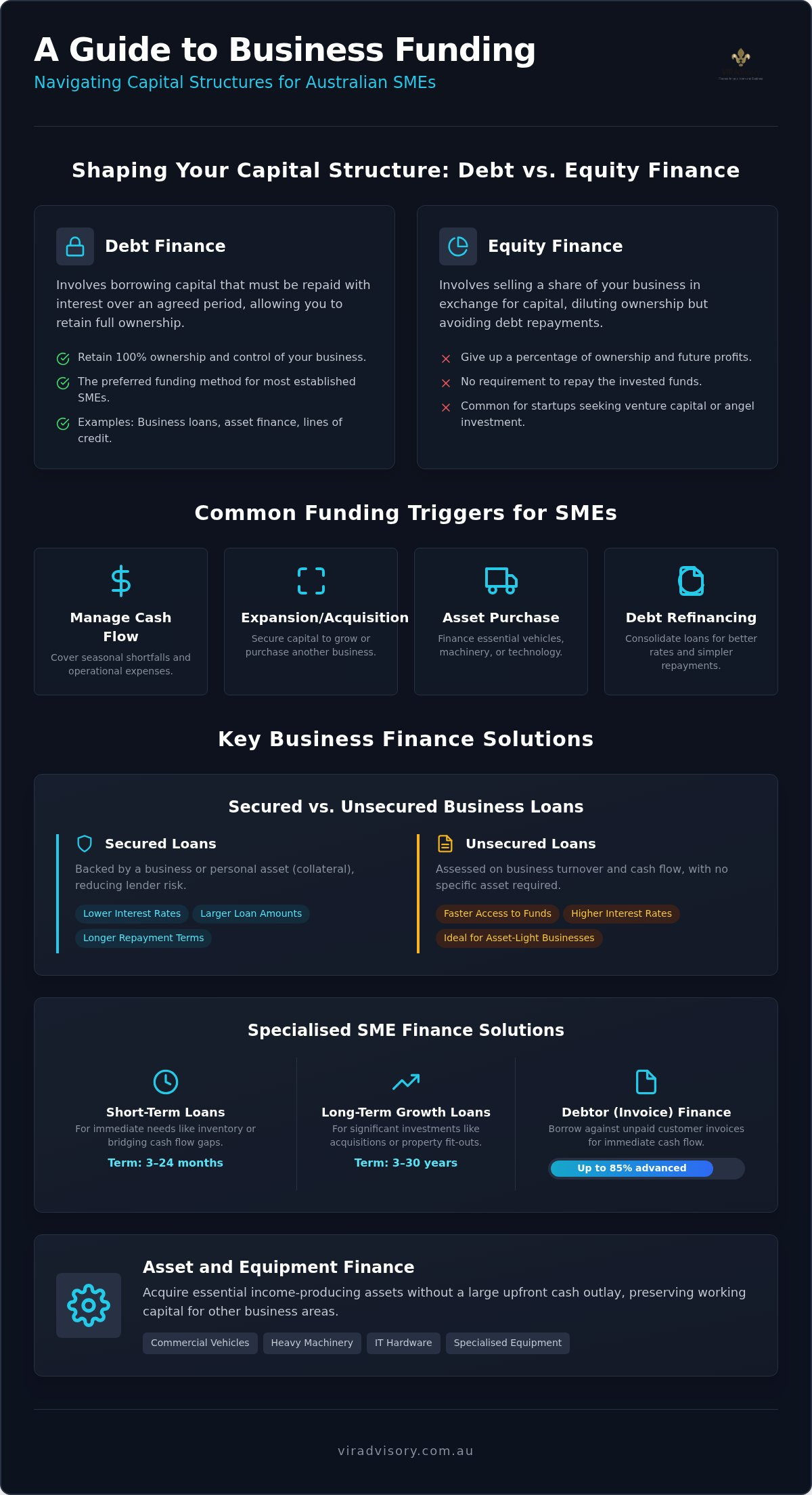
Understanding the fundamental difference between debt and equity is essential for shaping your company's capital structure.
- Debt finance involves borrowing capital that must be repaid, with interest, over an agreed period. This allows you to retain full ownership and control of your business. Common examples include business loans, asset finance, and lines of credit.
- Equity finance involves selling a share of your business in exchange for capital. While you don't have to repay the funds, you give up a percentage of ownership and future profits. This is common for startups seeking venture capital or angel investment.
The choice between debt and equity depends on your tolerance for risk, desire for control, and the stage of your business. Most established SMEs focus on debt finance to fund growth without diluting ownership.
Common Funding Triggers for Australian SMEs
Businesses seek funding for a variety of strategic and operational reasons. Common triggers include:
- Managing Cash Flow: Covering seasonal shortfalls, paying suppliers while awaiting customer payments, or meeting unexpected expenses.
- Expansion or Acquisition: Securing capital to purchase another business, open a new location, or enter a new market.
- Asset Purchase: Financing essential vehicles, machinery, or technology to improve productivity and service delivery.
- Debt Refinancing: Consolidating existing loans to secure better interest rates, simplify repayments, or improve the overall debt structure. You can learn more about this in our guide to business loan refinancing.
Business Loans and Working Capital Finance
Business loans and working capital facilities are two of the most common forms of debt finance for SMEs. While both provide access to funds, they are designed for different purposes and should be structured to meet specific business objectives. A skilled finance broker can navigate the market to identify lenders and products with terms that align with your financial position and requirements.
Working capital finance is specifically designed to support the day-to-day operational liquidity of a business. It addresses the timing gap between paying expenses (like wages and suppliers) and receiving revenue from customers, ensuring smooth and uninterrupted operations.
Secured vs. Unsecured Business Loans
Lenders typically offer two main categories of business loans, determined by whether an asset is used as collateral.
- Secured Business Loans: These loans are secured against a business or personal asset, such as commercial property, residential property, or high-value equipment. By providing security, the lender's risk is reduced, which often results in access to larger loan amounts, lower interest rates, and longer repayment terms.
- Unsecured Business Loans: These loans do not require a specific asset as collateral. Instead, lenders assess the application based on the business's turnover, cash flow, and credit history. They are often used by businesses with strong revenue but limited physical assets, such as professional services or tech companies. The interest rates are typically higher to reflect the lender's increased risk.
Specialised SME Finance Solutions
Beyond standard term loans, specialised finance products are available to meet tactical and strategic needs:
- Short-Term Loans: Designed for immediate needs like purchasing inventory, bridging a cash flow gap, or funding a small project. They typically have terms of 3 to 24 months.
- Long-Term Growth Loans: Used for significant investments such as business acquisitions, major equipment purchases, or commercial property fit-outs. Terms can extend from 3 to 30 years, depending on the loan's purpose and security.
- Debtor Finance (Invoice Finance): A solution that allows you to borrow against the value of your unpaid customer invoices. A lender advances up to 85% of the invoice value upfront, providing immediate cash flow without waiting 30, 60, or 90 days for payment.
Asset and Equipment Finance: Unlocking Operational Potential
For many businesses, purchasing essential equipment, vehicles, or technology outright can place significant strain on working capital. Asset finance is a strategic alternative that allows you to acquire and use these assets without a large upfront cash outlay, preserving liquidity for other areas of the business.
This form of commercial finance is designed to fund income-producing assets, from commercial vehicles and heavy machinery to IT hardware and specialised medical equipment. A key advantage is that the repayment structure can often be tailored to match the revenue generated by the asset, creating a self-sustaining investment.
Leasing vs. Hire Purchase: Which is Right for You?
Two primary structures for asset finance in Australia are finance leases and commercial hire purchase agreements. The right choice depends on whether you want eventual ownership of the asset.
- Finance Lease: A lender purchases the asset and rents it to your business for an agreed term. You have full use of the equipment, but the lender retains ownership. At the end of the term, you can typically choose to return the asset, extend the lease, or purchase it for its residual value. Lease payments are generally tax-deductible.
- Commercial Hire Purchase (CHP): Under a CHP, the lender also purchases the asset, but you agree to hire it with the intention of taking ownership. You make regular payments over the term, and once the final payment (and any residual) is made, legal title transfers to your business. Businesses using this method can often claim depreciation and the interest portion of the payments as tax deductions.
Vehicle and Fleet Finance
Vehicle finance is a specialised form of asset finance for acquiring single commercial vehicles or an entire fleet. It allows businesses to access cars, vans, utes, or trucks without tying up capital. Lenders offer tailored solutions, including novated leasing, which can be an attractive employee benefit for retaining key staff by allowing them to package a vehicle and its running costs through their pre-tax salary.
Government Grants and Alternative Funding Pathways
While debt finance is the most common funding route, it's worth exploring other available options. Government grants and alternative funding models can supplement a traditional capital structure, though they come with their own unique requirements and considerations.
Grants from Federal and State governments are periodically available to support specific industries, innovation, or regional development. However, they are highly competitive and have strict eligibility criteria. It is generally advisable to view grants as a potential bonus rather than a primary funding strategy.
Navigating the Grant Application Process
Successfully securing a grant requires meticulous preparation. Key considerations include:
- Eligibility Criteria: Most grants have strict rules regarding industry, business size, location, and project scope. Ensure you meet all requirements before investing time in an application.
- A Clear Business Plan: Applications must clearly articulate how the grant funds will be used to achieve specific, measurable outcomes that align with the grant's objectives.
- Reputable Resources: Use official government websites like business.gov.au to find legitimate grant opportunities and avoid misleading third-party services.
Commercial Lending Through SMSF
A sophisticated funding strategy for some business owners is using a Self-Managed Super Fund (SMSF) to acquire a commercial property that can then be leased back to their business. This is achieved through a Limited Recourse Borrowing Arrangement (LRBA).
This structure allows your business to pay rent directly to your super fund, effectively using business revenue to build your retirement wealth. However, the regulatory framework set by the Australian Taxation Office (ATO) is extremely strict. This is a complex area of finance where expert, independent advisory is non-negotiable to ensure full compliance.
Common Business Loan Requirements
Lenders assess funding applications by analysing a business's ability to service and repay debt. To do this, they require a comprehensive set of documents that provide a clear picture of your financial health and history. Preparing this information in advance can significantly streamline the application process.
Key requirements typically include:
- ABN and GST Registration: Lenders require a valid Australian Business Number (ABN) and will check how long it has been active. Most also require the business to be registered for GST.
- Trading History: Most mainstream lenders prefer a minimum of 1-2 years of trading history, although some specialist lenders can assist newer businesses.
- Annual Turnover: Lenders have minimum turnover thresholds, which vary depending on the loan type and amount.
- Business Activity Statements (BAS): Recent BAS statements (typically the last 4 quarters) are used to verify reported turnover and confirm tax obligations are current.
- Business Bank Statements: Usually 6-12 months of statements are required to demonstrate consistent cash flow, revenue patterns, and responsible account management.
- Financial Statements: For larger or more complex loans, lenders will require full financial statements, including Profit & Loss statements and Balance Sheets, often for the past two financial years.
- Credit History: Lenders will check both the business's credit file and the personal credit files of the directors.
- Existing Debts & ATO Liabilities: You must disclose all existing business and personal debts. Lenders will also check for any outstanding ATO debt through an ATO portal check.
Lenders use this information to assess risk, calculate your borrowing capacity, and determine whether your business generates sufficient, consistent profit to comfortably meet the proposed loan repayments.
Which Funding Option Is Right for Your Business?
Choosing the correct type of finance is crucial. Aligning the funding product with its intended purpose ensures you are not paying for features you don't need or locking yourself into an unsuitable structure. Here is a comparison of common options:
-
Working Capital Finance
Best for: Managing day-to-day cash flow, paying wages and suppliers, or purchasing inventory.
Example: A retail business uses a line of credit to purchase extra stock ahead of the busy Christmas season, repaying the facility as the sales revenue comes in during January and February. -
Asset Finance
Best for: Acquiring vehicles, essential equipment, or machinery to improve operations.
Example: A construction company uses a commercial hire purchase to acquire a new excavator, with repayments structured to align with the income generated from its contracts. -
Debtor Finance
Best for: Unlocking cash tied up in unpaid customer invoices.
Example: A manufacturing business that offers 60-day payment terms to its clients uses debtor finance to receive up to 80% of an invoice's value immediately, allowing it to pay for raw materials for the next production run. -
Business Loans (Term Loans)
Best for: Long-term strategic investments like business expansion, acquisitions, or significant growth projects.
Example: A successful cafe secures a 5-year secured business loan to fund the fit-out of a second location, using the existing cafe's property as security. -
Commercial Property Finance
Best for: Purchasing the premises from which your business operates, or buying a commercial investment property.
Example: A dental practice obtains a commercial property loan to buy its own clinic, stopping rent payments and building a valuable business asset instead.
Tips for a Stronger Funding Application
Presenting a well-organised and financially sound application is key to securing approval on favourable terms. Proactive financial management demonstrates to lenders that you are a responsible and low-risk borrower.
To improve your approval prospects, focus on these areas:
- Maintain Current Financial Statements: Ensure your profit & loss statements and balance sheets are up-to-date and accurately reflect your business's performance.
- Lodge Tax and BAS on Time: Lenders view on-time lodgements as a sign of a well-run business. Delays can be a red flag.
- Manage ATO Debt: If you have an outstanding tax debt, have a formal payment arrangement in place with the ATO and ensure you are meeting its terms.
- Separate Personal and Business Finances: Use dedicated business bank accounts and credit cards. Mingling funds makes it difficult for lenders to assess business performance and can suggest poor financial discipline.
- Maintain Cash Reserves: A healthy cash buffer in your bank account demonstrates financial stability and the ability to handle unexpected downturns.
- Present Clean Bank Statements: Avoid regular overdrafts, dishonoured payments, or excessive personal spending from the business account in the months leading up to an application.
For more detailed information, see our guide on understanding business loan eligibility in Australia.
How VIR Advisory Helps Businesses Access Finance
Navigating the commercial finance market requires specialist expertise. The difference between an adequate funding outcome and an optimal one often lies in the quality of the advice, the breadth of lender access, and the strategic structuring of the facility. A transactional broker might simply find a loan; a specialist adviser helps you build the right capital structure.
At VIR Advisory, Raina Doshi leverages over 15 years of banking and finance experience to assist businesses with their funding requirements. The focus is on a methodical and technical approach to securing finance that aligns with your commercial objectives.
The Process: From Initial Assessment to Loan Settlement
Our process is designed to ensure a thorough and efficient outcome. It begins with a detailed assessment of your financial position, funding needs, and business goals. We then manage the entire process on your behalf:
- Lender Selection and Negotiation: We identify suitable lenders from a broad network, including major banks and specialist non-bank institutions, and negotiate terms on your behalf.
- Application Preparation: We assist in compiling and presenting your financial information to meet lender requirements, ensuring your application is positioned for a positive outcome.
- Strategic Structuring: We provide guidance on structuring your loans—covering commercial finance, asset finance, and debtor finance—to optimise cash flow, minimise costs, and support your long-term objectives.
- Ongoing Review: We believe in long-term relationships, ensuring your funding structure continues to serve your business as it evolves.
Take the Next Step in Your Financial Strategy
A well-structured funding facility is a cornerstone of business success. If you are ready to explore your options for small business loans in Australia, we can provide the clarity and expertise you need. Your business objectives require a robust financial foundation; let’s work on building it.
Book a strategic 30-minute funding consultation with Raina Doshi to discuss your business loan requirements.
Frequently Asked Questions (FAQs)
What are the main types of small business funding in Australia?
The main types include secured and unsecured business loans, lines of credit, working capital finance, asset finance (for equipment and vehicles), debtor finance (invoice financing), and government grants. The best option depends on your specific needs, such as managing cash flow, purchasing assets, or funding growth.
How do I know if my business is eligible for a commercial loan?
Lenders typically assess eligibility based on your ABN registration, trading history (usually 1-2 years), annual turnover, credit score, and demonstrated ability to repay the loan. They will require financial documents like bank statements, BAS, and profit & loss statements to verify your financial position.
Can I get a business loan if the big banks have already declined my application?
Yes. Many non-bank and specialist lenders in Australia have different lending criteria and risk appetites compared to the major banks. They can often provide solutions for businesses that don't fit the traditional banking model. A finance broker can help you access these alternative options.
What is the difference between secured and unsecured business finance?
A secured loan is backed by an asset (like property or equipment) that the lender can claim if you default. This lowers the lender's risk, often resulting in better rates. An unsecured loan does not require collateral and is approved based on the business's cash flow and creditworthiness, usually at a higher interest rate.
How does asset finance help with my business cash flow?
Asset finance allows you to acquire essential equipment or vehicles without a large upfront payment. Instead, you pay for the asset in manageable instalments over its useful life. This preserves your working capital for other critical business expenses like wages, inventory, and marketing.
Is it possible to use my SMSF to fund a commercial property for my business?
Yes, it is possible through a Limited Recourse Borrowing Arrangement (LRBA). This allows your SMSF to purchase a commercial property to be leased by your business. However, the rules are extremely strict and complex, and it is essential to seek expert financial advice to ensure compliance with ATO regulations.
What documents do I need to prepare for a small business funding application?
Commonly required documents include 6-12 months of business bank statements, the last 1-2 years of financial statements (P&L, Balance Sheet), recent Business Activity Statements (BAS), company and personal tax returns, and identification for all directors.
How can a finance broker help me find better terms than a direct lender?
A finance broker has access to a wide panel of lenders, including those who do not deal directly with the public. They understand the different lender appetites and can match your application to the right institution. They also negotiate on your behalf to secure more favourable interest rates, fees, and loan structures.

Article by
Raina Doshi
Raina Doshi has worked in banking and finance since 2011, including experience with major Australian lenders. She helps homeowners, property investors, business owners and professionals secure and structure lending solutions across home loans, refinancing, commercial finance and business lending.
Areas of expertise include residential lending, investment property finance, debt recycling, commercial property finance, equipment finance, construction finance and strategic debt structuring.
Drawing on extensive banking and finance experience, Raina helps clients navigate lender requirements, improve borrowing outcomes and structure effective finance solutions.
Disclaimer
The information in this article is general in nature and does not take into account your personal objectives, financial situation or needs. Before acting on any information, consider whether it is appropriate to your circumstances and seek professional advice.


