

For many Australian business owners, a loan is the fuel for growth. But what happens when the terms of that loan start holding you back? High interest rates, restrictive conditions, and clunky repayment schedules can drain your cash flow and limit your potential. This is where strategic refinancing comes in.
Business loan refinancing is more than just chasing a lower interest rate; it’s about restructuring your debt to better suit your business’s current needs and future ambitions. It’s an opportunity to lower your repayments, simplify your finances, and unlock capital to invest back into your operations.
This guide will walk you through the practical steps of business loan refinancing in Australia, helping you understand when it’s the right move and how to navigate the process to secure a better financial future for your business.
Understanding Business Loan Refinancing in the Australian Market
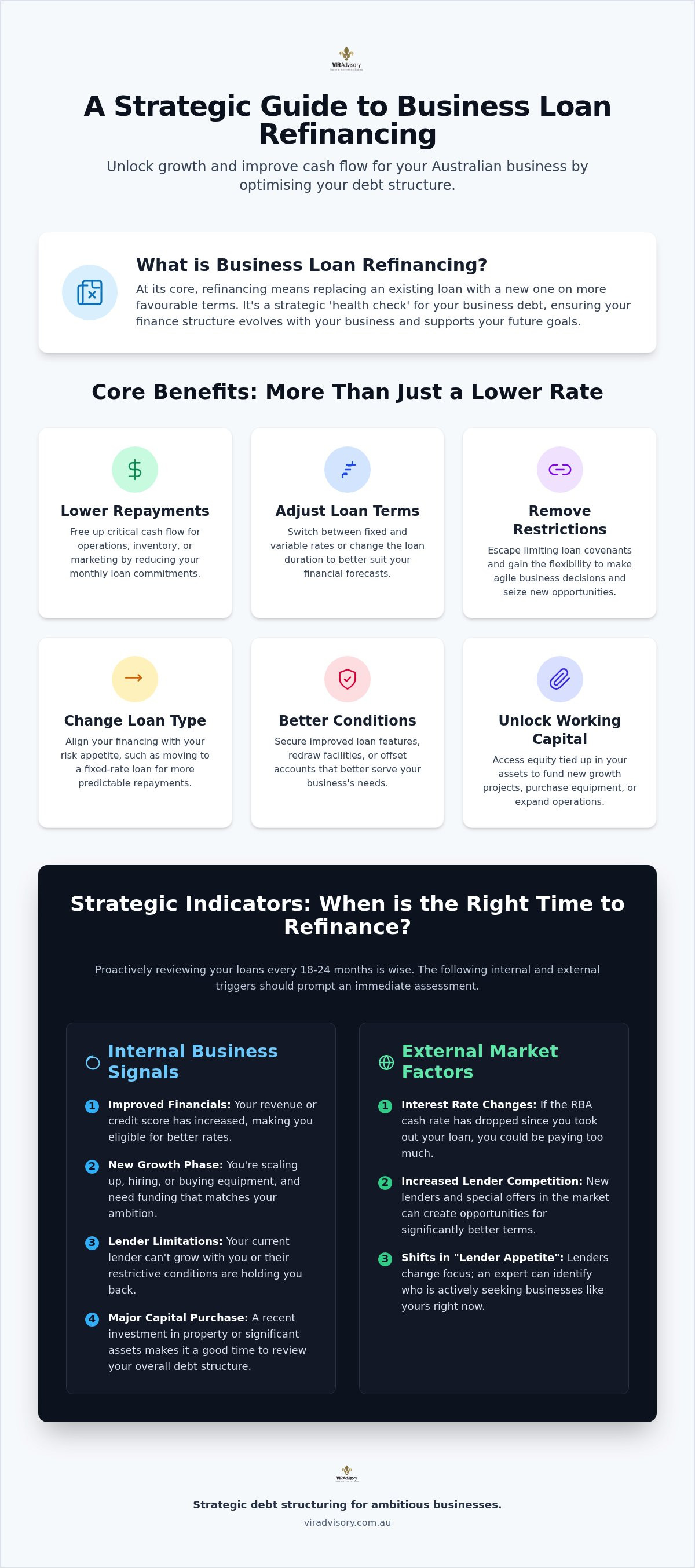
At its core, business loan refinancing means replacing an existing loan with a new one that offers more favourable terms. Think of it as a "health check" for your business debt. Just as your business evolves, so should your finance structure. A loan that was a perfect fit two or three years ago might now be inefficient or costly.
The goal is to find a solution that improves your financial position, whether that’s through lower monthly repayments, better loan conditions, or accessing equity you’ve built up. In Australia’s competitive lending market, with a wide range of banks and non-bank lenders all vying for business, there are often better deals available than the one you first signed.
The Core Concept: More Than Just a Lower Rate
While a lower interest rate is a major drawcard, effective refinancing goes much deeper. It’s an opportunity to realign your entire debt structure with your current business goals. A comprehensive refinance can:
- Lower your monthly repayments: This is the most immediate benefit, freeing up cash flow that can be used for inventory, marketing, or other operational costs.
- Change your loan type: You might switch from a variable-rate loan to a fixed-rate loan for more predictable repayments, or vice versa.
- Adjust your loan term: You could extend the loan term to reduce repayment pressure or shorten it to pay off the debt faster and save on total interest.
- Remove restrictive conditions: Your current loan might have covenants that limit your ability to take on other funding or make certain business decisions. A new loan can offer greater flexibility.
- Unlock working capital: By refinancing, you may be able to access cash tied up in your assets (equity) to fund growth projects.
Ultimately, refinancing is the strategic reorganisation of your business debt to better support your operational needs and growth plans.
Why Australian Business Owners are Refinancing Now
The Australian lending landscape is constantly changing, creating both challenges and opportunities for SMEs. Several key factors make now a sensible time for business owners to review their finances:
- A Competitive Lending Market: The rise of non-bank and specialist lenders has increased competition. These lenders often have a greater appetite for specific industries or more flexible lending criteria than traditional banks, creating more options for borrowers.
- Shifting Interest Rates: Even small movements in interest rates can have a significant impact on your profit margins. Refinancing allows you to secure a more competitive rate and protect your bottom line from market volatility.
- Business Growth and Change: As your business grows, its financial needs change. A loan taken out during the start-up phase is rarely suitable for a business in a high-growth or expansion phase. Refinancing ensures your funding matches your current scale and future ambitions.
Strategic Indicators: When is the Right Time to Refinance?
Timing is crucial when it comes to refinancing. Acting proactively, rather than waiting for a cash flow crisis, puts you in the strongest possible negotiating position. It’s wise to conduct a "debt health check" every 18-24 months, but certain triggers—both internal and external—should prompt an immediate review.
Identifying Shifts in Your Business Lifecycle
Your business isn't static, and your financing shouldn't be either. Look for these internal signs that it might be time to explore your options:
- Your financial position has improved: If your revenue has grown, your profits are stronger, or your credit score has improved since you took out the loan, you are likely to qualify for a much better deal. Lenders reward stability and performance.
- You're moving into a new phase: The funding needs of a start-up are very different from those of a business looking to scale up, hire more staff, or purchase new equipment. Your debt structure should support your next phase of growth, not hinder it.
- Your current lender is holding you back: Are you hitting a lending ceiling with your current bank? Do their strict conditions prevent you from seizing new opportunities? If your lender can't grow with you, it's time to find one that can.
- You've made a major capital purchase: If you've recently invested in significant assets like property or equipment, it’s a good time to review your overall debt structure to ensure it remains efficient.
Market Conditions and the Australian Lending Landscape
Beyond your own business, the broader economic environment plays a huge role. Staying aware of these external factors can help you time your refinance perfectly:
- Changes in interest rates: Official cash rate movements by the Reserve Bank of Australia (RBA) influence lender rates. If rates have dropped since you took out your loan, you could be paying too much.
- Increased lender competition: Pay attention to the market. New lenders or special offers can create opportunities to secure significantly better terms than what was available a year or two ago.
- Shifts in "lender appetite": Lenders sometimes change their focus, favouring certain industries or asset types. An experienced broker will know which lenders are actively seeking businesses like yours and are therefore more likely to offer competitive terms.
Refinancing vs. Debt Consolidation: Choosing Your Pathway
While often discussed together, refinancing and debt consolidation serve slightly different purposes. Understanding the distinction is key to choosing the right strategy for your business.
- Refinancing typically involves replacing one loan with another. For example, replacing your primary $500,000 business term loan with a new one at a lower rate.
- Debt Consolidation involves combining multiple debts into a single, new loan. For instance, rolling an overdraft, a credit card balance, and an equipment loan into one term loan with one regular repayment.
Consolidation is a form of refinancing, and it’s a powerful tool for simplifying your finances and improving cash flow. By combining several facilities, you can often secure a lower overall interest rate and reduce the administrative burden of managing multiple due dates and lenders. To explore the different funding options available, see our overview of services offered.
Streamlining Cash Flow Through Consolidation
For many SMEs, juggling multiple debts is a major headache. You might have a term loan for initial setup, separate asset finance for vehicles, and an overdraft for daily cash flow. Consolidation offers clear benefits:
- One Repayment: It simplifies your bookkeeping and reduces the mental load of tracking different payment schedules.
- Improved Cash Flow: By blending high-interest debts (like credit cards) with lower-interest ones and potentially extending the loan term, you can significantly reduce your total monthly outgoing.
- A Clearer Financial Picture: With a single loan, it’s much easier to see your total business debt and manage it effectively.
Practical Example: A construction business might have a $150,000 loan on an excavator, a $50,000 overdraft, and $20,000 in credit card debt. By consolidating these into a single $220,000 secured business loan, they could achieve a lower blended interest rate and one simple monthly repayment, freeing up vital cash for wages and materials.
Unlocking Equity for Growth and Expansion
Refinancing is also a powerful way to access the equity in your assets—both commercial and residential. If you own your business premises or have a residential property with significant equity, you can use it to secure better terms or borrow additional funds.
This is often called "cash-out" refinancing. You refinance your existing loan for a higher amount, and the difference—the "cash out"—is made available to you. This capital can be used for almost any business purpose, such as:
- Funding an expansion or opening a new location.
- Purchasing new equipment or technology to improve efficiency.
- Buying out a business partner.
- Boosting working capital to manage seasonal fluctuations.
Using property equity can give you access to larger loan amounts and much lower interest rates than unsecured business loans, making it one of the most cost-effective ways to fund major growth initiatives.
Navigating the Refinancing Process with Precision
A successful refinance requires a structured approach. While a good finance broker will handle the heavy lifting, understanding the steps involved will help you prepare and ensure a smooth process.
The typical journey follows five key stages:
- Initial Assessment: The first step is a thorough review of your current loans. We look at your interest rates, fees, loan terms, and any restrictive conditions. We also discuss your business goals to understand what you want to achieve through refinancing.
- Gathering Documentation: Lenders need a clear picture of your business's financial health. You’ll typically need to provide documents like financial statements (Profit & Loss, Balance Sheet), recent tax returns, and bank statements.
- Market Comparison and Strategy: Your broker will take your information to their network of lenders to find the best options. This goes beyond comparing interest rates; it involves finding the right loan structure and a lender who understands your industry.
- Application and Negotiation: Once the best-fit lender is identified, your broker will prepare and submit the application on your behalf, presenting your business in the best possible light and negotiating the terms.
- Approval and Settlement: After the new loan is approved, the new lender pays out ("settles") your old loan, and your new repayment schedule begins.
Presenting a Strong Case to Lenders
Lenders want to see more than just numbers on a page; they want to understand the context behind them. Presenting a clear and compelling case is critical to getting your application approved on the best possible terms.
- Explain your performance: Don't just hand over your financial statements. Be prepared to talk through your revenue trends, profit margins, and key business drivers. A broker can help you frame this information effectively.
- Be upfront about challenges: If your business had a one-off bad quarter due to a specific event (like a major client leaving or a delayed project), it's crucial to explain it. A lender is more likely to be understanding if you can show it was an isolated incident and not a sign of ongoing instability.
- Show your vision: Lenders are investing in your future. Clearly articulate your plans for the business and how the refinanced loan will help you achieve them. Whether it’s buying a new machine to increase output or hiring new staff to expand your service area, a clear plan builds confidence.
The best way to explain a one-off financial dip is to address it proactively with a brief, clear explanation supported by evidence showing the business has since recovered and is back on track.
Avoiding Common Pitfalls in the Refinancing Journey
While the benefits are significant, there are potential traps to be aware of. Working with an experienced adviser can help you navigate them.
- Understanding Break Costs: If you have a fixed-rate loan, leaving it early may trigger substantial "break costs" or exit fees. It's essential to calculate these costs to ensure the long-term savings from refinancing outweigh the upfront expense.
- The Risk of Over-Leveraging: It can be tempting to borrow the maximum amount available, but it’s vital to maintain a sustainable level of debt. A good broker will help you assess how much debt your business can comfortably service without putting undue stress on your cash flow.
- Not All Rates Are Created Equal: The loan with the lowest headline interest rate isn't always the best option. It might come with higher fees, stricter conditions, or less flexibility. It’s important to compare the total cost and features of a loan, not just the rate.
Optimising Your Debt Structure with VIR Advisory
Navigating the world of business loan refinancing can be complex and time-consuming. At VIR Advisory, we act as your expert guide, simplifying the process and ensuring you secure a finance structure that genuinely supports your business growth.
With over 15 years of banking and finance experience, our principal, Raina Doshi, understands the intricacies of the Australian lending market. We take a personalised approach, taking the time to understand your business, its challenges, and its ambitions. This allows us to advocate for you effectively and find solutions that a bank, with its rigid criteria, might overlook.
The Value of a Strategic Finance Broker
Working with VIR Advisory gives you a distinct advantage. We are not tied to any single lender; we are your partner, working solely in your best interest.
- Access to a Wide Network: We have strong relationships with a diverse panel of banks and non-bank lenders across Australia. This means more options and more competition for your business, leading to better outcomes.
- Expert Guidance: We translate the jargon and complexities of commercial finance into plain English, empowering you to make confident, informed decisions. We handle the paperwork, the negotiations, and the follow-up, so you can stay focused on running your business. Learn more about us and our client-focused philosophy.
- A Long-Term Partner: Our goal is to build a lasting relationship. We provide ongoing support and advice, helping you adapt your financial strategy as your business continues to grow and evolve.
Securing Your Business's Long-Term Financial Health
A well-structured loan is the foundation of a financially healthy business. It provides stability, improves cash flow, and creates the capacity for future growth. The peace of mind that comes from knowing your debt is working for you, not against you, is invaluable.
The journey starts with a simple, no-obligation conversation. We'll listen to your situation, answer your questions, and provide a clear assessment of your refinancing opportunities.
Ready to ensure your business finance is aligned with your growth goals? Book a 30-minute strategic consultation with Raina Doshi today and take the first step towards a stronger financial future.
Frequently Asked Questions (FAQs)
Is business loan refinancing a good idea in the current Australian market?
For many businesses, yes. The Australian market is highly competitive, with both traditional banks and a growing number of non-bank lenders offering diverse products. This competition can lead to better rates and more flexible terms. If your business's financial situation has improved or if market rates have fallen since you took out your loan, refinancing is often a very smart move.
How much does it cost to refinance a business loan in Australia?
Costs can vary. You may encounter application fees with the new lender, as well as government charges. The most significant potential cost is the "break fee" or "exit fee" from your current lender, especially on fixed-rate loans. A thorough cost-benefit analysis is essential to ensure the savings from the new loan will outweigh these upfront costs over time.
Can I refinance my business loan if my credit score has recently improved?
Absolutely. An improved credit score is one of the best reasons to consider refinancing. It demonstrates to lenders that your risk profile has decreased, which often makes you eligible for a lower interest rate and more favourable terms. It's a key indicator that you may be paying too much on your current loan.
What is the difference between loan modification and full refinancing?
Loan modification involves changing the terms of your existing loan with your current lender (e.g., extending the term or temporarily reducing payments). Full refinancing involves taking out a completely new loan, usually with a new lender, to pay off and replace the old one. Refinancing typically provides access to a much wider range of options and more significant savings.
How long does the business loan refinancing process typically take?
The timeline can range from a few weeks to a couple of months. It depends on the complexity of your financial situation, the type of loan, and the efficiency of the lenders involved. Having all your documentation organised upfront can significantly speed up the process.
Do I need to provide property as security when refinancing a business loan?
Not always. There are both secured and unsecured business loan options available for refinancing. However, providing property as security (a secured loan) will almost always result in a much lower interest rate and allow you to borrow a larger amount compared to an unsecured loan.
Can I consolidate my personal debt with my business loan through refinancing?
This is generally not recommended and often not permitted by lenders. Business loans are for business purposes, and lenders like to see a clear separation between personal and business finances. Attempting to mix them can complicate your application and your accounting. It's better to manage personal and business debts separately.
What documents will my broker need to start the refinancing assessment?
To begin, a broker will typically ask for your recent business financial statements (Profit & Loss, Balance Sheet), business and personal tax returns for the last two years, recent bank statements, and details of your existing loans (including current interest rates and balances). For secured loans, they will also need details of the property being offered as security.

Article by
Raina Doshi
Raina Doshi has worked in banking and finance since 2011, including experience with major Australian lenders. She helps homeowners, property investors, business owners and professionals secure and structure lending solutions across home loans, refinancing, commercial finance and business lending.
Areas of expertise include residential lending, investment property finance, debt recycling, commercial property finance, equipment finance, construction finance and strategic debt structuring.
Drawing on extensive banking and finance experience, Raina helps clients navigate lender requirements, improve borrowing outcomes and structure effective finance solutions.
Disclaimer
The information in this article is general in nature and does not take into account your personal objectives, financial situation or needs. Before acting on any information, consider whether it is appropriate to your circumstances and seek professional advice.


