

Securing business finance in Australia can feel like navigating a maze. Lenders’ requirements are often unclear, the paperwork can be overwhelming, and it’s hard to know where your business truly stands. Many business owners are left wondering: what do I actually need to prove to get my loan approved?
This guide provides a clear, practical roadmap to understanding and meeting business loan eligibility criteria in 2026. We will demystify the process, replacing complex jargon with straightforward advice. You will learn what lenders look for, how to prepare your application for success, and the specific steps you can take to strengthen your borrowing capacity.
Whether you're looking to scale, manage cash flow, or invest in new assets, mastering these fundamentals will move you from a position of uncertainty to one of confidence.
Business Loan Eligibility Checklist (2026)
While every lender has unique policies, most Australian business loan applications are assessed against a core set of criteria. Before you apply, use this checklist to see where your business stands. This is the foundation of your approval strategy.
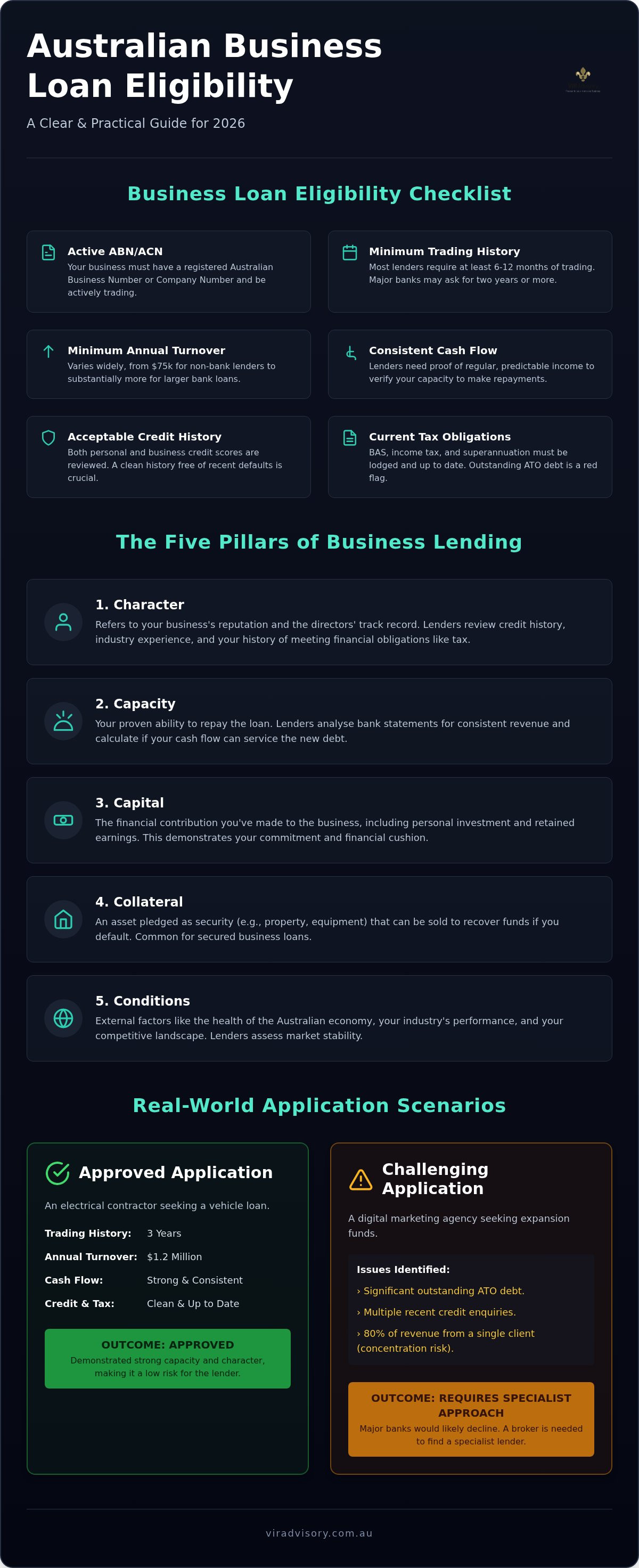
- ✅ Active ABN/ACN: Your business must have a registered Australian Business Number (ABN) or Australian Company Number (ACN) and be actively trading.
- ✅ Minimum Trading History: Most lenders require at least 6 to 12 months of trading history. Some, particularly major banks, may ask for two years or more.
- ✅ Minimum Annual Turnover: This varies significantly. Non-bank lenders might offer unsecured loans for businesses with as little as $75,000 in annual revenue, while larger loans and bank financing will require substantially more.
- ✅ Consistent Cash Flow: Lenders need to see regular, predictable income flowing through your business bank account. This proves you have the capacity to make repayments.
- ✅ Acceptable Credit History: Both your personal and business credit scores will be reviewed. A clean history free of recent defaults is crucial, although specialist lenders can assist with more complex credit profiles.
- ✅ Current Tax Obligations: Your Business Activity Statements (BAS), income tax, and employee superannuation payments should be lodged and up to date. An outstanding ATO debt is a common reason for rejection.
- ✅ Supporting Financial Documentation: Be prepared to provide documents like bank statements, profit and loss statements, balance sheets, and tax returns.
Understanding the Five Pillars of Business Lending
Lenders in Australia, from the 'Big Four' banks to specialised non-bank financiers, assess risk using a framework often called the "Five Cs of Credit." Understanding these pillars helps you see your business from their perspective and prepare a stronger application.
- 1. Character: This refers to your business's reputation and the track record of its directors. Lenders look at your credit history, your experience in the industry, and your history of meeting financial obligations, such as tax and supplier payments. A clean ATO portal and a good credit score are powerful indicators of strong character.
- 2. Capacity: This is your proven ability to repay the loan. Lenders analyse your business bank statements to confirm consistent revenue and calculate your Debt Service Cover Ratio (DSCR)—a measure of whether your cash flow is sufficient to cover your proposed new loan repayments on top of existing debts.
- 3. Capital: This is the financial contribution you and your business have made. It includes the money you’ve personally invested, as well as retained earnings. Having a healthy amount of capital in the business demonstrates your commitment and shows you have a financial cushion.
- 4. Collateral: Also known as security, this is an asset you pledge to the lender that can be sold to recover their funds if you are unable to repay the loan. This is most common for secured business loans and can include residential or commercial property, equipment, or invoices.
- 5. Conditions: Lenders consider external factors that could impact your business. This includes the health of the Australian economy, your specific industry's performance (identified by your ANZSIC code), and your competitive landscape. They want to ensure your business is operating in a stable market.
Practical Examples: Approved vs. Challenging Applications
Seeing how these pillars apply in the real world makes the criteria easier to understand.
Approved Application Example:
- Business: An electrical contracting company seeking an unsecured loan for a new vehicle.
- Trading History: 3 years.
- Annual Turnover: $1.2 million.
- Cash Flow: Strong and consistent, with regular payments from multiple clients.
- Credit & Tax: No defaults on credit file and all ATO obligations are up to date.
- Outcome: Approved. The business demonstrated strong capacity, good character, and a solid trading history, making it a low risk for the lender even without property security.
Challenging Application Example:
- Business: A digital marketing agency seeking funds for expansion.
- Trading History: 2 years.
- Annual Turnover: $500,000.
- Issues Identified:
- A significant ATO debt from a previous financial year.
- Multiple credit enquiries in the last three months from applying with several lenders online.
- 80% of revenue comes from a single client (high concentration risk).
- Outcome: Requires a specialist approach. A major bank would likely decline this application due to the ATO debt and concentration risk. A finance broker would need to work with the client to either resolve the tax debt first or find a specialist lender who understands the situation and can accept a detailed explanation for the circumstances.
How to Improve Your Business Loan Eligibility Before Applying
One of the biggest mistakes business owners make is applying for finance before their business is ready. Taking a few proactive steps can dramatically increase your chances of not only getting approved but also securing more favourable terms.
1. Check and Clean Your Credit Reports
Before a lender sees it, you should review both your personal and business credit reports from agencies like Equifax or Illion. Check for errors, outdated information, or defaults you were unaware of. If you find any issues, take steps to resolve them. Paying off a small, forgotten default can make a significant difference.
2. Resolve All Outstanding ATO Arrears
An unresolved tax debt is one of the most common and serious red flags for lenders. It suggests poor financial management or cash flow distress. If you have outstanding tax or superannuation obligations, contact the ATO to arrange a payment plan. Lenders are far more comfortable if they see you have a formal, documented arrangement in place and are making consistent payments.
3. Improve and Stabilise Your Cash Flow
Lenders value consistency. In the 3-6 months leading up to your application, focus on maintaining a healthy bank balance. Avoid frequent overdrafts or bounced payments. If your business is seasonal, be prepared to explain the fluctuations with historical data. Improving your invoicing and collections process can also help create a more stable cash flow picture.
4. Organise Your Financial Statements
Having up-to-date, accurate financials is non-negotiable. Work with your accountant or bookkeeper to ensure your Profit & Loss statements, Balance Sheets, and BAS lodgements are current. Disorganised or outdated documents slow down the process and create a poor impression.
5. Reduce Unnecessary Credit Enquiries
Every time you submit a formal loan application, it leaves an enquiry on your credit file. Too many enquiries in a short period can lower your credit score, as it may signal to lenders that you are in financial distress. Instead of applying to multiple lenders directly, consider using a finance broker who can assess your eligibility across a panel of lenders with a single enquiry.
6. Prepare a Clear "Use of Funds" Explanation
Lenders want to know exactly why you need the money and how it will benefit your business. Be prepared to articulate this clearly. For example, instead of saying "for business growth," specify: "To purchase a new CNC machine that will increase our production capacity by 30% and allow us to take on two new, larger contracts."
Loan Eligibility by Finance Type
The eligibility requirements for a business loan in Australia vary significantly depending on the type of finance you need. Understanding these differences helps you apply for the right product and manage your expectations.
Unsecured Business Loans
These loans don't require you to pledge a specific asset (like property) as security. Because this presents a higher risk to the lender, the eligibility criteria are heavily focused on cash flow and trading history.
- Typical Amount: $10,000 to $250,000+
- Key Eligibility: Strong, consistent revenue shown in bank statements, a minimum of 6-12 months of trading, and a good credit score. Lenders will closely analyse your daily bank balances and cash flow patterns.
Secured Business Loans
A secured loan is backed by a valuable asset, most commonly residential or commercial property. The presence of security reduces the lender's risk, often resulting in lower interest rates and larger loan amounts.
- Typical Amount: $100,000 to $5 million+
- Key Eligibility: The main requirement is having sufficient equity in the property being offered as collateral. While cash flow is still important, lenders may be more flexible if the security is strong.
Equipment Finance
This type of loan is used to purchase specific assets like vehicles, machinery, or technology. The equipment itself typically serves as security for the loan.
- Typical Amount: Varies based on the cost of the asset.
- Key Eligibility: Lenders will assess your business's capacity to service the loan, but the application is often simpler than a standard business loan. For new businesses, directors may need to show industry experience and a strong business plan.
Business Line of Credit
This provides a flexible funding source where you can draw funds up to a pre-approved limit and only pay interest on what you use. It's ideal for managing short-term cash flow gaps.
- Typical Amount: $10,000 to $500,000+
- Key Eligibility: Similar to an unsecured loan, eligibility is driven by proven cash flow, trading history, and a solid credit profile. Lenders need to be confident you can manage the facility responsibly.
Essential Documentation for Your Business Loan Application
A well-organised application is the cornerstone of a smooth approval process. Lenders require documentation to verify the information you provide and to conduct their risk assessment. While requirements differ between lenders, having these documents ready will put you in a strong position.
Standard Financial Statements Required
- Business Bank Statements: Typically, the last 6 to 12 months of statements for your primary business account. This is used to verify your turnover and analyse your cash flow strength.
- Profit and Loss (P&L) Statements: An up-to-date P&L, along with statements from the last two financial years, shows your profitability over time.
- Balance Sheets: These provide a snapshot of your business's financial health, detailing your assets and liabilities.
- Business Activity Statements (BAS): Your last four quarters of lodged BAS help lenders verify the turnover you've declared to the ATO.
- Aged Payables and Receivables: These reports show who owes you money and who you owe, giving insight into your day-to-day financial management.
Your Business Plan and Use of Funds
For larger loans or applications for growth funding, lenders often want to see a simple business plan. This doesn't need to be a 50-page document, but it should clearly outline your goals, strategies, and financial projections.
Crucially, it must include a clear "Use of Funds" statement. This is a concise explanation that connects the loan to a specific, positive business outcome. For example: "The $150,000 loan will be used to purchase a new delivery truck ($85,000) and hire a dedicated driver ($65,000 salary), allowing us to expand our service area and increase revenue by an estimated 25% over the next 12 months."
How a Finance Broker Improves Your Approval Strategy
Navigating the world of commercial lending can be complex and time-consuming. While it's possible to approach lenders directly, partnering with an experienced finance broker like VIR Advisory offers a distinct strategic advantage. It's not just about submitting paperwork; it's about building the strongest possible case for your business.
Identifying the Right Lenders for Your Business
The Australian lending market is vast, with dozens of banks, non-bank lenders, and private funders. Each has a different risk appetite, preferred industries, and specific credit policies. A broker’s expertise lies in understanding this landscape. We can quickly identify the lenders most likely to approve your application based on your unique circumstances, whether you're in construction, hospitality, or a niche professional service. This targeted approach saves you time and protects your credit score from multiple, unnecessary enquiries.
Structuring Your Funding Correctly
A broker does more than just find a loan; we help structure it for long-term success. This means matching the right product to your specific goal. For example, using a flexible line of credit to manage cash flow gaps is more effective than taking out a fixed-term loan. By understanding your business's full financial picture, we can advise on a debt structure that supports your growth rather than constraining it. For more insight, explore our guide on Strategic Business Loans in Australia.
Explaining Your Story to the Lender
Financial statements don't always tell the whole story. Perhaps you had one difficult quarter due to a major project delay, or your revenue dipped while you were investing in a new service line. A broker acts as your advocate, providing context and explanations for any unusual circumstances. We can articulate the strengths of your business and mitigate perceived risks, presenting your application in the most positive light.
If you're ready to move forward with confidence, our team can provide a methodical, unhurried assessment of your eligibility and options. Contact our team for a bespoke assessment and let us manage the complexity for you.
Your Next Steps to Securing Funding
The path to funding begins with a clear understanding of your position. During an initial consultation, we review your goals and financial situation to provide an honest assessment of your borrowing capacity. From there, we streamline the entire process, from preparing documentation to negotiating with lenders and managing the settlement process. Our goal is to make the experience as seamless as possible, allowing you to focus on running your business.
Ready to take the next step? Schedule your strategic 30-minute consultation with Raina Doshi today and build a clear plan to secure the funding your enterprise deserves.
Frequently Asked Questions (FAQs)
- What credit score do I need for a business loan in Australia?
- There is no single magic number, but generally, a good to excellent credit score (typically 650+ on Equifax) will open up more options with traditional lenders and secure better interest rates. However, many specialist and non-bank lenders can work with businesses that have lower credit scores, provided other factors like cash flow are strong.
- Can startups qualify for business finance?
- It is challenging for true startups (pre-revenue or trading less than 6 months) to secure traditional business loans, as lenders rely on historical performance. Options may include government startup grants, personal loans, or specialised startup financing. Businesses with at least 6-12 months of trading history have a much wider range of options.
- Can I get a business loan with ATO debt?
- Yes, it is possible, but it significantly narrows your options. Most major banks will decline applications with an existing tax debt. However, some specialist lenders are willing to provide finance, often with the condition that a portion of the loan is used to clear the ATO debt. Having a formal ATO payment plan in place improves your chances.
- Does applying multiple times affect my credit score?
- Yes. Each formal application for credit leaves a hard enquiry on your credit report. Multiple hard enquiries in a short period can lower your credit score, as it can be interpreted as a sign of financial distress. This is why it's beneficial to work with a broker who can assess your options with multiple lenders through a single channel.
- How can I improve business loan eligibility before applying?
- Focus on the fundamentals: ensure your tax and superannuation obligations are up to date, check your credit report for errors, pay down other debts where possible, and focus on maintaining consistent cash flow in the months leading up to your application. Having your financial documents well-organised is also key.
- Can sole traders qualify for business loans?
- Absolutely. Sole traders are eligible for most types of business loans. Lenders will assess the business's ABN, trading history, and cash flow, just as they would for a company. As a sole trader, your personal and business finances are legally linked, so your personal credit score will be a critical factor in the assessment.
- What turnover do lenders typically require?
- This varies widely. For smaller, unsecured loans from fintech and non-bank lenders, the minimum annual turnover can be as low as $75,000 to $100,000. For larger loans or financing from major banks, the requirements are significantly higher, often starting from $250,000 and increasing based on the loan size and industry.

Article by
Raina Doshi
Raina Doshi has worked in banking and finance since 2011, including experience with major Australian lenders. She helps homeowners, property investors, business owners and professionals secure and structure lending solutions across home loans, refinancing, commercial finance and business lending.
Areas of expertise include residential lending, investment property finance, debt recycling, commercial property finance, equipment finance, construction finance and strategic debt structuring.
Drawing on extensive banking and finance experience, Raina helps clients navigate lender requirements, improve borrowing outcomes and structure effective finance solutions.
Disclaimer
The information in this article is general in nature and does not take into account your personal objectives, financial situation or needs. Before acting on any information, consider whether it is appropriate to your circumstances and seek professional advice.


