

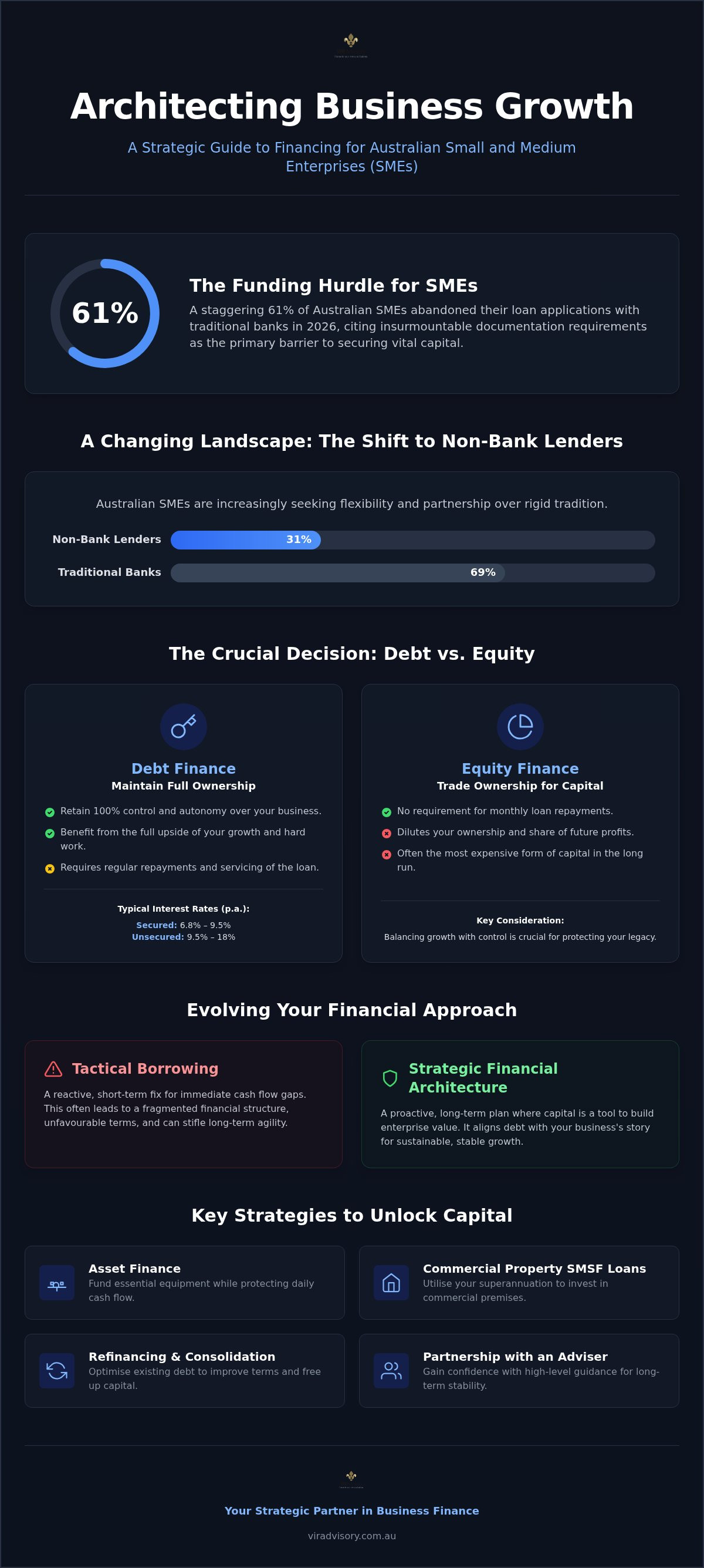
In 2026, 61% of Australian small and medium enterprises abandoned their loan applications with traditional banks because the documentation requirements felt like an insurmountable wall. It's a staggering figure that highlights a growing disconnect between ambitious business owners and the rigid systems of major lenders. You've likely felt that same friction, wondering if the capital you need to scale will come with restrictive terms that stifle your agility or put your hard-earned stability at risk.
We understand that the path to expansion isn't always linear, and the confusion between debt and equity can often lead to unnecessary stress. This article will show you how to architect a sophisticated capital structure that fuels sustainable expansion while protecting your long-term financial stability. By exploring tailored financing strategies for business growth, you'll discover how to move beyond simple loan procurement toward a deliberate, high-level funding roadmap. We'll examine the shift toward non-bank lenders, the implications of the current 4.35% cash rate, and how a partnership with a dedicated adviser can turn complex lending markets into your greatest competitive advantage.
Key Takeaways
- Shift your mindset from tactical borrowing to strategic financial architecture, ensuring capital serves as a tool for sustainable expansion rather than just a temporary fix.
- Evaluate the benefits of non-bank lending and debt structures to help you retain business control and avoid the common pitfalls of traditional bank documentation.
- Explore diverse financing strategies for business growth, such as utilising asset finance and commercial property SMSF loans to protect your daily cash flow.
- Identify opportunities to unlock capital by optimising your existing debt through refinancing and consolidation, effectively removing hurdles to your next growth phase.
- Gain confidence by partnering with a strategic adviser who offers high-level guidance and a personalised pathway toward long-term financial stability.
Defining Your Growth Pathway: Why Strategy Trumps Capital
Many Australian business owners mistake the procurement of capital for the ultimate destination. Capital is merely a tool, a precise instrument designed to facilitate a specific outcome. When you focus solely on the dollar amount, you're engaging in tactical borrowing, which often solves a temporary cash flow gap but ignores the broader horizon. This approach can lead to a fragmented financial structure that lacks the cohesion needed for true stability.
Strategic financial architecture looks at the foundation of your enterprise. It's about ensuring your debt doesn't just exist, but actively works to increase your business's worth. By considering financing strategies for business growth early in your journey, you can avoid the reactive scramble for funds that often leads to unfavourable terms. To better understand this concept, watch this helpful video:
The "Story-First" Approach to Business Finance
At VIR Advisory, we believe every dream begins with a story and yours deserves to be heard. This isn't just a motto; it's a practical framework for identifying whether your growth levers are tied to inventory, headcount, or commercial property. Your narrative dictates the type of facility you need, whether it's a flexible line of credit or long-term asset finance. Strategic financing is the alignment of debt structure with long-term enterprise value.
Moving Beyond Transactional Lending
Quick-fix business loans often come with aggressive interest rates and restrictive terms that can stifle your agility. A methodical mentor helps you look past these transactional traps to find solutions that respect your personal values and business mission. By focusing on relationship-led financial strategy guidance, you ensure your fiscal health remains robust throughout the growth phase. We take pride in walking beside you as a trusted guide, offering the intellectual weight of a consultancy with the approachability of a local partner. With over 15 years of experience, Raina Doshi and the team provide the steady hand needed to navigate today's complex lending markets.
If you're ready to move beyond simple debt and start building a sustainable future, contact us today to discuss your next steps.
Navigating the Australian Lending Landscape: Debt vs. Equity for SMEs
Choosing how to fund your expansion is one of the most critical decisions you'll face. With 31% of Australian SMEs now preferring non-bank lenders over major banks, the options for financing strategies for business growth have never been more diverse. The fundamental choice remains: do you borrow the funds or trade a portion of your business? Your decision determines how much of your future success you'll actually own, making it essential to understand the long-term impact of each pathway on your enterprise value.
Equity often seems attractive because there are no monthly repayments, yet it's frequently the most expensive form of capital in the long run. When you bring in a private investor, you aren't just sharing profits; you're often conceding a degree of autonomy. Debt, while requiring regular servicing, allows you to maintain 100% ownership and benefit from the full upside of your growth. Striking the right balance is about protecting your legacy while ensuring you have the fuel to move forward.
Debt Finance: Retaining Control While Scaling
Business expansion loans and working capital solutions provide the fuel needed to scale without diluting your shareholding. In August 2026, secured business loans typically range from 6.8% to 9.5% per annum, while unsecured options generally sit between 9.5% and 18%. Working with a professional broker gives you access to a network of lenders that extends far beyond the four major banks. This is vital because "favourable terms" involve more than just a low interest rate. True value lies in flexible repayment schedules and loan structures that respect your business's seasonal cash flow.
Equity and Alternative Funding
There are times when rapid expansion requires a capital injection that exceeds your borrowing capacity. In these scenarios, angel investors or private equity can provide the necessary weight to leapfrog competitors. However, you must weigh this against the loss of future dividends and the potential for conflicting visions. Many sophisticated owners choose to layer their funding, using a balanced capital stack that combines secured debt with smaller equity portions to preserve as much ownership as possible while managing risk.
Lenders are looking for clarity and confidence when they review your application. When presenting your business case, you must translate your vision into a language of risk mitigation and logical progression. Clear communication regarding your growth levers helps lenders see the person behind the numbers, which often results in more personalised offers. If you find the current landscape overwhelming, you might consider booking a strategy session to refine your approach and identify the most suitable funding mix for your specific goals.
Strategic Financing Instruments: From Asset Finance to SMSF Solutions
Once you've established your capital structure, the next step is selecting the specific instruments that will drive your expansion. A sophisticated approach to financing strategies for business growth requires matching the life of the loan to the life of the asset being financed. You wouldn't fund a ten-year property acquisition with a two-year line of credit, just as you wouldn't use long-term debt for seasonal inventory. This alignment ensures your repayments remain sustainable and your cash flow stays predictable as you scale.
In the current Australian market, commercial property finance often serves as the bedrock of long-term stability. By securing the roof over your head, you eliminate the volatility of commercial rent hikes and begin building equity in a tangible asset. This transition from tenant to owner-occupier is a powerful milestone that transforms a monthly expense into a wealth-building vehicle for your enterprise.
Asset and Equipment Finance for Operational Growth
For many growing firms, buying equipment or vehicles outright can be a strategic mistake. Draining your working capital to purchase a depreciating asset often leaves you "cash poor" during critical periods. Structured asset finance allows you to preserve your cash reserves for high-impact activities like marketing or hiring. With the government's permanent implementation of the $20,000 instant asset write-off in the May 2026 budget, small businesses with a turnover under $10 million have a clear pathway to upgrade their technology and machinery while managing their taxable income. We help you tailor these solutions to your industry's specific cycles, ensuring your debt levels remain in harmony with your revenue patterns.
Unlocking the Power of SMSF Lending
Self-Managed Super Funds (SMSFs) offer a unique strategic advantage for Australian professionals and business owners. While regulatory changes in August 2026 ended new borrowing for residential property within super, the pathway to acquire commercial property remains open and highly effective. Using your superannuation to purchase your business premises allows you to pay rent to yourself, effectively building personal wealth alongside your business success. Navigating the complexities of Limited Recourse Borrowing Arrangements (LRBAs) requires a methodical mentor who understands the nuances of the law. With commercial SMSF loan rates currently sitting around 6.6% to 6.8% per annum, this strategy provides a secure anchor for your financial future. If you're ready to explore these pathways, our team at VIR Advisory is here to provide the expert guidance you need to make informed decisions.
Building a robust financial foundation is a journey that requires precision and patience. To discuss how these instruments can be integrated into your specific story, please submit your enquiry and we will reach out to start the conversation.
The Power of Refinancing: Optimising Debt Structures to Unlock Capital
Growth isn't always about finding new sources of capital; often, it's about freeing up the resources you already have. Inefficient debt structures can act as a silent anchor, weighing down your cash flow and preventing you from seizing new opportunities. When you're assessing financing strategies for business growth, it's vital to look inward at your current obligations. High interest costs or restrictive repayment terms on existing loans might be the single biggest hurdle to your next expansion phase.
Refinancing is the process of realigning your debt with your current reality. By consolidating various facilities or negotiating better terms, you can significantly reduce your monthly commitments. This doesn't just lower your overheads; it directly increases your reinvestment budget, allowing you to pivot quickly when market conditions shift. We also look for "lazy equity" within your property portfolio. This is capital sitting idle in your residential or commercial holdings that could be safely extracted to fund your business vision. Identifying these pockets of value ensures your financing strategies for business growth are built on a foundation of existing strength rather than just new debt.
Refinancing as a Growth Catalyst
Think of a mortgage health check as a necessary diagnostic for your financial engine. In an environment where the RBA has held the cash rate at 4.35% as of August 2026, the difference between an outdated loan and a market-leading product can be substantial. A comprehensive assessment every two years ensures you aren't paying a "loyalty tax" to a lender that no longer serves your needs. By lowering your interest costs, you create a buffer that allows for more aggressive reinvestment in headcount or technology, effectively turning your debt into a growth catalyst.
Investment Loan Structuring for Professionals
For high-net-worth individuals and professionals, the line between personal and business finance often blurs. You need to align your home loan strategy with your broader business goals to ensure they don't work at cross-purposes. One of the most common risks we see is cross-collateralisation, where multiple properties are used to secure a single loan. This can limit your flexibility and put your entire portfolio at risk if one asset's value fluctuates. Through smart structuring, we help you decouple these assets, providing greater protection and more options for future borrowing. You can explore our specialised refinancing solutions to see how we tailor these pathways for sophisticated borrowers.
Securing Your Financial Future: Partnering with a Strategic Adviser
The journey toward sustainable expansion is rarely a solo endeavour. While the technical aspects of financing strategies for business growth are vital, the value of a steady hand cannot be overstated. Navigating complex lending markets requires more than just an understanding of interest rates; it demands a deep knowledge of how different lenders perceive risk and opportunity. With over 15 years of industry experience, we act as your methodical mentor, ensuring every financial decision aligns with your broader business mission and personal values.
A relationship-focused approach leads to more honest and effective financial advice. Unlike faceless bank portals, we take the time to listen to your story, understanding that your business is more than just a balance sheet or a set of figures. This partnership provides a sense of security, allowing you to focus on your core operations while we manage the intricacies of your capital structure. By walking beside you from the initial enquiry through to loan settlement and beyond, we ensure a seamless experience that prioritises your long-term fiscal health and managed momentum.
The VIR Advisory Difference
Founder Raina Doshi’s extensive banking background provides an "insider" advantage that is rare in the brokerage space. This experience allows us to anticipate lender requirements and present your business case in the most compelling light, effectively removing the friction from the application process. Our commitment to clarity and compassion defines every interaction we have with our clients. We believe that if it's important to you, it's important to me, and this motto sits at the core of our service. We take pride in being a reliable anchor, helping you navigate the shifts in the Australian financial landscape with precision and calm authority.
Your Next Steps Toward Sustainable Growth
Preparing for a successful funding application in 2026 requires meticulous attention to detail and a clear understanding of the current environment. Australian lenders are increasingly seeking comprehensive documentation that proves both current stability and future viability. You'll need to provide clear evidence of your growth levers and a logical roadmap for how the capital will be deployed to create value. A preliminary consultation is essential to align your specific goals with the most suitable lending products, avoiding the pitfalls of generic solutions that don't fit your unique circumstances.
If you're ready to share your story and explore the right financing strategies for business growth, we invite you to submit your enquiry today. Let's begin the process of architecting a future that reflects your ambition and protects your long-term financial stability through expert guidance and personalised care.
Architecting Your Next Chapter
Sustainable growth is built on deliberate financial architecture rather than just accumulating debt. By aligning your funding mix with your enterprise value and optimising existing structures through refinancing, you create a resilient foundation for expansion. Effective financing strategies for business growth involve more than just securing a facility; they require a partnership with a guide who understands your unique story and can navigate complex markets with precision.
With over 15 years of expert banking and finance experience, Raina Doshi provides the compassionate, personalised guidance needed to turn your vision into reality. You gain access to an extensive network of Australian commercial and residential lenders, ensuring your capital structure is as sophisticated as your business goals. Taking the next step shouldn't be a source of stress, but a moment of managed momentum toward your long-term success.
We look forward to hearing your story and helping you build a legacy of financial stability and prosperity.
Frequently Asked Questions
What are the most common financing strategies for business growth in Australia?
Common strategies include asset finance for equipment, commercial property loans for premises, and working capital solutions to manage cash flow. SMEs often look at a mix of debt and equity, though many prefer debt to maintain control. Strategic debt architecture involves matching the loan term to the asset's life. This ensures repayments are sustainable while you scale. Accessing non-bank lenders has become a popular choice for 31% of SMEs seeking flexibility.
How does a business expansion loan differ from a standard commercial loan?
A business expansion loan is specifically structured to fund growth activities like hiring or market entry, rather than just covering operational gaps. While a standard commercial loan might provide general funding, expansion loans often feature terms aligned with your projected revenue increases. These facilities are tailored to the "story" of your growth. They require a clear roadmap showing how the capital will generate long-term enterprise value rather than just meeting immediate needs.
Can I use my home equity to fund my business growth?
Yes, using "lazy equity" in your residential property is a common way to secure lower-interest capital for business purposes. This involves refinancing your home loan to extract equity, which can then be injected into your firm. However, it's vital to structure this correctly to avoid cross-collateralisation. By decoupling your personal and business assets, you protect your home while gaining the necessary funds to implement effective financing strategies for business growth.
Is it better to use asset finance or a business loan for new equipment?
Asset finance is generally superior for equipment because the loan is secured by the asset itself, preserving your general business borrowing capacity. This structure allows you to benefit from tax advantages like the $20,000 instant asset write-off for small businesses. Unlike a general business loan, asset finance matches the repayment term to the equipment's useful life. This ensures you aren't still paying for machinery that has become obsolete or requires replacement.
What do Australian lenders look for in a growth-focused business loan application?
Lenders look for a combination of historical stability and a logical roadmap for future revenue. They require clear documentation, including financial statements and a detailed business case that explains your growth levers. In 2026, lenders are particularly focused on serviceability in a 4.35% cash rate environment. They want to see that you've considered various financing strategies for business growth and have a methodical plan to manage the debt responsibly.
How can refinancing my existing debts help my business grow?
Refinancing helps by reducing your monthly interest costs and freeing up cash flow for reinvestment. By consolidating high-interest short-term debts into a single, more efficient facility, you improve your business's net profit margin. This extra capital can be redirected toward marketing, hiring, or technology upgrades. A mortgage health check every two years ensures your debt structure remains a catalyst for expansion rather than a hurdle that stifles your agility.
What are the benefits of using a finance broker over a major bank for business loans?
A broker provides access to an extensive network of both bank and non-bank lenders, whereas a bank can only offer its own products. This is crucial given that 61% of SMEs abandoned bank applications in 2026 due to rigid documentation. A broker acts as a strategic adviser, using their "insider" knowledge to present your case effectively. This relationship-focused approach ensures you receive personalised guidance and terms that respect your business's specific mission.
Is SMSF lending a viable strategy for purchasing a commercial warehouse?
Purchasing a commercial warehouse through an SMSF remains a highly effective strategy for building wealth. While residential borrowing within super has ceased for new entrants as of August 2026, commercial property lending is still permissible. This allows you to pay rent to your own super fund, effectively building a personal asset while securing your business premises. It requires careful navigation of regulatory complexities, making expert guidance essential for a successful, compliant outcome.

Article by
Raina Doshi
Raina Doshi has worked in banking and finance since 2011, including experience with major Australian lenders. She helps homeowners, property investors, business owners and professionals secure and structure lending solutions across home loans, refinancing, commercial finance and business lending.
Areas of expertise include residential lending, investment property finance, debt recycling, commercial property finance, equipment finance, construction finance and strategic debt structuring.
Drawing on extensive banking and finance experience, Raina helps clients navigate lender requirements, improve borrowing outcomes and structure effective finance solutions.
Disclaimer
The information in this article is general in nature and does not take into account your personal objectives, financial situation or needs. Before acting on any information, consider whether it is appropriate to your circumstances and seek professional advice.


