

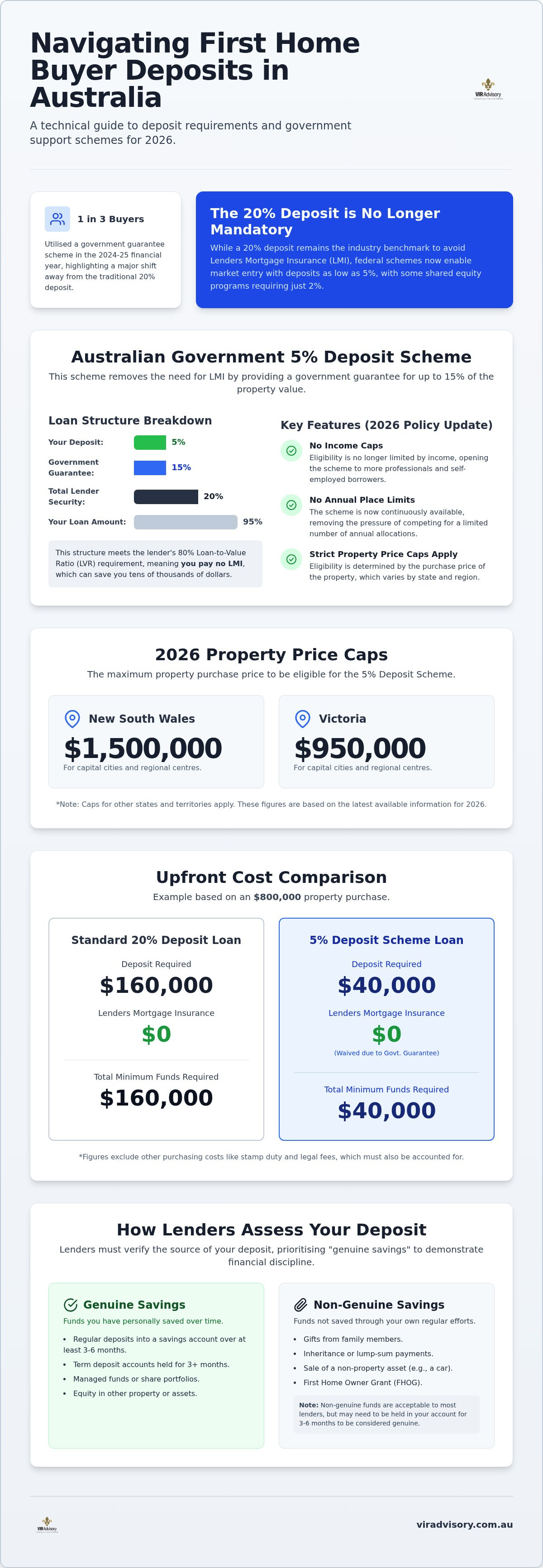
One in three first home buyers utilised a federal government guarantee scheme in the 2024–25 financial year, confirming that the 20% deposit is no longer a mandatory requirement for market entry. To secure an Australian home loan, a first home buyer deposit can now be as low as 5% under the Australian Government 5% Deposit Scheme, or 2% for those eligible for the Help to Buy shared equity program. While 20% remains the standard threshold to avoid Lenders Mortgage Insurance (LMI), lenders frequently approve applications with smaller deposits if the borrower meets specific serviceability and genuine savings criteria.
Managing the financial requirements for a first purchase is increasingly complex, especially following the significant 2025 and 2026 shifts in federal policy. This article explains the technical requirements of current schemes, including the removal of income caps for the 5% Deposit Scheme and the latest property price limits across each state. We will outline a strategy to reduce LMI costs, explain how lenders assess your savings history, and provide a framework to ensure your finance application meets the highest probability of approval.
Key Takeaways
- Learn why the 20% deposit remains the benchmark for avoiding Lenders Mortgage Insurance and how to navigate the 2026 federal government scheme changes.
- Understand the technical difference between genuine savings and non-genuine funds when calculating your first home buyer deposit to ensure lender approval.
- Discover how the removal of income caps in the Australian Government 5% Deposit Scheme has expanded eligibility for professionals and self-employed borrowers.
- Identify specialised lending solutions, such as LMI waivers for medical and legal professionals, that allow for higher borrowing capacity with lower upfront capital.
- Apply a strategic framework to audit your credit file and align your finance structure with lender-specific assessment criteria before submitting an application.
Understanding First Home Buyer Deposit Requirements in 2026
In the Australian lending market, a deposit is the initial equity contribution a borrower provides towards the purchase price of a property. While many view it simply as a hurdle to clear, lenders see it as a measure of risk and commitment. For most, understanding mortgage deposits involves balancing the desire for immediate market entry with the long-term cost of borrowing. A 20% deposit remains the benchmark because it eliminates the need for Lenders Mortgage Insurance (LMI). It also typically unlocks lower interest rate tiers, as lenders reward lower-risk profiles with more competitive pricing. However, for a first home buyer deposit, reaching this amount in capital cities can be difficult, leading many to explore 5% or 10% entry points.
To better understand the mechanics of low-deposit lending, watch this detailed explanation of the government's current scheme framework:
The size of your deposit determines your Loan-to-Value Ratio (LVR). Loan-to-Value Ratio is calculated by dividing the total loan amount by the appraised value of the property and expressing it as a percentage. While 5% is a common entry point for a first home buyer deposit under government schemes, some lenders may require a 10% deposit for specific property types. High-density apartments or regional holdings often carry stricter requirements to mitigate valuation volatility and market risk.
Lenders Mortgage Insurance (LMI) Explained
LMI is a one-off premium that protects the lender, not the borrower, in the event of default. It usually applies when the LVR exceeds 80%. Most borrowers choose to "capitalise" the LMI, which means adding the premium to the total loan balance rather than paying it upfront. This increases the total debt and interest paid over the life of the loan. Premiums are tiered; a 5% deposit attracts a significantly higher LMI cost than a 12% deposit because the perceived risk to the bank is greater.
The Impact of Deposit Size on Borrowing Capacity
A larger deposit directly reduces the required loan amount, which improves your serviceability position. Lenders perform rigorous risk assessments on low-deposit applications, often requiring higher surplus income to offset the lack of equity. If you provide a 5% deposit, your borrowing capacity may be lower compared to a 20% deposit scenario, as the lender's buffer for interest rate rises or price fluctuations is reduced. We specialise in helping clients navigate these complex lending requirements to ensure the chosen structure aligns with their financial capacity.
Australian Government Support: Schemes to Reduce Upfront Costs
Federal support for property entry underwent a significant overhaul in late 2025, resulting in a more accessible landscape for a first home buyer deposit in 2026. The primary shift involves the consolidation of various programs under the Australian Government 5% Deposit Scheme. This framework allows eligible buyers to secure a property with a 5% equity contribution without paying Lenders Mortgage Insurance (LMI), as the government provides a guarantee for the remaining 15% of the loan value. Unlike previous years, the 2026 guidelines have removed income caps and annual place limits, making the scheme available to a broader range of professionals and high-income earners who previously exceeded eligibility thresholds.
The 5% Deposit Scheme (Formerly Home Guarantee Scheme)
The government guarantee functions as a synthetic equity buffer. It satisfies the lender's 80% Loan-to-Value Ratio (LVR) requirement, effectively removing the LMI premium which can often exceed $20,000 on a standard metropolitan purchase. However, borrowers must navigate strict property price caps to qualify. For instance, in New South Wales capital cities and regional centres, the cap sits at $1,500,000, while in Victoria, the limit is $950,000. It is also vital to recognise that not all banks participate in this scheme. Lenders on the government panel have specific internal quotas and may apply their own credit overlays, meaning an approval with one participating bank does not guarantee approval with another.
The Help to Buy Shared Equity Framework
Launched in December 2025, the Help to Buy scheme offers a different mechanism for those with limited capital. This shared equity program requires only a 2% first home buyer deposit. The government contributes up to 40% of the purchase price for a new home or 30% for an existing property. This significantly reduces the loan size and monthly repayments, but it comes with a trade-off: the government owns a percentage of your home's equity. If the property value increases, the government's share grows proportionally. Borrowers can choose to buy back the government's interest in increments of 5% once their financial position improves. To determine which scheme best suits your specific finance strategy, you can book a consultation with our team.
In addition to federal schemes, state-level concessions provide further relief. Most states offer stamp duty exemptions or concessions for first-time purchases, such as the full exemption in New South Wales for properties up to $800,000. Combined with the First Home Super Saver Scheme (FHSSS), which allows individuals to release up to $50,000 in voluntary super contributions for a deposit, these tools can reduce the total cash required for settlement by tens of thousands of dollars. Success requires aligning these various grants with a lender whose policy supports the specific combination of funds you intend to use.
How Lenders Assess Your Deposit: Genuine Savings vs. Gifts
Possessing the required funds for a property purchase is only the first step in the approval process. Lenders distinguish between the total cash available and its source, applying a "genuine savings" filter to assess a borrower's financial reliability. A first home buyer deposit might appear sufficient on a bank balance, but if the funds arrived as a lump sum without a documented history of accumulation, the application may face rejection. Lenders use savings history as a proxy for financial discipline, assuming that if you can consistently save, you can consistently service a mortgage.
The standard requirement for genuine savings is a clear history of funds held or accumulated in a bank account for at least three months. This rule is particularly strict for high Loan-to-Value Ratio (LVR) loans, such as those with a 5% or 10% deposit. When you borrow a higher percentage of the property's value, the lender's risk increases, making your proven ability to manage cash flow a critical component of their credit assessment.
Documenting Your Savings History
To verify your position, lenders require three to six months of consecutive bank statements. They look for regular, incremental deposits that align with your reported income. Common obstacles include irregular deposit patterns or large, unexplained cash injections that disrupt the narrative of steady saving. Withdrawing significant sums for discretionary spending during this period can also signal a lack of discipline. For professionals or business owners, ensuring that personal savings accounts are kept distinct from business trading accounts is essential for demonstrating a clean savings track record.
Using Gifted Deposits and Statutory Declarations
When a first home buyer deposit includes a gift from family members, lenders require a Statutory Declaration. This document legally confirms that the funds are a non-repayable gift rather than a loan. If the funds were a loan, the lender would have to include those repayments in your debt-to-income calculations, which often reduces borrowing capacity. Even with a gift, many lenders still insist on a 5% genuine savings component to ensure you have "skin in the game."
Lender policies regarding non-genuine savings vary significantly across the Australian market. Some banks are more flexible if you have a strong rental history. If you've been paying rent through a licensed real estate agent for over 12 months, some lenders may accept this as evidence of financial commitment, potentially waiving the requirement for a three-month savings history. Understanding these lender-specific nuances allows you to target the right institution based on how your deposit was formed.
Tailored Home Loan Solutions and Deposit Alternatives
While federal programs offer substantial relief, they aren't the only method to circumvent the standard 20% first home buyer deposit requirement. Many borrowers find that federal schemes carry restrictive property price caps or eligibility constraints that don't align with their preferred location or income level. In these instances, private lending solutions and tailored finance structures provide alternative routes to market entry without the burden of Lenders Mortgage Insurance (LMI).
Guarantor Support vs. Government Schemes
A guarantor loan involves a family member, usually a parent, using the equity in their own property to secure a portion of the borrower's loan. This differs significantly from the Australian Government 5% Deposit Scheme because it often allows for a 0% deposit while still avoiding LMI. While government schemes are restricted by specific price limits, guarantor loans are generally bound only by the borrower's serviceability and the guarantor's available equity. To manage risk, we often structure these as limited guarantees, where the guarantor is only liable for a specific dollar amount, typically 20% of the purchase price plus costs. Once the property value increases or the loan balance reduces to an 80% Loan-to-Value Ratio (LVR), the guarantor can be formally released from the mortgage.
Specialised Lending for High-Income Professionals
Lenders frequently offer LMI waivers to professionals in specific high-income industries, recognising their statistically lower risk of default and strong career progression. Medical practitioners, legal professionals, and qualified accountants can often secure a 90% LVR loan with only a 10% first home buyer deposit while completely waiving the insurance premium. These tailored home loan solutions are particularly effective for those with complex income structures, such as partners in firms or self-employed specialists, where standard bank algorithms might otherwise struggle to assess borrowing capacity. You can learn more about our services regarding professional waivers and complex income assessments.
For those unable to secure approval through major institutions due to a low deposit or non-genuine savings, second-tier lenders often provide more flexible credit overlays. Another alternative is rentvesting, where you purchase an investment property in a more affordable area to build equity, eventually using that growth as a deposit for a primary residence. This strategy allows you to enter the property market sooner while maintaining your current lifestyle in a preferred location.
Securing Approval: A Strategic Framework for First Home Buyers
Successfully accumulating a first home buyer deposit is a significant milestone, but the final hurdle is converting that capital into a formal loan approval through a methodical application process. Lenders do not assess deposits in isolation; they view them as one component of a broader risk profile that includes your credit history, debt-to-income ratio, and spending patterns. To navigate this, we recommend a four-step strategic framework designed to minimise risk and maximise the probability of a successful outcome.
- Step 1: Conduct a comprehensive audit of your credit file and debt-to-income ratio to identify any defaults or excessive credit inquiries that may hinder your application.
- Step 2: Align your specific deposit type with a lender whose credit policy matches your savings history, ensuring that if you are using gifts or grants, the institution accepts these as valid equity.
- Step 3: Secure a formal, credit-backed pre-approval rather than a simple online estimate, providing you with a definitive borrowing ceiling before you attend auctions.
- Step 4: Manage your finance strategy with precision from the moment of application through to settlement, avoiding any significant financial changes that could trigger a reassessment.
Improving Your Approval Prospects
Lenders scrutinise your existing credit facilities with extreme care. Even if you don't carry a balance, banks assess the total limit of your credit cards as a potential debt, which directly reduces your borrowing capacity. You should close buy-now-pay-later (BNPL) accounts and reduce credit card limits at least three months before applying. Employment stability is equally vital, as most lenders require a minimum of six to twelve months in a current role to approve a high-LVR loan. A broker assessment is critical before a formal bank submission because it identifies policy misalignments that could lead to a permanent credit mark on your file.
Common Approval Obstacles and How to Avoid Them
One of the most frequent reasons for rejection is a discrepancy between declared living expenses and actual bank statement data. Lenders now use digital tools to categorise every transaction, meaning that high discretionary spending on entertainment or gambling can lead to an immediate decline based on serviceability. Another risk involves postcode restrictions, where a lender might suddenly require a higher first home buyer deposit because the property is located in a high-density or regional area they deem high-risk. To ensure your application is structured for success, you should contact VIR Advisory for a finance assessment before engaging with real estate agents.
Optimising Your Finance Strategy for Market Entry
The 2026 lending landscape has evolved, providing accessible entry points through shared equity frameworks and the uncapped 5% Deposit Scheme. However, a competitive first home buyer deposit is only effective when paired with a clean credit file and a documented history of genuine savings. Lenders prioritising risk management will scrutinise your discretionary spending, existing credit limits, and debt-to-income ratio before granting a formal pre-approval. Establishing these foundations early ensures your application remains resilient throughout the assessment process.
With over 15 years of banking and finance expertise, VIR Advisory specialises in complex lending structures for professionals and self-employed borrowers. We provide independent technical finance strategy to ensure your application meets stringent lender assessment criteria. Our focus is on creating a tailored structure that provides long-term stability and maximises your approval prospects by aligning your capital with the right institutional policy.
Securing your first property requires precision and professional oversight, but with the right framework, it's an achievable objective.
Frequently Asked Questions
Can I buy my first home with only a 5% deposit in 2026?
Yes, you can purchase a property with a 5% equity contribution by utilising the Australian Government 5% Deposit Scheme. This program allows eligible buyers to avoid the cost of Lenders Mortgage Insurance because the government guarantees up to 15% of the loan value. In 2026, this scheme is more accessible than ever because income caps and annual place limits have been removed, though you must still meet lender serviceability requirements and property price caps.
What is the difference between a deposit and a down payment in Australia?
While the terms are often used interchangeably, "deposit" is the standard term in the Australian market, whereas "down payment" is more common in North America. Both refer to the initial equity you contribute to the property purchase. Your deposit size directly dictates your Loan-to-Value Ratio (LVR), which lenders use to determine your interest rate tier and whether you are required to pay for Lenders Mortgage Insurance to protect their risk.
Do I have to pay Lenders Mortgage Insurance if I have a 10% deposit?
Most lenders require Lenders Mortgage Insurance (LMI) if your deposit is less than 20% of the property's value. A 10% deposit results in a 90% LVR, which falls outside the standard 80% threshold for LMI waivers. However, certain high-income professionals, such as doctors or accountants, may qualify for an LMI waiver with a 10% deposit through specialised lender policies. Without such a waiver, the LMI premium is typically added to your total loan balance.
Can I use the First Home Owner Grant as part of my 5% deposit?
You can use state-based grants to increase your total funds, but lenders typically require a 5% first home buyer deposit to come from genuine savings. Genuine savings are funds you have accumulated in a bank account over at least three months. While the grant helps reduce the total amount you need to borrow, lenders use your ability to save as a key indicator of the financial discipline required to manage mortgage repayments.
How does a guarantor loan help me avoid a large deposit?
A guarantor loan allows a family member to use the equity in their own home as additional security for your mortgage. This structure can allow you to purchase a property with a 0% or 5% deposit without paying Lenders Mortgage Insurance. The guarantor's property covers the 20% equity gap that banks usually require. It is a highly effective alternative to government schemes, provided the guarantor understands their limited liability and the requirements for their eventual release.
Is there an income limit for the 5% Deposit Scheme in 2026?
There are no income limits for the Australian Government 5% Deposit Scheme in 2026. This is a result of policy changes effective from 1 October 2025 that removed previous income caps to support a wider range of buyers. While your income is no longer a barrier to eligibility, lenders still perform rigorous serviceability assessments to ensure you can afford the repayments on a high-LVR loan, particularly in a fluctuating interest rate environment.
What happens if the property valuation comes in lower than the purchase price?
If the bank's valuation is lower than the purchase price, you must provide the difference in cash to maintain your approved LVR. For a first home buyer deposit, a valuation shortfall can be a significant obstacle. If you have only a 5% deposit and the valuation drops by 2%, your effective LVR increases, which may push you beyond the lender's maximum risk threshold or significantly increase the cost of your Lenders Mortgage Insurance premium.
How long does it take to get a home loan pre-approval?
Obtaining a formal, credit-backed pre-approval typically takes between three and seven business days, depending on the complexity of your financial situation. Self-employed applicants or those with complex company structures may require up to ten business days for a full assessment. It is essential to secure a formal pre-approval rather than a simple online "indication," as a credit-backed assessment provides a definitive borrowing limit and gives you greater confidence when bidding at an auction.

Article by
Raina Doshi
Raina Doshi has worked in banking and finance since 2011, including experience with major Australian lenders. She helps homeowners, property investors, business owners and professionals secure and structure lending solutions across home loans, refinancing, commercial finance and business lending.
Areas of expertise include residential lending, investment property finance, debt recycling, commercial property finance, equipment finance, construction finance and strategic debt structuring.
Drawing on extensive banking and finance experience, Raina helps clients navigate lender requirements, improve borrowing outcomes and structure effective finance solutions.
Disclaimer
The information in this article is general in nature and does not take into account your personal objectives, financial situation or needs. Before acting on any information, consider whether it is appropriate to your circumstances and seek professional advice.


