

An equipment loan can be the wrong fit when the real pressure is the gap between paying suppliers and receiving customer payments. For manufacturers comparing manufacturing loans Australia-wide, start with the funding need and how it aligns with the production cash-flow cycle.
Production costs and cash receipts don’t always arrive on the same schedule, while machinery or a facility can tie up cash for years. Equipment finance may suit a machinery purchase, while working capital finance or debtor finance may help manage timing gaps. Business lending or commercial property finance may suit other requirements, each with different repayment obligations and risks.
This article explains how to compare finance options and what lenders may assess, including cash flow, existing debts, security and the business case for expansion. It also covers records and forecasts to prepare, common application obstacles, and how to weigh potential benefits against repayment commitments. Lender requirements vary, so a clear funding purpose and realistic figures are important starting points.
Key Takeaways
- For manufacturing loans Australia, define the production need before choosing a finance structure. Match the funding to how and when the business will use it.
- Compare business loans, working capital finance, debtor finance, equipment finance and commercial property finance by their uses, flexibility and risks.
- Lenders may assess business performance, existing debt and the source of repayments. Requirements vary between lenders.
- Before applying, set out the funding amount, timing and purpose, then organise evidence to support the business case and expected repayment source.
Manufacturing loans in Australia: match finance to the production need
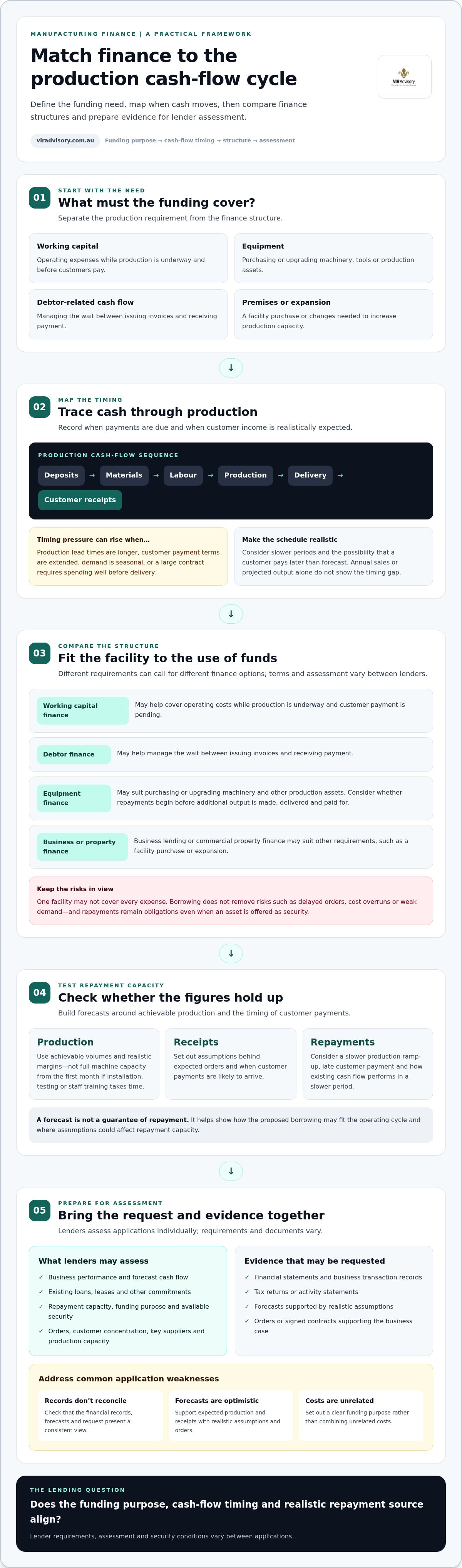
Manufacturing finance is borrowing matched to a production, equipment, cash-flow or facility need. For businesses considering manufacturing loans Australia, the first decision isn’t simply how much to borrow. Define what needs funding, when the funds are needed and how the business expects to repay them.
Separate the funding requirement from the finance structure. A new machine may increase production capacity, but repayments could begin before the extra output is made, delivered and paid for. The machine is the requirement; equipment finance is one possible structure. Its suitability, assessment and security requirements vary between lenders and applications.
For a broader overview of the sector’s industries and development, see Manufacturing in Australia.
For an additional perspective on borrowing for manufacturing and engineering, watch this video:
What can manufacturing finance be used for?
Manufacturing funding needs commonly fall into several groups. Each addresses a different cash-flow requirement:
- Working capital: covering operating expenses while production is underway and before customers pay.
- Equipment: purchasing or upgrading machinery, tools or production assets.
- Debtor-related cash flow: managing the wait between issuing invoices and receiving payment, potentially through debtor finance.
- Premises or expansion: funding a facility purchase or changes needed to increase production capacity.
Map the costs that create the funding gap. A manufacturer may pay a supplier deposit, purchase materials and meet wages during production, then wait for delivery acceptance and customer payment. Longer production lead times or extended customer payment terms can increase the cash tied up before revenue arrives. Don’t assume one facility will cover every expense or remove risks such as delayed orders, cost overruns or weak demand.
How production cash flow changes the borrowing decision
A manufacturing loan is borrowing used to fund a defined production need, with repayments planned around the business’s ability to generate cash. To test whether the timing works, map the cycle in order: deposits, materials, labour, production, delivery and customer receipts. Record when each payment is due and when income is realistically expected, rather than relying only on annual sales or projected output.
Seasonal demand can leave a business with uneven receipts, while a large contract may require substantial spending well before delivery. Estimate whether existing cash flow can meet repayments during a slower period or if a customer payment arrives later than forecast. Lenders assess applications differently, but the purpose of the funds, business performance, existing debt and repayment capacity may inform their decision. A realistic cash-flow schedule helps show how the borrowing fits the operating cycle. It doesn’t make future production a guarantee of repayment.
How lenders assess Australian manufacturing loan applications
Lenders assess applications individually, so there’s no universal checklist or formula that guarantees approval. For manufacturing loans Australia, an assessment may consider the business’s financial performance, current commitments, forecast cash flow, repayment capacity and the use of funds. The lender needs evidence that the proposed borrowing fits the business and can be repaid under the facility’s terms.
Manufacturers may also need to explain how orders translate into cash flow. A lender could consider signed contracts, customer concentration, reliance on key suppliers and whether the business has the production capacity to fulfil forecast work. These details put the figures in context. A strong order book may not support repayments if delivery depends on a constrained supplier or receipts rely heavily on one customer.
Financial information and repayment capacity
Depending on the lender and application, requested evidence may include financial statements, business transaction records, tax returns or activity statements. Requirements differ, including the documents needed and the periods they must cover. Consistency matters: financial records, forecasts and the funding request should present a coherent view of performance and obligations.
Make forecasts useful by basing them on achievable production volumes, realistic margins and the timing of customer payments. For example, a projection based on full machine capacity from the first month may overstate early revenue if installation, testing or staff training takes time. Include the assumptions behind expected orders and show how repayment capacity could change if production ramps up more slowly or a customer pays late. ABS Australian Industry Statistics can provide sector context, but it doesn’t replace a lender’s assessment of an individual business’s accounts and forecasts.
Security, existing debt and approval obstacles
Available security and existing obligations can affect the structure a lender considers and its assessment of repayment capacity. The lender may review current loans, leases and other commitments alongside the new request. Security requirements vary by lender and application. Offering security doesn’t remove the obligation to make repayments or the risk attached to the asset.
Common application weaknesses include records that don’t reconcile, optimistic forecasts without supporting orders, and a funding purpose that combines unrelated costs. Address these issues before submission:
- Reconcile business transaction records with the financial information provided, and explain material differences.
- Support forecasts with documented assumptions, such as production volumes, margins, contracts and expected payment timing.
- Separate the requested amount by purpose, showing what it will fund and how the business expects to repay it.
- List existing debt and recurring commitments so the assessment reflects the business’s full obligations.
Commercial credit assessment is separate from eligibility for a government finance programme. A programme may have its own qualifying activities, application process or evidence rules. Meeting those criteria doesn’t itself mean a commercial lender will approve borrowing. Keep the assessments distinct and account for programme conditions before relying on them in a funding plan.
Where revenue varies across the year, show the trading pattern clearly in the records. This helps a lender understand seasonal fluctuations and assess repayment capacity during quieter periods, rather than treating stronger trading months as typical of every month.
Compare manufacturing finance options by use, flexibility and risk
The suitable structure depends on what the funds need to cover, when they’re required and the cash flow available for repayments. Comparing manufacturing loans Australia options by use alone can overlook important differences. Flexibility, repayment profile, security requirements and potential costs also affect how well a facility fits the business.
The table outlines common commercial finance options. Features and assessment criteria vary between lenders and applications, so treat these as general considerations rather than standard terms.
| Finance option | Typical use | Potential benefit | Key risk | Likely assessment focus |
|---|---|---|---|---|
| Business loan | A defined business purpose, such as funding an expansion or several related costs. | Can provide a lump sum for planned expenditure. | Repayments may continue even if the project takes longer to generate revenue. | Purpose, business performance, existing commitments and repayment capacity. |
| Working capital finance | Operating liquidity for costs incurred before sales receipts arrive. | May help manage short-term timing gaps in the production cycle. | Repayments or facility costs can add pressure if the cash-flow gap persists. | Cash-flow patterns, trading performance and the size and timing of the funding need. |
| Debtor finance | Cash flow linked to eligible customer invoices. | May help access funds before customers pay, subject to the facility terms. | Availability can depend on receivables and customer payment behaviour. Costs and obligations still apply. | Invoice quality, debtor concentration, payment history and eligibility rules. |
| Equipment finance | Acquiring or upgrading machinery and production equipment. | Can align funding with a specific asset and its productive use. | Repayments may start before the equipment is operating at planned capacity. | Business repayment capacity, equipment details and any security requirements. |
| Commercial property finance | Buying premises for business operations. | Can fund property ownership rather than machinery or day-to-day expenses. | Repayments and property-related obligations may constrain cash available for operations. | Business finances, property and proposed borrowing structure. |
Working capital, debtor finance and business loans
Working capital finance addresses general operating liquidity, while debtor finance is linked to receivables that meet a lender’s or provider’s criteria. A business loan may suit a defined purpose that doesn’t fit those narrower needs. Each option can help manage a timing gap, but none removes the obligation to repay. Check how repayments, access to funds and facility costs would interact with slower customer payments or a production delay.
Equipment, property and export-related finance
Equipment finance is tied to machinery acquisition, while commercial property finance concerns premises ownership. The risks differ: machinery may take time to reach productive use, whereas premises finance creates a longer-term property commitment that can affect operating flexibility. Businesses assessing a premises purchase can read this commercial property finance guide.
Export-related finance is a specialised option for businesses undertaking export activity, not a general substitute for domestic working capital or equipment funding. Eligibility, assessment and facility terms depend on the product and its provider. Before comparing options, match the funding purpose to the repayment source, then test whether the structure still works if production, delivery or customer receipts are delayed.
Prepare a manufacturing finance application with a practical checklist
A clear application starts with a defined funding request, not a guessed borrowing limit. State what the funds will cover, when they’re needed, how much is required and where repayments are expected to come from. This helps compare manufacturing loans Australia options against the business’s actual cash flow and gives the lender a specific purpose to assess.
Map the request to the production cycle before applying. For example, a machinery purchase may require a deposit before installation, while the extra production income could arrive only after the equipment is operating and customer invoices are paid. Make this timing visible in the supporting figures.
A step-by-step funding preparation framework
Work through these steps in order. The result is a more coherent request that connects the business need with its evidence and repayment plan.
- Define the need. Identify whether the request relates to operating cash, receivables, equipment, premises or expansion. Separate distinct purposes rather than bundling unrelated expenses.
- Quantify the request. Set out the amount required and when it must be available. Explain how the figure was calculated, using supplier quotes, invoices or project estimates where relevant.
- Map the cash flow. Record expected inflows and outflows, existing repayments and the proposed repayment source. Consider the effect of delayed production, delivery or customer payments.
- Compare structures. Assess whether a business loan, working capital finance, debtor finance, equipment finance or commercial property finance fits the purpose and cash-flow profile. Compare repayment obligations, flexibility and risks.
- Assemble and check evidence. Gather current financial records and supporting documents, then reconcile key figures before submitting the application.
Application checklist: records to organise
- Financial records: current financial statements and business transaction records, plus tax or activity statements where relevant to the lender’s request.
- Forecasts: cash-flow projections with assumptions for production volumes, margins, costs and customer payment timing.
- Contracts and orders: relevant customer agreements, purchase orders or other evidence supporting forecast work, including delivery milestones and payment terms.
- Existing commitments: a summary of current loans, leases and other regular repayments.
- Funding evidence: a breakdown of the requested amount and documents supporting the planned expenditure.
Evidence requirements vary by lender and application. Use this as a preparation aid, not a universal document list.
Common application mistakes and how to avoid them
A request without a defined purpose, realistic forecast or clear repayment logic can be difficult to assess. Don’t present projected output as guaranteed income. Explain the assumptions behind production levels and what happens if the ramp-up takes longer than expected. A large contract also needs context: when delivery is due, when payment is expected and how much the business depends on that customer.
Check that figures agree across records and explain material changes in trading performance, rather than leaving a lender to infer the reason. Existing obligations and cash flow affect borrowing assessments. The borrowing capacity calculation guide explains how these factors can shape an assessment. A consistent, documented request won’t guarantee approval, but it makes the funding purpose and repayment case clearer.
How VIR Advisory can help assess manufacturing finance options
Choosing finance for machinery, working capital or an expansion involves more than comparing repayments. The structure also needs to fit the funding purpose, production cash-flow timing and the business’s existing commitments. VIR Advisory is an Australia-wide finance brokerage that connects businesses with lenders and helps assess finance options against the application requirements.
Led by Raina Doshi, VIR Advisory draws on more than 15 years of banking and finance experience, including over a decade with one of Australia’s leading banks. This experience informs a practical review of the request: what the funds will cover, when they’re needed, how the business expects to repay them and which existing obligations may affect the assessment.
For a manufacturer, that could mean comparing whether equipment finance aligns with a machinery purchase or whether working capital finance better reflects an operating cash-flow need. The assessment considers relevant lender options and repayment obligations in context. Lender criteria and outcomes vary, and a brokerage assessment can’t guarantee approval. VIR Advisory’s business and equipment finance services include support across commercial and business funding requirements.
What to bring to an initial finance discussion
A concise summary helps focus the discussion. Note the funding purpose, amount required, when funds are needed and the expected source of repayments. If the request relates to a machine or expansion, outline how it is expected to affect production and when any additional income may be received.
Where available, gather current financial records, cash-flow forecasts and details of existing loans, leases or other facilities. These provide a starting point for identifying information a lender may require, although the evidence needed depends on the lender and application. You don’t need to have every question resolved before an initial conversation. It can clarify the issues to consider and possible next steps, without implying that finance will be approved.
The finance enquiry form provides a way to outline the requirement and relevant timing. Include the key details available so the discussion can focus on how the funding need relates to the business’s cash flow and existing commitments.
Discuss your manufacturing finance requirements
Whether you’re considering machinery, working capital or expansion funding, a clear summary gives the assessment a practical starting point. Compare the purpose, expected repayment source and obligations before proceeding, then consider the lender’s criteria for the proposed structure.
Set a clear next step for your manufacturing finance
Before progressing a funding request, make it a clear decision: what must be funded first, what evidence supports the expected benefit, and what would change if production or customer payments are delayed? This keeps discussions about manufacturing loans Australia grounded in operating realities rather than an assumed borrowing limit.
Use the figures you’ve prepared to test the proposed structure against both expected and slower cash-flow scenarios. Consider whether repayments remain manageable alongside existing commitments, and whether the funding still serves its intended purpose if the expansion takes longer to generate income. These checks can clarify which questions need answers before an application moves forward.
VIR Advisory provides business and commercial finance brokerage across Australia, connecting businesses with lenders rather than lending directly. Raina Doshi brings over 15 years of banking and finance experience to assessing funding requirements and lender options. Approval remains subject to lender assessment.
A well-defined request gives the next decision a firmer basis, whether you proceed now or refine the plan first.
Frequently Asked Questions
Can a new manufacturing business apply for a business loan?
Yes, a new manufacturer can apply, although lender criteria differ and a shorter trading history may limit the financial history available for review. A useful application can explain the owners’ relevant industry experience, how production will be commissioned and what supports expected demand. If the business is pre-revenue, distinguish confirmed orders from sales projections so the lender can assess what is established and what remains an assumption.
What documents might a lender request for manufacturing finance?
The evidence required depends on the lender, facility and stage of the business. For a start-up or major expansion, the lender may need information explaining how the operation will work in practice, such as equipment specifications, production plans or customer order details. Organise documents by period and purpose, and ensure the figures are consistent with the funding request.
Can manufacturing finance cover both machinery and working capital?
Possibly, but the lender determines whether one facility can cover both purposes or whether separate arrangements are more appropriate. If the request includes a machine and operating costs, distinguish the amount allocated to each and identify when each drawdown is needed. This helps avoid borrowing the full amount too early and makes it easier to track whether funds are used for the purposes presented in the application.
Is government finance available to Australian manufacturers in 2026?
Availability depends on the individual programme and its current application status, so there isn’t one answer for all Australian manufacturers. Programmes may set their own qualifying activities, application processes and evidence requirements. Treat public finance as a separate funding possibility, and don’t include it as available capital until the business has established that the programme is open and the relevant criteria are met.
Does a manufacturing business need to offer property as security?
Not necessarily. Security arrangements depend on the lender and proposed facility. Before accepting an offer, clarify whether security is limited to the financed asset or extends to other business or personal assets, and whether a director guarantee is required. These details affect the risk if the business can’t meet its obligations. Review the proposed terms so the people responsible for the application understand which assets or guarantees may be involved.
Can export-focused finance help a manufacturer with overseas contracts?
It may be relevant, depending on the export transaction and the product’s criteria. The stage of the contract can shape the funding need: costs incurred before goods are shipped differ from the period after dispatch while an invoice remains unpaid. Set out contract milestones, payment currency and expected settlement timing as part of the assessment. Eligibility rules and terms vary, so don’t assume export finance will be available for a particular order.
What if a lender declines a manufacturing loan application?
A decline is a reason to pause and understand the decision before changing or resubmitting the request. Identify whether the issue relates to the application evidence, the proposed facility or the lender’s appetite for that type of transaction. Then consider whether a narrower request, different timing or revised structure addresses the stated concern. Avoid making another application on unchanged assumptions if the underlying issue remains unresolved.

Article by
Raina Doshi
Raina Doshi has worked in banking and finance since 2011, including experience with major Australian lenders. She helps homeowners, property investors, business owners and professionals secure and structure lending solutions across home loans, refinancing, commercial finance and business lending.
Areas of expertise include residential lending, investment property finance, debt recycling, commercial property finance, equipment finance, construction finance and strategic debt structuring.
Drawing on extensive banking and finance experience, Raina helps clients navigate lender requirements, improve borrowing outcomes and structure effective finance solutions.
Disclaimer
The information in this article is general in nature and does not take into account your personal objectives, financial situation or needs. Before acting on any information, consider whether it is appropriate to your circumstances and seek professional advice.


