

Your healthcare role may open up additional home loan options, but it won’t guarantee a particular rate, borrowing limit or Lenders Mortgage Insurance (LMI) waiver. A healthcare worker mortgage may include profession-based benefits, such as an LMI waiver for some eligible applicants with a deposit below 20%. The occupations covered, deposit limits and registration criteria vary between lenders, and the full application still matters.
Whether you’re a nurse, allied health professional, casual employee or doctor earning income from several sources, check how a lender treats your role and each part of your income. Overtime and shift allowances can affect your borrowing capacity if a lender accepts them, but policies and evidence requirements differ. This article explains what to compare, how your deposit can affect LMI and lender choice, and how to prepare documents that clearly show your income, expenses, debts and property plans.
Key Takeaways
- A healthcare worker mortgage is assessed under standard home loan criteria, although some lenders also have occupation-specific policies. Eligibility depends on the lender and your circumstances.
- Compare the potential cost of LMI with the trade-offs of using a larger deposit, including the effect on your loan options and cash reserves.
- Find out how a lender assesses overtime, shift allowances and income from multiple employers before relying on those earnings in your borrowing estimate.
- Organise evidence of your income, expenses, debts, deposit and employment to give lenders a clear picture of your application.
- Use a consistent comparison process to assess policy requirements and avoid choosing a loan based on a potential waiver alone.
Healthcare worker mortgage options: what may differ from a standard application?
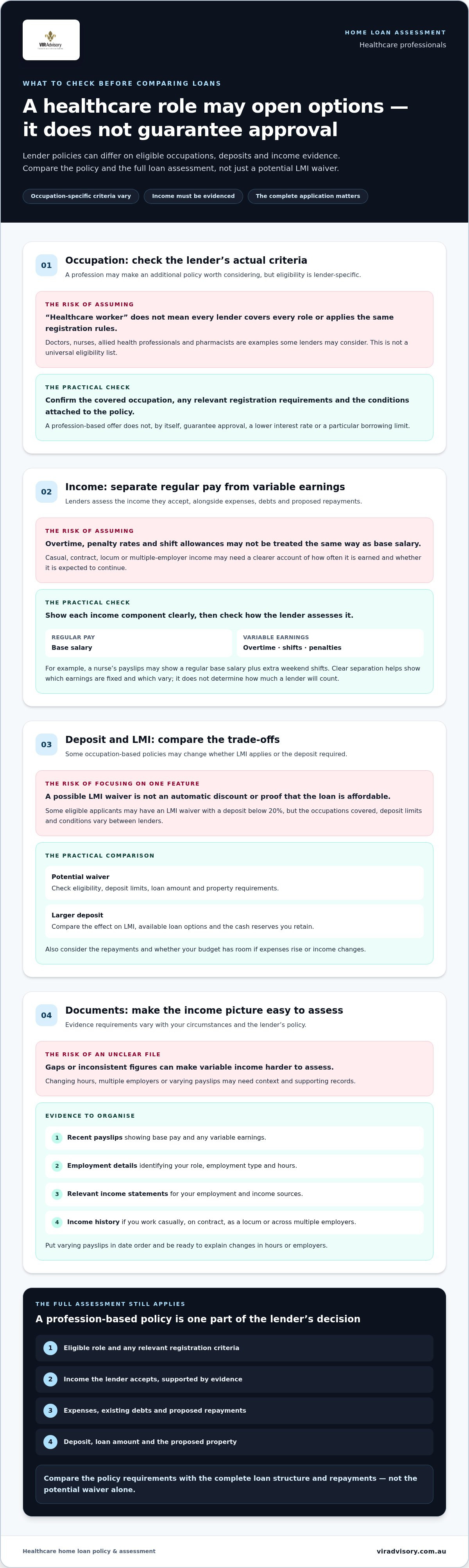
Some lenders have policies for applicants in eligible healthcare occupations, but the roles covered and the terms vary. A healthcare worker mortgage is still a home loan application assessed against the lender’s usual requirements, as well as any occupation-specific policy that may apply. Your profession could make an additional option available, but it doesn’t guarantee approval, a lower interest rate or an LMI waiver.
Occupation is only one part of the assessment. Lenders also consider whether the repayments are affordable based on the income they accept, your expenses, debts and deposit. They assess the proposed property against their own requirements, too. A professional offer does not override these checks.
Which healthcare roles might be considered?
Doctors, nurses, allied health professionals and pharmacists are examples of occupations that some lenders may consider under profession-based policies. This isn’t a universal eligibility list. One lender may include a particular allied health role while another has narrower criteria. Registration requirements can also differ, including the type and status of registration where relevant.
Employment type and income evidence matter alongside occupation. A permanent employee with regular payslips may present a different income profile from a casual worker whose hours change, or a professional combining salaried work with locum shifts. Lenders need evidence they accept to assess the income included in the application.
What can a profession-based home loan change?
A lender may apply a specific policy to an eligible applicant or make a particular loan structure available. One area to investigate is Lenders Mortgage Insurance (LMI). LMI is a loan-related cost that may apply when the deposit is below the lender’s preferred threshold. Some occupation-based policies may change whether LMI applies or the deposit required, but eligibility and conditions depend on the lender and the complete application.
A possible waiver is not the same as an automatic discount. It doesn’t, by itself, set your interest rate, borrowing capacity or approval outcome. Nor does it prove that a loan is affordable. Borrowing more can increase repayments and leave less room in your budget if expenses rise or income changes.
When comparing options, separate the policy question from the wider loan assessment. Check which roles and registration criteria are covered, how the lender treats your deposit, and whether the loan amount and property meet its requirements. For a general explanation of how a mortgage loan works, see the overview of its basic structure and terms.
The occupation may affect which lender policies are worth considering, but it doesn’t remove the need to assess the full loan terms and repayments. Don’t assume a professional offer will be cheaper or more suitable without comparing the complete structure.
How lenders assess healthcare income, expenses and borrowing capacity
A healthcare role doesn’t replace the lender’s affordability assessment. Lenders review verified income, household expenses, existing debts and the proposed loan together. Borrowing capacity depends not just on gross earnings, but on the income the lender accepts and the repayments and other commitments included in its assessment.
For a more useful estimate, separate reliable base income from variable earnings before comparing options. The guide to borrowing capacity in Australia explains how the wider application can affect the result. Lenders may treat overtime and allowances differently, so don’t assume each will count the same proportion.
How variable healthcare income may be assessed
List your base salary separately from overtime, penalty rates, shift allowances and other variable earnings. A lender may consider how consistently you receive these amounts and whether your records support them, then apply its own income rules. Casual, contract, locum or multiple-employer work may require a clearer account of how often you earn the income and whether it is expected to continue.
Illustrative example: A nurse’s payslips show a regular base salary as well as additional weekend shifts. Separating the components helps the lender see which earnings are fixed and which vary. It doesn’t establish how much of the variable income a particular lender will use or determine the application outcome.
Borrowing capacity also reflects the rest of your financial position. Household spending and repayments on existing debts reduce the funds available for a new home loan. Lenders assess these alongside proposed repayments rather than treating all rostered income as available in full.
Documents that can help explain your application
Prepare records that match your employment arrangement. Depending on your circumstances and lender policy, useful evidence may include:
- Recent payslips showing base pay and any variable earnings.
- Employment details that identify your role, employment type and hours.
- Income statements relevant to your employment and income sources.
- Records showing income history if you work casually, on contract, as a locum or across multiple employers.
Gaps or inconsistent figures can make income harder to assess. If your payslips vary, put them in date order and be ready to explain changes in hours or employers. The aim is to show a clear, supportable picture of regular and variable earnings.
For clarity, the linked HUD healthcare mortgage insurance programs concern healthcare facility financing, not personal home loan eligibility or income assessment.
LMI waiver or larger deposit? Compare the benefits, costs and risks
A larger deposit, a potential Lenders Mortgage Insurance (LMI) waiver and borrowing with a smaller deposit each affect the loan differently. A profession-based waiver may reduce the upfront funds required, but it isn’t automatic and doesn’t determine whether the lender approves your application. Eligibility and final terms depend on the lender’s criteria and your full financial position.
Compare the overall loan structure, not only whether LMI applies. The table sets out possible trade-offs. The outcome for an individual borrower depends on the deposit, loan purpose, property and lender requirements.
| Option | Potential benefit | Trade-off to consider |
|---|---|---|
| Larger deposit | Reduces the amount borrowed and may affect whether LMI applies under the lender’s criteria. | Saving a larger deposit may take longer and use cash that could otherwise remain available after purchase. |
| Potential LMI waiver | If you meet the relevant policy, it may reduce upfront funds needed for the purchase. | Occupation, deposit, loan purpose and other criteria can limit access, and the offer may not suit your broader loan requirements. |
| Smaller deposit without a waiver | May allow a purchase with less saved upfront, subject to lender approval. | A higher loan balance can mean higher repayments, and LMI may apply under the lender’s rules. |
When a potential LMI waiver may be worth exploring
Explore a waiver if your occupation may qualify and you’re comparing the cost of waiting to save a larger deposit with borrowing sooner. Access can depend on your role, deposit, loan purpose and lender policy, so don’t make plans on the assumption that your profession alone is enough. Check the relevant criteria before basing a loan structure on a possible waiver.
Compare the loan balance, repayments, features and lender choice alongside the LMI treatment. A waiver may reduce the upfront amount required, but it doesn’t necessarily make the loan more affordable overall. Keeping more savings after purchase may provide a buffer, while borrowing more increases the balance you need to repay.
Risks to weigh before choosing a smaller deposit
Borrowing more can increase repayments and reduce financial flexibility. Consider how repayments fit alongside regular expenses if costs rise or income changes. Include purchase-related expenses in your cash planning and decide how much you want to retain after settlement. Using all available savings to reach a particular deposit level could leave less room for unexpected costs.
A smaller deposit isn’t automatically better, and a larger deposit won’t suit every borrower. Compare the options against your cash flow, expected repayments, lender eligibility and need for accessible savings. Treat a potential waiver as one feature to assess, not a substitute for checking affordability, loan terms and the property’s eligibility.
Prepare a stronger healthcare worker mortgage application: practical checklist
A well-prepared application helps a lender assess your income, commitments and property plans together. Before comparing policies, organise records that support your figures and identify anything that may need explanation. Healthcare applications can involve variable shifts or income from multiple employers, so a clear summary helps distinguish documented income from estimates.
Checklist before discussing lender options
Work through these steps in order. They’ll help you present a consistent view of your finances and identify details to clarify when comparing lender criteria.
- Review your budget. List regular household expenses and consider the repayments you could manage if costs rise or income changes.
- Map your income. Separate base pay from overtime, penalty rates, shift allowances and casual or locum work. Note each employer and gather records that support the amounts you’ve included.
- List debts and liabilities. Include existing loans, credit facilities and other financial commitments. Check that your figures are current and disclose relevant liabilities accurately.
- Document your deposit. Record the amount available, where it is held and when the funds can be accessed.
- Set out your property plans. Identify the intended use of the property, likely purchase timing and household commitments that may affect your budget or application.
- Compare lender criteria. Once your position is clear, compare how relevant lenders assess your role, income evidence, deposit and proposed property.
Application checklist infographic
- Income: payslips, income statements and a clear split between base and variable earnings.
- Expenses: a current record of regular household spending.
- Debts: an accurate list of loans and credit commitments.
- Deposit: the amount available and evidence that supports it.
- Employment: role, employment type, employers and records showing income history where relevant.
Approval obstacles and ways to address them
Inconsistent income records can make it harder to understand how your earnings are made up, particularly if your hours or employers change. Don’t present variable income as guaranteed or rely on a best-case roster. Organise records by date, distinguish regular pay from variable components and make sure the figures in your application match the evidence.
Overlooked or undisclosed liabilities can also complicate an assessment. Review your statements and commitments before applying, and make sure your budget reflects them. Reducing spending or debt may help clarify your financial position, but it doesn’t guarantee higher borrowing capacity or approval.
Before lodging an application, check that your documents give a consistent account of your employment, income and commitments. If a figure has changed, note why and ensure the supporting records reflect it. This preparation can help you respond to lender questions and reduce delays caused by missing or unclear information.
Pre-approval is not final approval. The lender may still need to assess the specific property, confirm your information and apply relevant finance conditions before finalising the loan. Keep your records current and don’t treat an early indication as confirmation that any property or loan will be approved.
How VIR Advisory can help you assess healthcare worker mortgage options
VIR Advisory is a national mortgage and finance brokerage. It helps borrowers compare lender options and organise an application around their circumstances. The lender makes the assessment and determines the approval outcome, rate and any Lenders Mortgage Insurance waiver.
Raina Doshi brings over 15 years of banking and finance experience, including more than a decade with one of Australia’s leading banks. Her experience informs a practical assessment of how lender criteria may apply to your occupation, income evidence, deposit and property plans.
What a tailored mortgage discussion can cover
A useful discussion starts with your full financial position, not just your healthcare role. Employment type and income components can affect how a lender assesses an application, so separate regular salary from overtime, shift allowances, casual work or income from multiple employers. Your deposit, existing debts, household expenses and intended property use also shape the comparison.
From there, compare relevant lender policies and possible loan structures against your priorities. If keeping more savings accessible matters, weigh that against the potential repayment impact of borrowing more. If reducing the loan balance is the priority, a larger deposit may be worth comparing. Neither approach is automatically preferable. Lender eligibility and your budget matter.
To make the assessment practical, be ready to discuss:
- How your employment is structured and which income sources are ongoing or variable.
- What records you have to support each income component.
- Your deposit, regular expenses, debts and other financial commitments.
- The property’s intended use and any timing or household considerations.
Once the likely lender requirements are clearer, you can identify the evidence needed and any gaps to address. This may reduce avoidable omissions, although the lender makes its own assessment and may request further documents.
Discuss your home-loan options
VIR Advisory provides mortgage broking support based on your objectives and financial position. The discussion can clarify relevant options and trade-offs, so you can consider the criteria involved before deciding what to explore next.
If you’re weighing lender policies or preparing to apply, contact VIR Advisory about your home-loan options to discuss your circumstances with Raina.
Set clear priorities for your next home-loan decision
Before taking the next step, decide what a suitable loan needs to do for your household. You might prioritise keeping repayments within a set budget, retaining savings after purchase or preserving flexibility if your work hours change. These priorities give lender comparisons a practical basis and help distinguish a useful feature from one that simply sounds attractive.
For a healthcare worker mortgage, assess any profession-based option against your circumstances rather than making a decision based on a possible waiver alone. A clear view of your preferred repayment range, available deposit and cash buffer can focus the comparison on loan structures worth considering.
Raina Doshi can discuss your circumstances and relevant lender options. A conversation can help clarify what to investigate next.
Frequently Asked Questions
Are healthcare workers eligible for an LMI waiver in Australia?
Some healthcare workers may qualify, but a healthcare role alone doesn’t secure an LMI waiver. The lender’s recognised occupations, deposit requirements, loan purpose and assessment of the full application all matter. Compare the lender’s criteria with your proposed loan structure before relying on a waiver. If your role or registration status needs clarification, establish how it is classified before making financial commitments based on a possible concession.
Can casual healthcare workers get a home loan?
Casual healthcare workers can apply, although each lender assesses income and employment evidence under its own policy. If your hours vary between roster periods, records covering a range of periods may show the pattern more clearly than a single payslip. Explain changes in employers or hours, and make sure the income figures in your application match the documents provided.
Do lenders count overtime and shift allowances for healthcare workers?
Some lenders may include overtime, penalty rates or shift allowances in their assessment, but the amount and evidence they accept can differ. Keep these earnings separate from base pay in your records. If a recent roster included extra shifts that aren’t usual, show the broader income pattern instead of relying on that peak period to represent ongoing earnings. The lender determines which income it can use.
What documents do healthcare workers need for a home loan?
Requirements depend on your employment and the lender, but you may need evidence of income, employment, savings, expenses and liabilities. A contract worker may need records that explain income across contracts, while an employee with one regular salary may have a different set of supporting documents. Keep your information consistent and allow for further evidence requests during assessment.
Do healthcare workers automatically receive lower home-loan interest rates?
No. Working in healthcare doesn’t automatically qualify you for a lower interest rate. Any profession-based offer depends on the lender’s current products, eligibility rules and your application. Compare the rate with the loan’s features, costs and conditions, and consider whether the structure suits your needs. An advertised rate or occupational benefit doesn’t confirm the terms you’ll receive.
Can a healthcare worker apply for a home loan with multiple employers?
Yes, having more than one employer doesn’t automatically prevent you from applying. The lender may assess each income source and consider which shifts are regular, occasional or expected to continue. Provide accurate employment details and don’t count occasional extra work as guaranteed income. A concise summary of each employer, role and income source can make a multi-employer application easier to follow.
Does pre-approval guarantee a healthcare worker's home loan?
No. Pre-approval isn’t a guarantee of final approval, and the lender may still assess the specific property and updated application information. A change in employment, income or financial commitments after pre-approval could affect the assessment. Keep your details current and review any conditions attached to the pre-approval before making commitments. The lender’s final decision depends on its assessment of the complete application.
To discuss your healthcare worker mortgage options with Raina, contact VIR Advisory or use the link below to book a conversation.

Article by
Raina Doshi
Raina Doshi has worked in banking and finance since 2011, including experience with major Australian lenders. She helps homeowners, property investors, business owners and professionals secure and structure lending solutions across home loans, refinancing, commercial finance and business lending.
Areas of expertise include residential lending, investment property finance, debt recycling, commercial property finance, equipment finance, construction finance and strategic debt structuring.
Drawing on extensive banking and finance experience, Raina helps clients navigate lender requirements, improve borrowing outcomes and structure effective finance solutions.
Disclaimer
The information in this article is general in nature and does not take into account your personal objectives, financial situation or needs. Before acting on any information, consider whether it is appropriate to your circumstances and seek professional advice.


