

Commercial property loan rates in Australia range from 6.05% to 14%, depending on the lender, loan-to-value ratio (LVR) and documentation. By comparison, Australian home loan rates were around 5.5% to 6.5% in April 2026, while commercial rates started at 6.05%. A residential mortgage rate is therefore not a reliable benchmark for the cost of a commercial property loan.
It’s understandable to focus on the advertised interest rate, but that figure alone doesn’t show the full cost or whether a loan suits your circumstances. This article explains how security, property type, borrower finances and documentation can affect pricing, and how LVR, fees and lender comparisons fit into the assessment. It also covers how commercial lending differs from a residential mortgage, so you can assess options against your cash flow and funding needs.
Key Takeaways
- Compare the interest rate with establishment, ongoing and valuation fees to understand the loan’s broader cost.
- Review how the property’s LVR, use and supporting documentation may influence lender pricing.
- Compare loan options on matching terms, including rate type, fees, security and repayment structure.
- Prepare clear financial and property information before applying to help lenders assess the request.
- Assess commercial finance separately from a residential mortgage, as the security and lending criteria differ.
Commercial loan interest rates, fees and charges
Upfront Fees and Charges
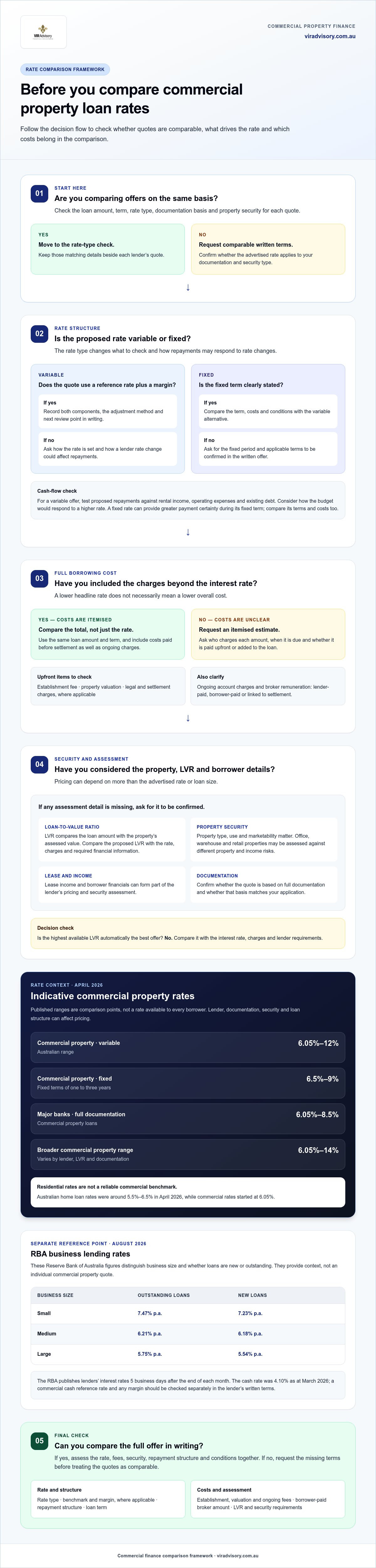
Before comparing commercial loan interest rates, identify each charge due before settlement. A lender may charge an establishment fee, and a property valuation may add a separate cost. Legal and settlement charges may also apply, depending on the transaction. Request an itemised estimate that shows who charges each amount, when it is due, and whether it is added to the loan or paid upfront.
Total Borrowing Costs
The advertised interest rate is only one part of the total borrowing cost. Compare fees alongside the repayment structure, loan term and any ongoing account charges. A lower rate, for example, may not mean lower overall costs if the establishment fee or valuation expense is higher. Compare written estimates using the same loan amount and term, and include costs paid before settlement.
Reserve Bank of Australia figures offer context for business lending, but they are not individual commercial property quotes. In August 2026, Australian small-business loan rates were 7.47% per annum for outstanding loans and 7.23% per annum for new loans, according to the Reserve Bank of Australia.
In August 2026, Australian medium-business loan rates were 6.21% per annum for outstanding loans and 6.18% per annum for new loans, according to the Reserve Bank of Australia.
In August 2026, Australian large-business loan rates were 5.75% per annum for outstanding loans and 5.54% per annum for new loans, according to the Reserve Bank of Australia.
These figures distinguish business size and whether lending is new or outstanding. They help frame lender pricing, but the property, security and borrower profile also shape commercial loan interest rates.
The Reserve Bank of Australia publishes lenders' interest rates 5 business days after the end of each month. This timing helps borrowers compare the latest published business lending data with a current loan proposal.
Broker remuneration is another item to clarify. Ask whether it is lender-paid, borrower-paid or linked to settlement, and whether you pay any fee directly. Include borrower-paid amounts in your comparison instead of assessing the lender’s rate alone.
- Compare each lender’s interest rate and establishment fee against the same loan amount.
- Record valuation and ongoing fees separately, including their timing.
- Ask how broker remuneration is structured and whether you pay any amount.
- Compare the total upfront amount with ongoing costs across the proposed term.
Indicative commercial loan rates and rate updates
Commercial property rates vary by lender, documentation, security and loan structure. Treat published ranges as comparison points, not a substitute for assessing the full offer.
Indicative Rate Ranges
In April 2026, Australian commercial property variable rates ranged from 6.05% to 12%. Fixed rates for one- to three-year terms ranged from 6.5% to 9%. Major banks offered full-documentation commercial property loans from 6.05% to 8.5%. These ranges show how lender type and loan structure influence pricing, but don’t represent one rate available to every borrower.
Compare like with like: variable and fixed offers have different exposure to rate changes. Record the lender, documentation basis, security and rate type beside each quote.
Advertised and Reference Rates
An advertised commercial property loan rate is a starting point, not necessarily the rate in a borrower’s offer. The Reserve Bank of Australia cash rate was 4.10% as at March 2026. A commercial cash reference rate is a lender’s benchmark for pricing; where a loan uses a reference rate plus a margin, assess both components and how changes affect repayments.
Ask for the reference rate, margin, adjustment method and next review point in writing. A clear comparison should also show whether the advertised rate applies to your documentation and security type.
Loan Size and Rate Negotiation
Loan size can affect which lender products and pricing tiers are available.
The overlapping ranges show that a larger facility doesn’t automatically secure a lower rate. Present the requested amount, property security, repayment plan and supporting financial information together. Compare the written offer’s margin, fees and conditions instead of negotiating on the headline rate alone.
Rate Risks and Changes
With a variable commercial loan, a lender rate change can alter repayments and business cash flow. Test proposed repayments against rental income, operating expenses and existing debt, then consider how your budget would respond to a higher rate. A fixed rate can provide greater payment certainty during its fixed term, but compare its terms and costs with variable options.
Before accepting an offer, use this three-step check: identify the rate type; record the benchmark and margin; model repayments using the lender’s proposed terms. Revisit the comparison when an offer changes or a rate review is due. For a structured discussion of commercial loan options, book a time to review your borrowing requirements.
How loan-to-value ratio affects pricing
Lenders use loan-to-value ratio (LVR) to compare the loan amount with the property’s assessed value. Property type, lease income, borrower financials and security also affect pricing. Office, warehouse and retail loans are assessed against their distinct property and income risks.
Loan-to-Value Ratios by Loan Type
Commercial property loan LVRs vary with security, documentation and intended use. A lender may assess an owner-occupied warehouse differently from a leased retail property because lease income and marketability affect the security assessment. Compare the maximum LVR with the interest rate, charges and required financials, rather than treating the highest available LVR as the best offer.
A lower LVR can improve pricing because the borrower has more equity supporting the loan. Reducing LVR by 10% typically saves 0.25% to 0.75% on a commercial property loan interest rate. The actual loan amount still depends on the lender’s valuation and assessment of the borrower’s financial position.
Property type matters alongside LVR. National CBD office vacancy rates averaged 12% to 14% in 2026, compared with under 2% for residential property. Lenders may weigh an office’s vacancy exposure, lease terms, tenant income and resale marketability when assessing security; warehouses and retail properties have their own income and marketability considerations.
Maximum Loan-to-Value Ratios
Traditional lender commercial property loan products show LVRs of up to 90%. This is a listed maximum, not an automatic approval limit: the property valuation, lease or occupancy details, borrower financials and loan purpose all affect the approved loan amount. A higher LVR can reduce the equity required, while increasing the debt secured against the property.
To assess a maximum, first compare the requested loan amount with the lender’s accepted property value. If the valuation is lower than the purchase price, the same loan amount results in a higher LVR. Then review the lender’s conditions and charges, as a maximum LVR may come with different pricing or documentation requirements.
Loan-to-Value Ratios and Deposits
LVR and deposit are inverse measures: a 90% LVR means 10% of the assessed value is not funded by that loan. That equity contribution does not include other purchase costs, and a lender’s valuation can differ from the agreed purchase price. Calculate the deposit using the assessed value and keep transaction costs separate.
Before applying, organise the purchase details, property information and business financials. Compare the requested loan with the valuation and calculate the resulting LVR. Then consider whether a lower loan amount could improve pricing or fit the lender’s criteria. This clarifies the trade-off between deposit, loan size and interest rate.
Lender comparison and loan application process
Australian lenders assess commercial property applications against borrower eligibility, repayment capacity, property security and supporting documents. Serviceability considers business income, existing liabilities and proposed repayments. Common documents include financial statements, tax returns, bank statements and lease information.
Comparing Lenders
Compare offers using the same loan amount, property details and repayment structure. Record each lender’s interest rate, fees, assessment criteria, loan term and repayment conditions in one table. A calculator can estimate repayments using the quoted rate and loan structure, but the lender also assesses income, liabilities and property security.
Check whether each lender’s criteria suit the transaction. A leased retail property, for example, needs clear lease and rental information, while an owner-occupied warehouse application should explain how the business uses the premises. A lower advertised rate may not help if its documentation or security requirements don’t match your circumstances.
Eligibility and Serviceability
Lenders review the borrower’s financial position, credit conduct, business income and existing debts. They also assess the property’s value, use, condition and contribution to income. A company applicant should provide company financials and details of relevant liabilities. For a self-employed borrower, consistent income records help demonstrate repayment capacity.
Serviceability means showing that business or rental income can support proposed repayments alongside existing commitments. Keep figures consistent across financial statements, tax returns, bank records and lease documents. Differences in reported income or undisclosed debt can prompt questions and delay an assessment.
A practical application process keeps lender comparisons aligned:
- Define the request: state the purchase or refinance purpose, proposed loan amount, security and preferred repayment structure.
- Assemble evidence: prepare financial statements, tax returns, bank statements, liability details, property information and lease documents where relevant.
- Match lender criteria: compare the property type, borrower structure, documentation and servicing approach against each lender’s requirements.
- Review the proposal: check the interest rate, fees, repayment terms, conditions and requested supporting documents before proceeding.
Submit a complete, consistent application rather than relying on a calculator result alone. If a calculator uses rental income but the application omits the lease, for example, the lender cannot assess that income using the same evidence. Include explanations for unusual account movements or changes in business income alongside the relevant records.
Before accepting an offer, compare the written terms rather than verbal estimates. Confirm the rate type, repayment basis, security and any conditions attached to approval. This gives you a like-for-like view of lender proposals and clarifies the next step in your application.
Listed rates vary by product: traditional lenders’ lease-documentation loans are 6.23% to 9.19%, while three-year fixed loans are 6.99% to 9.88%.
Commercial rates compared with residential mortgages
A commercial loan secured by a residential property is still different from a standard home mortgage. The property offered as security and the purpose of borrowing are separate considerations. For example, a business owner might use a home as security while borrowing to buy business premises. Comparing that facility only with an ordinary home loan can obscure how the funds will be used and repaid.
Traditional lenders’ commercial loans secured by residential property were listed at 6.34% to 8.84% for variable rates and 6.24% to 8.56% for fixed rates in 2026. These figures relate to commercial borrowing with residential security, not simply a home loan used to buy a home. The distinction matters when deciding which lending options to compare.
Consider a company director who owns a home and plans to buy a warehouse for business operations. The home may be offered as security, but the borrowing supports a commercial purchase. Before comparing finance, identify the loan purpose, borrower and security separately. This avoids assuming that residential collateral automatically means residential mortgage terms.
Investors should also distinguish a residential investment loan from a commercial facility. A residential rental property and a leased shop generate income differently, and the finance purpose and property use can affect the lending structure. Buying a home to rent and buying retail premises through a business entity are distinct transactions, even if both rely partly on rent.
- Purpose: record what the borrowed funds will acquire or refinance.
- Borrower: identify whether an individual, company or investment structure applies.
- Security: list the property offered, separately from the asset being purchased.
- Repayment source: show whether repayments rely on household income, business cash flow or rent.
Use these distinctions before comparing proposals. If a home secures business borrowing, examine how that affects both household and business exposure. If rental income supports a commercial facility, consider how vacancies or lease changes could affect available cash flow. A clear comparison should reflect the actual transaction, not just the property’s residential appearance.
For comparison, Australian owner-occupiers with full documentation typically pay commercial property loan rates from 6.05% to 8%. This is a separate benchmark from the ranges above, not a quote for every borrower or transaction. When assessing options, keep the borrower’s documentation status and the commercial purpose in view alongside the security offered, so the comparison reflects the relevant financing context.
VIR Advisory: Business Loans
VIR Advisory helps business owners assess Business Loans against commercial property requirements, borrower financials and repayment capacity. Turn to the brokerage when comparing lender terms, planning a purchase or refinance, or seeking clarity on how loan structure may affect business cash flow. The assessment brings the interest rate, fees, security and documentation requirements into one comparison, helping you weigh the full terms instead of focusing only on the headline rate.
For borrowers whose business and personal commitments overlap, VIR Advisory also provides Refinancing solutions and Financial strategy guidance. The right discussion depends on the borrowing purpose, available equity, income evidence and property offered as security.
Contact VIR Advisory to discuss your commercial property borrowing requirements.
Put your commercial finance options into focus
Your next step is to turn rate research into a clear funding brief. Set out the property’s intended use, proposed ownership structure, available equity, repayment plan and supporting income records. This gives lender comparisons a practical basis and helps show how commercial property loan rates in Australia relate to your requirements, rather than treating an advertised rate as the whole decision.
VIR Advisory offers Business Loans, Home Loans and Refinancing solutions. Its finance brokerage can help assess commercial borrowing requirements and compare how loan structure, security and repayment capacity fit together. This can help when preparing an application, considering a purchase or reviewing existing business debt. The right option depends on the transaction and your financial position.
A well-prepared brief makes your next lending discussion more focused and helps you move forward with greater clarity.
Frequently Asked Questions
What are current commercial property loan interest rates in Australia?
There isn’t one current rate that applies to every commercial property borrower. Published figures provide a market snapshot, while an actual offer reflects the application and lender assessment. Check the quote’s issue date and whether it is indicative, conditional or formally approved. Confirm which loan amount, property security and borrower details the pricing assumes, so you can compare current proposals consistently.
How do commercial property loan rates compare with residential investment loan rates in Australia?
Commercial and residential investment loans finance different asset types and may involve different borrower structures. An individual buying a residential rental property may apply in their own name, while commercial premises might be purchased through a company. Before comparing options, identify who will own the property, who will borrow and which income will support repayments. This helps reveal structural differences a headline rate comparison can miss.
How do rates differ for owner-occupied and investment commercial property loans?
Occupancy can affect how a lender assesses the property and repayment source, but it doesn’t determine the rate by itself. A business using premises should be ready to explain how the site supports its operations. An investor should outline the property’s rental arrangements and income. If occupancy is changing, explain this in the application, as the intended use influences the lender’s assessment.
Are Australian commercial property loan rates fixed or variable, and what are typical loan terms?
Commercial property finance may have fixed or variable pricing, and the facility term can differ from any fixed-rate period. Before accepting an offer, clarify when the rate may change, what happens at the end of a fixed period, and whether repayment options change during the facility. With a variable structure, consider how rate changes could affect cash flow. With fixed pricing, understand the conditions that apply during the fixed period.
Which Australian banks and non-bank lenders offer competitive commercial property loan rates?
Major banks offer full-documentation commercial property loan rates from 6.05% to 8.5%. Second-tier banks offer rates from 6.5% to 9.5%, while non-bank lenders offer rates from 7.5% to 12%.

Article by
Raina Doshi
Raina Doshi has worked in banking and finance since 2011, including experience with major Australian lenders. She helps homeowners, property investors, business owners and professionals secure and structure lending solutions across home loans, refinancing, commercial finance and business lending.
Areas of expertise include residential lending, investment property finance, debt recycling, commercial property finance, equipment finance, construction finance and strategic debt structuring.
Drawing on extensive banking and finance experience, Raina helps clients navigate lender requirements, improve borrowing outcomes and structure effective finance solutions.
Disclaimer
The information in this article is general in nature and does not take into account your personal objectives, financial situation or needs. Before acting on any information, consider whether it is appropriate to your circumstances and seek professional advice.


