

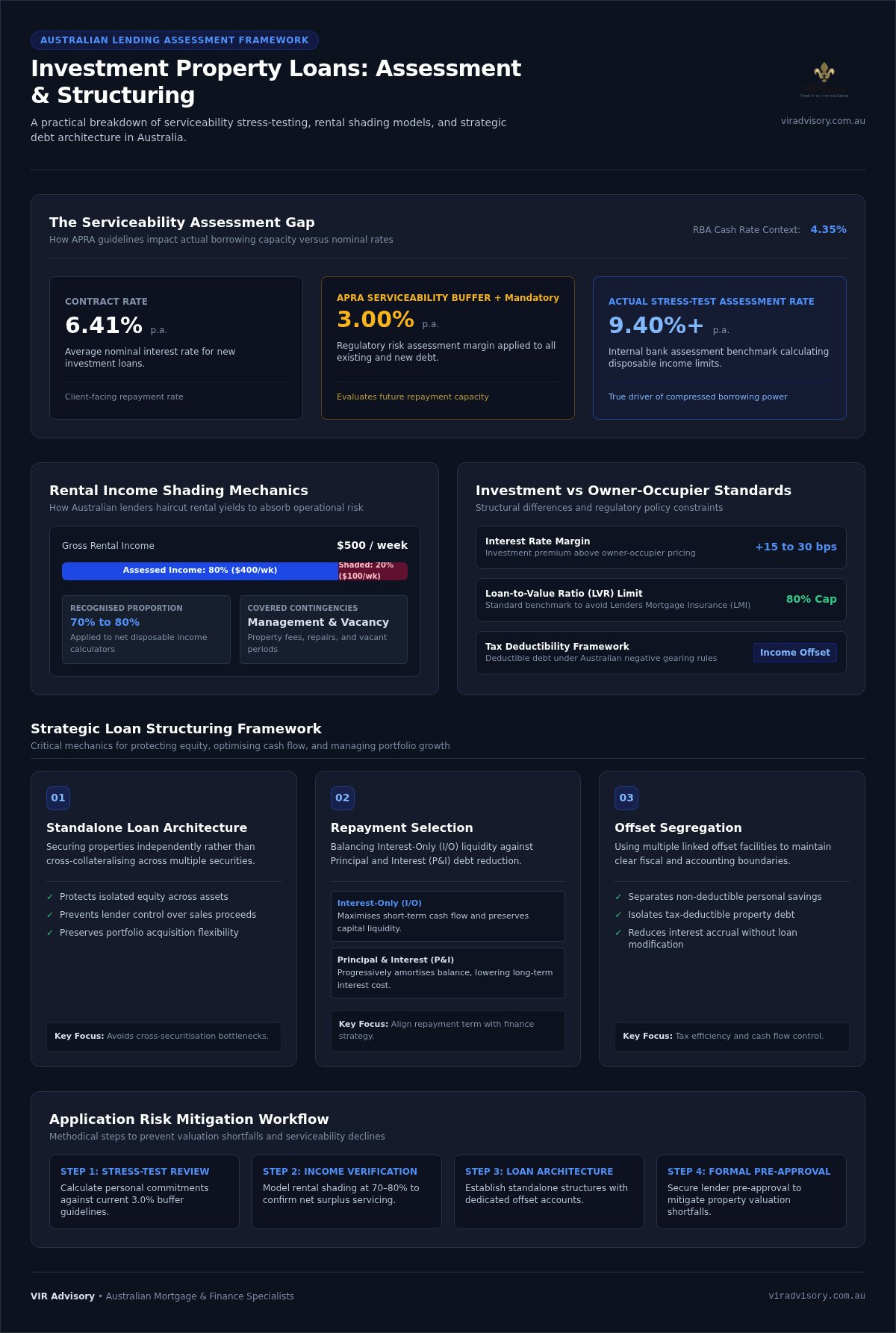
A 6.41% interest rate doesn't mean your lender assesses you at that level. Under current APRA guidelines, Australian banks apply a mandatory 3.0% serviceability buffer, meaning your application for investment property loans Australia is likely being stress-tested at a rate of 9.4% or higher. This regulatory requirement often leads to unexpected reductions in borrowing capacity, leaving many investors feeling restricted by traditional lending models.
You've probably experienced the frustration of seeing your borrowing power diminish or felt confused by the long-term trade-offs between interest-only and principal and interest repayments. It's common to worry that cross-collateralising your assets might limit your future growth by giving lenders too much control over your portfolio. I'll provide an authoritative breakdown of investment loan structures and lender assessment criteria to help you optimise your cash flow and borrowing capacity. We will examine practical strategies for debt management, compare repayment types, and outline the specific requirements needed to secure a competitive approval in the current Australian market.
Key Takeaways
- Understand how lenders apply a 3.0% serviceability buffer and rental income shading to assess your true borrowing capacity in the current market.
- Discover why standalone loan structures are superior to cross-collateralisation for protecting your equity and maintaining future portfolio flexibility.
- Learn to optimise your cash flow by using multiple offset accounts to separate personal savings from deductible investment debt.
- Identify the core differences between interest-only and principal and interest repayments for investment property loans Australia to align with your long-term finance strategy.
- Implement a methodical documentation process and secure formal pre-approval to mitigate the risk of valuation shortfalls or application rejections.
Understanding Investment Property Loans in the Australian Market
Investment property loans Australia are credit facilities designed specifically for purchasing income-producing assets. While these products share some characteristics with owner-occupier mortgages, they carry a higher risk profile for lenders, leading to distinct structural differences. The primary variations include higher interest rates, typically 15 to 30 basis points above owner-occupier rates, and stricter Loan-to-Value Ratio (LVR) limits. Additionally, these loans are governed by specific tax-deductibility rules under the negative gearing framework in Australia, which allows investors to offset certain property-related expenses against their assessable income.
Lenders view investment debt through a different lens because investors are statistically more likely to prioritise their primary residence during periods of financial stress. This perceived risk drives the requirement for higher deposits and more rigorous serviceability testing. In the 2026 credit environment, professional investors prioritise loan architecture over simple interest rate comparisons, ensuring their debt is structured to support long-term cash flow and equity growth without compromising future borrowing capacity.
Investment vs Owner-Occupier Loan Comparison
The most visible difference between these loan types is the interest rate margin. As of September 2026, the average new investment loan rate sits at approximately 6.41% p.a., while owner-occupier rates remain lower. Lenders also enforce a strict 80% LVR cap for most investment applications to avoid Lenders Mortgage Insurance (LMI). Declaring your investment intent is a legal requirement; attempting to secure an owner-occupier rate for a rental property constitutes "occupancy fraud" and can lead to immediate loan recall. Practical investment loan structuring involves selecting the right repayment type, such as interest-only, to preserve liquidity for further acquisitions.
The Impact of 2026 Interest Rate Trends on Serviceability
With the RBA cash rate holding at 4.35%, banks now apply a mandatory 3.0% APRA serviceability buffer to their assessment models. This means a borrower applying for a loan at 6.4% is tested on their ability to repay at 9.4%. This high "floor rate" has compressed borrowing capacity across the board. Consequently, many investors are moving toward non-bank lenders who, while still following responsible lending obligations, may offer more flexible assessment criteria for complex income types or professional portfolios. This shift reflects a broader trend toward methodical debt optimisation in a high-interest-rate environment.
How Lenders Assess Investment Loan Applications
Lenders assess applications for investment property loans Australia using a serviceability calculator designed to stress-test your finances against future volatility. While your actual interest rate might be 6.41%, banks add a 3.0% assessment buffer, evaluating your ability to repay debt at 9.4%. This calculation isn't limited to the new loan; it applies to all existing debt, including your primary residence and personal credit facilities. Banks want to ensure that your net disposable income remains sufficient even if interest rates climb significantly higher than current levels.
Rental shading is a critical factor often overlooked by new investors. Most Australian banks only recognise 70% to 80% of gross rental income to account for property management fees, maintenance, and vacancy periods. If your property earns $500 per week, a lender might only include $400 in their assessment. This conservative approach ensures you can maintain repayments even during lean months when the property might be empty or requires urgent repairs. Understanding these internal bank policies is essential for anyone looking to scale their portfolio without hitting a serviceability wall.
Existing credit limits also impact your capacity. Lenders treat the total limit of a credit card as debt, regardless of whether the balance is zero. Similarly, HECS debts are factored into your net monthly income, which can significantly reduce the amount you're eligible to borrow. For a more detailed look at how these variables interact, you can book a strategy session to review your specific situation.
Borrowing Capacity and Rental Yield Calculations
Consider an investor purchasing a property with a $500 weekly rental return. Annually, this equates to $26,000. However, after applying a 20% shading factor, the lender only views $20,800 as assessable income. This Net Rental Income is the metric that dictates your ability to service the loan. To improve your borrowing capacity, consider closing unused credit cards or reducing limits on existing facilities. These small adjustments can sometimes unlock tens of thousands of dollars in additional funding because banks treat every $1,000 of credit limit as a monthly repayment liability.
Lender Assessment Criteria for Professionals and Directors
For company directors and high-net-worth individuals, assessment becomes more complex. Lenders scrutinise dividends, trust distributions, and business profit-and-loss statements. Self-employed borrowers typically need to provide two years of personal and business tax returns to demonstrate income stability. If you're unsure about your documentation, reviewing our frequently asked questions can clarify standard bank requirements. A clean credit file is non-negotiable in the 2026 market, as even minor defaults can lead to immediate rejection. Many professionals opt for interest-only structures to manage cash flow effectively, as outlined in the Moneysmart guide to interest-only loans. This methodical approach to debt helps maintain liquidity for future acquisitions.
Strategic Loan Structures for Australian Property Investors
While many investors focus on securing the lowest interest rate, the structural design of investment property loans Australia often has a more significant impact on long-term tax efficiency. A methodical approach to loan architecture ensures that debt remains deductible while providing the flexibility to acquire further assets. Sophisticated investors often use multiple offset accounts linked to a single facility. This structure allows for the separation of personal savings from rental income and property-related expenses, preventing the accidental "contamination" of deductible debt with private funds.
Equity release is another strategic tool for portfolio expansion. By establishing a separate sub-facility against the increase in value of an existing property, you can fund deposits for subsequent purchases. This keeps the "use of funds" clear for taxation purposes, as the ATO focuses on what the borrowed money was used for rather than what property secures it. It's helpful to understand how borrowing capacity is actually calculated to determine how much equity you can safely access without over-leveraging. According to Moneysmart's guide to buying an investment property, managing ongoing costs and repayment risks is fundamental to a sustainable strategy.
Interest-Only vs Principal and Interest (P&I)
Interest-only (IO) repayments are a standard choice for investors aiming to maximise tax-deductible interest while preserving monthly cash flow. Since the principal component of a repayment isn't tax-deductible, paying it down on an investment loan often provides less benefit than diverting those funds into an offset account against a non-deductible home loan. However, IO terms are typically capped at five years. When this period ends, borrowers face the "interest-only cliff," where repayments increase significantly as the loan reverts to principal and interest over a shorter remaining term. P&I repayments might be preferable for investors with high equity who want to reduce their total debt exposure or those who have reached their maximum borrowing capacity.
Offset Accounts vs Redraw Facilities for Investors
Offset accounts are generally superior to redraw facilities for investment purposes. When you withdraw funds from a redraw facility, the ATO treats it as a new borrowing. If those funds are used for a non-investment purpose, such as a car or holiday, the interest on that portion of the loan is no longer deductible. This "contamination" is difficult to undo. An offset account avoids this risk because the money remains in a separate deposit account, meaning the loan balance itself is never reduced. Split loans are another effective tool, allowing you to fix a portion of the debt for interest rate certainty while keeping a variable portion with an offset account to maintain liquidity.
Common Pitfalls and Risk Management in Property Finance
Managing investment property loans Australia requires a proactive approach to risk, as even a well-structured portfolio can be derailed by poor security architecture or unforeseen valuation gaps. A common error during the acquisition phase is failing to account for valuation shortfalls. If a lender's valuation comes in lower than the purchase price, you must cover the difference in cash to maintain the required LVR. This risk is particularly prevalent in volatile markets or off-the-plan purchases where market conditions shift between contract signing and settlement. Effective risk management involves maintaining a liquidity buffer to absorb these discrepancies without compromising your deposit. For those with existing portfolios, a strategic debt optimisation and refinancing review can identify where equity is trapped and how to better protect your assets.
The Dangers of Cross-Collateralisation
Cross-collateralisation occurs when a lender uses multiple properties to secure one or more loans. While this might simplify the initial application, it gives the bank total control over your assets. If you sell a property within a cross-collateralised pool, the lender may insist that all sale proceeds be used to pay down the remaining debt rather than allowing you to reinvest the capital. To maintain future flexibility, you should use a stand-alone financing framework. This involves securing each loan against a single property with separate titles. This structure ensures that a valuation drop in one asset doesn't automatically trigger a review of your entire portfolio's LVR, allowing you to manage each property as an independent financial unit.
Mitigating Interest Rate and Vacancy Risks
Interest rate risk is best managed through a combination of hedging and cash reserves. While the APRA 3.0% buffer provides a regulatory baseline, professional investors often calculate a personal safety margin that accounts for rates reaching 10% or higher. This ensures that cash flow remains positive even if the RBA continues to adjust the cash rate target. Lender diversification is another essential strategy. By spreading your debt across different institutions, you reduce the risk of a single lender changing its credit policy and freezing your ability to borrow. A robust liquidity buffer should cover at least three to six months of mortgage repayments to account for unexpected vacancies or major repairs, ensuring you aren't forced to sell an asset under duress.
Navigating the Investment Loan Application Process
Securing investment property loans Australia requires a methodical approach to documentation and a clear understanding of lender expectations. Rejections or delays often stem from poorly organised data rather than a lack of serviceability. A professional application must present a coherent narrative of your financial position, demonstrating stability and a thorough grasp of your existing liabilities. This structured presentation allows credit assessors to move through your file with confidence, reducing the likelihood of additional information requests that can stall a settlement.
Obtaining a formal pre-approval is a non-negotiable step before you attend auctions or sign purchase contracts. It provides a verified borrowing ceiling, allowing you to bid with certainty and protecting your deposit from the risks associated with a declined finance clause. A finance broker plays a critical role here by identifying which lenders have policies that align with your specific income structure. They act as an intermediary, ensuring your case is presented to the institution most likely to provide an approval that supports your long-term debt strategy.
Documentation Checklist for Investment Loans
A complete application package typically requires the following items to satisfy standard Australian banking requirements:
- Proof of income: For PAYG employees, this includes your two most recent payslips and a Group Certificate. Self-employed borrowers must provide two years of personal and business tax returns, along with corresponding Notices of Assessment.
- Property details: You will need formal rental appraisals for the target property, current rates notices for any existing holdings, and copies of signed tenancy agreements.
- Statement of Assets and Liabilities: A comprehensive list of all bank accounts, shares, and superannuation balances, alongside detailed statements for all credit cards, personal loans, and existing mortgages.
The VIR Advisory Approach to Finance Strategy
At VIR Advisory, the focus remains on long-term debt optimisation rather than simple transactional lending. Raina Doshi utilises over 15 years of experience, including more than a decade within a leading Australian bank, to navigate the complexities of professional and self-employed lending. This background provides an internal perspective on how credit teams assess risk, allowing for the identification of specific lender policies that others might overlook. This methodical process ensures that your loan is structured correctly from the outset, preventing issues like cross-collateralisation or serviceability bottlenecks as your portfolio grows.
Your initial consultation involves a deep dive into your current financial architecture to identify opportunities for refinancing or equity release. This unhurried, analytical approach continues through to settlement and beyond, providing a steady anchor for your property finance requirements. We prioritise precision and individual attention, ensuring every detail of your application is handled with professional oversight.
Contact VIR Advisory for a professional finance strategy assessment
Optimising Your Property Finance Strategy for 2026
Success in the current credit environment requires more than just finding a low interest rate. It demands a methodical approach to loan architecture that prioritises tax efficiency and borrowing capacity. By avoiding common pitfalls like cross-collateralisation and maintaining a standalone security structure, you preserve the flexibility needed to expand your holdings as market opportunities arise. It's helpful to remember that how you structure your debt today dictates your ability to scale tomorrow.
Securing competitive investment property loans Australia involves navigating intricate lender policies and rigorous assessment buffers. With over 15 years of banking and finance experience, Raina Doshi provides national service across Australia, specialising in complex investment loan structuring for professionals and self-employed borrowers. This level of professional oversight ensures your debt is managed with precision, providing a stable anchor for your long-term finance strategy.
Discuss your investment lending strategy with Raina Doshi We look forward to providing the decisive, high-value input needed to help you move forward with complete confidence.
Frequently Asked Questions
Can I use the equity in my home for an investment property deposit?
You can access equity in your primary residence by establishing a separate loan facility to cover the deposit and acquisition costs of a new asset. This methodical approach avoids cross-collateralisation and ensures the use of funds remains clear for tax purposes. By keeping the security standalone, you maintain control over your portfolio and prevent the lender from seizing sale proceeds to pay down other secured debt.
What is the minimum deposit required for an investment property loan in Australia?
Most lenders require a 20% deposit to avoid Lenders Mortgage Insurance (LMI) and secure competitive terms for investment property loans Australia. While some institutions accept a 10% deposit, this incurs significant risk fees and stricter serviceability testing. You must also account for stamp duty and legal fees, which typically add another 4% to 6% to the total cash required at settlement. Maintaining a cash buffer is essential to manage these upfront costs.
Is the interest on an investment loan tax-deductible?
Mortgage interest is generally tax-deductible when the borrowed funds are applied directly to an income-producing asset. This includes the interest on both the primary loan and any equity release used for the deposit. It is essential to avoid using redraw facilities for personal expenses, as this contaminates the debt and complicates your tax position. Always consult a professional to ensure your loan architecture supports your specific tax requirements and maintains clear debt separation.
What happens if the property valuation comes in lower than the purchase price?
A valuation shortfall requires you to increase your cash contribution to maintain the lender's approved Loan-to-Value Ratio. If a property is purchased for $800,000 but valued at $780,000, the bank calculates your 80% borrowing limit against the lower figure. This results in a $16,000 funding gap that you must settle personally. Maintaining a liquidity buffer is a critical risk management strategy to handle such discrepancies during the settlement process without jeopardising your contract.
How does an interest-only period affect my long-term loan costs?
An interest-only period reduces your monthly commitment but increases the total interest paid over the life of the mortgage. Because the principal balance remains unchanged, you aren't reducing the debt during this time. When the interest-only term expires, usually after one to five years, the loan reverts to principal and interest repayments. These are then amortised over the remaining, shorter duration, which can cause a significant and sudden increase in your monthly cash flow requirements.
What is the difference between a residential and a commercial investment loan?
Residential investment loans are secured against dwellings and typically offer 30-year terms with LVRs up to 80%. Commercial investment loans are used for warehouses, offices, or retail spaces and usually have shorter terms of 15 to 20 years. Lenders assess commercial applications primarily on the strength of the lease and tenant profile, often capping the LVR at 65% to 70% while requiring higher interest rate margins due to the perceived increase in risk.
How many investment properties can I own before lenders stop lending to me?
There is no specific cap on property numbers; however, your expansion is limited by serviceability and Debt-to-Income (DTI) ratios. APRA considers a DTI ratio of 6.0 times or higher as high risk, and many banks apply stricter assessment criteria once you reach this threshold. As your portfolio grows, rental shading and the 3.0% assessment buffer make it increasingly difficult to demonstrate a surplus, eventually limiting your borrowing capacity with traditional Australian banking institutions.
Why did my bank reject my investment loan despite a high income?
Rejections for high-income earners are frequently caused by the 3.0% serviceability buffer or high existing credit limits. Lenders treat the total limit of all credit cards as a monthly liability, regardless of the actual balance. If your income is complex, involving trust distributions or dividends, certain banks may heavily shade these figures. A methodical review of your debt structure can often identify these obstacles before you apply for investment property loans Australia.

Article by
Raina Doshi
Raina Doshi has worked in banking and finance since 2011, including experience with major Australian lenders. She helps homeowners, property investors, business owners and professionals secure and structure lending solutions across home loans, refinancing, commercial finance and business lending.
Areas of expertise include residential lending, investment property finance, debt recycling, commercial property finance, equipment finance, construction finance and strategic debt structuring.
Drawing on extensive banking and finance experience, Raina helps clients navigate lender requirements, improve borrowing outcomes and structure effective finance solutions.
Disclaimer
The information in this article is general in nature and does not take into account your personal objectives, financial situation or needs. Before acting on any information, consider whether it is appropriate to your circumstances and seek professional advice.


