

Having substantial paper wealth in your property doesn't guarantee you can actually release equity from home; credit assessors scrutinise your net surplus cash flow long before they look at your property's appraisal. Under standard Australian lending policy, usable equity is calculated by taking 80% of your property's certified bank valuation and deducting your existing mortgage balance. Borrowing beyond that 80% loan-to-value ratio threshold introduces mandatory lenders mortgage insurance and heightened underwriting requirements.
It is understandable to feel constrained when rising property valuations collide with APRA's stringent 3.00% serviceability buffer, leaving you uncertain about your borrowing capacity and cautious about escalating monthly commitments. This guide explains how to calculate your accessible funds precisely, navigate lender stress-testing, and structure debt facilities safely without unnecessary financial risk. Below, we break down bank assessment rules, evaluate term splits versus lines of credit, and outline the practical steps to secure credit approval efficiently.
Key Takeaways
- Usable equity is calculated at 80% of your property's certified bank valuation minus outstanding mortgage balances, allowing you to access capital without incurring lenders mortgage insurance.
- Establishing an independent loan split paired with a 100% offset account is often far more cost-effective than paying premium interest rates on a line of credit when you release equity from home.
- Borrowing capacity remains the true ceiling on any equity release, as lenders must stress-test your existing and new debt under APRA's mandatory 3.00% serviceability buffer.
- Interest deductibility depends entirely on the purpose of the drawn funds under ATO rules, requiring clean debt segregation to avoid tainting loan accounts.
- Avoiding cross-collateralised loan structures protects your portfolio from restrictive bank security controls and forced sale proceeds sweeps.
Understanding Usable Home Equity and How Australian Lenders Calculate It
Homeowners often assume that their net property value translates dollar-for-dollar into liquid borrowing power. In banking practice, home equity represents the gross accounting difference between your security's current market value and the debt encumbering it. If your residential property is valued at $1,000,000 and your outstanding mortgage balance is $500,000, your total equity stands at $500,000. However, this is not the amount a bank permits you to draw.
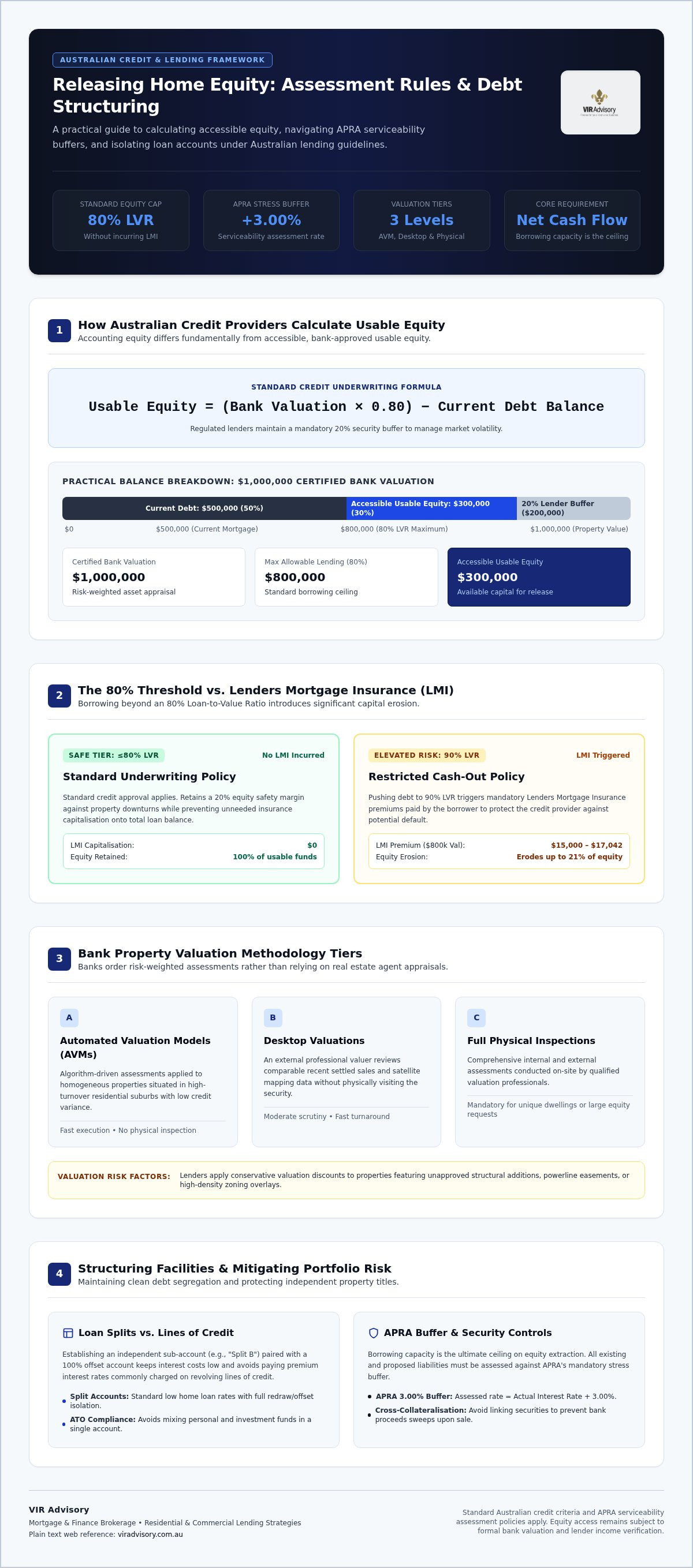
To safely release equity from home without punitive overheads, credit providers assess usable equity. Regulated Australian lenders cap unsecured capital extraction at an 80% loan-to-value ratio (LVR). This buffer ensures the financial institution maintains a 20% equity cushion against market volatility. You can calculate accessible funds using this standard credit equation:
Usable Equity = (Bank Valuation × 0.80) – Current Debt Balance
Applying this formula to our $1,000,000 security:
- Maximum Borrowing at 80% LVR: $800,000
- Current Mortgage Debt: $500,000
- Accessible Usable Equity: $300,000
Equity is merely collateral. It does not guarantee credit approval. A borrower holding $600,000 in usable equity will still face outright credit decline if their verifiable income cannot service the proposed total debt.
The 80% LVR Rule and Lenders Mortgage Insurance
Exceeding the 80% threshold triggers Lenders Mortgage Insurance (LMI), an insurance premium paid by the borrower that protects the lender against default. Cash-out applications above 80% LVR carry elevated credit risk, prompting underwriters to apply restrictive evidentiary checks. On an $800,000 valuation, pushing debt to 90% LVR ($720,000 total balance) can capitalise between $15,000 and $17,042 in LMI premiums directly onto your loan. This erodes up to 21% of the equity you intended to withdraw. Paying LMI is generally counterproductive, though commercial property investors occasionally absorb the expense to secure a time-sensitive, high-yielding acquisition deposit.
How Credit Providers Determine Your Property Valuation
Real estate agent appraisals reflect optimistic listing expectations, whereas bank valuations are risk-weighted assessments of immediate liquidation value. Mortgage lenders utilise three primary appraisal tiers:
- Automated Valuation Models (AVMs): Algorithm-driven assessments applied to homogeneous properties in high-turnover suburbs with low credit variance.
- Desktop Valuations: An external valuer reviews comparable recent sales and satellite data without physical property access.
- Full Physical Inspections: Comprehensive internal and external assessments conducted by qualified professionals, mandatory for unique dwellings or large equity requests.
Lenders apply conservative valuation discounts when properties feature unapproved structural additions, powerline easements, or high-density zoning overlays. Understanding these thresholds prevents unforced credit rejections when seeking to release equity from home.
Comparing Mechanisms to Release Equity: Refinance, Line of Credit, and Loan Splits
Extracting capital from residential security requires selecting a borrowing structure that matches your purpose and repayment capacity. While retail banks often market simple top-ups or redraw facilities, pulling capital directly from an existing home loan can create significant accounting problems. If personal and investment funds mix in one account, calculating tax deductions becomes difficult under Australian Taxation Office guidelines. Borrowers aiming to release equity from home typically choose between full external refinancing, creating separate loan splits, or establishing a revolving credit facility.
Refinancing with Cash Out vs Additional Loan Splits
An internal policy variation allows you to carve out a new sub-account with your current bank while leaving your original loan terms untouched. For example, if you require $150,000 for an investment deposit, your lender establishes "Split B" alongside your primary mortgage ("Split A"). This isolates debt purposes cleanly. Conversely, refinancing your mortgage to an alternate credit provider involves full underwriting, discharge documentation, and settlement fees. An external refinance takes more time to process, but it allows you to renegotiate headline pricing across your entire debt portfolio and take advantage of lenders offering more generous serviceability models.
Line of Credit Facilities: Flexibility and Discipline
Revolving lines of credit function like a large overdraft secured against your property, charging interest only on the capital you actually draw. Despite their flexibility, these products carry notable structural disadvantages:
- Elevated Interest Margins: Dedicated lines of credit routinely attract pricing premiums of 0.40% to 0.95% p.a. above standard variable principal and interest terms, alongside annual facility fees between $300 and $495.
- Principal Stagnation Risk: Without an amortisation schedule, borrowers who lack disciplined cash management risk paying continuous interest without ever reducing their principal balance.
- Regulatory Reductions: Prudential capital rules heavily penalise banks for undrawn limits, leading major lenders to restrict or reprice line of credit products.
A more cost-effective alternative involves establishing a standard term loan split linked to a 100% offset account. You draw the entire approved equity balance into the offset facility on settlement day. Because funds in an offset reduce your chargeable interest to zero until spent, you secure immediate liquidity without paying interest on unallocated funds. If you want to review which facility structure suits your cash flow requirements, you can book a consultation to discuss borrowing structures before submitting a formal application.
Lender Assessment Criteria: Borrowing Capacity, APRA Buffers, and Acceptable Use
Your property valuation merely establishes the security ceiling; your demonstrable net income dictates whether a bank approves your application. Credit assessors do not evaluate equity in isolation. Instead, they run your household finances through rigorous serviceability models to confirm that you can sustain higher debt commitments. Understanding how borrowing capacity is calculated helps clarify why a substantial asset base cannot override an uncommitted cash flow deficit.
Every regulated Australian deposit-taking institution must apply a mandatory APRA serviceability buffer of at least 3.00 percentage points above the contract interest rate. If your standard variable rate is 5.90% p.a., the bank stress-tests your application at 8.90% p.a. over a thirty-year amortisation term. For an applicant releasing $300,000 in equity, the bank assesses affordability on a monthly repayment of approximately $2,393 rather than the actual cash repayment of $1,779. Because every 0.50% buffer variation impacts borrowing capacity by roughly 5%, this 3.00% benchmark suppresses overall borrowing power by 25% to 30% across the banking sector.
Acceptable Use of Funds and Scrutiny on Uncontrolled Cash Out
Credit underwriters categorise cash-out applications into distinct risk tiers based on loan purpose and funding size:
- Low-Doc Cash-Out (Under $50,000 to $100,000): Approved across major banks using statutory declarations or borrower statements for personal reserves, vehicle purchases, or minor cosmetic upgrades.
- High-Scrutiny Cash-Out (Above $100,000 to $250,000+): Requires concrete documentary proof prior to formal credit sign-off, such as fixed-price building contracts, registered council plans, or executed property purchase contracts.
- Prohibited Purposes: Mainstream banks strictly refuse equity release intended for ATO tax debt settlement, speculative share trading, cryptocurrency purchases, or injecting uncommitted cash into unprofitable trading entities.
Borrowing Capacity Considerations for Self-Employed Applicants
Company directors and self-employed professionals face unique hurdles when they attempt to release equity from home to fund commercial initiatives. Major banks average the last two financial years of business tax returns and add back depreciation, but they heavily penalise fluctuating annual profits. If an enterprise experiences temporary earnings dips while pursuing expansion, standard servicing algorithms often fail.
To access residential equity for business growth or working capital, self-employed borrowers frequently turn to specialised non-bank lenders. These institutions provide alternative documentation loans evaluated via twelve months of Business Activity Statements (BAS) or qualified accountant declarations. Matching your capital requirements with the appropriate lender policy ensures you secure necessary funding without triggering unnecessary credit file inquiries.
Critical Risks, Cross-Collateralisation, and Structural Mistakes to Avoid
Poor debt architecture can transform valuable equity into an operational trap. When property values fluctuate or interest rates shift, structural errors made during the initial setup quickly surface. Releasing capital against your primary residence introduces distinct balance sheet risks that require proactive isolation, particularly if you manage multiple investment securities or variable credit facilities.
The Dangers of Cross-Collateralising Property Assets
Major lenders routinely encourage borrowers to cross-collateralise, bundling multiple properties under a single mortgage contract to simplify internal underwriting. This structure creates significant institutional friction:
- Loss of Transactional Autonomy: When you sell a cross-securitised asset, the lender has the contractual right to enforce a "partial discharge sweep," seizing net sale proceeds to pay down debt on your remaining properties to satisfy their internal portfolio LVR benchmarks.
- Valuation Contagion: If one property in the bundle drops in value, the bank restricts usable equity across your entire portfolio, preventing access to capital even if other holdings have appreciated.
- Uncoupling Friction: Dismantling a crossed portfolio requires full property revaluations, fresh serviceability assessments across all associated debts, and substantial legal discharge fees.
Structuring loans on a stand-alone basis ensures each title remains independent. This isolates risk and preserves your freedom to divest assets without bank interference.
Debt Consolidation Pitfalls: Term Length and Interest Accumulation
Rolling unsecured liabilities into a home loan provides immediate cash flow relief, but it introduces substantial long-term interest costs. Replacing an $80,000 unsecured commercial facility or vehicle debt at 11.00% over five years with a home loan at 6.00% amortised over thirty years substantially inflates the total interest paid over the life of the debt.
To avoid paying for short-term liabilities decades later, you should establish a dedicated split with an accelerated principal repayment schedule designed to eliminate that debt within three to five years. Reviewing the mechanics of debt consolidation vs refinancing helps ensure that restructuring debt reduces actual costs rather than merely stretching liabilities across a longer timeline.
Fluctuating variable rates also demand disciplined risk management. Expanding your total mortgage balance magnifies repayment sensitivity whenever the Reserve Bank alters monetary policy, making it vital to establish clear cash buffers before you release equity from home.
Step-by-Step Framework to Release Equity with VIR Advisory
Executing an equity top-up requires a structured approach that aligns property assets with broader debt management requirements. Rather than applying blindly with an existing lender, following a methodical process ensures your borrowing capacity is maximised and your loan accounts remain cleanly partitioned. When you prepare to release equity from home, executing these procedural steps minimises administrative friction and prevents structural errors.
Five-Step Equity Extraction Process
- Commission Upfront Property Valuations: Order electronic desktop assessments and automated valuation models across multiple lenders before lodging credit files. This confirms usable security thresholds and avoids recording unnecessary inquiries on your credit history.
- Stress-Test Household Serviceability: Calculate verifiable net surplus income against the mandatory 3.00% APRA buffer rate, incorporating existing living costs and liabilities to verify exact borrowing capacity.
- Architect Segregated Debt Facilities: Structure separate, stand-alone split accounts or sub-facilities linked to dedicated offset accounts, avoiding cross-collateralisation across existing property securities.
- Compile Comprehensive Credit Evidence: Assemble targeted documentary proof matching specific lender tiers, including builder contracts for renovations, signed contracts of sale for deposits, or BAS statements for commercial purposes.
- Execute Settlement and Allocate Funds: Finalise mortgage contracts and direct loan proceeds into segregated accounts to ensure clear accounting lines under Australian Taxation Office guidelines.
Partnering with VIR Advisory for Custom Debt Structuring
Negotiating complex credit policies demands deep institutional insight. Led by founder Raina Doshi, who brings over 15 years of specialised banking and corporate finance expertise, VIR Advisory delivers credit architecture designed around your specific balance sheet requirements. Retail banks restrict you to their proprietary credit appetite, but an independent brokerage provides direct access to an extensive national panel of bank and non-bank lenders.
Whether you require residential refinancing, investment loan structuring, commercial debt advisory, or asset finance, our credit analysis identifies lenders whose servicing calculators and cash-out policies align with your financial objectives. Review the comprehensive range of services offered to see how tailored debt structures protect your assets while unlocking usable capital across Australian credit markets.
Executing a Safe and Structured Equity Release Strategy
Unlocking capital from residential property requires balancing asset valuations against real serviceability constraints. When you release equity from home, preserving an 80% loan-to-value ratio prevents costly mortgage insurance, while establishing independent loan splits isolates investment debt and maintains clean accounting records. Most importantly, avoiding cross-collateralised bank security packages preserves your freedom to sell or restructure individual assets without institutional lender interference.
Led by finance professional Raina Doshi, who brings over 15 years of banking experience, VIR Advisory delivers credit architecture tailored to your broader balance sheet requirements. Through direct access to an extensive national panel of bank and non-bank lenders, we evaluate your borrowing capacity and implement debt structures focused on tax efficiency and asset protection.
With an appropriately structured lending facility in place, your usable equity serves as a controlled, effective mechanism for funding commercial operations or expanding your property portfolio.
Frequently Asked Questions
How much usable equity can I realistically withdraw from my residential property?
You can realistically withdraw usable equity up to 80% of your property's certified bank valuation minus your existing mortgage balance. Borrowing past this 80% loan-to-value ratio triggers lenders mortgage insurance, which adds thousands in capitalised costs. In addition, credit providers calculate the final release amount against your demonstrable borrowing capacity, verifying that your surplus income can service the increased total debt facility comfortably.
Can I release equity from my home if I am self-employed or have variable income?
Yes, self-employed borrowers can release equity from home using alternative documentation structures if standard tax returns don't reflect current trading performance. While major banks typically require two consecutive years of individual and company tax returns, specialist non-bank lenders assess serviceability using twelve months of Business Activity Statements or an accountant declaration. This approach provides capital without penalising business owners for standard tax depreciation deductions.
What is the difference between a cash-out refinance and a home equity line of credit?
A cash-out refinance replaces your existing mortgage with a larger term loan split, providing a lump sum usually paired with an offset account at standard home loan interest rates. A home equity line of credit functions like an ongoing revolving overdraft, charging interest only on drawn balances. However, lines of credit attract higher variable rates, annual facility fees, and lack structured principal amortisation, making term splits generally more cost-effective.
Is the interest on released home equity tax-deductible in Australia?
Tax deductibility in Australia is determined entirely by how you deploy the borrowed funds, not by the property used as security. Under Australian Taxation Office ruling TR 2000/2, if you use released equity to purchase income-producing assets such as commercial real estate or shares, the interest is generally deductible. Conversely, drawing equity for private expenditure or owner-occupied renovations remains non-deductible regardless of whether the loan is secured against an investment property.
What are the most common reasons an Australian lender will decline an equity release application?
The primary reason Australian lenders decline equity applications is insufficient borrowing capacity under APRA's mandatory 3.00% serviceability stress test. Other frequent decline triggers include unverified cash-out purposes above lender thresholds, poor credit history, recent undisclosed liabilities, and conservative property valuations that push the loan-to-value ratio above 80%. Lenders will also automatically reject applications intended to settle overdue ATO tax debts or fund speculative investments.
Does releasing equity from my property require a full in-person valuation by the bank?
Not necessarily, as lenders decide valuation types based on property risk, loan balance, and suburb data density. Many low-risk applications qualify for automated valuation models or electronic desktop assessments completed within hours without physical inspection. However, if you request large cash-out sums, own a unique or acreage property, or push close to the 80% loan-to-value ratio threshold, credit underwriters will mandate a comprehensive physical inspection by an independent certified valuer.

Article by
Raina Doshi
Raina Doshi has worked in banking and finance since 2011, including experience with major Australian lenders. She helps homeowners, property investors, business owners and professionals secure and structure lending solutions across home loans, refinancing, commercial finance and business lending.
Areas of expertise include residential lending, investment property finance, debt recycling, commercial property finance, equipment finance, construction finance and strategic debt structuring.
Drawing on extensive banking and finance experience, Raina helps clients navigate lender requirements, improve borrowing outcomes and structure effective finance solutions.
Disclaimer
The information in this article is general in nature and does not take into account your personal objectives, financial situation or needs. Before acting on any information, consider whether it is appropriate to your circumstances and seek professional advice.


