

With the ATO General Interest Charge (GIC) currently sitting at 11.43% and no longer tax-deductible as of July 2025, carrying tax arrears is now one of the most expensive ways to fund an Australian business. Most directors assume that a tax liability is an automatic barrier to finance, especially when the major banks often require a $0 balance on your Integrated Client Account before they will consider an application. It's a common frustration to feel that your growth is stalled by the very debt you're trying to clear.
Securing a business loan with ATO debt is entirely possible through specialist non-bank lenders who view tax liabilities as a manageable credit risk rather than a terminal obstacle. By matching the origin of the debt with the correct lending structure, you can regain control of your cash flow and exit expensive daily compounding interest rates. This article explains the specific lender assessment criteria you must meet, the commercial frameworks used to clear arrears, and the practical steps needed to consolidate tax debt into a sustainable loan facility that supports your long-term business stability.
Key Takeaways
- Specialised commercial lenders provide viable funding solutions for entities with tax arrears, even when major trading banks maintain rigid rejection policies for non-zero tax balances.
- Identify the critical distinctions between Tier 1 bank requirements and the risk-based pricing models used by non-bank lenders to assess tax-related credit risk.
- Leverage specific finance structures, such as debtor finance or working capital injections, to settle tax liabilities and eliminate daily compounding interest charges.
- Discover the strategic framework required to secure a business loan with ATO debt, beginning with a comprehensive review of your Integrated Client Account (ICA) statement.
- Understand how expert credit structuring can transform a complex tax liability into a manageable commercial loan, improving your overall business cash flow and borrowing capacity.
Can You Get a Business Loan with ATO Debt in 2026?
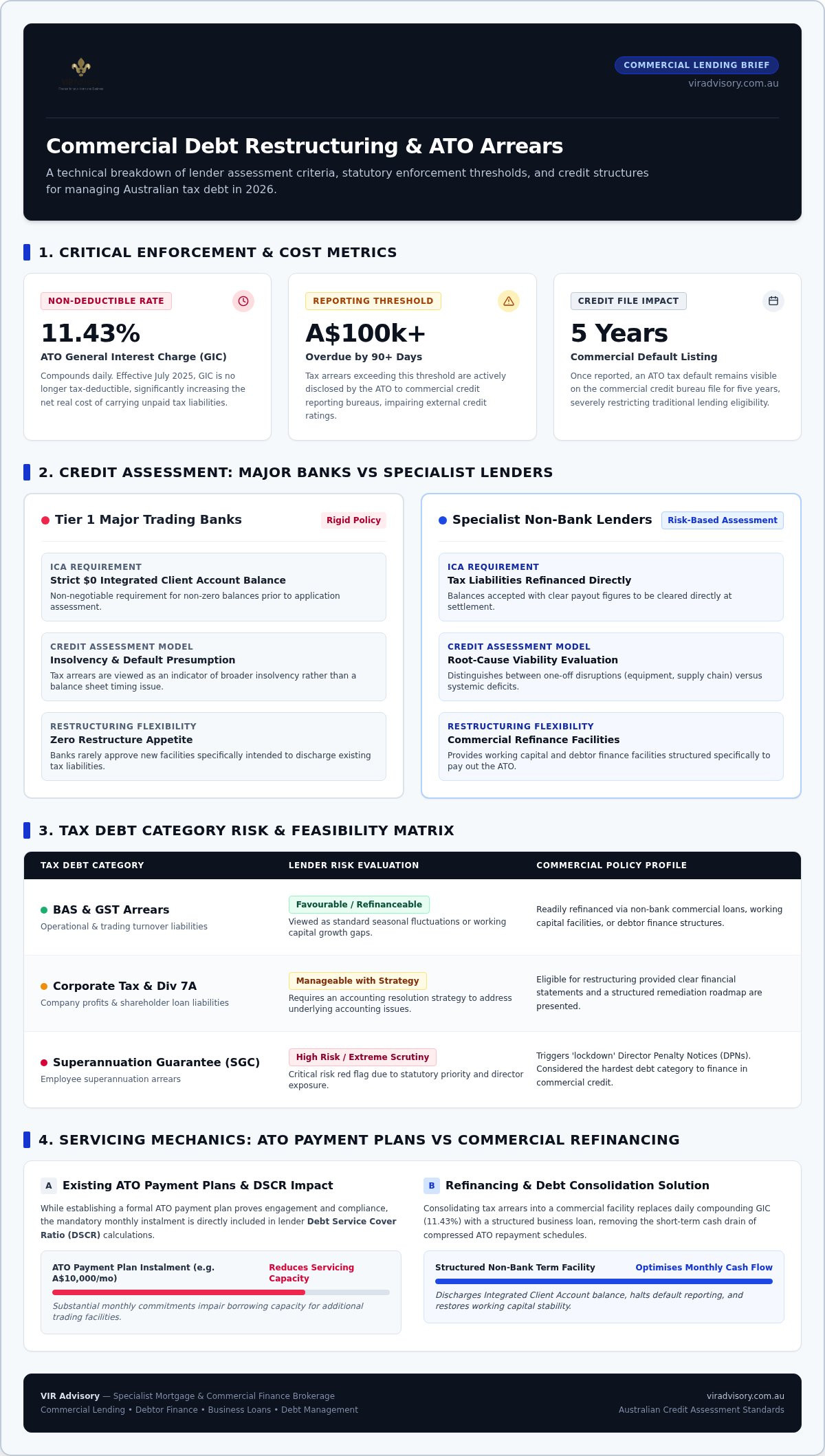
Yes, securing a business loan with ATO debt is achievable in 2026, provided you target the right credit market. While major banks often view tax arrears as a sign of terminal insolvency, specialised commercial lenders treat it as a structural challenge that requires specific debt management. The Australian Taxation Office has significantly ramped up enforcement, making it critical to address liabilities before they transition from 'undisclosed' to 'disclosed' debt. Under current regulations, the tax office can report business tax debts of A$100,000 or more that are overdue by 90 days to credit reporting bureaus. Once a default is listed, it remains on your commercial credit file for five years, severely limiting your future borrowing capacity.
The primary objective for any director should be transitioning from high-cost tax arrears to a structured commercial facility. Carrying an ATO debt effectively means you are using a non-deductible overdraft with an 11.43% interest rate. By securing a business loan with ATO debt, you can often move this liability into a tax-deductible loan structure with more favourable terms. This shift not only protects your credit score but also stabilises your working capital.
To better understand the current landscape of tax enforcement in Australia, watch this report on the increasing pressure faced by small businesses:
Types of Tax Debt Lenders Will Consider
Most specialised lenders are comfortable refinancing Business Activity Statement (BAS) and GST arrears. They understand that seasonal fluctuations or rapid growth can lead to temporary cash flow gaps. Corporate Income Tax and Division 7A liabilities are also manageable, provided there is a clear strategy to resolve the underlying accounting issues. However, Superannuation Guarantee Charge (SGC) debt is viewed with extreme caution. Because superannuation belongs to employees, non-payment triggers 'lockdown' Director Penalty Notices. Lenders see SGC arrears as a significant risk management red flag, making it the hardest debt to finance. You can view our full range of finance strategy guidance for more details on specific debt types.
The Impact of an Existing ATO Payment Plan
Lenders generally prefer borrowers who have already engaged with the tax office. A formalised payment plan proves you aren't avoiding your obligations. However, the monthly instalment on that plan must be included in your debt service cover ratio (DSCR) calculations. If the ATO requires a A$10,000 monthly payment, that reduces the cash flow available to service a new commercial loan. A formal plan is often a prerequisite for any consideration by traditional banks, but for non-bank lenders, the goal is usually to pay out the plan entirely to improve your monthly position and overall borrowing capacity.
Lender Assessment Criteria: How Banks vs Non-Banks View Tax Arrears
Major Australian trading banks maintain a conservative posture toward tax liabilities, often requiring an Integrated Client Account (ICA) balance of zero before considering a new facility. This rigid stance stems from Tier 1 credit policies that equate tax debt with broader financial distress or potential insolvency. For these institutions, any outstanding balance is a non-negotiable barrier to entry. They rarely provide the flexibility needed to restructure debt that has already fallen into arrears.
Non-bank lenders operate with a different philosophy, utilising risk-based pricing to assess the viability of an application. They view tax arrears as a specific hurdle to be cleared rather than a terminal failure. When applying for a business loan with ATO debt, these lenders focus on the "why" behind the arrears. They distinguish between a one-off event, such as a temporary supply chain disruption or a large equipment purchase, and systemic cash flow issues that suggest an unviable business model.
To bridge this gap, credit managers often rely on a 'Letter of Comfort' or accountant-prepared declarations. These documents provide a professional narrative that contextualises the debt and confirms the business remains a going concern. It's also vital to understand the ATO tax debt disclosure rules, as debt already reported to credit bureaus requires a more sophisticated mitigation strategy. If you're unsure how your current arrears will be viewed by different credit teams, discussing your specific tax position with a specialist can clarify your options.
Security and Collateral Requirements
Lender requirements vary significantly based on the documentation provided. Full-doc applications require complete financial statements, while low-doc options may rely on BAS or bank statements, though these often attract higher interest rates. Many business owners find success by using residential equity to secure a commercial loan for tax clearance, as this typically offers the lowest possible interest rate. While unsecured business loans are available for smaller arrears, they come with higher rates and shorter terms, making them better suited for rapid execution rather than long-term debt management.
The 'Purpose of Loan' Test
Lenders maintain a strong preference for loans that completely clear the debt. A partial payment often signals ongoing stress, whereas a full payout demonstrates a definitive resolution. The intended use of funds directly impacts the loan term and interest rate offered. Our Refinancing solutions are designed to optimise this structure, ensuring the new facility provides genuine cash flow relief rather than just shifting the problem elsewhere. A structured payout plan often leads to more favourable assessment criteria and improved approval prospects.
Commercial Finance Options for Managing ATO Arrears
While the tax office provides internal payment arrangements, these are often restricted to short timeframes and come with non-deductible interest. Exploring an external business loan with ATO debt allows you to leverage your company's balance sheet to clear the liability in full. This proactive approach is supported by data in the RBA small business financial conditions bulletin, which highlights the expanding role of non-bank lenders in providing credit where traditional institutions hesitate.
There are four primary commercial structures used to address tax arrears:
- Working Capital Finance: This provides a short-term liquidity injection to settle immediate BAS or GST obligations, preventing further daily compounding interest and legal enforcement.
- Debtor Finance: This uses your unpaid B2B invoices as collateral to generate cash without taking on traditional debt or encumbering property.
- Asset Finance: This involves refinancing unencumbered equipment to extract equity for tax payments.
- Debt Consolidation: This merges your tax liability with other commercial debts, such as equipment loans or unsecured lines of credit, into a single monthly repayment.
Debtor Finance as a Cash Flow Solution
For B2B businesses, debtor finance is a powerful tool for clearing tax debt because it doesn't require real estate security. By accessing up to 85% of the value of your outstanding invoices, you can settle your Integrated Client Account balance immediately. This facility grows in line with your sales, providing a flexible alternative to term loans. Understanding how borrowing capacity is actually calculated in Australia is essential, as this facility uses your sales ledger rather than personal property equity to determine the available funds. It turns an idle asset into immediate tax clearance capital.
Asset Refinancing Strategies
If your business owns vehicles, machinery, or heavy equipment outright, you can utilise a 'sale and leaseback' strategy. The lender purchases the asset from you at its current market value and leases it back over a set term, providing an immediate lump sum to pay the ATO. While this generates rapid liquidity, directors must exercise caution. Using long-term assets to settle short-term tax liabilities can be risky if the repayment structure isn't matched to your future cash flow. We ensure that any asset-backed solution aligns with your broader finance strategy to maintain long-term stability and operational capacity.
A 5-Step Framework to Improve Your Approval Prospects
Applying for a business loan with ATO debt requires a methodical approach to credit risk management. Lenders don't just look at the figure you owe; they evaluate the steps you've taken to address it. A structured application can mean the difference between a high-interest unsecured facility and a sustainable, lower-rate secured loan. By following a sequential process, you can present a narrative of stability that satisfies non-bank credit requirements.
- Step 1: Obtain a current ICA statement. You must have a clear view of your Integrated Client Account (ICA) balance, including any General Interest Charge (GIC) that has accrued. This provides the baseline for the total funding required.
- Step 2: Formalise a payment plan. If immediate funding isn't available, entering a formal arrangement shows the lender you're engaging with the tax office and managing your statutory obligations responsibly.
- Step 3: Prepare a 'Management Account' explanation. Write a concise summary explaining why the debt occurred. Lenders prefer one-off events, such as a delayed client payment or rapid growth, over structural unprofitability.
- Step 4: Assess your 'Total Facilities'. Identify other commercial debts that could be consolidated to improve your overall debt service cover ratio (DSCR) and simplify your monthly cash flow.
- Step 5: Engage a specialised finance broker. Accessing the non-bank market requires a specialist who understands which credit teams have an appetite for tax-related risks and how to structure the application for approval.
Common Mistakes to Avoid During Application
The most frequent error directors make is attempting to hide the debt. Since lenders perform thorough credit checks and often request a current ICA statement, undisclosed tax arrears lead to an automatic decline for non-disclosure. Another mistake is applying to multiple lenders simultaneously. Each enquiry leaves a footprint on your commercial credit file, which signals financial desperation to credit managers. Finally, failing to provide context for the arrears is a missed opportunity. Securing a business loan with ATO debt is often about the quality of the data provided, so be specific about whether the debt arose from external market shocks or internal growth pressures.
Documentation Requirements for Tax-Related Loans
Lenders require a specific set of documents to verify your business's viability. You'll need accountant-prepared BAS for the last four quarters and current Aged Receivables and Payables reports. These reports prove that your cash flow is sufficient to service the new loan while maintaining current tax obligations. For those considering using business premises as security, reviewing our guide on Commercial Property Finance can help you understand how to leverage your assets effectively to clear tax liabilities.
Navigating Complex Lending with VIR Advisory
Resolving tax arrears requires more than a simple application; it demands a sophisticated understanding of how credit managers weigh risk. Raina Doshi brings over 15 years of experience in the banking and finance sector, including extensive tenure within major Australian banks, to every client engagement. This background allows VIR Advisory to anticipate lender objections before they arise. By constructing a precise and transparent narrative, we ensure your application for a business loan with ATO debt is positioned for approval rather than immediate rejection.
Our approach extends beyond the Tier 1 banking sector. We maintain relationships with a broad network of private and non-bank lenders whose products aren't available to the general public. These institutions often provide the flexibility needed to clear tax liabilities while focusing on your company's long-term fiscal health. Instead of settling for a high-interest 'quick fix', we seek out structures that support sustainable growth and improved cash flow. This methodical oversight ensures every detail of your finance strategy is handled with professional precision.
Why Professional Brokerage Matters for Tax Debt
Engaging a specialist broker is critical when negotiating interest rates. Without professional representation, businesses often get funnelled into 'default' high-risk rates that don't reflect their actual creditworthiness. We advocate for risk-based pricing that acknowledges your business's underlying strengths. We also carefully monitor existing bank covenants. It's vital that a new facility doesn't inadvertently trigger a breach in your current commercial property or equipment finance agreements, as such a breach could lead to a broader recall of funds by your primary bank.
Submit your enquiry for a confidential debt review
Take Action on Your Business Finance Strategy
The cost of inaction in the current regulatory environment is severe. With the ATO increasingly issuing garnishee orders and Director Penalty Notices (DPNs), waiting to address tax debt can lead to personal liability and frozen trading accounts. Moving from a defensive tax position to an offensive growth strategy requires a decisive shift in your finance structure. By refinancing tax arrears into a manageable commercial loan, you protect your director standing and clear the way for future investment. Transitioning from arrears to stability is a methodical process that begins with a comprehensive credit assessment.
Stabilising Your Cash Flow Through Strategic Refinancing
Securing a business loan with ATO debt is a technical exercise in matching your specific tax position with the appropriate non-bank credit appetite. While major banks often maintain rigid rejection policies for tax arrears, the specialist market provides structured facilities designed to clear these liabilities and protect your commercial credit file. Moving from high-cost, non-deductible tax interest to a tax-deductible commercial loan can immediately improve your monthly cash flow and director standing.
Success relies on a methodical approach, including a clear narrative for the debt and a thorough review of your Integrated Client Account. With over 15 years of banking and finance experience, Raina Doshi specialises in complex commercial lending structures for clients across Australia. Transitioning from a defensive tax position to an offensive growth strategy is possible with the right credit expertise and a well-structured application.
Taking proactive steps to manage your tax liabilities today ensures your business remains resilient and ready for future investment opportunities.
Frequently Asked Questions
Can the ATO stop me from getting a business loan?
The ATO does not have the legal authority to veto a commercial loan application; however, their enforcement actions can effectively block your access to credit. If the tax office reports a debt of A$100,000 or more that is overdue by 90 days to credit bureaus, your credit score will drop significantly. Additionally, the issuance of a garnishee order can freeze your business bank accounts, making it impossible to demonstrate the cash flow required for a new facility.
What is the maximum amount of tax debt I can have and still get a loan?
There is no specific statutory limit on the amount of tax debt a business can carry while seeking finance. Instead, lenders evaluate your Loan-to-Value Ratio (LVR) and Debt Service Cover Ratio (DSCR). Specialist non-bank lenders frequently provide a business loan with ATO debt up to 80% or 85% of your residential property's value. The primary requirement is demonstrating that your business generates sufficient recurring EBITDA to service the new loan repayments alongside existing operational costs.
Do I need to put my house up as security to pay off tax debt?
You are not strictly required to use residential property as security, though doing so often results in the lowest interest rates. Alternative structures include debtor finance, which uses your unpaid B2B invoices as collateral, or asset refinancing, where you extract equity from unencumbered machinery or vehicles. While unsecured business loans are available for smaller tax arrears, they typically carry higher interest rates and shorter repayment terms compared to facilities secured by real estate.
How does a Director Penalty Notice (DPN) affect my borrowing capacity?
A Director Penalty Notice is a significant credit risk that alerts lenders to potential personal liability for company tax debts. Lockdown DPNs, triggered by unlodged BAS or superannuation, are particularly damaging as they cannot be extinguished by liquidation. Most lenders will pause an application upon discovering an active DPN. However, if you are within the 21-day response window for a non-lockdown notice, a specialised broker can sometimes secure funding to clear the debt and discharge the notice.
Is the interest on a business loan used to pay tax debt tax-deductible?
Yes, interest incurred on a commercial loan used for business purposes, including clearing tax arrears, is generally tax-deductible under Section 8-1 of the Income Tax Assessment Act 1997. This creates a distinct advantage over the ATO’s General Interest Charge (GIC), which became non-deductible for Australian businesses on 1 July 2025. By refinancing, you effectively convert a non-deductible 11.43% penalty into a potentially deductible interest expense, significantly improving your business's net cash flow position.
How quickly can a business loan for ATO debt be approved?
Approval timeframes vary based on the complexity of the debt and the required security. Unsecured business loans or debtor finance facilities can often be approved within 24 to 48 hours, providing rapid relief from ATO enforcement. Property-backed refinancing typically takes between two and four weeks to reach settlement, as it requires formal valuations and legal documentation. Engaging a specialist early in the process ensures that all required paperwork, such as Integrated Client Account statements, is ready for immediate assessment.
Can I get a loan if my business has a tax default on its credit file?
You can still secure a business loan with ATO debt even if a default is listed on your commercial credit file. While major banks will automatically decline applications with active tax defaults, specialist non-bank lenders focus on the current viability of your business and the purpose of the new loan. If the funds are being used to clear the default and provide a clean slate, these lenders will assess the application based on your security and future cash flow projections.
What happens if I don't disclose my ATO debt to a lender?
Non-disclosure of tax debt typically results in an automatic decline for fraud or non-disclosure. Lenders verify your tax position by requesting a current Integrated Client Account statement and performing comprehensive credit searches. If a lender discovers undisclosed arrears during the assessment process, it destroys the trust required for a commercial partnership. Transparency allows a broker to structure a narrative that explains the debt and proposes a viable resolution while matching you with the correct credit appetite.

Article by
Raina Doshi
Raina Doshi has worked in banking and finance since 2011, including experience with major Australian lenders. She helps homeowners, property investors, business owners and professionals secure and structure lending solutions across home loans, refinancing, commercial finance and business lending.
Areas of expertise include residential lending, investment property finance, debt recycling, commercial property finance, equipment finance, construction finance and strategic debt structuring.
Drawing on extensive banking and finance experience, Raina helps clients navigate lender requirements, improve borrowing outcomes and structure effective finance solutions.
Disclaimer
The information in this article is general in nature and does not take into account your personal objectives, financial situation or needs. Before acting on any information, consider whether it is appropriate to your circumstances and seek professional advice.


