

Walking directly into a major bank for commercial finance often locks you into the most restrictive covenants and unnecessary personal security requirements. A specialised commercial property loan broker engineers debt structures that look beyond headline rates to protect operational cash flow and preserve asset independence. By negotiating critical metrics such as Interest Cover Ratios (ICR) and Debt Service Coverage Ratios (DSCR) across both bank and non-bank lenders, a broker secures funding tailored to your balance sheet rather than a single institution's rigid policy.
Securing commercial property debt in Australia has grown increasingly complex under tight serviceability hurdles and stringent annual review conditions. You will discover how an experienced commercial property loan broker structures high-leverage facilities without cross-collateralising personal assets, manages debt covenants, and accesses competitive alternative doc options. Below, we examine essential borrowing metrics, evaluate non-bank capital solutions, and outline the exact credit frameworks required to optimise your commercial debt.
Key Takeaways
- Discover how a commercial property loan broker constructs detailed credit memorandums that satisfy strict institutional underwriting criteria.
- Learn how lenders calculate critical metrics like Debt Service Coverage Ratios (DSCR), Interest Cover Ratios (ICR), and Weighted Average Lease Expiries (WALE).
- Compare major banks against non-bank and private lenders to secure higher borrowing capacity without cross-collateralising personal assets.
- Avoid operational disruption by preparing for mandatory annual bank reviews, debt covenants, and commercial property revaluations before settlement.
- Streamline your application using a structured documentation checklist designed to navigate multi-entity and commercial SMSF borrowing requirements.
The Strategic Role of a Commercial Property Loan Broker in Australia
A commercial property loan broker operates as an accredited credit specialist who engineers and negotiates corporate debt facilities on behalf of business operators and property investors. Unlike standard residential mortgages, which rely on automated credit scoring algorithms, commercial debt underwriting requires bespoke credit memorandums. As an established commercial mortgage broker demonstrates, each funding request demands a comprehensive presentation of historical cash flow, tenant quality, and asset liquidity. Brokers manage transactions across diverse asset classes, from light industrial warehouses and suburban office suites to multi-tenanted retail strips and specialised facilities like childcare centres or medical clinics. Because commercial credit appetites shift rapidly, specialist brokers identify unadvertised bank policies and non-bank mandates across Australia.
Commercial Mortgages Versus Residential Lending Frameworks
Commercial finance operates under distinctly separate legal and structural principles than personal mortgages. Key differences include:
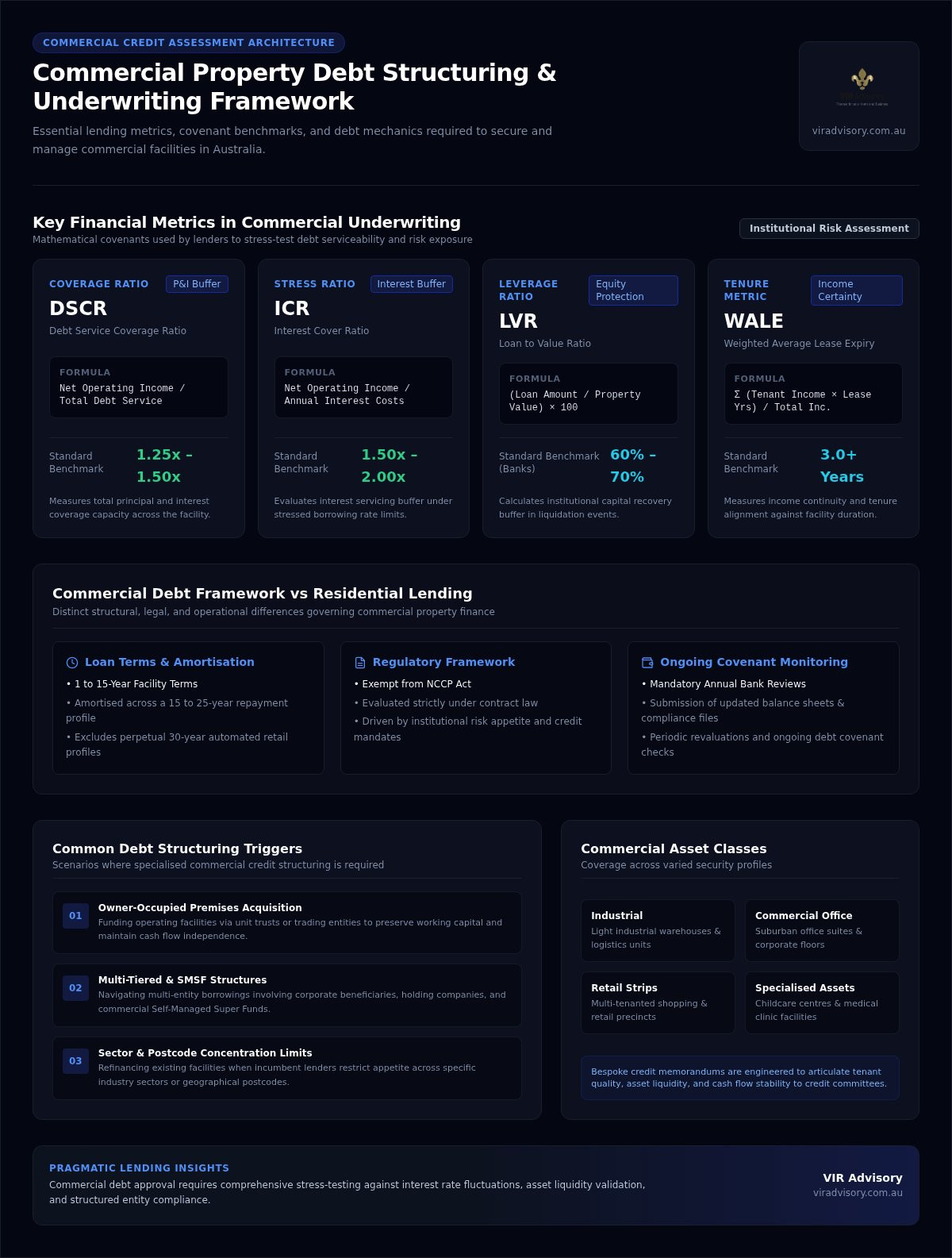
- Loan terms and amortisation: Commercial facilities rarely provide perpetual 30-year terms. Instead, they feature loan terms of 1 to 15 years, frequently amortised over a 15 to 25-year profile that requires regular renewals or balance-sheet reviews.
- Regulatory exemptions: Commercial lending falls outside the National Consumer Credit Protection (NCCP) Act, removing standard consumer protections and placing assessment strictly on contract law and institutional risk appetite.
- Annual reviews and covenants: Lenders actively monitor loans via annual reviews, requiring updated balance sheets, compliance certificates, and mandatory debt covenant evaluations.
When to Engage a Specialist Commercial Finance Broker
Engaging a dedicated commercial property loan broker becomes essential when debt requirements exceed conventional retail credit policies. Common triggers include:
- Acquiring owner-occupied trading premises: Purchasing operating facilities through complex trading entities or unit trusts without draining operational cash flow.
- Multi-tiered legal structures: Securing funding across group structures involving holding entities, corporate beneficiaries, and Self-Managed Super Funds (SMSFs).
- Sector concentration limits: Refinancing debt facilities when an incumbent lender reduces its exposure to specific asset classes, postcodes, or tenant sectors.
Key Financial Metrics Commercial Brokers Use to Structure Property Debt
Commercial lenders evaluate transactions through risk-weighted mathematical covenants rather than retail credit cards or personal asset registers. A commercial property loan broker applies rigorous stress-testing against potential interest rate movements before lodging a file, assessing secondary repayment sources and realisable asset liquidity. As documented in Reserve Bank of Australia analysis on financial stability risks in commercial property, institutional lenders monitor debt servicing capacity closely to mitigate exposure during volatile economic cycles.
| Metric | Formula | Standard Benchmark | Lender Focus |
|---|---|---|---|
| DSCR | Net Operating Income / Total Debt Service | 1.25x to 1.50x | Total principal and interest coverage capacity |
| ICR | Net Operating Income / Annual Interest Costs | 1.50x to 2.00x | Interest servicing buffer under stressed rate limits |
| LVR | (Loan Amount / Property Value) × 100 | 60% to 70% (Banks) | Capital recovery buffer in liquidation events |
| WALE | Σ (Tenant Income × Lease Years) / Total Income | 3.0+ Years | Income certainty and tenure matching loan term |
Evaluating Debt Service Coverage Ratio and Interest Cover
Debt Service Coverage Ratio (DSCR) benchmarks require operational cash flows to cover principal and interest commitments by at least 1.25 times. Interest Cover Ratio (ICR) measures net operating income exclusively against interest liabilities, with major institutions requiring 1.50 to 2.00 times coverage. A specialised commercial property loan broker normalises business EBITDA by stripping out non-recurring overheads, director discretionary bonuses, or abnormal tax charges, presenting true operational repayment strength.
Loan-to-Value Ratios Across Commercial Asset Classes
Standard commercial Loan-to-Value Ratios (LVR) range between 60% and 70% with traditional banks, whereas non-bank lenders can stretch to 80% for standard industrial or commercial office premises. Specialised assets, such as fuel stations or motels, are restricted to 50% to 60% LVR due to limited secondary market appeal. Lenders also tier borrowing thresholds based on property postcodes and liquidity classifications, discounting vacant possession valuations by 10% to 20% compared to fully leased premises.
Lease Profiles, WALE, and Tenant Covenant Strength
Weighted Average Lease Expiry (WALE) dictates maximum loan tenure and security margins. Blue-chip or national corporate tenants provide strong covenant strength, allowing brokers to negotiate tighter credit spreads. If your property carries short lease expiries under 18 months, an experienced adviser can structure interest reserves or step-down covenants. You can book a pre-lending assessment to analyse your asset's debt covenants before approaching financiers.
Comparing Bank, Non-Bank, and Private Commercial Lending Options
Institutional risk appetites dictate the capital structures available to commercial property borrowers across Australia. Selecting an unsuitable lending category can severely compromise an enterprise's liquidity by imposing unworkable reporting requirements or restricting balance sheet growth. A specialised commercial property loan broker evaluates funding across three core tiers:
- Major Banks (Tier 1): Offer the lowest interest margins and advanced treasury products, suited for mature businesses with stable, multi-year operating profits.
- Specialist Non-Banks (Tier 2): Deliver flexible underwriting, higher leverage thresholds, and bespoke debt service models without stringent institutional caps.
- Private Debt Funds (Tier 3): Provide short-term bridging, asset repositioning finance, and urgent settlement liquidity based primarily on realisable security values rather than serviceability models.
Major Australian Banks Versus Specialist Non-Bank Lenders
Major banks deliver competitive interest pricing, yet they enforce onerous ongoing conditions. These include mandatory annual compliance submissions, ongoing debt covenant checks, and the risk of lender-directed property revaluations during volatile market cycles. A failed covenant check can trigger automatic margin increases or formal default notices, even if interest payments remain completely current.
Conversely, specialist non-bank credit providers have expanded their market presence significantly, offering commercial borrowers relief from automated credit hurdles. Non-bank lenders regularly forgo annual balance sheet reviews, accept higher leverage positions up to 80% LVR, and execute approvals rapidly. When evaluating your capital requirements, review our detailed guide on commercial property finance to assess whether bank or non-bank capital aligns with your trading goals.
Full Doc Versus Low Doc and Alternative Commercial Solutions
Full Doc applications demand two consecutive financial years of certified balance sheets, profit and loss statements, and entity tax returns, supplemented by individual notices of assessment. This documentation structure secures Tier 1 bank pricing but requires absolute historical income consistency.
Alternative documentation (Alt Doc) facilities provide vital capital solutions for self-employed directors whose recent business growth outpaces historical lodgements. A commercial property loan broker structures these proposals using supporting verification methods:
- Accountant declarations: Standardised letters confirming ongoing solvency and projected debt serviceability.
- Business Activity Statements (BAS): Recent consecutive quarters lodged with the Australian Taxation Office to verify operating turnover.
- Trading bank statements: Six months of verified account statements illustrating actual cash inflows.
While Alt Doc solutions carry higher interest margins, they eliminate extensive historical tax lodgement delays and deliver capital to secure tactical acquisitions.
Navigating the Commercial Property Loan Application Process
Securing commercial debt approval requires presenting a well-supported financial case directly to credit underwriters. Unlike automated retail loan platforms, commercial credit teams scrutinise underlying trading viability, asset marketability, and potential covenant vulnerabilities. An experienced commercial property loan broker manages this process through strict document curation, targeted lender submission, and independent valuation management, mitigating post-approval delays before loan contracts are drafted.
Essential Financial Documentation and Information Required
Institutional underwriters require verifiable evidence demonstrating consistent debt service capacity across the entire entity group:
- Corporate financials: Balance sheets, profit and loss statements, and tax returns for the past two full financial years, accompanied by an up-to-date group organisation structure chart.
- Property documentation: Certified lease agreements, a detailed tenancy schedule outlining area breakdowns and outgoings recovery, and historical operational costs.
- Director and guarantor profiles: Statements of financial position detailing personal assets, existing liabilities, contingent liabilities, and personal tax portal statements.
Mitigating Common Approval Risks and Covenant Triggers
Credit analysts immediately red-flag single-tenant reliance, looming lease expiries, and outstanding statutory tax debts. If an asset faces imminent tenant roll-off, brokers present alternative local leasing benchmarks or establish capital interest buffers to offset immediate vacancy risks. Existing Australian Taxation Office (ATO) liabilities must be managed proactively; presenting formal, complying repayment schedules prior to credit lodgement prevents automatic file declines. Understanding how institutional credit teams quantify your borrowing capacity allows you to structure group entities cleanly without incurring unnecessary file rejections.
Step-by-Step Approval and Settlement Protocol
Executing a commercial finance transaction follows four structured phases to ensure alignment between the lender's credit mandate and legal documentation:
- Credit Assessment and Structuring: Your broker reviews group cash flows, calculates debt coverage under stressed interest rates, and compiles a comprehensive credit memorandum.
- Lender Submission: The proposal is lodged with chosen credit teams, initiating formal credit reviews and preliminary risk scoring.
- Terms Sheet and Independent Valuation: The lender issues an indicative terms sheet outlining pricing and covenants, followed by instructions to an independent panel valuer to confirm market value and vacant possession realisation.
- Legal Due Diligence and Settlement: Panel solicitors review leases, confirm mortgage registrations, satisfy all conditions precedent, and coordinate fund disbursement.
Structuring Commercial Property Finance with VIR Advisory
VIR Advisory provides a disciplined, corporate finance approach to credit advisory and facility design. Founded by Raina Doshi, who brings over 15 years of banking and finance experience, the brokerage operates nationally to assist business owners, corporate entities, and seasoned property investors. Instead of transactional broking, the firm manages debt facilities as an active component of balance-sheet optimisation. Engaging an experienced commercial property loan broker ensures your borrowing capacity remains protected while securing institutional funding aligned with operational cash flow.
Customised Debt Structuring Across Complex Business Entities
Commercial assets require structured entity arrangements to minimise commercial liabilities and retain borrowing flexibility. VIR Advisory specialises in structuring debt across diverse legal entities:
- Multi-tiered trusts and holding entities: Isolating trading operations from underlying real estate holdings by arranging finance through unit trusts, discretionary trusts, or corporate beneficiaries. This separation shields core property assets from day-to-day trading liabilities.
- SMSF property acquisitions: Structuring compliant Limited Recourse Borrowing Arrangements (LRBA) for commercial premises, enabling business owners to purchase their trading premises through self-managed super funds.
- Multi-lender security partitions: Segregating cross-securitised properties across distinct financiers to eliminate blanket institutional liens.
Review our complete range of funding capabilities and commercial facilities on our services offered page.
Strategic Debt Review and Commercial Refinancing Frameworks
Commercial facilities should never remain unmonitored. Market interest rates, asset valuations, and banking policies fluctuate constantly, often leaving borrowers exposed to covenant creep or excessive bank margins. VIR Advisory conducts systematic audits of existing loan portfolios to identify structural vulnerabilities before annual bank reviews occur.
Through comprehensive balance-sheet analysis, the firm renegotiates restrictive Debt Service Coverage Ratio (DSCR) covenants, resets uncompetitive risk margins, and negotiates the release of cross-collateralised residential security or superfluous personal guarantees. Whether refinancing multi-tenanted industrial assets or arranging new acquisition debt, working with an experienced commercial property loan broker delivers structured, sustainable debt terms. Connect directly with Raina Doshi to evaluate your commercial financing options through our contact us page.
Secure Strategic Commercial Property Debt with Confidence
Aligning commercial property debt with operational reality requires far more than comparing headline interest rates. Establishing sustainable debt coverage buffers, choosing strategically between bank and non-bank capital, and eliminating unnecessary cross-collateralisation safeguards your broader enterprise. Partnering with a qualified commercial property loan broker ensures your loan facilities are negotiated proactively, structuring debt cleanly across company, trust, or commercial SMSF entities without compromising balance-sheet liquidity.
VIR Advisory brings over 15 years of tier-one banking and commercial finance expertise directly to your transaction. Accredited across Australia's leading bank and non-bank lending institutions, founder Raina Doshi delivers rigorous credit structuring designed to protect borrowing capacity and support business expansion nationwide.
Taking control of your debt positioning today ensures your commercial portfolio remains resilient, fully compliant, and primed to capitalise on future market opportunities.
Frequently Asked Questions
How much deposit is typically required for a commercial property loan in Australia?
Most Australian commercial lenders require a deposit of 30% to 35%, reflecting standard Loan-to-Value Ratios (LVR) of 65% to 70% for freehold assets like warehouses, offices, or retail premises. Specialist non-bank lenders may accept a 20% deposit under specific credit policies. For specialised assets such as petrol stations or childcare centres, lenders often require deposits between 40% and 50% due to higher liquidity and operational risks.
Can I purchase commercial property through a Self-Managed Super Fund (SMSF)?
Yes, your SMSF can acquire commercial property using a Limited Recourse Borrowing Arrangement (LRBA). The property is held in a separate trust until the debt is extinguished, protecting other fund assets. Business owners frequently use this structure to buy their trading premises, paying commercial market rent directly into their SMSF. A commercial property loan broker coordinates with your professional advisers to ensure the facility meets strict statutory compliance standards.
What is an Interest Cover Ratio (ICR) and why do commercial lenders require it?
An Interest Cover Ratio measures a commercial property's net operating income against annual interest liabilities, verifying debt servicing buffers under potential market stress. Major banks typically require an ICR between 1.50x and 2.00x calculated using assessment benchmark rates. Lenders mandate this financial covenant to ensure that unexpected tenant vacancies, outgoings increases, or interest rate movements will not cause loan repayment defaults during volatile market conditions.
What happens if a commercial property value drops during an annual bank review?
If a formal valuation drops during an annual review, your Loan-to-Value Ratio can breach agreed loan covenants. When this happens, the bank may issue a covenant breach notice, request a partial debt paydown, or ask for supplementary real estate security to restore the required ratio. An experienced broker often renegotiates these covenants or refinances the balance to non-bank lenders who do not require ongoing revaluations.
How does a commercial property loan broker get paid in Australia?
A commercial property loan broker typically receives upfront and trailing commissions paid directly by the chosen lender upon loan settlement. For complex corporate debt advisory, bespoke syndications, or private debt facilities, brokers may also charge an agreed engagement or mandate fee. Any applicable fee structure is disclosed transparently in a formal credit proposal or mandate before your application is submitted to prospective credit providers.
Can I obtain a commercial property loan with low doc or alternative documentation?
Yes, alternative documentation (Alt Doc) facilities allow business owners and investors to secure commercial funding without two years of certified financial statements. Lenders assess serviceability through recent Business Activity Statements (BAS), six months of trading bank statements, or an accountant declaration letter. While Alt Doc loans carry slightly higher interest margins than Full Doc institutional debt, they provide essential speed and liquidity for expanding enterprises.
What is the difference between an uncommitted and a committed commercial loan facility?
A committed loan facility is a legally binding contract where the lender cannot cancel funding or demand immediate repayment before expiry, provided all covenants are met. An uncommitted facility allows the financier to review, reduce, or demand repayment of the debt on short notice or at their complete discretion. Most overdrafts and short-term lines are uncommitted, whereas commercial term mortgages should always be structured as committed debt.

Article by
Raina Doshi
Raina Doshi has worked in banking and finance since 2011, including experience with major Australian lenders. She helps homeowners, property investors, business owners and professionals secure and structure lending solutions across home loans, refinancing, commercial finance and business lending.
Areas of expertise include residential lending, investment property finance, debt recycling, commercial property finance, equipment finance, construction finance and strategic debt structuring.
Drawing on extensive banking and finance experience, Raina helps clients navigate lender requirements, improve borrowing outcomes and structure effective finance solutions.
Disclaimer
The information in this article is general in nature and does not take into account your personal objectives, financial situation or needs. Before acting on any information, consider whether it is appropriate to your circumstances and seek professional advice.


