

What is Debt Consolidation and How Does it Optimise Cash Flow?
Are you managing multiple credit cards, a personal loan, and perhaps a car loan, each with a different due date and a high interest rate? This constant juggling act can put significant pressure on your monthly budget and make it feel impossible to get ahead financially. If this situation sounds familiar, restructuring your liabilities could be the solution you need.
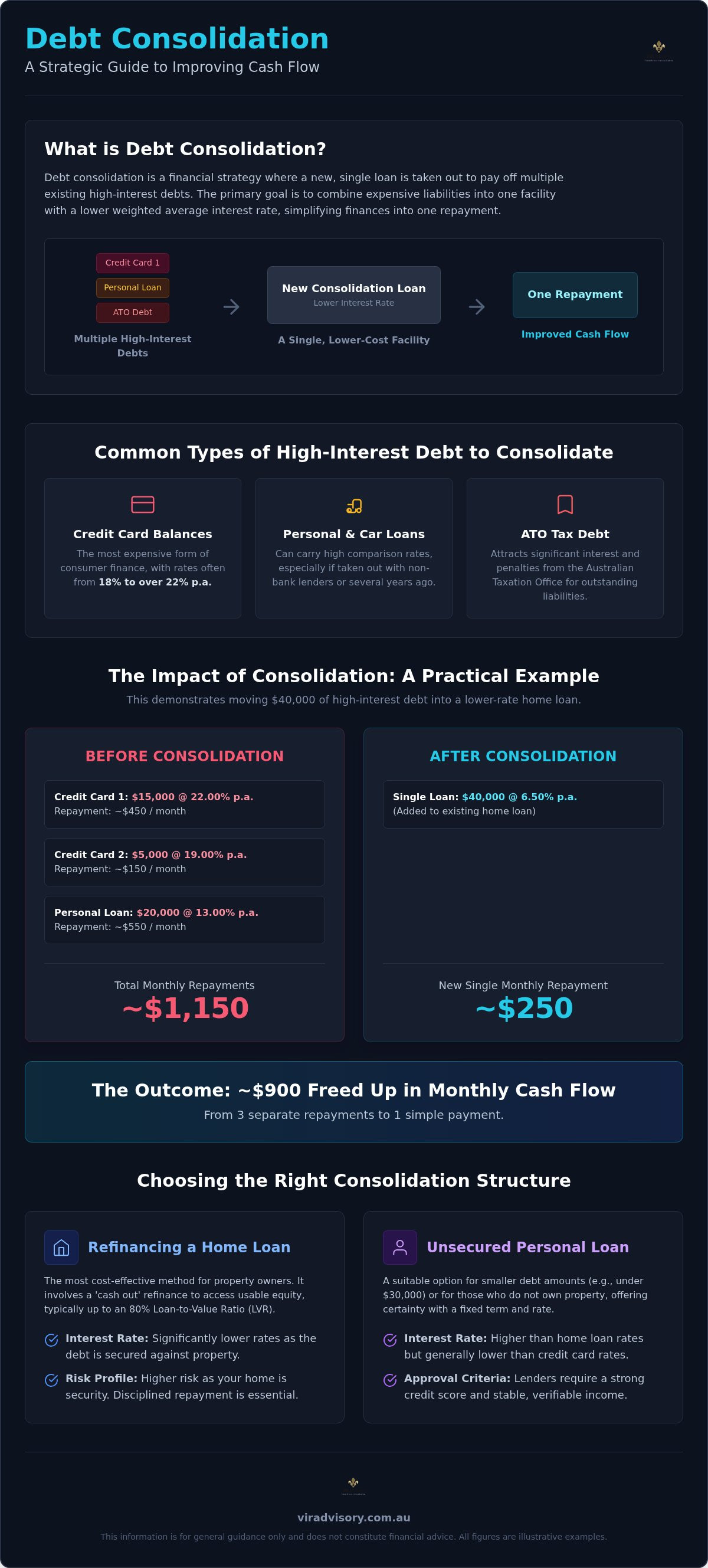
Debt consolidation is a financial strategy where you take out a new, single loan to pay off multiple existing high-interest debts. The primary goal is to combine your expensive debts—like credit cards and personal loans—into one facility with a lower weighted average interest rate. By doing this, you can simplify your finances into a single repayment and, in many cases, reduce your total monthly outgoing, significantly improving your cash flow.
- It involves taking out a new loan to pay off several high-interest liabilities.
- The main objective is to secure a lower overall interest rate across all borrowings.
- This strategy can improve monthly cash flow by extending the loan term or reducing the interest rate.
- At its core, combining debts is a structural finance strategy designed to reduce interest expense.
Common Types of High-Interest Debt in Australia
Many Australians find themselves carrying debt that accrues interest at a rapid rate. These facilities are often easy to acquire but can become difficult to manage over time. Common examples include:
- Credit card balances: With interest rates often ranging from 18% to over 22% p.a., credit card debt is one of the most expensive forms of consumer finance. According to the Reserve Bank of Australia (RBA), Australians owe tens of billions of dollars on credit cards accruing interest.
- Unsecured personal loans and car finance: These loans can carry high comparison rates, especially if they were taken out several years ago or with a non-bank lender.
- ATO tax debt: For self-employed professionals and business owners, outstanding tax liabilities can attract significant interest and penalties from the Australian Taxation Office.
Cash Flow vs. Total Interest Cost
When you restructure liabilities, you often face a trade-off between lowering your monthly repayments and minimising the total interest paid over the life of the loan. Extending the loan term will almost certainly reduce your monthly commitment, freeing up cash flow. However, a longer term means you may pay more in total interest. The key is to find a balance that meets your immediate cash flow needs without unnecessarily extending the debt. An effective consolidation strategy also improves your debt-to-income (DTI) ratio, which can enhance your borrowing capacity for future investments.
A Practical Example of Debt Consolidation
To understand the real-world impact, consider this common scenario for an Australian household:
Before Consolidation:
- Credit Card 1: $15,000 balance at 22.00% p.a. (Monthly repayment: ~$450)
- Credit Card 2: $5,000 balance at 19.00% p.a. (Monthly repayment: ~$150)
- Personal Loan: $20,000 balance at 13.00% p.a. (Monthly repayment: ~$550)
- Total Debt: $40,000
- Total Monthly Repayments: ~$1,150
After Consolidating into a Home Loan:
- Single Loan: $40,000 added to a home loan at 6.50% p.a.
- New Monthly Repayment (on the $40k portion): ~$250 (based on a 30-year term)
- Total Debt: $40,000 (now secured against property)
- Total Monthly Repayments: $250
Outcome:
In this example, the borrower simplifies three repayments into one and frees up approximately $900 in monthly cash flow. This demonstrates the powerful effect of moving high-interest unsecured debt into a lower-rate, secured facility.
Refinancing vs. Personal Loans: Choosing the Right Structure
The two most common methods for debt consolidation in Australia are refinancing a home loan to release equity or taking out a new unsecured personal loan. The right choice depends on your financial situation, the amount of debt you have, and your risk tolerance.
- Interest Rate Delta: The difference in interest rates between a mortgage-backed consolidation and an unsecured personal loan can be substantial. Home loan rates are typically much lower.
- Setup Costs: Refinancing a mortgage may involve costs like valuation fees, mortgage registration, and discharge fees, while personal loans often have simpler application fees.
- Risk Profile: Using your home as security carries the risk of losing the property if you cannot meet repayments. Unsecured loans don't carry this risk, but their higher rates reflect this.
For a detailed analysis of the refinancing process, see our Refinance Home Loan Guide.
Using Home Equity for Debt Consolidation
For property owners, using home equity is often the most cost-effective way to combine multiple debts. Lenders calculate your 'usable equity' based on your property's value and your current mortgage balance. Typically, you can borrow up to 80% of your property's value (the Loan-to-Value Ratio or LVR) without incurring Lenders Mortgage Insurance (LMI).
The process involves a 'cash out' refinance, where the lender provides funds to pay your creditors directly at settlement. To maintain financial discipline, it's a sound risk management strategy to separate this consolidated debt into a dedicated sub-account or 'split loan'. This prevents it from simply being absorbed into your primary mortgage and allows you to focus on paying it down aggressively.
Unsecured Personal Loans for Consolidation
An unsecured personal loan can be a more appropriate option in certain circumstances, particularly for smaller debt amounts (e.g., under $30,000) or for those who do not own property. These loans offer repayment certainty through fixed interest rates and a set loan term, unlike the variable rates on most home loans.
However, lender requirements are strict. Approval depends heavily on stable, verifiable income and a strong credit score. Lenders will scrutinise your credit history for any signs of financial stress before approving an unsecured facility for the purpose of debt simplification.
Lender Assessment Framework: How Applications are Evaluated
When you apply to consolidate debt, lenders conduct a rigorous assessment that goes far beyond a simple income check. They are looking for evidence of responsible financial management and a clear capacity to service the new, larger loan.
- Account Conduct: This is a top priority. Lenders will examine your statements for the debts you intend to pay out. Any late payments, overdrawn accounts, or dishonour fees in the last six months can lead to an immediate rejection.
- Serviceability Calculations: Lenders don't take all income at face value. They often 'shade' or discount variable income sources like bonuses, commissions, and overtime by 20% or more. They also apply a 'serviceability buffer' or 'floor rate' (typically 3% above the actual loan rate) to test if you can still afford repayments if interest rates rise.
- Comprehensive Credit Reporting (CCR): Your credit file now shows up to 24 months of repayment history for each account, including whether you paid on time, late, or missed a payment. This detailed data gives lenders a clear picture of your reliability as a borrower.
- Common Approval Obstacles: Two frequent deal-breakers are undisclosed liabilities (like a small personal loan or credit card) and excessive use of 'Buy Now Pay Later' services, which lenders may view as a sign of poor cash flow management.
Borrowing Capacity and Debt-to-Income Ratios
A lender's assessment of your borrowing capacity is heavily influenced by your existing credit limits. It's the total limit on your credit cards that counts against you, not just the balance. For example, having three credit cards with $10,000 limits each reduces your borrowing power as if you had a $30,000 loan, even if the balances are zero. For business owners seeking to consolidate personal or business debts, lenders will require up-to-date financial statements, including recent Business Activity Statements (BAS) and tax returns, to verify income.
Improving Your Approval Prospects
You can significantly strengthen your application by taking a few proactive steps at least three to six months before you apply:
- Reduce Credit Limits: Lower the limits on any credit cards you don't use or plan to close. This immediately improves your calculated borrowing capacity.
- Ensure Lodgements are Current: If you have business or tax debts, ensure all your tax lodgements are up to date with the ATO. Lenders will not approve a consolidation loan if there are outstanding filings.
- Demonstrate a 'Net Tangible Benefit': Clearly articulate to the lender how the consolidation will improve your financial position. This could be through a significant interest rate reduction, a material improvement in monthly cash flow, or both.
Step-by-Step Process to Consolidate High Interest Debt
A structured approach to debt consolidation ensures you address all critical factors and select the most effective solution for your circumstances. Rushing the process can lead to a suboptimal outcome.
- Conduct a Full Financial Audit: Create a comprehensive list of all your current liabilities. For each debt, note the outstanding balance, the exact interest rate, the monthly repayment, and any expiry dates.
- Determine the Total Funding Requirement: Sum up all the balances to get a total payout figure. Remember to include any potential break fees for fixed-rate loans or government charges associated with refinancing a mortgage.
- Select the Optimal Loan Structure: Based on your audit, decide whether a mortgage refinance, a personal loan, or a specialised business facility is the most suitable structure to achieve your goals.
- Engage a Specialist Broker: A finance broker can identify lenders whose credit policies align with your specific profile. This is crucial, as different lenders have very different appetites for debt consolidation applications, especially for self-employed borrowers or those with complex financial histories.
Phase 1: Financial Audit and Strategy
The initial phase is about gathering data and forming a clear plan. Start by calculating the 'weighted average interest rate' of your current debts to create a benchmark. This helps you quantify the benefit of any new loan offer. Identify any 'toxic' debts—those with excessively high interest rates or punitive fees—that must be prioritised for immediate payout. It is also wise to check your credit file with a provider like Equifax or Experian to ensure there are no errors or unexpected listings that could derail your application.
Phase 2: Application and Settlement
Once you have a strategy, the next step is to prepare and submit your application. You will need to gather documentation, including recent payslips, bank statements for all accounts, and official payout letters from each of your current creditors. Lenders almost always insist on paying your creditors directly at settlement. This is a non-negotiable risk management policy to ensure the funds are used for the stated purpose of eliminating the high-interest debts. After settlement, your final task is critical: close the old credit card accounts and other credit facilities to remove the temptation of re-accumulating debt.
Strategic Debt Management with VIR Advisory
Successfully navigating the complexities of debt consolidation requires more than just finding a low interest rate; it demands a technical understanding of lender credit policies and optimal loan structuring. At VIR Advisory, we specialise in precisely this area, providing expert guidance for professionals, investors, and business owners across Australia.
We provide a technical assessment of your current debt structure to identify clear opportunities for optimisation. With access to a broad panel of Australian lenders, including non-bank options, we can find solutions for unique and complex circumstances.
To learn more about our approach, you can read about VIR Advisory and our 15+ years of banking and finance experience.
Expertise in Complex Lending Structures
Many of our clients are self-employed borrowers or investors whose financial situations do not fit the standard 'tick-box' criteria of major banks. We excel at structuring applications for these clients, integrating debt consolidation into a broader strategy for property investment, business growth, or improved personal cash flow. Our extensive experience is invaluable in presenting your application to lenders in a way that highlights its strengths and clearly demonstrates the merits of the proposed consolidation.
Next Steps for Your Debt Optimisation
Before seeking finance, it's crucial to prepare. Your next steps should be to:
- Review your existing debt structure: Use the audit process described above to get a clear picture of your total liabilities and their costs.
- Assess your available equity: If you are a homeowner, get an estimate of your property's current market value to understand your potential equity position.
- Understand your borrowing capacity: Analyse your income and expenses to see how your position aligns with lender assessment criteria.
- Seek a professional lending assessment: An initial consultation can provide a clear, no-obligation assessment of your options and borrowing power.
A proactive mortgage health check can reveal hidden equity and opportunities for consolidation you may not have been aware of. To begin this process, you can submit your enquiry to book a consultation with our specialist team.
Frequently Asked Questions (FAQs)
Will consolidating my debt affect my credit score?
Consolidating debt can affect your credit score in both the short and long term. In the short term, applying for a new loan will generate a hard enquiry on your credit file, which may temporarily lower your score. However, in the long term, successfully managing one single repayment and closing old accounts can demonstrate responsible credit behaviour and potentially improve your score.
Can I consolidate my ATO tax debt into a home loan?
Yes, many lenders allow you to consolidate Australian Taxation Office (ATO) tax debt into a home loan, provided you have sufficient usable equity in your property. Lenders will require evidence that your tax lodgements are up to date and may ask for a payment arrangement to be in place with the ATO.
How much equity do I need in my property to consolidate debt?
Generally, you need to maintain a Loan-to-Value Ratio (LVR) of 80% or less after the consolidation to avoid paying Lenders Mortgage Insurance (LMI). This means the total of your existing mortgage plus the new consolidated debt amount should not exceed 80% of your property's assessed value.
What are the common fees associated with debt consolidation in Australia?
If you are refinancing a home loan, fees can include bank application fees, valuation fees, mortgage discharge fees from your old lender, and government registration charges. For personal loans, you may encounter an establishment fee and potentially ongoing monthly account-keeping fees.
Is it possible to combine debts if I am self-employed?
Yes, it is possible for self-employed individuals to consolidate debt. However, you will need to provide more extensive documentation to prove your income, typically including two years of personal and business tax returns, profit and loss statements, and recent BAS lodgements. For tailored advice, see our guide on home loans for self-employed professionals.
What happens if I consolidate my debt but don't close my old credit cards?
Failing to close your old credit card accounts is a major financial risk. It leaves the credit facilities open, creating the temptation to spend and accumulate new debt on top of your consolidation loan. This can quickly put you in a worse financial position than you were in before. Most financial experts strongly advise closing the accounts immediately after they are paid out.
How long does the debt consolidation process typically take?
For an unsecured personal loan, the process can take anywhere from a few days to two weeks. For a home loan refinance, the process is more involved and typically takes four to six weeks from application to settlement, depending on the complexity of the file and lender processing times.
Can I consolidate business debt into a personal residential mortgage?
This depends on the lender and the purpose of the business debt. Some lenders will allow you to consolidate business debt (such as from a business credit card or overdraft) into a home loan, provided it meets their 'cash out' policy guidelines and the primary purpose of the property remains owner-occupied or for residential investment.
Can debt consolidation save money?
Yes, the primary purpose of debt consolidation is to save money by moving multiple high-interest debts into a single loan with a lower average interest rate. This reduces the amount of interest you pay each month and over the life of the loan, provided you don't extend the loan term unnecessarily.
Is debt consolidation worth it for credit card debt?
It is often highly beneficial for managing significant credit card debt. With credit card interest rates frequently above 20%, refinancing this debt into a home loan or personal loan with a rate of 6-12% can result in substantial interest savings and a much more manageable repayment.
What credit score is needed for debt consolidation?
While there is no single magic number, most mainstream lenders in Australia look for a good to excellent credit score (typically 650 and above) for debt consolidation loans. A higher score demonstrates lower risk and increases your chances of approval, especially for unsecured personal loans.
Can I consolidate debt with a poor credit history?
It is more challenging but not impossible. If you have a poor credit history, you may need to apply with a specialist or non-bank lender who has more flexible criteria. Be prepared for higher interest rates and stricter conditions. If you own property, using your home equity will provide a stronger application.
Do my existing accounts close automatically after consolidation?
No, they do not. When your lender pays out your old debts, the balance on those accounts becomes zero, but the accounts themselves remain open. It is your responsibility to contact each creditor and formally request that the accounts be closed. This is a critical final step in the process.

Article by
Raina Doshi
Raina Doshi has worked in banking and finance since 2011, including experience with major Australian lenders. She helps homeowners, property investors, business owners and professionals secure and structure lending solutions across home loans, refinancing, commercial finance and business lending.
Areas of expertise include residential lending, investment property finance, debt recycling, commercial property finance, equipment finance, construction finance and strategic debt structuring.
Drawing on extensive banking and finance experience, Raina helps clients navigate lender requirements, improve borrowing outcomes and structure effective finance solutions.
Disclaimer
The information in this article is general in nature and does not take into account your personal objectives, financial situation or needs. Before acting on any information, consider whether it is appropriate to your circumstances and seek professional advice.


