

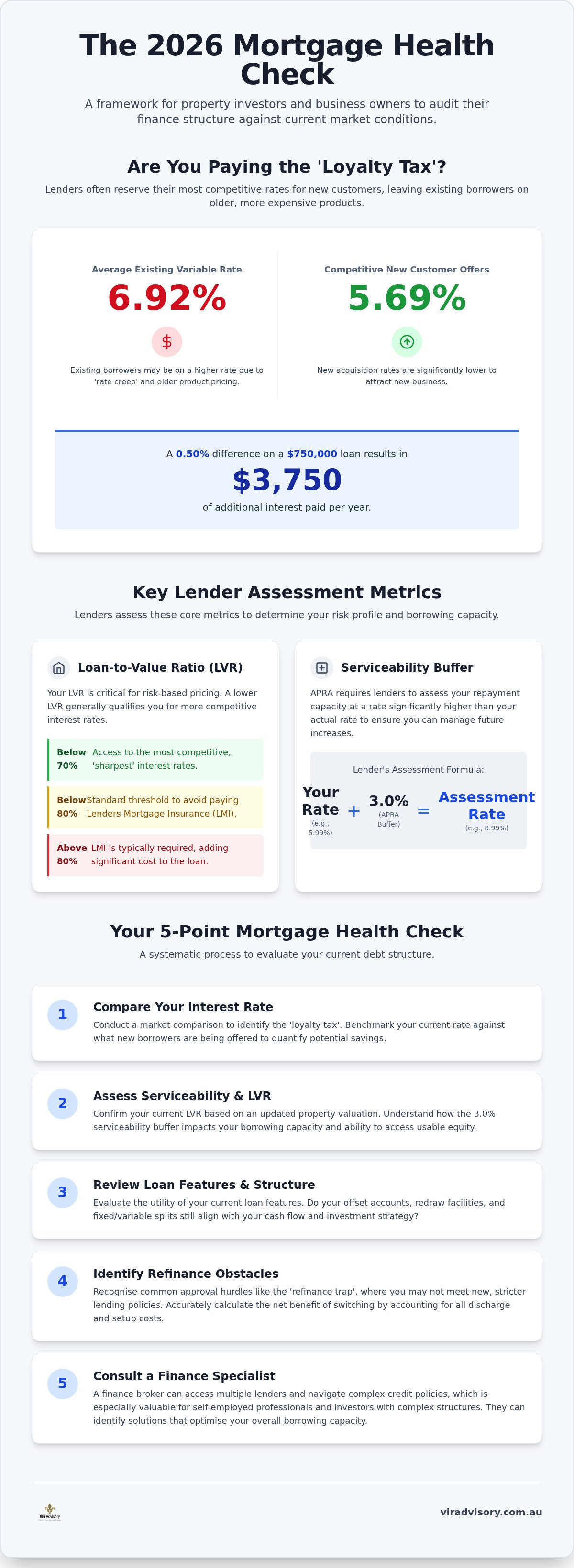
If you haven't reviewed your finance structure since the RBA held the cash rate at 4.35% in August 2026, you're likely paying a loyalty tax that could be costing you thousands in unnecessary interest. With the average variable mortgage rate sitting at 6.92% while competitive offers start from 5.69%, it's understandable why many property investors and business owners feel uncertain about their current debt position. A comprehensive mortgage health check allows you to validate your loan's competitiveness against current lender requirements and identify opportunities to optimise your borrowing capacity.
We've developed a professional framework to help you evaluate your debt structure against the 3.0% serviceability buffer and evolving market conditions. You'll learn how to identify underutilised equity, navigate complex lender assessments for self-employed borrowers, and determine if a formal debt restructure is required to improve your long-term fiscal health. This review outlines a logical sequence for auditing your risk management and funding solutions to ensure your finance remains a tool for growth rather than a constraint.
Key Takeaways
- Identify the "loyalty tax" by conducting a mortgage health check to compare your current interest rate against market benchmarks and lender acquisition offers.
- Gain clarity on how the 3.0% serviceability buffer and your current Loan-to-Value Ratio (LVR) impact your ability to restructure debt or access equity.
- Evaluate the utility of your loan features, including offset accounts and redraw facilities, to ensure your debt structure remains aligned with your cash flow.
- Recognise common approval obstacles such as the "refinance trap" and learn how to account for discharge costs when calculating the net benefit of switching lenders.
- Understand how a specialist finance broker navigates complex credit policies to enhance borrowing capacity for self-employed professionals and property investors.
Why a Mortgage Health Check is Essential in 2026
A mortgage health check is a structured audit of your existing finance facilities against current market benchmarks. In 2026, this involves more than just rate-shopping; it requires a detailed analysis of how your debt management aligns with the Australian Prudential Regulation Authority (APRA) guidelines and the prevailing mortgage underwriting process. With the average variable rate currently at 6.92%, borrowers often find their loan structure has become inefficient as lender appetites and risk-based pricing models shift.
To better understand how a professional audit identifies these inefficiencies, watch this helpful video:
Lenders currently apply a 3.0% serviceability buffer to assess your repayment capacity. This means your application is tested at a rate significantly higher than your actual interest rate. A professional review identifies if your current lender's assessment criteria are unnecessarily restricting your borrowing capacity or if a more flexible funder could unlock capital. Unlike a bank-led review, which is limited to a single institution's policy, an independent specialist brokerage assessment provides a market-wide perspective on funding solutions.
The Cost of Inaction: Understanding the 'Loyalty Tax'
Banks frequently prioritise new customer acquisition, offering lower rates to attract new business while existing borrowers remain on older, more expensive products. This discrepancy is often termed a 'loyalty tax'. For instance, a 0.50% difference on a $750,000 loan results in $3,750 of additional interest per year. Lenders rely on borrower inertia to maintain these profit margins. As your property value changes, your loan-to-value ratio (LVR) may improve, qualifying you for lower pricing that your bank won't automatically offer. For property investors, a 'set and forget' approach is high-risk; it can lead to trapped equity that could otherwise be utilised for further acquisitions or business working capital.
Strategic Timing for Your Next Review
You should conduct a formal review every 18 to 24 months to ensure your loan features, such as offset accounts and redraw facilities, still serve your cash flow requirements. Proactively managing your finance strategy prevents 'rate creep' from eroding your liquidity. Specific trigger events also necessitate an immediate check. These include the expiration of a fixed-rate term, changes to your business structure, or before applying for asset finance. If you're a company director or self-employed, reviewing your home loan before seeking business lending is critical. It ensures your primary debt is optimised to support your overall borrowing capacity and risk management profile.
Key Metrics Lenders Use to Assess Your Financial Health
During a professional mortgage health check, we analyse the specific metrics that determine your risk profile in the eyes of a credit assessor. Lenders don't just look at your gross income; they evaluate how your debt is structured against the broader economic environment and their internal credit policies. Understanding these benchmarks allows you to position your next application for more competitive pricing or higher borrowing limits. By identifying which metrics are currently constraining your finance strategy, you can take practical steps to improve your standing before approaching a lender.
LVR Thresholds and Risk-Based Pricing
The Loan-to-Value Ratio (LVR) remains one of the most critical factors in determining your interest rate. In 2026, many lenders have refined their risk-based pricing, offering the sharpest rates to borrowers with an LVR below 60% or 70%. Maintaining an LVR of 80% or less is the standard threshold to avoid Lenders Mortgage Insurance (LMI), which can add tens of thousands to your debt. If a recent valuation shows your property value has increased, your LVR may have dropped naturally, providing an opportunity to renegotiate your rate or access equity for further investment or debt consolidation.
Serviceability and Borrowing Capacity in 2026
Lenders currently apply a 3.0% serviceability buffer on top of the actual interest rate to ensure you can manage repayments if rates rise. This means if your loan is at 6.2%, you're assessed as if you're paying 9.2%. Combined with the Household Expenditure Method (HEM), which benchmarks your living costs based on family size and location, this buffer can significantly restrict your borrowing capacity. Lenders also monitor Debt-to-Income (DTI) ratios, often capping total debt at six or seven times your annual gross income. To improve your approval prospects, consider closing unused credit cards or 'buy now pay later' accounts, as lenders treat the total credit limit as a monthly expense regardless of your actual balance.
Considerations for Self-Employed and Company Directors
For business owners, the assessment process is more complex. Lenders evaluate business distributions, director salaries, and 'add-backs' such as one-off expenses, interest, or depreciation to determine true income. Having up-to-date tax returns and BAS is essential for 'Full-Doc' applications. However, if your most recent tax figures don't reflect your current business performance, 'Alt-Doc' funding solutions using accountant declarations or bank statements may be more appropriate. If you're unsure how your current business structure affects your borrowing capacity, you can book a strategic review to discuss your specific circumstances.
The 5-Point Mortgage Health Check Checklist
Executing a mortgage health check requires a methodical review of your current debt structure against the broader lending environment. In an environment where the RBA has held the cash rate at 4.35% as of August 2026, the gap between retention rates and new customer acquisition offers has widened significantly. Use this framework to audit your facilities and ensure your finance strategy remains cost-effective.
- Interest Rate Benchmark: Compare your current variable rate against the market. With average variable rates at 6.92% and competitive offers starting from 5.69%, a discrepancy of more than 0.50% indicates your loan is no longer priced optimally.
- Feature Audit: Evaluate whether you're actually using your offset accounts or split-loan options. If you're paying for features that remain dormant, you're essentially subsidising the lender's profit margin.
- Loan Structure Alignment: Assess if your current split between fixed and variable components still suits your risk profile. With typical 2-year fixed rates at 5.99%, the decision to lock in should be based on your specific cash flow requirements rather than market speculation.
- Equity Assessment: With the national median dwelling price at $894,000, calculate your current LVR. If your property value has increased, you may have crossed into a lower risk tier, qualifying you for sharper pricing.
- Repayment Efficiency: Review your repayment frequency. Switching from monthly to fortnightly repayments can reduce the total interest paid over the life of the loan by effectively making an extra month's payment every year.
Auditing Your Loan Features and Fees
Many professionals are placed into 'Gold' or 'Professional' packages that carry annual fees ranging from $350 to $400. While these packages offer offset accounts and credit card fee waivers, they're only cost-effective if your offset balance is high enough to save more in interest than the annual fee cost. For borrowers with minimal savings, a basic loan with a redraw facility may provide a more efficient finance strategy. It's also critical to understand the tax implications; property investors often prefer offset accounts over redraw facilities to maintain the integrity of tax-deductible debt for future property acquisitions.
Structuring for Cash Flow and Risk Management
If you have Interest Only (IO) terms expiring in the next 12 months, you face a potential 'repayment shock' as the loan reverts to Principal and Interest (P&I). A proactive review allows you to negotiate an extension of the IO period or restructure the debt to manage the increased cash flow demand. Splitting your loan can hedge against interest rate volatility, providing the certainty of fixed repayments for a portion of your debt while allowing the flexibility of an offset account on the variable component. Aligning your repayment dates with your business distributions or salary cycles further optimises your daily cash flow and interest calculations.
Common Pitfalls and Approval Obstacles to Avoid
A mortgage health check often exposes the "Refinance Trap," where borrowers find themselves unable to switch lenders despite identifying more competitive market rates. This usually occurs when property values have softened, pushing the LVR above 80%, or when credit scores have dipped due to missed payments or excessive credit enquiries. Before initiating a switch, you must calculate the net benefit after accounting for discharge costs, settlement fees, and government registration charges. These exit costs can erode the first year of interest savings if the discrepancy between your current and new rate is marginal.
Many serviceability failures stem from inaccurate living expense reporting. Lenders scrutinise at least three months of bank statements to verify your actual spending against the Household Expenditure Method (HEM). For company directors and self-employed professionals, failing to disclose business-related liabilities or personal guarantees is a common oversight that leads to immediate rejection. Lenders treat these as potential personal obligations that reduce your available cash flow, regardless of whether the business is currently servicing the debt.
Identifying and Mitigating Lending Risks
Lenders require a minimum level of "uncommitted monthly income" (UMI) to provide a safety margin for unexpected expenses. If your UMI is too narrow, you may need to reduce discretionary spending or close redundant credit limits three months before your next review. Employment status also presents a significant hurdle; most lenders require you to be out of a probation period, typically three to six months, before they will approve a refinance. Addressing credit report "niggles," such as a disputed utility bill or a forgotten default, before the bank sees them is a core part of a proactive finance strategy.
Mistakes in Debt Consolidation Strategies
When using a home loan for debt consolidation, the primary risk is extending the term of high-interest debt. Turning a $25,000 credit card balance into 30-year mortgage debt can result in paying significantly more interest over the long term, even if the interest rate is lower. To avoid this, you must implement a strict repayment plan to clear the consolidated portion within its original timeframe, such as three to five years. Additionally, ensure the new loan amount doesn't breach LVR limits on your primary security, as this could trigger expensive Lenders Mortgage Insurance (LMI) that outweighs the consolidation benefits.
How a Finance Broker Optimises Your Debt Structure
While a bank-led review is limited to a single institution's internal policy, a mortgage health check conducted through a specialist broker provides access to a broad network of over 30 lenders. This market-wide perspective is essential for navigating complex refinance home loan scenarios, particularly for high-net-worth individuals with multi-layered entity structures or diverse investment portfolios. A broker doesn't just compare interest rates; they evaluate which lender's credit policy aligns with your specific financial position to ensure your debt structure remains efficient and scalable.
Managing the end-to-end application process saves significant time for busy professionals and company directors. From the initial data collection to negotiating with credit underwriters, a broker handles the administrative burden and technical queries that often stall direct-to-bank applications. Beyond the initial settlement, ongoing monitoring ensures your loan remains competitive. As lender appetites shift or new products enter the market, your broker proactively identifies opportunities to renegotiate your terms without you needing to initiate the process yourself.
Strategic Financial Guidance and Policy Knowledge
Matching your specific profile with the right lender is a technical exercise in policy alignment. For self-employed borrowers or those managing SMSF loans, the way a lender treats business distributions or rental income can be the difference between an approval and a decline. Brokers use their expertise to advocate for credit exceptions and "unadvertised" pricing that isn't available to the general public. Having a professional finance advisor who understands these nuances ensures your finance strategy isn't limited by the restrictive appetite of a single bank.
Next Steps: Preparing for Your Professional Review
To ensure your review is thorough, you should organise several key documents in advance. Gather your most recent payslips, the last two years of full tax returns and notice of assessments, and your latest six months of loan statements. It's also helpful to have an updated summary of any business-related liabilities or personal guarantees. Before the assessment, set clear objectives for your debt management. Are you looking to lower your monthly repayments, access equity for a commercial property acquisition, or accelerate your debt reduction through a more efficient offset structure? Once your goals are defined, you can contact VIR Advisory for a comprehensive, no-obligation assessment of your current portfolio to determine the most effective funding solutions for your requirements.
Submit your enquiry for a professional mortgage health check
Optimising Your Finance Strategy for Long-Term Stability
Validating your current debt structure against the 3.0% serviceability buffer is essential for maintaining liquidity in 2026. A methodical mortgage health check identifies if you're paying an unnecessary loyalty tax and reveals whether your loan features still align with your cash flow requirements. By addressing these metrics now, you position your portfolio to withstand market volatility while ensuring your borrowing capacity remains unconstrained.
VIR Advisory provides the technical oversight needed to navigate complex lender requirements, drawing on over 15 years of banking and finance experience. We specialise in high-net-worth scenarios and complex lending structures for professionals, offering national service across all Australian states to ensure your funding solutions are both robust and competitive.
Taking a proactive approach to your debt management today creates a more secure foundation for your future property and business acquisitions.
Frequently Asked Questions
How often should I conduct a mortgage health check?
You should conduct a formal review every 18 to 24 months to ensure your debt structure remains competitive. Lenders frequently update their acquisition rates, meaning existing borrowers often pay higher interest than new customers. A regular mortgage health check identifies these discrepancies before the cumulative cost of a higher rate impacts your cash flow. Significant life events, such as business expansion or the end of a fixed-rate term, also necessitate an immediate audit.
Will a mortgage health check affect my credit score?
A professional review of your current loan does not impact your credit score because it involves an analysis of your existing terms rather than a formal application. Credit scores are only affected when a lender performs a hard enquiry during a formal submission. By assessing your position first, you can ensure your serviceability meets requirements before any enquiry is recorded, protecting your credit file from unnecessary rejections or multiple applications.
What documents do I need for a professional loan review?
To perform a thorough assessment, you generally need your most recent two payslips, two years of full tax returns, and your latest six months of home loan statements. Business owners should also provide their most recent business tax returns and financial statements. These documents allow for an accurate calculation of your borrowing capacity under current 3.0% serviceability buffers. Having this data ready ensures the review can pinpoint exact opportunities for debt optimisation.
Can I do a health check if I am currently on a fixed rate?
You can and should review your position even if you're currently on a fixed rate. While break fees may apply if you exit early, a health check helps you calculate whether the long-term interest savings outweigh the immediate discharge costs. It also allows you to prepare for the transition to variable rates well in advance, ensuring you have a finance strategy in place before your current term expires.
How much does a mortgage health check cost with a broker?
Most mortgage brokers don't charge borrowers an upfront fee for a standard review, as they're typically compensated by the lender upon the successful settlement of a loan. This allows you to access professional credit expertise and market-wide comparisons without an initial capital outlay. It's important to confirm any potential service fees for complex commercial or SMSF reviews during your initial consultation to ensure complete transparency in your funding solutions.
What happens if the health check shows I am on a poor deal?
If a mortgage health check reveals your current rate is uncompetitive, the first step is often a pricing request to your existing lender. If they refuse to match market acquisition rates, we then evaluate external refinancing options. This involves a cost-benefit analysis of the interest savings against discharge fees. If your serviceability or LVR makes switching difficult, we focus on internal debt management strategies to improve your position for a future move.
Is a mortgage health check different for property investors?
Reviews for property investors focus heavily on tax-effective loan structures and the strategic use of equity. We assess whether your current facilities are cross-collateralised, which can restrict your future borrowing capacity. The audit also examines the expiry of Interest Only terms and the utility of offset accounts across multiple securities. For investors, the goal is often to maximise tax deductibility while maintaining enough liquidity for subsequent property acquisitions or business investments.
Can I use a health check to access equity for my business?
Accessing equity is a common outcome of a professional review, particularly for company directors seeking working capital. By calculating your current LVR against recent property valuations, we can determine the amount of usable equity available for business purposes. This capital can often be secured at residential interest rates, which are typically lower than standard commercial business loans. We ensure the resulting debt structure remains compliant with lender requirements for both personal and business use.

Article by
Raina Doshi
Raina Doshi has worked in banking and finance since 2011, including experience with major Australian lenders. She helps homeowners, property investors, business owners and professionals secure and structure lending solutions across home loans, refinancing, commercial finance and business lending.
Areas of expertise include residential lending, investment property finance, debt recycling, commercial property finance, equipment finance, construction finance and strategic debt structuring.
Drawing on extensive banking and finance experience, Raina helps clients navigate lender requirements, improve borrowing outcomes and structure effective finance solutions.
Disclaimer
The information in this article is general in nature and does not take into account your personal objectives, financial situation or needs. Before acting on any information, consider whether it is appropriate to your circumstances and seek professional advice.


