

Understanding Home Loans for Self-Employed Professionals
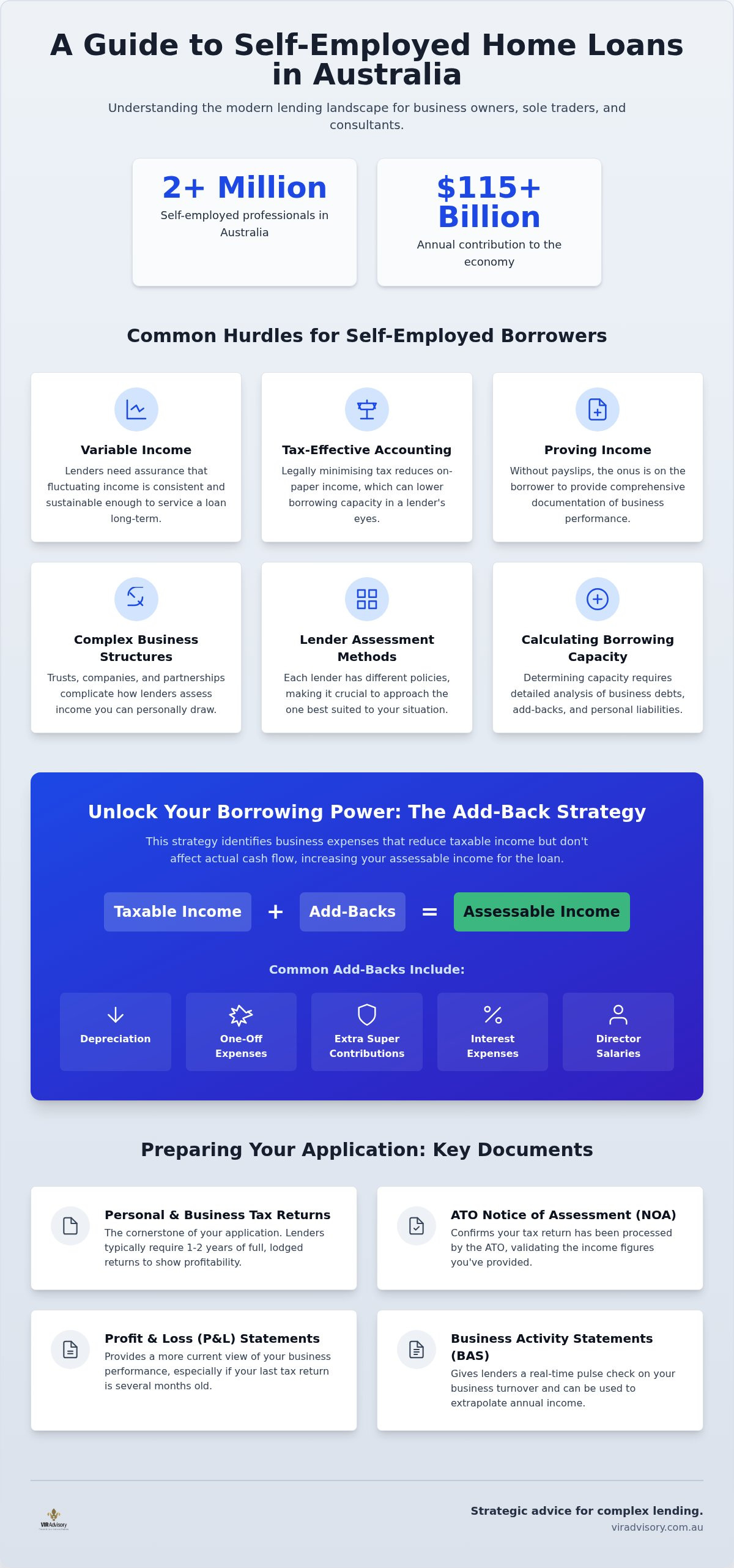
As a nation of entrepreneurs, with over two million self-employed professionals contributing more than $115 billion to the economy, your contribution is undeniable. Yet, when it comes to securing a home loan, many business owners, sole traders, and consultants feel penalised by a system designed for PAYG employees. The good news is that the lending landscape has evolved. A self-employed home loan is not a different product; it is a specialised assessment of a standard home loan, designed to accurately reflect your financial position.
The common misconception that you need a perfect two-year tax history and a 20% deposit is no longer the only reality. A growing number of banks and non-bank lenders now recognise the unique financial structures of modern businesses. They are increasingly willing to look beyond traditional income verification to assess the real performance and cash flow of your enterprise.
Common Lending Challenges for Self-Employed Borrowers
Securing a home loan when you're self-employed presents a unique set of challenges that PAYG applicants don't face. Lenders require a higher level of assurance regarding income stability and business longevity. Understanding these hurdles is the first step toward building a successful application.
- Variable Income: Unlike a fixed salary, self-employed income can fluctuate. Lenders need to be convinced that your income is consistent and sustainable enough to service a loan over the long term.
- Tax-Effective Accounting: A good accountant will legally minimise your taxable income. While this is excellent for your tax obligations, it can reduce your on-paper income, potentially lowering your borrowing capacity in the eyes of a lender.
- Proving Income: Without payslips, the onus is on you to provide comprehensive documentation that paints a clear and accurate picture of your business performance and personal earnings.
- Complex Business Structures: Company structures, trusts, and partnerships can complicate how income is assessed. Lenders need to untangle these structures to verify the income you can personally draw from the business.
- Lender Assessment Methods: Each lender has its own policies for assessing self-employed income. Some may average income over two years, while others might consider the most recent year if it's higher. This inconsistency makes it crucial to approach the right lender.
- Calculating Borrowing Capacity: Accurately determining your borrowing capacity requires a detailed analysis of business debts, add-backs, and personal liabilities, which is often more complex than for a standard applicant.
The Mechanics of Income Assessment: What Lenders Really Want to See
For self-employed professionals, a home loan application is a detailed presentation of your business's financial health. Lenders scrutinise your documentation to build a complete picture of your stability and capacity to repay the loan. While the traditional "two-year rule" is a common benchmark, many lenders now offer a "one-year exception" for established businesses with a strong financial position, allowing the use of the most recent year's tax return for assessment.
A credit assessor’s primary goal is to verify a consistent and reliable income stream. The longevity of your Australian Business Number (ABN) and Goods and Services Tax (GST) registration serves as a key indicator of your business's stability and track record.
Essential Documentation for a Robust Application
The quality and clarity of your financial documents are paramount. These records provide the evidence lenders need to make an informed credit decision.
- Personal and Business Tax Returns: These are the cornerstone of your application, showing your declared income and business profitability over time. Lenders typically require one to two years of full, lodged returns.
- Australian Taxation Office (ATO) Notice of Assessment (NOA): An NOA confirms that your tax return has been processed by the ATO, validating the income figures you have provided.
- Profit and Loss (P&L) Statements: A recent P&L, often prepared by your accountant, can provide a more current view of your business performance, especially if your last tax return is several months old.
- Business Activity Statements (BAS): Your BAS provides a real-time pulse check on your business turnover. For certain loan types, lenders will use several consecutive BAS to extrapolate an annual income figure.
Interpreting the "Add-Back" Strategy
One of the most powerful tools in a self employed mortgage application is the "add-back" strategy. This involves identifying specific business expenses that reduce your taxable income but don't affect your actual cash flow. A skilled adviser can present these to a lender to increase your assessable income and, consequently, your borrowing power.
Common add-backs include:
- Depreciation: An accounting expense for the declining value of assets (like vehicles or equipment) that doesn't represent an actual cash outlay.
- One-Off or Non-Recurring Expenses: Significant, isolated costs (e.g., a major equipment purchase) that are not part of your regular operating expenses.
- Additional Superannuation Contributions: Voluntary contributions made above the superannuation guarantee.
- Interest Expenses: Interest paid on business loans can often be added back to your income for assessment purposes.
- Director Salaries: For company structures, the salaries paid to directors are considered part of the business's overall earnings.
Navigating the Documentation Maze: Full Doc vs. Alt Doc Solutions
Self-employed borrowers have several documentation pathways available, each designed for different business circumstances. Choosing the correct one is a strategic decision that impacts interest rates, loan features, and your long-term financial structure. The primary options are Full Documentation (Full Doc) and Alternative Documentation (Alt Doc).
When to Choose a Full Doc Loan
A Full Doc loan is the traditional approach, requiring complete financial records, typically including two years of lodged tax returns and corresponding Notices of Assessment. This pathway is ideal for established businesses with a consistent and predictable history of profitability.
- Benefits: Provides access to the most competitive interest rates and a full range of loan features, such as offset accounts and redraw facilities.
- Requirements: A strong, consistent trading history demonstrated through comprehensive financial statements.
- Best Suited For: Mature businesses seeking to secure the best possible loan terms.
The Strategic Use of Alt Doc Home Loans
Alt Doc home loans (sometimes referred to as Low Doc home loans) are designed for borrowers who have a strong business and healthy cash flow but cannot provide the standard two years of tax returns. This could be due to rapid business growth, recent changes in business structure, or having not yet completed two full financial years of trading.
Instead of full tax returns, Alt Doc applications are typically supported by:
- An Accountant's Letter verifying income.
- 12 months of Business Activity Statements (BAS).
- 6-12 months of business bank account statements.
While Alt Doc loans often come with slightly higher interest rates or require a larger deposit (lower Loan-to-Value Ratio), they are a powerful strategic tool. They provide a solution for securing property now, with a clear plan to refinance to a Full Doc loan with a lower rate once the required tax history is established.
Strategic Steps to Optimise Your Borrowing Capacity Before You Apply
Maximising your borrowing capacity self employed requires proactive financial management. By taking specific steps 3-6 months before submitting your loan application, you can present the strongest possible case to lenders. This involves professionalising your financial presentation and minimising any liabilities that could reduce your borrowing power.
Professionalising Your Financial Presentation
Lenders value clear, well-maintained financial records. The easier it is for them to understand your financial position, the smoother the assessment process will be.
- Separate Personal and Business Finances: Maintain distinct bank accounts for business and personal use. Running personal expenses through your business account can create confusion for credit assessors.
- Structure Director Drawings Correctly: If you operate through a company, establish a consistent "salary" or drawing pattern. Lump-sum or erratic withdrawals can make it difficult for lenders to verify a stable income.
- Ensure All ATO Obligations Are Current: Before applying, ensure all tax returns, BAS, and superannuation obligations are lodged and any outstanding debts are paid or under a formal payment arrangement with the ATO.
- Clean Up Bank Statements: In the months leading up to an application, be mindful of your spending on personal accounts. Lenders will review these statements, and excessive discretionary spending can impact their assessment of your living expenses.
Managing Your Liabilities and Credit Health
Your existing debts and credit history play a significant role in how much you can borrow. Reducing your liabilities directly increases your capacity to service a new home loan.
- Reduce Unused Credit Card Limits: Lenders assess the full limit of your credit cards as a potential debt, not just the amount you owe. Reducing the limits on cards you don't use can significantly boost your borrowing capacity.
- Manage BNPL (Buy Now, Pay Later) Facilities: While convenient, multiple BNPL facilities are viewed as a form of debt and can negatively impact your credit score and serviceability assessment.
- Pay Down Personal Loans and Car Loans: Clearing high-interest personal debt before applying for a mortgage demonstrates financial discipline and frees up cash flow.
- Maintain Business Cash Reserves: Healthy cash reserves in your business bank accounts demonstrate strong financial management and provide a buffer that lenders view favourably.
- Monitor Your Credit Score: Be aware of your personal and business credit history. A default on a business account can directly impact your personal home loan application. Address any inaccuracies or issues well before you apply.
Common Reasons Self-Employed Home Loan Applications Are Declined
Even with a profitable business, a self employed loan application can be declined if it doesn't meet specific lender criteria. Understanding these common pitfalls allows you to address them proactively and strengthen your position.
- Tax Returns Not Lodged: The most common reason for delay or decline. Lenders require up-to-date, lodged tax returns to verify your income.
- Outstanding ATO Debt: An undeclared or unmanaged tax debt is a major red flag for lenders, signalling potential financial distress.
- Recent ABN History: Most lenders want to see a minimum of 18-24 months of ABN registration to demonstrate business stability.
- Poor Credit History: Personal or business credit defaults, late payments, or too many credit enquiries can lead to an automatic decline.
- Excessive Personal Debt: High limits on credit cards, multiple personal loans, or large car loans can reduce your debt-to-income ratio to an unacceptable level.
- Inconsistent Business Income: A recent, sharp decline in revenue or profitability will cause lenders to question the long-term viability of your income.
- High Debt-to-Income (DTI) Ratios: Lenders have strict limits on your total debt compared to your total income. If a new mortgage pushes you over this limit, the application will be rejected.
- Unclear Financial Records: Messy or poorly maintained financial records that mix personal and business expenses make it impossible for an assessor to verify your true financial position.
Self-Employed Home Loan Application Checklist
Being prepared with the right documentation is crucial for a smooth and efficient application process. While requirements can vary between lenders, a typical business owner mortgage application will require the following:
- Identification Documents: 100 points of ID (e.g., driver's licence, passport, Medicare card).
- Personal Tax Returns: The last 1-2 financial years.
- Notices of Assessment (NOA): Corresponding NOAs for each tax return lodged.
- Business Tax Returns: The last 1-2 financial years (for company or trust structures).
- Business Financial Statements: Including Profit & Loss statements and balance sheets.
- Business Activity Statements (BAS): The last 2-4 quarters, especially for Alt Doc applications.
- Business Bank Statements: The last 6-12 months of transaction history.
- Personal Bank Statements: To verify savings and day-to-day financial conduct.
- Existing Loan Statements: For any current mortgages, personal loans, or credit cards.
How VIR Advisory Helps Self-Employed Borrowers Navigate Lending Requirements
Successfully securing a home loan as a self-employed professional requires more than just submitting documents; it demands a strategic approach. With over 15 years of banking and finance expertise, VIR Advisory specialises in structuring complex lending solutions for business owners, company directors, and sole traders across Australia.
Our methodology is built on deep technical knowledge and a thorough understanding of how different lenders assess self-employed income. We translate your business's financial performance into a language that credit assessors understand, ensuring your application is presented in the strongest possible light.
Our specialist services include:
- Comprehensive Income Assessment: We conduct a detailed analysis of your financial statements to determine which lender’s policy will result in the most favourable income assessment for your situation.
- Detailed Add-Back Analysis: We work with you and your accountant to identify all eligible add-backs, ensuring your borrowing capacity is maximised by reflecting your business's true cash flow.
- Borrowing Capacity Reviews: We provide clear, calculated assessments of your borrowing power and offer actionable advice on how to improve it before you apply.
- Strategic Alt Doc and Full Doc Guidance: We help you choose the right documentation pathway—Full Doc or Alt Doc—that aligns with your business's current stage and long-term financial goals.
- Extensive Lender Selection: We leverage our access to a wide panel of banks and non-bank lenders to match you with an institution that understands and values your business structure.
- Professional Application Presentation: We manage the entire application process, ensuring your financial position is presented clearly, professionally, and in a way that meets all lender requirements. Find out more about what to expect when working with VIR Advisory.
Conclusion: A Strategic Approach to Your Property Goals
Securing a home loan as a self-employed professional is entirely achievable with the right preparation and strategy. Success hinges on understanding lender requirements, preparing your financial records meticulously, and presenting your income in a way that accurately reflects your business's strength. By choosing the correct documentation pathway and taking proactive steps to improve your borrowing capacity, you can navigate the process with confidence.
A well-structured sole trader home loan or business owner mortgage is not just a transaction; it's a critical component of your long-term wealth strategy. Engaging a specialist adviser ensures your loan structure is optimised not just for approval, but for your financial future.
Secure your financial future with a strategic adviser who understands the nuances of self-employed lending. Contact VIR Advisory today for a confidential consultation to discuss your financial position and property goals.

Article by
Raina Doshi
Raina Doshi has worked in banking and finance since 2011, including experience with major Australian lenders. She helps homeowners, property investors, business owners and professionals secure and structure lending solutions across home loans, refinancing, commercial finance and business lending.
Areas of expertise include residential lending, investment property finance, debt recycling, commercial property finance, equipment finance, construction finance and strategic debt structuring.
Drawing on extensive banking and finance experience, Raina helps clients navigate lender requirements, improve borrowing outcomes and structure effective finance solutions.
Disclaimer
The information in this article is general in nature and does not take into account your personal objectives, financial situation or needs. Before acting on any information, consider whether it is appropriate to your circumstances and seek professional advice.


