

A $10,000 credit card limit could be reducing your home loan potential by as much as $50,000, even if you keep a zero balance every month. Many professionals and business owners find that their ability to secure finance is restricted not by their actual income, but by how lenders apply the current 3% serviceability buffer to existing liabilities. If you want to improve borrowing capacity, you must look beyond your salary and focus on the technical ways banks assess risk and debt-to-income ratios.
It's understandable to feel constrained by shifting assessment criteria, especially when self-employed income is treated inconsistently across the market. This article outlines the precise strategies required to maximise your borrowing power for home and business loans in 2026. We'll examine how to restructure your debts, manage credit limits, and present your financials to ensure you meet the most stringent lender requirements and secure the funding solutions you need.
Key Takeaways
- Understand the 'Net Serviceability' calculation lenders use to determine your maximum loan amount after accounting for tax, living expenses, and existing debt commitments.
- Implement technical strategies to improve borrowing capacity, such as reducing unused credit card limits to mitigate the impact of mandatory lender serviceability buffers.
- Identify specific income 'add-backs' for self-employed borrowers, including depreciation and one-off expenses, to ensure your true financial position is accurately represented.
- Learn how restructuring existing liabilities like car loans can lower your Debt-to-Income (DTI) ratio and enhance your overall serviceability profile.
- Perform a thorough pre-application audit of your credit report and bank statements to resolve potential issues before they trigger a formal lender rejection.
How Lenders Calculate Borrowing Capacity in Australia
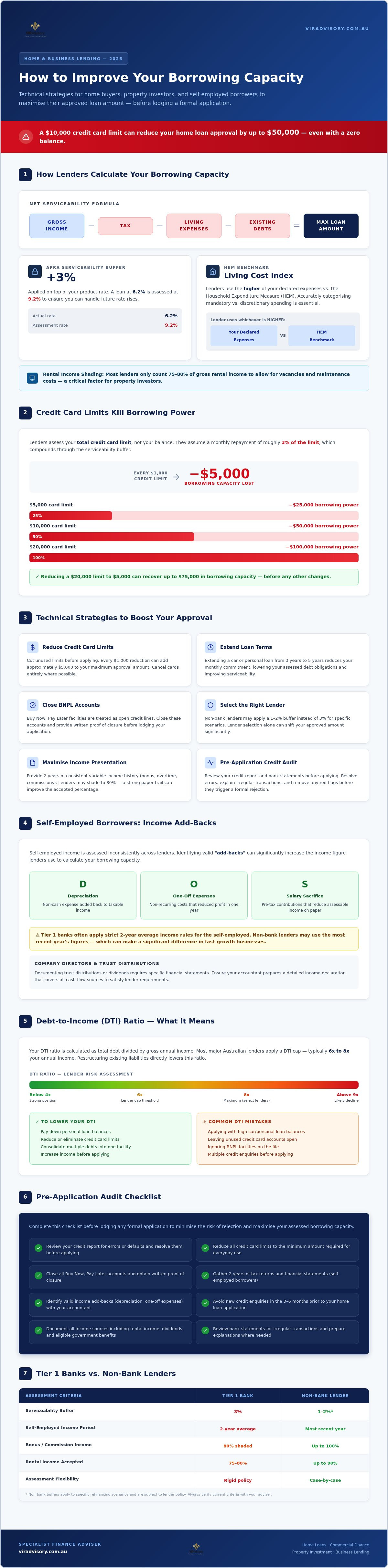
Borrowing capacity is the maximum loan amount a lender will approve based on your ability to service the debt. It's not a static figure; it's a dynamic assessment that changes based on lender policy and your current financial structure. To improve borrowing capacity, you must understand the 'Net Serviceability' formula: your gross income, less tax, living expenses, and existing debt commitments.
Lenders don't just look at what you earn today. They apply a risk-weighted lens to your application. While Tier 1 banks often maintain rigid criteria, non-bank lenders may offer more flexibility, particularly regarding how they treat bonus income or self-employed commissions. The final figure is heavily influenced by the Australian Prudential Regulation Authority (APRA), which currently mandates a 3% serviceability buffer. This means if you apply for a loan at a 6.2% interest rate, the lender assesses your ability to pay at 9.2% to ensure you can manage potential future rate hikes.
The Role of the Household Expenditure Measure (HEM)
The Household Expenditure Measure (HEM) acts as a benchmark for minimum living costs based on your family size and location. Lenders compare your declared living expenses against this index and will use whichever figure is higher. If your actual spending significantly exceeds the HEM, your borrowing power will decrease. Accurately categorising your outgoings is essential. Distinguishing between mandatory costs and discretionary lifestyle spending, which could be reduced if necessary, helps ensure your assessment reflects a sustainable financial position.
Serviceability Buffers and Assessment Rates
Lenders use an 'assessment rate' rather than the actual interest rate of your chosen product. This assessment rate is often the higher of a 'floor rate', which is a minimum percentage set by the bank, or the product rate plus the 3% buffer. For instance, a $500,000 loan might have repayments of $3,100 at the actual rate, but the bank tests your cash flow against a repayment of roughly $4,100. Additionally, most lenders 'shade' rental income, often only counting 75% to 80% of the gross rent to account for vacancies and maintenance. Understanding these nuances allows you to organise your finance strategy before lodging a formal application.
Technical Strategies to Improve Borrowing Capacity
To improve borrowing capacity, you must address the specific liabilities that weigh most heavily on lender calculators. One of the most effective technical adjustments involves your credit card limits. Lenders assess the total limit of a card rather than the balance you actually owe. In many cases, every $1,000 of credit limit can reduce your total borrowing capacity by approximately $5,000 because banks assume a monthly repayment of roughly 3% of the limit. Reducing a $20,000 limit to $5,000 can therefore significantly boost your approval amount.
Another strategy is to re-evaluate the structure of existing debts. Extending the term of a car loan or personal loan from three years to five years reduces the monthly repayment commitment. While this may increase the total interest paid over time, it lowers your non-mortgage debt obligations in the eyes of a lender, which can help you improve borrowing capacity for a larger home or business loan. You might also consider selecting lenders with lower assessment buffers, such as certain non-bank lenders who may use a 1% or 2% buffer instead of the standard 3% for specific refinancing scenarios.
Managing Credit Limits and Unused Facilities
Buy Now, Pay Later (BNPL) services are often overlooked by borrowers but are closely scrutinised by credit teams. These facilities are treated as open lines of credit. Even if you don't have an active balance, the mere existence of the account can suggest a reliance on credit. To prepare for an application, it's advisable to close these accounts and provide proof of closure. A systematic approach to debt management is often required to ensure your file is bank-ready before you book a strategic consultation to review your options.
Income Presentation and Optimisation
Presenting your income accurately is just as vital as managing debt. Many lenders 'shade' variable income such as bonuses, commissions, or overtime, often only counting 80% of the total. Providing two years of consistent history can sometimes persuade a lender to accept a higher percentage. For company directors or high-net-worth individuals, documenting trust distributions or dividends requires specific financial statements to ensure the lender recognises the full scope of your cash flow. Don't forget to include eligible government benefits or child support, as these are often valid income sources that can bolster your serviceability profile.
Self-Employed Borrowers: Navigating Complex Assessment
Self-employed borrowers often encounter significant friction when seeking finance due to the rigorous documentation required by Australian lenders. While a PAYG employee provides a few payslips, a business owner must generally produce two years of personal and business tax returns, along with corresponding Notices of Assessment. To improve borrowing capacity in this segment, it's essential to identify 'add-backs' that traditional accounting might treat as expenses but lenders may view as available cash flow.
Lenders typically allow for the following add-backs to be included in your serviceability assessment:
- Depreciation: Since this is a non-cash accounting expense, lenders often add this back to your net profit.
- One-off expenses: Non-recurring costs, such as a major equipment repair or a specific legal fee, can be excluded from your expense profile.
- Additional Superannuation: Voluntary contributions above the mandatory Superannuation Guarantee (SG) are viewed as discretionary income.
- Interest: Interest paid on business loans that are being refinanced or closed is often added back to reflect your new debt position.
For those with complex company structures or shorter trading histories, 'Alt-Doc' or 'Low-Doc' funding solutions may be appropriate. These products often rely on an accountant's declaration or business bank statements rather than full tax returns, though they typically carry higher interest rates or lower Loan-to-Value Ratios (LVR).
Utilising Business Financials for Personal Capacity
Lenders distinguish between the net profit of a business and the personal drawings taken by the director. If you've left significant funds within the company as retained earnings, some lenders will allow these to be included in your personal income assessment, provided you have majority control. To support this, you'll need up-to-date interim financial statements, including a Profit and Loss statement and Balance Sheet, especially if your last lodged tax return is more than six months old. This ensures the lender sees your current trading performance rather than outdated figures.
Common Approval Obstacles for Company Directors
Inter-company loans often create confusion during the credit assessment process. If one entity owes money to another, lenders may treat this as a liability that reduces your personal serviceability. Similarly, any outstanding tax debt or ATO payment arrangements must be disclosed. Most lenders require tax liabilities to be cleared before settlement, or they will at least require a demonstrated history of compliance with an existing payment plan. To improve borrowing capacity, you must demonstrate income stability; if your profit has fluctuated by more than 20% between financial years, providing a clear explanation for the variance is vital to avoid a decline based on risk assessment.
Strategic Debt Management and Loan Restructuring
Existing liabilities are often the primary hurdle when you attempt to improve borrowing capacity. While previous sections focused on credit limits and income, the actual monthly repayment amount of your current loans is what lenders scrutinise most. A car loan with an $800 monthly repayment has a disproportionate impact on your serviceability compared to the same amount of debt held within a mortgage. This occurs because lenders treat short-term, high-repayment debt as a significant drain on your net disposable income.
Debt-to-Income (DTI) ratios also play a critical role in modern credit assessments. Most Australian banks now apply a DTI cap, typically between six and seven times your gross annual income. If your total combined debt, including the new loan, exceeds this threshold, your application may be declined regardless of your surplus cash flow. Restructuring your current debt portfolio is a technical necessity to stay within these risk parameters.
Consolidating High-Interest Liabilities
Consolidating personal loans or car finance into your mortgage can provide an immediate uplift in serviceability. By moving a high-interest debt with a three-year term into a home loan with a 30-year term, you drastically reduce the monthly commitment. For every $500 reduction in monthly debt obligations, your potential loan amount could increase by approximately $60,000 to $80,000, depending on the lender's specific floor rates. You can explore refinancing solutions for debt optimisation to see how this might apply to your specific portfolio.
There are risks to this strategy that you must consider. Rolling short-term debt into a 30-year mortgage means you'll pay significantly more interest over the life of the loan unless you make additional repayments. It's a trade-off between short-term capacity gains and long-term interest costs. This tactic is most effective when used as a targeted measure to secure a specific property or business acquisition.
Reviewing Existing Loan Terms and Structures
Refinancing existing property loans to extend the remaining term back to 30 years is another effective way to lower your total monthly expenses. If you've held a mortgage for ten years, your repayments are calculated over the remaining 20-year window. Resetting this to 30 years lowers the mandatory repayment, which the lender uses in their serviceability calculator for your new application. Similarly, switching investment loans to interest-only for a set period can free up the cash flow required to meet the assessment criteria for a new purchase. Using offset accounts during this time also allows you to demonstrate financial discipline while keeping your mandatory commitments as low as possible.
Preparing for a Strategic Home Loan Assessment
A successful loan application depends on the precision of your preparation. Before approaching a lender, you should conduct a comprehensive audit of your financial profile to ensure every data point supports your objective to improve borrowing capacity. This process begins with your credit report. Even minor inaccuracies or a single missed payment on a utility bill can lead to an automatic decline from some Tier 1 banks. Identifying these issues early gives you the opportunity to resolve them or provide a valid explanation before a credit assessor reviews your file.
Lenders now use sophisticated algorithms to categorise your spending over the last three months. Large, unexplained cash outgoings or frequent discretionary expenses can suggest a lack of financial discipline. By reviewing your bank statements before the bank does, you can ensure your spending patterns align with the requirements of the Household Expenditure Measure (HEM) discussed earlier. This proactive audit allows you to adjust your lifestyle spending habits well before the assessment period begins.
The Pre-Application Checklist
Self-employed directors must provide at least two years of tax returns and Notices of Assessment (NOAs) to confirm income stability. If you've recently restructured your business, a clear paper trail explaining the transition is essential. You can submit your enquiry for a strategic assessment to identify any potential gaps in your documentation. Ensure you have the following ready:
- Two years of personal and business tax returns and NOAs.
- The last three months of all personal and business bank statements.
- Evidence of any non-recurring 'add-backs' or one-off business expenses.
- A detailed list of all existing credit limits and current loan balances.
Partnering with a Specialist Finance Broker
Navigating the varying capacity policies of different lenders is a complex task that requires professional oversight. A specialist broker provides access to a wide panel of lenders, some of whom may have more generous assessment criteria for specific industries or income types. With over 15 years of industry experience, we understand which lenders are currently favouring certain debt structures. This expertise is vital for avoiding multiple 'hard' credit hits. Each rejected application leaves a mark on your credit file, which can further reduce your prospects. Selecting the right lender first is the most effective way to protect your credit score and improve borrowing capacity over the long term. This strategy ensures your funding solutions are secured without the stress of unnecessary delays or rejections.
Optimising Your Finance Strategy for 2026
Maximising your loan potential requires a technical approach to both liability management and income presentation. By reducing unused credit limits and restructuring existing debts to lower monthly commitments, you can significantly improve borrowing capacity before submitting a formal application. For self-employed borrowers, the focus must remain on identifying valid add-backs and ensuring business financials are up to date to reflect true serviceability.
Securing a higher loan amount isn't just about earning more; it's about navigating the 3% serviceability buffers and varied lender policies with precision. Raina Doshi brings over 15 years of banking and finance experience to help you identify specialised debt optimisation strategies. With access to a comprehensive panel of both bank and non-bank lenders, we ensure your application is directed toward the funding solutions that best align with your risk profile. Taking these methodical steps now prevents unnecessary credit hits and establishes a stable foundation for your future property or business acquisitions.
Proactive preparation allows you to approach the lending market with confidence and clarity.
Frequently Asked Questions
How much does a credit card limit reduce my borrowing capacity?
Banks assess the full credit limit rather than the balance you actually owe. They typically assume a monthly repayment of roughly 3% of your total limit, even if you pay it off in full every month. For a $10,000 limit, this adds a $300 monthly liability to your assessment. This $300 commitment can reduce your total loan amount by approximately $50,000. Reducing unused limits is a technical step to improve borrowing capacity.
Can I improve my borrowing capacity without a pay rise?
You can improve borrowing capacity by lowering your existing monthly commitments. Consolidating high-interest personal loans into a mortgage or extending car loan terms can free up the cash flow lenders require. Additionally, selecting a lender with more flexible policies regarding bonus income or using a non-bank lender with a lower assessment buffer can result in a higher approval amount without any change to your base salary.
How do lenders view HECS/HELP debt in 2026?
Lenders treat HECS/HELP repayments as a mandatory deduction from your gross salary. Because these repayments are calculated as a percentage of your total income, they reduce the net cash flow available to service a mortgage. Lenders look at the specific repayment bracket you fall into based on your current earnings in 2026. Paying off a small remaining HECS balance can sometimes boost your capacity by tens of thousands of dollars before you apply for finance.
Does having a large deposit increase how much I can borrow?
A larger deposit improves your Loan-to-Value Ratio (LVR), which can grant you access to lower interest rates and help you avoid Lenders Mortgage Insurance (LMI). However, it doesn't automatically increase your borrowing capacity. Capacity is primarily determined by your 'serviceability', which is your ability to meet monthly repayments from your income. A large deposit helps with equity and risk assessment, but your income must still support the total loan amount.
How many months of bank statements do lenders check for living expenses?
Most Australian lenders require the last three months of bank statements to verify your living expenses. They look for regular outgoings like insurance, school fees, and utilities, while also scrutinising discretionary spending. Lenders compare your actual spending against the Household Expenditure Measure (HEM). If your statements show spending significantly above this benchmark, your borrowing capacity will be adjusted downwards to reflect your actual lifestyle and financial habits.
Will refinancing my car loan help me borrow more for a home?
Refinancing a car loan can help if the restructure results in a lower monthly repayment. Lenders focus on the 'commitment' rather than the total debt amount. If you refinance a car loan from a three-year term to a five-year term, your monthly outflow decreases. This additional cash flow is then seen as available to service a larger home loan, effectively increasing the maximum amount a bank is willing to lend you.
How do APRA interest rate buffers affect my loan approval?
The Australian Prudential Regulation Authority (APRA) mandates a 3% serviceability buffer to ensure borrowers can handle future interest rate increases. If you apply for a loan at a 6% rate, the bank assesses your application as if the rate were 9%. This buffer significantly restricts the amount you can borrow. Navigating these requirements involves choosing lenders with different 'floor rates' or specific policies that may offer more flexibility for certain scenarios.
Can self-employed borrowers get a loan with only one year of tax returns?
While most Tier 1 banks require two years of tax returns, some specialist and non-bank lenders offer 'Alt-Doc' solutions requiring only one year of financials. These lenders may accept an accountant's letter or business bank statements as proof of income stability. While these products might have slightly higher interest rates, they provide a viable funding solution for business owners with a strong recent trading history but limited long-term documentation to secure finance.

Article by
Raina Doshi
Raina Doshi has worked in banking and finance since 2011, including experience with major Australian lenders. She helps homeowners, property investors, business owners and professionals secure and structure lending solutions across home loans, refinancing, commercial finance and business lending.
Areas of expertise include residential lending, investment property finance, debt recycling, commercial property finance, equipment finance, construction finance and strategic debt structuring.
Drawing on extensive banking and finance experience, Raina helps clients navigate lender requirements, improve borrowing outcomes and structure effective finance solutions.
Disclaimer
The information in this article is general in nature and does not take into account your personal objectives, financial situation or needs. Before acting on any information, consider whether it is appropriate to your circumstances and seek professional advice.


