

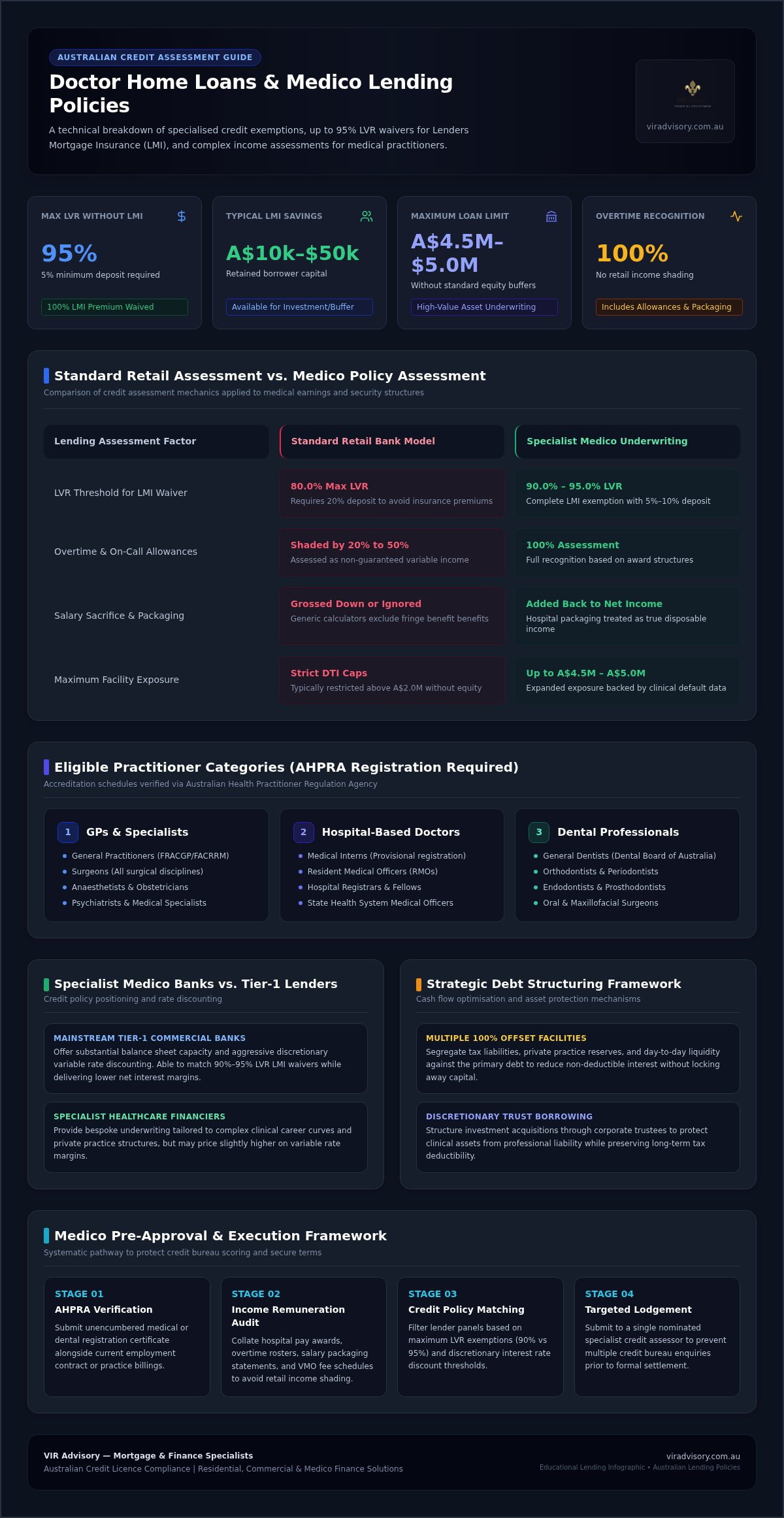
A 5% or 10% property deposit shouldn't trigger an avoidable five-figure Lenders Mortgage Insurance (LMI) charge. Under dedicated medico credit policies, eligible Australian medical practitioners can secure an approved home loan for doctors at up to 90% or 95% Loan-to-Value Ratio (LVR) with a complete LMI waiver, saving tens of thousands of dollars on purchases up to A$4.5 million or higher. Standard retail assessment models frequently misinterpret clinical remuneration, penalising overtime, on-call allowances, and salary packaging while treating substantial HECS-HELP balances as restrictive liabilities.
You shouldn't lose borrowing capacity simply because conventional retail bank calculators fail to comprehend hospital awards or private practice billings. In this comprehensive guide, you'll discover how to access tailored lending exemptions, ensure 100% of your secondary and variable earnings are recognised toward servicing, and structure multi-offset facilities to optimise your cash flow. We review specific credit assessment policies, verification requirements, and strategic financing frameworks designed to establish an efficient loan structure for your career.
Key Takeaways
- Qualify for an approved home loan for doctors at up to 95% LVR without paying Lenders Mortgage Insurance, retaining liquidity for investment or working capital.
- Uncover how specialist medical underwriters assess 100% of overtime, on-call allowances, and salary sacrifice arrangements rather than applying standard retail income shading.
- Evaluate the strategic trade-offs between specialist medical banking divisions and mainstream tier-1 commercial lenders offering aggressive discretionary interest rate discounts.
- Implement robust loan structures using multiple offset accounts and discretionary trusts to protect personal assets and preserve long-term tax deductibility.
- Follow a systematic pre-approval framework to verify complex remuneration schedules and avoid multiple credit bureau enquiries prior to property settlement.
What Is a Home Loan for Doctors and How Does Medical Professional Lending Work?
A home loan for doctors is a specialised residential credit facility that provides preferred underwriting terms to registered medical practitioners. In traditional retail lending, purchasing residential real estate with a deposit smaller than 20% incurs substantial insurance charges and rigid debt-to-income caps. Australian banks assess doctors under distinct medico credit policies because their historical default rates sit well below general market averages, backed by continuous employment demand and resilient earning trajectories.
Fundamentally, a medico package functions as a customised mortgage loan that alters standard retail underwriting thresholds. Credit committees view medical degrees and active practice as secure collateral substitutes. Consequently, lenders actively compete for clinical professionals by waiving costly balance sheet protections, discounting variable rate margins, and offering expanded borrowing limits up to A$4.5 million or A$5 million without requiring typical equity buffers.
To better understand how specialized physician mortgages work and how medical professionals leverage their unique lending status, watch this helpful video:
The Mechanics of Lenders Mortgage Insurance (LMI) Waivers
Lenders Mortgage Insurance protects the financial institution against capital loss if a borrower defaults; it provides no protection to the property owner. For a standard applicant borrowing above 80% Loan-to-Value Ratio (LVR), LMI costs between A$10,000 and A$50,000 depending on the property value. Under an approved medical waiver, eligible practitioners can secure up to 90% or 95% LVR without paying this premium, keeping capital liquid for other strategic allocations.
Eligible Medical Professions and Industry Registrations
Lenders maintain strictly defined accreditation schedules to verify policy eligibility. To qualify for an LMI-exempt home loan for doctors, applicants must hold active, unencumbered registration with the Australian Health Practitioner Regulation Agency (AHPRA). Qualifying classifications include:
- General Practitioners and Specialists: Fully registered GPs, surgeons, anaesthetists, obstetricians, and psychiatrists.
- Hospital-Based Doctors: Interns, Resident Medical Officers (RMOs), and Registrars working within state health systems.
- Dental Professionals: General dentists, orthodontists, periodontists, and oral surgeons registered with the Dental Board of Australia.
Approval requires submitting current AHPRA registration certificates alongside standard employment contracts, establishing immediate eligibility across major commercial bank panels.
Evaluating Lender Policies: Specialist Medical Banks Versus Mainstream Lenders
Choosing between dedicated healthcare financiers and major commercial institutions requires understanding how credit policies treat medical earnings. Specialist medical divisions build underwriting around practitioner career curves, but Australia's major commercial banks routinely match these waivers while delivering more aggressive interest rate pricing. Assessing a home loan for doctors across different institutions reveals noticeable differences in exposure limits, security property rules, and net interest margins.
Mainstream commercial banks possess substantial balance sheet capacity, enabling them to offer significant discretionary discounts off their headline variable rates for strong medical files. In contrast, while boutique institutions often understand healthcare employment arrangements inherently, mainstream lenders frequently win on pricing scale when negotiating home loans for doctors. The right choice depends on your specific balance sheet requirements and security property profile.
Credit Policy Differences and Maximum Borrowing Thresholds
Credit guidelines determine how much debt an institution will hold against a single practitioner across both residential and commercial facilities. Niche lenders may allow greater aggregate lending exposure for established practice principals, yet major trading banks offer compelling flexibility for high-density residential securities and regional clinical postings:
- Single-Borrower Exposure: Mainstream lenders generally cap medical professional packages between A$4.5 million and A$5 million at 90% or 95% LVR without LMI, whereas specialist banking divisions may assess exposures beyond this threshold under bespoke corporate guidelines.
- Security Restrictions: Mainstream institutions enforce strict concentration limits on inner-city apartments or oversized rural parcels, while medical divisions frequently accept non-standard properties if clinic proximity demands it.
- Investment Scalability: Major retail banks permit portfolio expansion across multiple investment securities up to 90% LVR, providing an avenue to build residential assets without eroding personal working capital.
Interest Rate Pricing Margins and Discretionary Discounts
Retail card rates rarely reflect what a medical applicant should pay. Lenders empower credit managers to apply discretionary pricing waivers based on overall loan volume and professional standing. While basic loans lack multi-offset flexibility, professional packages combine transactional features with tiered rate reductions that offset the annual facility fee on debt sizes above A$500,000.
A broker can present your clinical profile directly to senior credit teams to secure institutional-grade margins. To analyse how tier-1 policy concessions compare against specialist medical products for your specific situation, you can book a consultation to review lender pricing.
Income Verification and Serviceability Assessment for Complex Medical Earnings
Public hospital medical staff receive complex payslips featuring irregular allowances, shift penalties, and variable overtime. Standard retail credit scoring models routinely discount variable income streams by 20%, artificially depressing debt capacity. When underwriting a home loan for doctors, dedicated medical credit policies permit assessors to recognise 100% of regular overtime and clinical allowances, preserving true borrowing power across shifting hospital rotations.
Securing an accurate capacity assessment requires understanding how underwriters interpret fringe benefits tax exemptions, private billings, and secondary employment contracts. To examine the baseline servicing metrics, debt-to-income benchmarks, and assessment formulas lenders use before applying medical concessions, review these borrowing capacity fundamentals.
Treating Public Hospital Allowances, Overtime, and Salary Packaging
Public health employees frequently utilise Fringe Benefits Tax (FBT) exempt salary packaging to reduce taxable income. Traditional retail calculators treat reduced gross PAYG figures as baseline earnings, reducing approved loan amounts. Specialist medico underwriters gross up packaged amounts, adding them back into net disposable income alongside clinical loadings:
- Overtime and Call-Back Loadings: Mainstream policy shades variable hours to 80%, but specialist medico panels accept 100% of annualized overtime with a supportive letter from the health service or six months of payslips.
- Shift and Weekend Allowances: Regular rotational allowances are fully credited where historical stability shows ongoing patient care responsibilities.
- Salary Sacrificed Expenses: Mortgage, meal entertainment, and novated lease allocations are treated as discretionary cash flow rather than ongoing liabilities.
Private Practice Structures, Locum Contracts, and VMO Billings
Consultants operating through service trusts, trading companies, or Visiting Medical Officer (VMO) contracts require specialized commercial assessment. While standard policies mandate two consecutive years of lodged individual and company tax returns, medico guidelines allow borrowing against 12 months of Australian Business Number (ABN) activity, supported by Business Activity Statements (BAS) and Medicare billing summaries.
Managing Student Debt (HECS-HELP) in Serviceability Calculations
High student loan balances directly suppress disposable income under standard bank calculations. Australian Prudential Regulation Authority (APRA) serviceability buffers mandate assessing repayments at a 3.00% buffer above actual interest rates. For medical graduates holding substantial HELP debt, statutory repayment rates compress net monthly surplus.
Certain institutions evaluate HELP balances differently for registrars and fellows, taking into account imminent consultant salary increases. While extinguishing a HECS debt removes a monthly cash deduction, voluntary payouts simultaneously reduce the liquid capital available for property deposits. Preserving that capital under an approved home loan for doctors generally creates superior tax and cash management outcomes.
Structuring Your Medical Mortgage: Offsets, Trusts, and Portfolio Expansion
Securing an approved home loan for doctors represents only the initial phase of property financing. How you structure that debt dictates long-term tax deductibility, preserves future borrowing power, and protects personal balance sheets against litigation exposures. Doctors who purchase properties using simplistic, single-split retail accounts often inadvertently contaminate their debt, creating complex accounting problems when converting an owner-occupied residence into an investment property.
Structuring considerations become critical when planning for subsequent clinical clinic purchases, property acquisitions, or debt recycling strategies. For existing facilities requiring structural realignment, evaluate these practical debt optimisation approaches to balance operational liquidity against borrowing capacity.
Multiple Offset Accounts Versus Redraw Facilities
Relying on mortgage redraw rather than 100% offset accounts introduces substantial tax complications under Australian Taxation Office (ATO) rulings. Funds withdrawn from a redraw facility take on the character of the new expenditure, destroying interest deductibility if the property later becomes an investment rental:
- Tax Deductibility Preservation: Keeping cash reserves in linked 100% offset accounts leaves the original loan balance intact, ensuring full tax deductibility if you relocate and lease out the initial home.
- Tax Liability Partitioning: Multiple offset splits allow private practice owners to quarantine quarterly GST, PAYG instalments, and superannuation obligations directly against mortgage balances, saving non-deductible interest while awaiting ATO settlement dates.
- Education and Capital Reserves: Dedicated offset sub-accounts help isolate school fee reserves and equipment maintenance funds without relinquishing daily interest reduction benefits.
Asset Protection and Purchasing via Trust Entities
Medical practitioners operate under sustained professional liability exposures, making personal asset protection a fundamental consideration. Purchasing property solely under a non-practising spouse's name, or through a discretionary family trust with a corporate trustee, rings fences family wealth against commercial claims.
Lenders handle trust-based applications differently when assessing a home loan for doctors. Most major commercial panels allow medical exemptions to apply within trust setups, provided the eligible medical practitioner acts as a director of the corporate trustee and provides an unencumbered personal guarantee. This approach aligns strict credit underwriting with long-term wealth protection.
Navigating the Medical Loan Approval Process: Strategic Steps to Settlement
A systematic application strategy prevents unnecessary credit file inquiries and eliminates unforced underwriting declines. Medical professionals face distinctive underwriting scrutiny around shifting hospital contracts, variable roster patterns, and entity billings. Engaging an experienced finance brokerage ensures your application directly matches an accommodating lender policy before formal submission. You can examine our full suite of professional borrowing solutions through our services offered overview.
Progressing smoothly from pre-approval to unconditional settlement requires structured file preparation. By anticipating lender verification hurdles, you protect your credit standing and avoid settlement delays.
Document Preparation and Evidence Gathering Framework
Mortgage underwriting efficiency hinges on document completeness. Assessors require a clear paper trail confirming both identity and earnings stability:
- Core Identification: Valid primary photo identification, current AHPRA registration certificate, and three to six months of personal transactional bank statements.
- Employed Practitioners (PAYG): The three most recent computerised payslips, latest PAYG payment summaries or ATO income statements, and your current hospital appointment contract outlining contracted base hours.
- Private and Contract Consultants: Last two consecutive years of individual tax returns, full financial statements for trading entities or service trusts, and the past four quarterly BAS filings.
Mitigating Common Credit Obstacles and Credit Inquiry Risks
Administrative errors frequently derail medical applications. Rotational training programs often trigger automated policy flags regarding probationary employment. Specialist brokers resolve this by submitting network training letters upfront, proving that tenure within the state health service remains continuous despite facility changes.
Similarly, submitting uncoordinated digital applications across multiple banks damages credit bureau scores by generating hard inquiries. Credit card limits also represent a hidden capacity bottleneck. Under standard APRA guidelines, banks assess cards at approximately 3.8% of the total limit per month as an ongoing liability. Reducing unused limits from A$20,000 to A$5,000 can materially expand borrowing limits on a home loan for doctors.
Partnering with VIR Advisory for Tailored Medical Lending Solutions
VIR Advisory is an independent mortgage and finance brokerage delivering national lending solutions. Led by Raina Doshi, who brings over 15 years of banking and finance experience, the firm reviews credit criteria across bank and non-bank panels to identify lenders that provide full income recognition and maximum fee concessions. We eliminate credit policy friction, negotiate sharp discretionary margins, and establish sustainable structures for your property portfolio.
To establish an optimised home loan for doctors structured around your clinical career, book a confidential finance consultation with our specialist team today.
Maximising Your Medico Lending Concessions
Securing an approved home loan for doctors requires aligning your specific remuneration structure with a lender whose credit guidelines recognise its full value. By bypassing generic retail servicing models, you can obtain up to 95% LVR financing with complete LMI waivers, retain vital liquidity, and deploy offset accounts to manage tax reserves efficiently. Whether you're an intern entering the public hospital system or a private consultant operating through a trading trust, precise policy selection eliminates unnecessary friction.
VIR Advisory delivers specialised mortgage broking and loan structuring for healthcare professionals across Australia. Led by Raina Doshi, who brings over 15 years of banking and finance experience, our brokerage accesses premier bank and non-bank panels to identify exact credit matches for PAYG staff, VMO contractors, and practice directors. We negotiate competitive discretionary pricing, protect your borrowing capacity, and establish durable finance facilities designed to support your property portfolio.
Taking a structured approach to your lending today establishes a secure foundation for every future acquisition.
Frequently Asked Questions
Do all Australian banks offer LMI waivers for doctors?
No, LMI waivers are not universal across the banking sector. While all major Australian retail banks and select specialist lenders offer medico concessions, smaller regional credit unions and non-bank lenders frequently lack these policies. Qualification rules, approved medical professions, and minimum income thresholds vary between participating institutions. Sourcing an optimal home loan for doctors requires comparing lenders that actively maintain dedicated medical credit schedules.
What is the maximum Loan-to-Value Ratio (LVR) a doctor can borrow without LMI?
Eligible medical practitioners can borrow up to a 95% LVR without incurring Lenders Mortgage Insurance charges. Some specialist lenders will occasionally consider up to 100% LVR for established medical practitioners purchasing an owner-occupied residence, provided they satisfy strict income criteria. Most mainstream banks cap their standard medical waiver policy at 90% or 95% LVR, allowing purchases up to A$4.5 million or A$5 million.
Are medical interns and hospital resident medical officers eligible for doctor home loans?
Yes, medical interns, Resident Medical Officers (RMOs), and unaccredited registrars qualify for medical lending policies immediately upon commencement. Provided you hold valid provisional or general AHPRA registration and provide a formal hospital employment contract, lenders do not require a protracted employment history. Banks evaluate your capacity based on the base salary and contracted hours specified in your state health service letter of offer.
Can doctors borrow through a family trust or company structure with waived LMI?
Yes, lenders permit borrowing through discretionary family trusts, unit trusts, and proprietary limited companies under medical professional policies. The eligible medical practitioner must hold direct control as a corporate director and primary beneficiary, whilst providing an unlimited personal guarantee. Structuring a home loan for doctors through a corporate entity protects equity from potential professional liabilities without sacrificing standard interest rate discounts or LMI exemptions.
How do lenders calculate borrowing capacity if I work across public and private hospitals?
Lenders calculate total capacity by combining PAYG hospital earnings with private billings, but evidentiary requirements differ. For public hospital roles, assessors verify income through three consecutive payslips. For Visiting Medical Officer (VMO) income, sessional payments, or private consulting fees, underwriters require 12 months of Australian Business Number (ABN) registration, recent BAS filings, or an accountant's letter confirming sustained billings across multiple healthcare networks.
Does having a large HECS-HELP debt prevent me from securing a doctor home loan?
A substantial HECS-HELP debt will not prevent you from securing finance, though it directly impacts statutory servicing capacity. Lenders deduct indexed HELP repayment percentages from your gross earnings under standard APRA credit formulas. However, specialist medical underwriters compensate for this deduction by recognizing 100% of overtime, on-call allowances, and FBT-exempt salary sacrifice packaging to lift baseline borrowing limits.
Can general practitioners (GPs) access the same mortgage discounts as hospital specialists?
Yes, general practitioners receive identical access to discretionary interest rate discounts and LMI waivers as hospital specialists. Core clinical registrations, including general practice, surgery, anaesthetics, and dentistry, sit within tier-one medical policy tiers across all major commercial lenders. Whether trading as a salaried employee or an independent contractor receiving percentage-of-billings remuneration, GPs qualify for the full spectrum of medical concessions.

Article by
Raina Doshi
Raina Doshi has worked in banking and finance since 2011, including experience with major Australian lenders. She helps homeowners, property investors, business owners and professionals secure and structure lending solutions across home loans, refinancing, commercial finance and business lending.
Areas of expertise include residential lending, investment property finance, debt recycling, commercial property finance, equipment finance, construction finance and strategic debt structuring.
Drawing on extensive banking and finance experience, Raina helps clients navigate lender requirements, improve borrowing outcomes and structure effective finance solutions.
Disclaimer
The information in this article is general in nature and does not take into account your personal objectives, financial situation or needs. Before acting on any information, consider whether it is appropriate to your circumstances and seek professional advice.


