

The lowest-cost development loan may be the wrong fit if its drawdowns don’t line up with construction costs or you can’t meet its approval conditions. Development finance Australia involves matching a funding structure to a project’s risks, cash flow and expected repayment source, not simply comparing interest rates.
It’s understandable to focus on how much a lender may offer, but approval also depends on the project’s feasibility, your development experience and the strength of your repayment plan. Lenders may scrutinise the cost plan, sales assumptions, construction arrangements and exit strategy. Requirements vary between lenders and projects.
This guide explains how development finance works, compares structures such as senior debt, mezzanine finance and equity, and outlines their trade-offs. You’ll also learn how drawdowns may relate to project costs, what lenders commonly assess and how to identify gaps in your feasibility or cash-flow forecasts before applying. The aim is to help you prepare a credible funding case and understand the risks to resolve before committing.
Key Takeaways
- Development finance Australia can differ from a standard business loan or home mortgage because funding is assessed against the project and its expected repayment source.
- Compare senior debt, mezzanine funding and equity by considering their cost, security, repayment terms and effect on project cash flow.
- Prepare a clear project budget, funding plan and exit assumptions so lenders can assess feasibility and identify gaps early.
- Before choosing an option, check drawdown conditions, fees, security requirements and what happens if costs rise or the project takes longer than planned.
- A finance broker can help compare lender options and organise an application, but each lender makes its own assessment and approval isn’t guaranteed.
Development finance in Australia: what it covers and when it may fit
Development finance is funding for a property project. A lender assesses the proposed development, its costs and how the borrowing is expected to be repaid. In Australia, finance may relate to land acquisition, construction or costs arising at different project stages. The proposed funding, conditions and availability depend on the lender’s assessment of the project and borrower.
Development finance is project-based funding that a lender may structure around a development’s costs, risks and anticipated repayment. Terms vary by lender and project. The broader Development finance concept covers different contexts. This guide focuses on property development funding in Australia.
For an example of funding considerations for a smaller property development, watch this video:
Which projects and borrowers may consider development finance?
Developers, business owners and property investors may explore project-based funding for proposed commercial, residential or mixed-use developments. These are broad examples, not a promise that a lender will fund every project in these categories. The key question is whether the funding structure can address the project’s costs and timing, and whether the lender is satisfied with the proposal, borrower and repayment plan.
For example, a project may involve buying land before construction costs arise, followed by further expenses as work progresses. This differs from finance for a completed commercial property, where the funding request relates to acquiring or owning an existing asset rather than developing it.
How project funding differs from a standard business loan
A standard business loan may provide funding for general business purposes. Development finance is assessed against a defined property project, its costs and its expected repayment source. A residential mortgage for an established home is also different: development funding may need to account for project feasibility, construction risk and costs that fall due at separate stages.
Consider a project with land costs due before building expenses. Discuss whether proposed drawdowns can align with that schedule, what conditions apply before funds are released, and how repayment is expected to occur. A lender may review project feasibility, security, the borrower’s contribution and financial position, and relevant experience. These considerations vary by lender and application, so don’t assume a standard home loan or general business facility will meet the project’s needs.
How Australian development finance is structured across a project
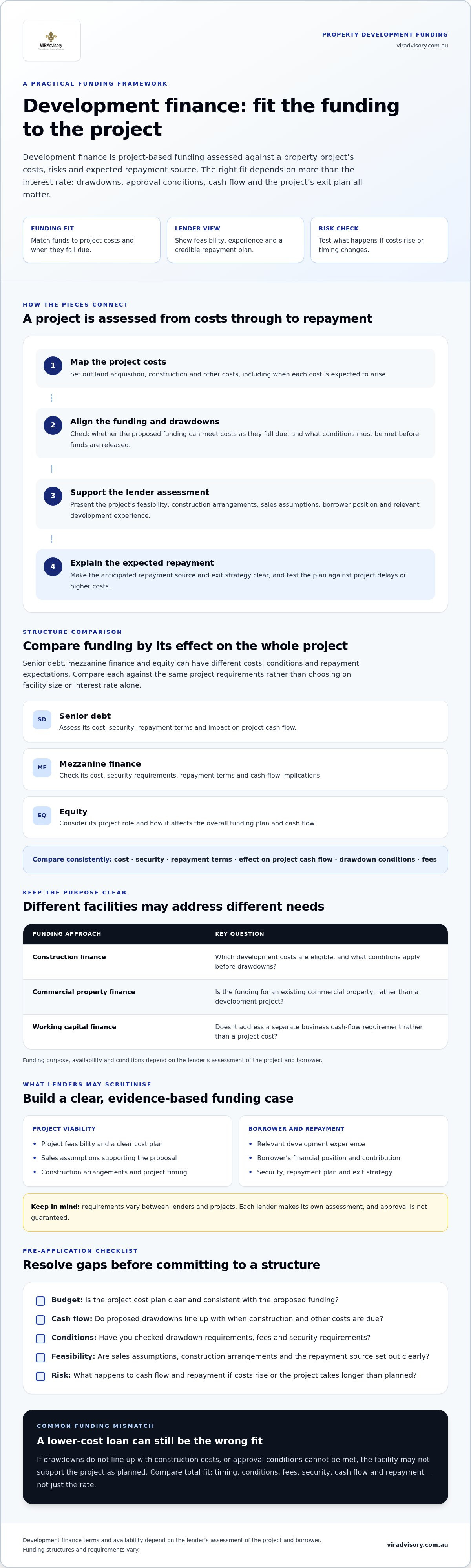
A project’s funding structure can combine different sources of capital, each with its own cost, conditions and repayment expectations. The right comparison isn’t simply which option offers the largest facility. Consider how each source fits the project’s risks and cash flow. In Development finance Australia, structures and lender terms vary, so compare them with your project documents and verify conditions directly.
Compare construction finance, commercial loans and other options
Construction finance may fund eligible development costs, subject to lender terms. Commercial property finance may instead relate to buying or owning an existing asset. Other funding may be relevant to separate business needs, but assess it separately from the development’s core funding requirement.
| Funding approach | Potential role | Questions to ask |
|---|---|---|
| Construction finance | Eligible costs associated with building work | What costs can be funded, and what conditions apply before drawdowns? |
| Commercial property finance | Acquisition or ownership of a commercial property | Is the facility intended for an existing asset or a development project? |
| Working capital finance | A separate business cash-flow requirement | Would this address an operating need rather than a project cost? |
| Equipment finance | Acquiring eligible business equipment | Should the equipment be funded separately from the development facility? |
Keep separate funding needs visible. For instance, equipment needed for business operations may not be treated like construction costs. Ask lenders how separate facilities could affect security, repayments and your overall financial position.
Match drawdowns and repayments to project cash flow
Prepare a project cash-flow schedule that links expected costs to proposed funding stages. Compare it with the lender’s drawdown conditions. Ask what information is required at each stage, whether any costs must be paid before funds are available, and how the facility handles changes to the project schedule.
Scrutinise the repayment assumptions too. A proposed exit may rely on sales, leasing income or refinancing, depending on the project. Check the assumptions behind the plan and how a delay or weaker-than-expected result could affect repayment. The Australian Housing and Urban Research Institute’s report on financing of residential development in Australia offers further context on funding residential projects.
Before comparing offers, request details of disclosed fees, security terms, repayment conditions and any costs associated with undrawn funds. Compare the full structure, not just the facility limit or headline rate. Ask the lender to clarify anything that could affect access to funds or repayment.
What lenders assess before approving development finance in Australia
There’s no single approval formula for development finance in Australia. Each lender assesses the project and borrower against its own current criteria, so an approach that suits one proposal may not suit another. Approval also brings obligations: the borrower must meet the agreed conditions, manage project costs and repay the facility under its terms.
For Development finance Australia applications, the central task is to present a consistent case: what the project involves, how it will be funded, what risks could affect delivery and how the debt is expected to be repaid. Confirm current lender policies and documentation requirements directly, as they can vary and change.
Project feasibility, equity, security and borrower experience
A lender may review whether the project’s costs, timing and expected revenue or sale proceeds are supported by documented assumptions. A feasibility assessment should explain how estimates were prepared and show how changes, such as higher costs or slower sales, could affect cash flow and repayment. Unsupported assumptions can make it harder to assess whether the proposal remains viable if conditions change.
The lender may also consider the borrower’s financial position, available equity, proposed security and relevant development experience. Don’t assume that a particular contribution level, experience threshold or security type applies across all lenders. Explain the source and availability of your contribution, disclose existing commitments and ask how the lender would assess the proposed security for this project.
Documents and approval obstacles to prepare for
Organise information so the lender can assess the project without having to reconcile inconsistent figures. A useful preparation list includes:
- Project plans and a clear description of the proposed development.
- A cost schedule with the assumptions behind key estimates and expected payment stages.
- Financial information showing the borrower’s position, existing commitments and proposed contribution.
- Relevant records of the borrower’s development or project experience.
- A repayment or exit plan, with the assumptions behind any expected sales, lease income or refinance.
Common obstacles include an unclear feasibility, missing or conflicting information, and an exit plan that relies on optimistic sale prices or timing without explaining the basis. Check that project costs and cash-flow forecasts use consistent assumptions. Identify what could delay completion and show how a delay could affect repayment. Don’t present a forecast as certain; make its dependencies visible.
Before lodging an application, ask the lender which documents it currently requires, how it assesses the proposed contribution and security, and what conditions may apply before funds are available. Confirm the assessment scope and project-specific requirements directly. Don’t rely on another lender’s checklist or assume earlier criteria still apply.
A practical checklist for comparing development finance options
Use this framework to compare a proposed facility with the project’s needs, then confirm unclear terms with the lender. For Development finance Australia, the right fit depends on the borrower, project and lender assessment. Review the full offer rather than relying on a single feature.
Funding comparison framework
Define the project and funding purpose → Prepare project and financial information → Compare terms and conditions → Test repayment assumptions → Confirm lender requirements
- Set the project brief. Record the scope, funding purpose, expected cost stages and proposed repayment or exit strategy. Note which assumptions are confirmed and which still need validation.
- Assemble the evidence. Organise project information, cost estimates, financial details and proposed security. Keep related figures consistent and explain the basis of key estimates.
- Review access to funds. Compare drawdown conditions with anticipated payment dates. Ask what documents, approvals or other conditions must be met before you can access funds.
- Compare the disclosed terms. Consider flexibility, security, repayment structure and fees, including when charges apply. Ask for an explanation of any term that could affect cash flow or total cost.
- Challenge the exit assumptions. Check how repayment may be affected by delays, cost increases, slower sales, changes to leasing assumptions or refinancing uncertainty. Confirm current lender-specific requirements before proceeding.
Common development finance mistakes and how to avoid them
Comparing headline rates alone can hide differences in fees, drawdown conditions, security and repayment obligations. Review these features together, and ask lenders to clarify terms that are unclear or not disclosed.
Another common error is treating approval, project timing or exit proceeds as certain. Test a downside scenario, such as delayed completion or a change in expected sales, and assess whether the funding plan can still meet its obligations. If key assumptions no longer hold, update the feasibility before relying on the original funding comparison.
Revisit the assessment if the project scope, costs, timing or market assumptions change. A facility that appeared suitable against earlier estimates may not fit the revised cash-flow requirement. Record outstanding questions and resolve them with the lender before committing.
Discussing a development finance strategy with a broker
A finance broker can help clarify the funding requirement, compare lender options and organise information for an application. For a Development finance Australia proposal, that may mean setting out the project’s funding needs and repayment assumptions, then checking which lenders may consider the request. A broker doesn’t approve or provide the loan. Each lender assesses the application and decides whether to offer finance and on what terms.
VIR Advisory is a finance brokerage, not a direct lender. Led by Raina Doshi, the firm brings more than 15 years of banking and finance experience. Available options depend on the borrower, project and lender assessment, and approval isn’t guaranteed.
What to bring to an initial development finance discussion
You don’t need to have every detail resolved before asking questions. A concise project summary and the information already available can make the discussion more specific. Prepare:
- A summary of the proposed development and the purpose of the funding.
- Indicative project costs, expected timing and key stages when funds may be required.
- Your proposed exit assumptions, such as expected sales, leasing or refinancing.
- Available financial information, including existing debt and the proposed borrower contribution.
- Relevant development or project experience, including details that help explain your role.
- Questions about lender criteria, security, project risks and the funding structure.
Be clear about what remains uncertain. For example, if costs are still being confirmed or the exit depends on a future refinance, identify that assumption rather than presenting it as settled. This gives the broker a clearer basis for comparing options and highlights what may need to be verified with a lender.
How VIR Advisory may support a finance comparison
VIR Advisory can review the project’s stated funding needs, help organise application information and compare lender options that may be relevant. Its commercial finance services include commercial property finance and construction finance. The appropriate structure, availability and terms depend on the lender’s assessment of the borrower and project.
Before proceeding, confirm lender-specific criteria, required documents, drawdown conditions and any outstanding assumptions. A comparison is useful when it reflects the project’s cash-flow requirements as well as its proposed security and repayment plan.
Prepare a clearer case for development finance
Before committing, bring the project scope, cost assumptions, drawdown timing and exit plan together in one view. The central lesson of Development finance Australia is to assess a facility against project delivery risks and cash flow, not headline pricing alone. Lender requirements and approval are specific to each application, so verify conditions and test how delays, cost increases, slower sales or refinancing could affect repayment.
Compare access conditions, security and repayment obligations alongside disclosed fees. Check that funding may be available when project costs fall due. A broker can help organise an application and compare lender options, but doesn’t lend directly or guarantee approval. VIR Advisory provides business loan, commercial finance and construction finance brokerage across Australia. Founder Raina Doshi has more than 15 years of banking and finance experience.
With your assumptions and questions clearly set out, you can approach lender discussions with greater clarity. To discuss your project and funding needs with VIR Advisory, book a development finance discussion.
Frequently Asked Questions
What is development finance in Australia?
Development finance Australia refers to project-based funding that may support property development costs, subject to lender assessment and terms. Depending on the proposal, funding may relate to land, construction or other staged expenses. Unlike a standard home mortgage, assessment may consider the project’s feasibility and expected repayment, along with the borrower’s financial position, experience and security. Structures and eligibility vary between lenders, so confirm the terms for your project.
How do lenders assess a development finance application?
Lenders assess applications case by case. They may review the project’s feasibility, cost assumptions, proposed funding stages and repayment or exit plan, alongside the borrower’s financial position, contribution, experience and available security. For example, a forecast relying on sales should explain its assumptions and how delays could affect repayment. There’s no single approval formula across lenders, so ask each prospective lender to confirm its current criteria and required supporting information.
Can a new developer apply for development finance?
A new developer may apply, but approval depends on the lender’s assessment of the borrower and project. Development experience may be one consideration, alongside feasibility, financial position, contribution and security. If you have limited direct experience, prepare clear records of relevant project or business experience and explain the roles of other parties involved in delivery. Ask lenders how they assess first-time developers, as eligibility requirements and acceptable evidence can differ.
What can development finance be used for?
Depending on the project and lender, development finance may relate to land acquisition, construction or costs at other project stages. Residential, commercial and mixed-use proposals are broad examples, not guaranteed eligible uses. Set out what the funds are intended to cover and when each cost is expected to fall due. This helps lenders assess the request and whether proposed drawdowns may align with project cash flow.
What documents are needed for development finance?
Requirements vary by lender and project, so confirm the current list directly. Useful information commonly includes a project summary, plans, cost estimates, a feasibility assessment, cash-flow forecasts and an exit plan. Lenders may also request financial information, details of existing debts, proposed security and records of relevant experience. Keep figures consistent across documents, explain the assumptions behind estimates and identify anything still being confirmed before submitting an application.
What are the main risks of development finance?
Key risks include cost overruns, delays, funding conditions that affect access to drawdowns, and uncertainty around sales, leasing or refinancing used for repayment. If a project takes longer than planned, costs may fall due before expected income arrives. Test a downside scenario, such as higher costs or slower sales, and check how it would affect cash flow and repayment. Review the feasibility if the project scope, costs or timing change.
Is development finance the same as construction finance?
Not necessarily. Construction finance generally refers to funding associated with building costs, while development finance may cover a broader project, potentially including land and costs across multiple stages. However, lenders may use these terms differently, and the product name alone doesn’t confirm what a facility will fund. Ask the lender to specify eligible costs, drawdown conditions, security and repayment terms for the proposed project.

Article by
Raina Doshi
Raina Doshi has worked in banking and finance since 2011, including experience with major Australian lenders. She helps homeowners, property investors, business owners and professionals secure and structure lending solutions across home loans, refinancing, commercial finance and business lending.
Areas of expertise include residential lending, investment property finance, debt recycling, commercial property finance, equipment finance, construction finance and strategic debt structuring.
Drawing on extensive banking and finance experience, Raina helps clients navigate lender requirements, improve borrowing outcomes and structure effective finance solutions.
Disclaimer
The information in this article is general in nature and does not take into account your personal objectives, financial situation or needs. Before acting on any information, consider whether it is appropriate to your circumstances and seek professional advice.


