

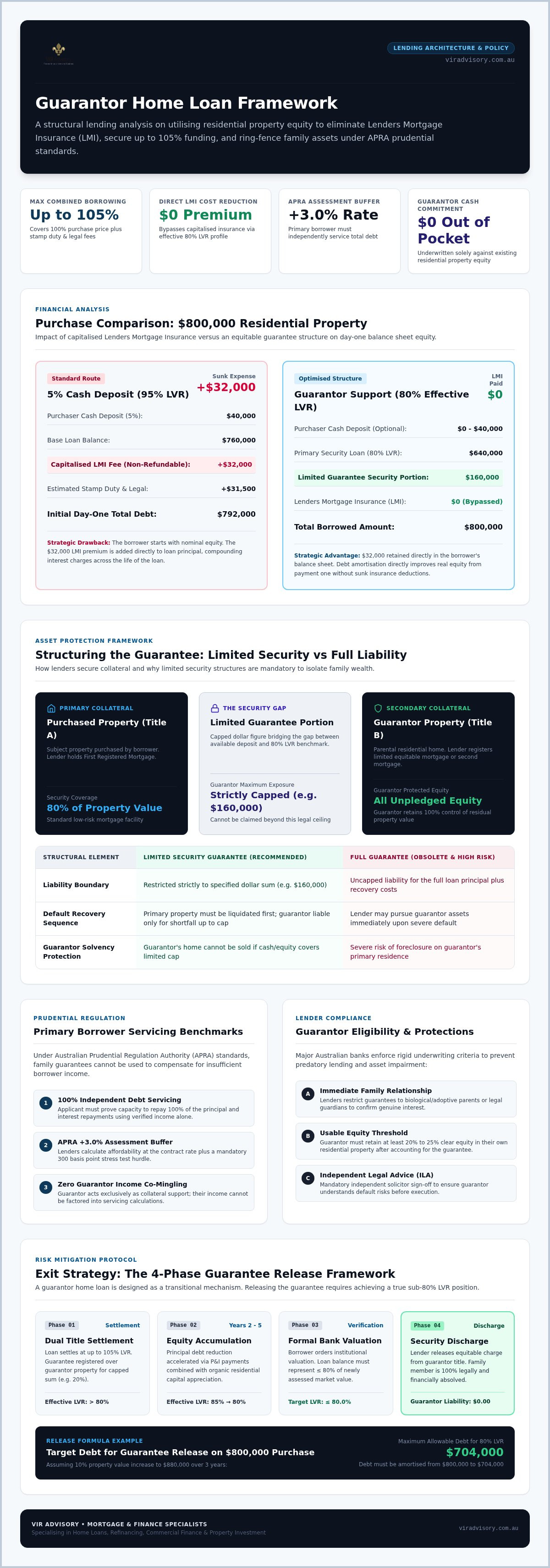
Paying $32,000 in Lenders Mortgage Insurance for a 5% deposit on an $800,000 property is effectively a non-refundable tax on your inability to save faster than the market moves. A guarantor home loan provides a strategic alternative, allowing an immediate family member to use their property equity as secondary collateral to secure up to 20% of the purchase price. This structure enables you to obtain up to 105% financing, covering both the property and purchase costs, while reducing your Lenders Mortgage Insurance (LMI) premium to zero. Under Australian Prudential Regulation Authority (APRA) rules, the primary borrower must still demonstrate they can independently service 100% of the debt at the current assessment rate plus a 3.0% buffer.
It's difficult to accumulate a traditional 20% deposit when rental costs and property prices continue to climb simultaneously. This guide details how to leverage professional lending strategies to bypass the LMI hurdle and enter the market years ahead of schedule. You'll understand the specific lender requirements for family guarantees, how to protect your family's assets through limited liability structures, and the exact process for releasing the guarantee once your property value grows or the loan balance reduces.
Key Takeaways
- Learn how a guarantor home loan enables you to secure up to 105% of the purchase price, effectively bypassing the need for a 20% cash deposit and Lenders Mortgage Insurance.
- Understand the mechanics of a 'Limited Security Guarantee' used to cap a family member's financial exposure while protecting their primary residence.
- Identify the serviceability benchmarks and APRA-mandated buffers required to prove you can independently manage the loan repayments without relying on the guarantor's income.
- Discover the specific equity thresholds and valuation steps necessary to execute a clean exit strategy and release the guarantor from the mortgage.
- Review the mandatory legal protections and disclosure requirements that ensure all parties are fully informed and independent before signing the loan documents.
What is a Guarantor Home Loan and How Does it Work?
In Australia, a guarantor home loan uses a portion of a family member's home equity to 'top up' your deposit, effectively bypassing the need for a large cash sum. This arrangement involves a third party, typically a parent, offering equity in their own residential property as additional security for your mortgage. By using this structure, you can secure a loan for up to 100% of the purchase price plus associated costs like stamp duty. The primary objective is to bring the effective Loan-to-Value Ratio (LVR) below the 80% threshold, which allows you to avoid the substantial cost of Lenders Mortgage Insurance (LMI).
A loan guarantee functions as a legal commitment where the guarantor provides a specific dollar amount of support. Unlike a traditional gift of cash, which requires the family member to have liquid funds available, this strategy leverages the paper wealth already built up in their home. Most Australian lenders restrict this facility to immediate family members, such as parents or legal guardians, to ensure a clear and genuine link between the parties involved in the transaction.
The Role of Security Support
Lenders typically secure this support by taking a 'second mortgage' or an equitable charge over the guarantor's property. This creates a dual-security structure where the bank holds the title to your new home and a limited claim against the guarantor's title. While a cash deposit is a liquid asset subtracted from the purchase price, equity-based security acts as a safety buffer that exists only on paper unless a default occurs. This distinction is vital for family members who want to assist but don't have the cash flow to provide a direct financial gift.
Bypassing Lenders Mortgage Insurance (LMI)
The most immediate financial benefit of a guarantor home loan is the elimination of LMI. Lenders Mortgage Insurance is a one-off premium that protects the lender, not the borrower. For a professional buyer purchasing a property for $800,000 with only a 5% cash deposit, the LMI premium can range from $32,000 to over $41,000 depending on the specific insurer and state taxes.
By using a guarantee to cover the remaining 15% of the deposit, the borrower avoids this expense entirely. This results in an improved equity position from day one because the loan balance isn't inflated by a capitalised insurance premium. Saving $30,000 or more at the start of your property ownership provides a significant head start in debt reduction and future borrowing capacity.
Structuring the Guarantee: Limited vs. Full Liability
Modern lending practices prioritise the 'Limited Security Guarantee'. This structure ensures the guarantor is only liable for a predetermined portion of the total debt, rather than the entire facility. In contrast, a 'Full Guarantee' covers the entire loan amount. While full guarantees were common in the past, they are rarely recommended for residential home loans due to the disproportionate risk they place on family assets. It's vital to clarify that this guarantee is not a cash payment. Instead, it is a legal commitment tied to property equity that only triggers if the primary borrower defaults and the sale of the security property doesn't cover the debt. By limiting the liability, the guarantor's other assets remain protected from the lender's reach.
Calculating the Limited Guarantee Amount
Lenders calculate the guarantee amount based on the gap between the borrower's contribution and the 80% Loan-to-Value Ratio (LVR) threshold. For example, if you purchase a property for $500,000 with a $25,000 deposit, you are borrowing $475,000. To avoid LMI, the loan amount against the property alone should be $400,000, which represents 80% of the $500,000 purchase price. The limited guarantee would typically be $75,000 plus costs. This precision significantly reduces the risk profile for the family member compared to an unlimited arrangement. Understanding these mechanics is essential, especially when assessing How Borrowing Capacity Is Actually Calculated in Australia.
Acceptable Security and Lender Policies
Lenders generally require the guarantor's property to be a standard residential asset with high equity levels. Commercial properties or rural land are often excluded or subject to lower LVR caps. A key consideration is 'servicing', which refers to the borrower's ability to repay the debt. While the guarantor provides security, the primary borrower must demonstrate they can afford 100% of the loan repayments under current APRA stress tests. Policies vary between major banks and non-bank lenders in Australia regarding a guarantor home loan, specifically concerning age and retirement status. Some lenders require a clear exit strategy if the guarantor is approaching retirement, while others may limit the term of the guarantee. You can find more detail in the Moneysmart guidance on going guarantor. If you're unsure how a specific lender might view your family's equity position, you can book a technical strategy session to review your options.
Risks and Responsibilities for Borrowers and Guarantors
Entering into a guarantor home loan carries substantial legal and financial implications that extend beyond the initial approval. For the guarantor, the primary risk is that their property serves as collateral; if the borrower is unable to meet their obligations, the lender has the legal right to access the secured portion of the guarantor's equity to satisfy the debt. This commitment isn't invisible to the credit system. It appears as a contingent liability on the guarantor’s credit report, which can influence their future creditworthiness and financial standing. To ensure all parties understand these obligations, Australian lenders mandate that guarantors obtain independent legal advice (ILA) before signing. This process aligns with consumer credit and guarantee regulations, protecting family members from making uninformed financial commitments.
Impact on the Guarantor’s Borrowing Capacity
A common oversight in these arrangements is the long-term impact on the guarantor’s own ability to borrow. When a parent guarantees a portion of a child's loan, lenders view that guarantee as a potential debt obligation. This can significantly reduce the parent's borrowing capacity if they later decide to refinance their own mortgage or purchase an investment property. Before proceeding, it's critical to calculate the 'residual' equity remaining after the guarantee is in place. If the guarantor plans to retire or downsize within the next few years, the presence of an active guarantee could complicate those transitions by limiting their finance options. Professional oversight is required to ensure the guarantor isn't left in a position of financial hardship.
Managing Default Scenarios
In the event of a default, lenders follow a strictly regulated sequence of actions. They must first exhaust all reasonable avenues to recover the debt from the primary borrower, which typically includes the sale of the primary security property. Only after these steps are completed, and if a shortfall remains, can they pursue the secured guarantee. To mitigate this risk, borrowers should consider structured protections such as income protection insurance, ensuring that unforeseen illness or job loss doesn't trigger the guarantee. Maintaining a proactive approach to debt management is essential. Borrowers should regularly review their position using a Refinance Home Loan Guide: Strategic Debt Optimisation to identify opportunities for increasing their equity and releasing the guarantor as early as possible.
The Application Framework: Eligibility and Requirements
Lenders view a guarantor home loan as a high-exposure transaction, which necessitates a more rigorous assessment than a standard mortgage application. This framework involves a dual-track approval process where both the primary borrower and the guarantor must satisfy distinct credit criteria. While the borrower provides the primary income for repayment, the guarantor's asset provides the secondary layer of capital protection that allows the bank to waive the standard deposit requirements. A critical component of this assessment is the standalone serviceability requirement. The primary borrower must demonstrate they can manage 100% of the loan repayments at the current contract rate plus the APRA-mandated 3.0% stress test buffer without relying on the guarantor's income.
The guarantor's eligibility centres on 'useable equity' within an Australian residential property. Lenders generally cap the total debt on the guarantor’s home, including their existing mortgage and the new guarantee amount, at 75% to 80% of its assessed market value. This ensures an equity safety buffer remains for the guarantor. Additionally, most Australian banks require the guarantor to be an Australian citizen or permanent resident, often with a preference for those who are still in the workforce or possess high net worth to mitigate the risk of financial hardship if the guarantee is ever called upon.
Checklist for a Successful Guarantor Loan Approval
Preparation is essential to manage the multi-party documentation requirements. A successful application typically requires the following:
- Borrower Requirements: Stable employment (usually 6 to 12 months in a PAYG role or 2 years of tax returns for self-employed applicants), a clean credit history, and a demonstrated ability to save, even if those savings aren't used for the deposit.
- Guarantor Requirements: Proof of significant equity in a residential property, recent council rates notices, and mortgage statements for the last six months to prove perfect repayment conduct.
- Compliance: A Certificate of Independent Legal Advice (ILA) for the guarantor, ensuring they have been briefed by a solicitor who does not represent the borrower.
Step-by-Step Approval Process
The sequence of approval is more complex than a standard loan due to the need for dual valuations. The process follows a logical flow to ensure all risks are identified early:
- Technical Assessment: An initial review of the borrower’s borrowing capacity and the guarantor’s available equity.
- Dual Valuations: The lender orders formal valuations for both the property being purchased and the guarantor's property to confirm the LVRs.
- Legal Review: The guarantor meets with their legal representative to review the guarantee documents and the borrower's facility contract.
- Final Credit Approval: Once valuations and legal requirements are met, the lender issues the formal loan offer.
Exit Strategy: How to Release the Guarantee
A guarantor home loan is designed as a temporary credit enhancement tool rather than a permanent debt structure. Establishing a clear exit strategy is essential for protecting family relationships and restoring the guarantor's financial independence. The primary milestone for a release is when the Loan-to-Value Ratio (LVR) on the primary security property reaches 80% or less. This reduction in the risk profile allows the lender to hold the debt against the single property without the need for additional security support or Lenders Mortgage Insurance. Reaching this threshold typically occurs within two to five years, depending on the borrower's repayment strategy and local market conditions.
The release process is a formal credit event. It requires the borrower to demonstrate that they can still service the entire loan amount on their own, even if interest rates have increased since the original application. Lenders will conduct a fresh assessment of your income, expenses, and credit conduct before agreeing to discharge the additional security. This ensures that the removal of the guarantee does not place the lender or the borrower in a position of unmanaged risk.
Accelerating the Path to Independence
Borrowers can proactively shorten the duration of the guarantee by focusing on rapid equity accumulation. Choosing a principal and interest repayment structure ensures the loan balance reduces from the first month. Making additional voluntary repayments, particularly when cash flow allows, further accelerates this process. Strategic property improvements or cosmetic renovations can also provide a valuation uplift, helping you reach the 80% LVR target sooner. For business owners or company directors, balancing these repayments with commercial debt is a specialised task. You can explore Strategic Business Loans in Australia to understand how to manage business cash flow while prioritising your home loan reduction.
The Refinancing Process for Release
The removal of a guarantor is not an automated process; it requires a formal Request for Release of Security and a new bank-ordered valuation to confirm the current market value of your home. If your current lender's assessment criteria are too restrictive or their valuation comes in lower than expected, you may need to look at refinancing solutions with a different institution to facilitate the release. This involves discharging the mortgage over the guarantor's property, which incurs minor government registration and lender discharge fees. We recommend reviewing your LVR with a professional broker every 12 to 24 months. This regular oversight ensures that once the 80% threshold is met, the paperwork can be lodged immediately to liberate the guarantor's equity for their own future use.
Strategic Entry into the Australian Property Market
A guarantor home loan remains one of the most effective mechanisms for professionals and first home buyers to enter the market without the burden of Lenders Mortgage Insurance. By structuring the application with a limited security guarantee, you can secure a property with a minimal deposit while ensuring your family's assets are legally protected. Success in this area requires a meticulous approach to serviceability and a documented exit strategy to release the guarantor as your equity increases through capital growth and principal repayments.
Raina Doshi provides personalised oversight based on 15 years of industry experience to ensure your application meets stringent lender requirements. With expertise in complex Australian lending policies, VIR Advisory helps you manage the multi-party approval process with precision and clarity.
Secure your property future with a structured lending strategy—contact VIR Advisory today. We look forward to providing the professional guidance needed to establish a stable and secure property portfolio.
Frequently Asked Questions
Who can act as a guarantor for my home loan in Australia?
Immediate family members are the primary candidates who can support a guarantor home loan in Australia. Most lenders restrict this to parents or legal guardians, though some institutions extend their policies to include siblings or grandparents. The guarantor must be an Australian citizen or permanent resident with sufficient equity in a residential property. Third-party guarantees from friends or distant relatives are not accepted under standard residential lending criteria.
Can I buy a house with a $0 deposit using a guarantor?
You can purchase a property with a $0 cash deposit using this specific loan structure. A guarantor can secure up to 100% of the purchase price plus associated costs like stamp duty and legal fees, often reaching a total loan of 105% of the property value. While a cash contribution isn't required, you must still demonstrate that you can independently service the full loan amount under current APRA-mandated serviceability stress tests.
Does the guarantor have to provide any actual cash for the deposit?
The guarantor does not provide any actual cash for the deposit. This arrangement is based entirely on the equity held in their existing property. It's a legal commitment rather than a financial payment, so no funds leave the guarantor's bank account at settlement. The lender simply registers a mortgage or equitable charge over the guarantor's property title to act as secondary collateral for the specified portion of your loan.
What happens if I cannot make my home loan repayments?
If you default on your repayments, the lender will first attempt to recover the debt from you and by selling your property. If a shortfall remains after the sale of your home, the lender can then pursue the guarantor for the specific amount they secured. This is why Australian lenders mandate that all guarantors obtain independent legal advice before signing, ensuring they fully understand the potential risk to their own property equity.
How long does the guarantor stay on the home loan?
A guarantor typically remains on the loan until your property's standalone Loan-to-Value Ratio (LVR) reaches 80% or less. This milestone is usually achieved within two to five years through a combination of regular principal repayments and capital growth. Once you reach this threshold, you can apply for a formal release of security. This process requires a fresh bank valuation and a reassessment of your ability to manage the debt independently.
Can my parents be guarantors if they are retired or on a pension?
Retired parents can act as guarantors if they have substantial equity and the arrangement doesn't pose a risk of financial hardship. Lenders are more stringent in these cases, often requiring a larger equity buffer and a clear exit strategy. Because retirees have limited income to cover a potential default, banks must ensure that the guarantee doesn't compromise their ability to maintain their own home or meet their daily living expenses.
Do I pay a higher interest rate on a guarantor home loan?
You don't pay a higher interest rate on this type of loan. In fact, you'll often access the more competitive interest rates usually reserved for borrowers with a 20% cash deposit. Because the guarantee brings the effective LVR down to 80%, the lender views the loan as lower risk. This allows you to avoid the higher interest rates and additional fees often associated with low-deposit home loans that require Lenders Mortgage Insurance.
Can I use a guarantor for an investment property purchase?
You can use a guarantor for an investment property purchase, although lender policies are generally more restrictive than for owner-occupied homes. This strategy is effective for professionals who want to expand their property portfolio without using their liquid cash reserves. The borrower must prove that the expected rental income and their existing earnings are sufficient to service the total debt at the buffered interest rate required by Australian lending standards.

Article by
Raina Doshi
Raina Doshi has worked in banking and finance since 2011, including experience with major Australian lenders. She helps homeowners, property investors, business owners and professionals secure and structure lending solutions across home loans, refinancing, commercial finance and business lending.
Areas of expertise include residential lending, investment property finance, debt recycling, commercial property finance, equipment finance, construction finance and strategic debt structuring.
Drawing on extensive banking and finance experience, Raina helps clients navigate lender requirements, improve borrowing outcomes and structure effective finance solutions.
Disclaimer
The information in this article is general in nature and does not take into account your personal objectives, financial situation or needs. Before acting on any information, consider whether it is appropriate to your circumstances and seek professional advice.


