

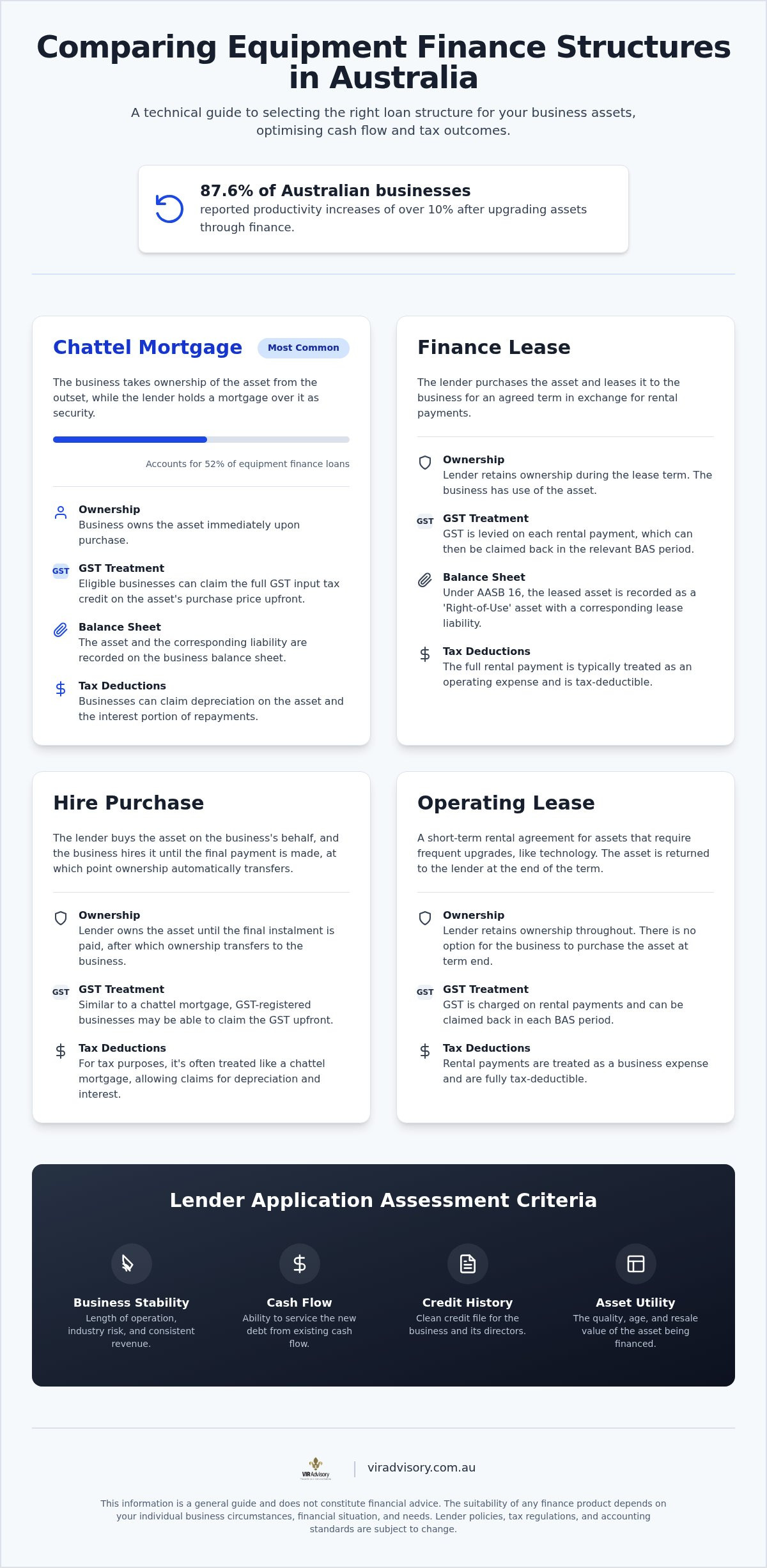
Did you know that 87.6% of Australian businesses reported productivity increases of over 10% after upgrading their assets through finance in 2026? Securing the right equipment finance Australia wide requires more than just picking a lender; it involves a strategic alignment between your asset’s lifespan and your business's cash flow requirements. With the instant asset write-off threshold now permanent at A$20,000 for eligible small businesses, the most effective funding strategy often involves a chattel mortgage to claim GST input credits upfront while preserving working capital for daily operations.
We understand that navigating strict bank eligibility criteria and fluctuating interest rates can be a source of significant stress for company directors and self-employed professionals. This article provides a clear technical breakdown of current loan structures and lender assessment criteria to help you secure competitive terms. You will learn how to optimise your debt management and choose between various finance options to ensure your next capital investment supports long-term stability rather than creating a liquidity bottleneck.
Key Takeaways
- Learn how to preserve working capital and manage cash flow by selecting a specialised funding solution tailored for the 2026 Australian market.
- Compare different structures, such as chattel mortgages and finance leases, to optimise your business balance sheet and maximise GST and tax benefits.
- Master the complexities of equipment finance Australia by understanding how lenders assess business stability and asset utility during the application process.
- Identify and avoid common application mistakes, such as failing to account for the total cost of ownership in your cash flow forecasts.
- Implement a strategic lending framework that aligns loan terms with the effective life of your equipment to ensure long-term financial stability.
What is Equipment Finance in the Australian Commercial Context?
The Australian equipment and asset finance market facilitates over A$80 billion in new business annually, serving as a vital mechanism for commercial growth and modernisation. Equipment finance is a specialised funding solution that allows businesses to acquire physical assets, such as machinery, vehicles, or technology, while preserving their essential working capital. In the high-interest environment of 2026, where the RBA cash rate remains at 4.35%, this model of equipment finance Australia wide has become a critical component of a robust finance strategy. It provides a structured method for businesses to access the latest hardware without the immediate burden of a large capital outlay.
Equipment finance is a strategic credit facility that allows a business to procure income-generating assets while maintaining the liquidity necessary to meet ongoing operational obligations. The primary distinction between this and a standard business loan is the nature of the security; the asset being purchased typically secures the debt. This structure often results in more accessible approval requirements compared to unsecured lending, as the lender retains a claim over the equipment if the business encounters financial difficulty.
To better understand this concept, watch this helpful video:
The Role of Asset Finance in Cash Flow Management
Utilising large cash reserves to purchase depreciating assets creates a significant opportunity cost. Those funds are effectively locked away, preventing the business from investing in marketing, inventory, or emergency buffers. Equipment finance mitigates this risk by spreading the cost over the asset's productive life. Matching the loan term to the useful life of the equipment ensures that the repayments are funded by the revenue the asset generates. Because these repayments are typically fixed, they assist in accurate long-term budgeting and protect the business from the volatility of operational costs.
Common Assets Funded via Equipment Loans
Lenders provide equipment finance Australia wide for a diverse range of income-producing hardware. These assets are generally categorised by their ability to retain value over time and their utility in specific industries. Common examples include:
- Commercial vehicles, ranging from light delivery vans to heavy transport fleets.
- Construction machinery, earthmoving equipment, and agricultural harvesters.
- Medical suites, dental chairs, and specialised diagnostic hardware.
- Office technology, server infrastructure, and complex manufacturing systems.
- Various Leasing arrangements for high-turnover technology that requires frequent updates.
By using the asset as security, businesses can often negotiate more favourable interest rates than they would receive with unsecured facilities. This makes equipment finance an efficient tool for managing debt while ensuring the business remains equipped with the latest technology to maintain a competitive edge.
Comparing Australian Equipment Finance Structures
Selecting the correct legal structure for equipment finance Australia wide is a technical decision that dictates your tax position and cash flow for years. It's not just about the interest rate. Each facility carries specific implications for GST, depreciation, and balance sheet reporting. While a structure with lower monthly instalments might appear attractive, it often incorporates a "balloon" payment. This residual value is a lump sum due at the end of the term, which can create a significant cash flow hurdle if you haven't planned for it during the initial strategy phase.
Chattel Mortgage (Goods Loan)
The chattel mortgage remains the most prevalent structure in the Australian market, currently accounting for 52% of equipment finance loans. Under this arrangement, your business takes ownership of the asset immediately upon purchase, while the lender secures the debt by taking a mortgage over the goods. This structure is particularly effective for businesses registered for GST on an accruals basis. You can typically claim the full GST component of the purchase price in your next Business Activity Statement (BAS), which provides an immediate cash flow injection. Additionally, the business can claim annual depreciation and interest charges as tax deductions. However, ownership from day one means the borrower is solely responsible for all maintenance, registration, and insurance costs.
Finance Lease vs. Hire Purchase
A finance lease functions differently because the lender retains ownership of the asset throughout the term. Your business pays "rent" for the use of the equipment, and these payments are often fully tax-deductible if the asset is used solely for income-producing purposes. This is a common choice for technology or assets with high turnover rates where you don't necessarily want to own the hardware long-term. In contrast, a Commercial Hire Purchase involves the business "hiring" the asset from the lender for a set period. Ownership is only transferred to your business once the final instalment, including any residual amount, is paid in full.
For large-scale enterprises, these structures impact the balance sheet in distinct ways. A finance lease may be treated differently in financial reporting, whereas a hire purchase or chattel mortgage clearly lists both the asset and the liability. Understanding these nuances is essential for maintaining healthy debt-to-equity ratios and meeting bank covenant requirements. If you are unsure which structure aligns with your current tax position, you can book a technical briefing to review your options. Choosing the wrong structure can lead to missed tax benefits or unexpected liabilities at the end of the term, so precise alignment with your accounting advice is vital.
How Lenders Assess Equipment Finance Applications
Lenders evaluate risk through two distinct lenses: the strength of the borrowing entity and the quality of the asset being purchased. Approval prospects for equipment finance Australia wide depend heavily on the secondary market value of the equipment, as this serves as the lender's primary security. Lenders view newer equipment as lower risk due to its higher resale value. If a borrower defaults, the lender must be confident that the asset can be sold quickly to recover the outstanding debt, which is why older or highly specialised machinery often attracts stricter terms or higher deposits.
Key Performance Indicators for Credit Approval
A business's credit history is the primary indicator of future repayment behaviour. Lenders examine both the company's credit file and the personal credit scores of all directors to identify any patterns of late payments or defaults. Even a minor oversight on a utility bill can complicate an application. Time in business is another non-negotiable benchmark; most Tier 1 lenders require a minimum of two years of active ABN registration and GST registration. For "Full Doc" applications, you'll need to provide comprehensive profit and loss statements and balance sheets to demonstrate that your current cash flow can comfortably service the new debt facility without compromising existing operations.
The "Low Doc" Pathway for SME Finance
For established businesses that need to move quickly, the "Low Doc" pathway offers a streamlined alternative to traditional assessments. This is typically available to property-backed business owners who have been trading for over two years with a clean credit history. Lenders often fast-track these approvals for specific asset classes, such as motor vehicles up to A$150,000 or primary production equipment up to A$100,000, without requiring the submission of full financial statements.
The trade-off for this speed is often a slightly higher interest rate compared to Full Doc solutions. Lenders offset the lack of detailed financial data by charging a premium for the perceived increase in risk. While you might save significant time on paperwork, you must ensure the asset's income-generating potential justifies the higher cost of capital. Understanding these requirements allows you to position your application for the best possible outcome before it reaches the credit department. By addressing potential obstacles early, such as clarifying a dip in seasonal revenue, you improve your chances of securing competitive lending terms.
Common Mistakes and the Approval Readiness Checklist
Many Australian businesses face unnecessary delays or rejections due to avoidable errors in the application phase. One major mistake is failing to account for the total cost of ownership, including insurance and registration, within the cash flow forecast. If you only budget for the monthly repayment, you might find your liquidity strained by these ancillary costs. Using experienced mortgage brokers to assist in structuring debt correctly ensures that your funding matches the actual operational impact of the asset. Precise alignment prevents unexpected cash flow bottlenecks later in the term.
Another common pitfall is applying for the wrong type of finance for an asset that depreciates rapidly, such as high-end IT hardware. If the loan term exceeds the useful life of the technology, you risk being left with a debt obligation for an obsolete asset. This is where precision in your equipment finance Australia strategy becomes essential, as it prevents capital from being tied up in non-productive debt. Lenders often look for a clear correlation between the asset's revenue generation and the repayment schedule.
The 5-Step Equipment Finance Checklist
- 1. Validate ABN and GST registration status: Lenders require your tax lodgements to be up to date to verify business stability.
- 2. Review Director credit files: Check for any defaults or inconsistencies that could trigger an automatic rejection.
- 3. Obtain a formal quote or invoice: Ensure the document includes the serial number or VIN of the asset for security registration.
- 4. Determine the preferred deposit or balloon payment: Align these figures with your specific cash flow goals and tax requirements.
- 5. Consult with a finance professional: Compare bank and non-bank lending options to find the most competitive terms for your industry.
Managing Risks: Interest Rates and Asset Depreciation
With the RBA cash rate sitting at 4.35% and major banks forecasting a potential rise to 4.60% before the end of 2026, the choice between fixed and variable rates is critical. Fixed rates provide certainty for long-term budgeting, protecting you from further fluctuations. However, you must also manage the risk of "negative equity." This occurs if the loan balance exceeds the asset’s market value, often due to an aggressive balloon payment on a fast-depreciating item. For businesses looking at larger scale funding, integrating this with Commercial Property Finance can help create a more holistic debt management strategy.
Securing Strategic Equipment Finance with VIR Advisory
Navigating the complexities of equipment finance Australia wide requires a level of technical precision that goes beyond simply submitting a loan application. In an environment where major lenders are scrutinising every balance sheet entry, your funding success depends on a tailored lending strategy that aligns with your specific operational requirements. VIR Advisory, led by Raina Doshi, leverages over 15 years of institutional banking and finance experience to identify the most appropriate structures for our clients. We provide professional guidance on business loans and asset finance, ensuring that every debt facility supports your long-term stability rather than creating a liquidity constraint. Our methodical approach focuses on clarity, helping you avoid the common approval obstacles that frequently lead to rejections or unfavourable terms. By understanding the internal logic of credit departments, we ensure your application is positioned for success before it reaches the lender's desk.
The Advantage of Professional Brokerage
Choosing a professional brokerage provides access to a wide range of lenders, including specialised non-bank providers who often offer more flexibility than traditional institutions. We possess deep expertise in lender assessment criteria, which allows us to refine your application and significantly improve your prospects for a first-time approval. Unlike generic bank products that follow a rigid model, our service prioritises your business’s actual fiscal health. We look at the interplay between your working capital, existing debt obligations, and the revenue potential of the new asset to ensure the finance facility is sustainable and cost-effective over the full term.
Next Steps for Your Business Funding
To begin the process, you should prepare your current financial documentation, including your most recent Business Activity Statements and asset quotes, for a preliminary assessment. It's also vital to consider how this new equipment fits into your broader commercial finance strategy. We work with you to organise a competitive finance facility that accounts for potential interest rate fluctuations and the specific depreciation schedule of your equipment. Contact VIR Advisory today to discuss your requirements and let our team handle the technical complexities of your next capital acquisition, allowing you to focus on the operational growth of your business.
Submit your finance enquiry here
Optimising Capital Investment Strategy for 2026
Securing effective equipment finance Australia wide depends on a precise alignment between your business’s cash flow and the specific depreciation schedule of your assets. By selecting the correct legal structure and addressing lender requirements proactively, you can maintain essential working capital while modernising your operations with the latest hardware. This strategic approach ensures that your debt facilities function as tools for growth rather than operational burdens.
Raina Doshi brings over 15 years of banking and finance experience to every engagement, providing high-level expertise in complex commercial and asset finance. Our personalised, methodical approach to debt structuring ensures that your facilities are integrated seamlessly into your broader commercial strategy, helping you avoid unnecessary liquidity bottlenecks. This professional oversight allows you to focus on your primary business objectives while we handle the technical intricacies of the lending market.
We look forward to helping you secure a competitive funding solution that supports your business's long-term fiscal health and stability.
Frequently Asked Questions
What is the difference between a Chattel Mortgage and a Finance Lease?
A Chattel Mortgage provides your business with immediate ownership of the asset while the lender secures the loan against the equipment. In contrast, under a Finance Lease, the lender retains ownership and you pay rent for the asset's use. Chattel mortgages typically allow for upfront GST claims on the purchase price, whereas lease payments are generally treated as deductible operating expenses. Both structures offer different advantages for your balance sheet and tax position.
Can I get equipment finance if I am a new business or self-employed?
Yes, new businesses and self-employed borrowers can secure equipment finance Australia wide, provided they meet specific lender requirements. Most Tier 1 lenders prefer a minimum of two years' ABN registration, but specialised non-bank lenders offer solutions for startups with as little as six months of trading history. You will likely need a clean personal credit file and a deposit or property backing to offset the perceived risk of a shorter trading history.
Are there tax benefits to financing equipment rather than buying it outright?
Financing equipment offers several tax advantages compared to outright purchases. For assets under the A$20,000 instant asset write-off threshold, eligible businesses can claim an immediate deduction. For larger acquisitions via a chattel mortgage, you can typically claim the full GST component in your next BAS, along with annual depreciation and interest charges. These structures help preserve your working capital while providing predictable, deductible monthly outgoings that align with your business’s income-generating capacity.
What documents do I need for a business equipment loan application?
For a standard "Full Doc" application, you will need to provide your ABN, two years of financial statements, and recent tax returns. If you qualify for a "Low Doc" facility, requirements are often reduced to a clean credit file and proof of ABN registration for at least two years. Regardless of the pathway, you must provide a formal invoice or quote from the supplier that includes the asset’s serial number or VIN for security registration.
How much can I borrow for equipment finance in Australia?
Borrowing capacity for equipment finance is primarily determined by your business's serviceability and the market value of the asset. Lenders typically fund between A$10,000 and several million dollars, often providing 100% of the purchase price for primary assets like commercial vehicles or construction machinery. For specialised or older equipment, a lender might require a deposit of 10% to 20% to ensure the loan balance remains below the asset's expected resale value.
What is a balloon payment and how does it affect my loan?
A balloon payment, or residual value, is a lump sum due at the end of your loan term. By deferring a portion of the principal, you reduce your monthly repayments, which can significantly improve your short-term cash flow. However, you must plan for this final payment by either refinancing the amount, selling the asset to cover the debt, or paying it from cash reserves. This structure is common for assets with high resale values.
Can I finance used equipment or machinery?
You can finance used equipment, although lenders often apply age restrictions to ensure the asset retains sufficient value throughout the loan term. Most lenders prefer the equipment to be no more than 12 years old at the end of the finance period. When financing used machinery from a private seller, an independent valuation or inspection is often required to verify the asset's condition and ensure the purchase price aligns with current market data.
How long does the equipment finance approval process take?
The approval process for equipment finance Australia can be remarkably efficient. "Low Doc" applications for motor vehicles or standard machinery are often approved within 24 to 48 hours. More complex "Full Doc" applications involving specialised manufacturing hardware or large-scale fleets may take three to five business days. Providing all necessary documentation, such as up-to-date tax portal records and formal quotes, at the outset is the most effective way to prevent delays and ensure a smooth settlement.

Article by
Raina Doshi
Raina Doshi has worked in banking and finance since 2011, including experience with major Australian lenders. She helps homeowners, property investors, business owners and professionals secure and structure lending solutions across home loans, refinancing, commercial finance and business lending.
Areas of expertise include residential lending, investment property finance, debt recycling, commercial property finance, equipment finance, construction finance and strategic debt structuring.
Drawing on extensive banking and finance experience, Raina helps clients navigate lender requirements, improve borrowing outcomes and structure effective finance solutions.
Disclaimer
The information in this article is general in nature and does not take into account your personal objectives, financial situation or needs. Before acting on any information, consider whether it is appropriate to your circumstances and seek professional advice.


