

A dental degree is one of the most powerful assets in the Australian mortgage market, yet many practitioners remain unaware that their professional status allows them to bypass the 20% deposit rule entirely. While standard lending requires Lenders Mortgage Insurance (LMI) for any loan exceeding 80% of the property value, specialised dentist home loans allow qualified professionals to borrow up to 90%, and occasionally 95%, with the LMI fee waived. This professional exemption recognises the historical stability and high earning potential of the dental sector, effectively removing a significant financial barrier to property acquisition.
It's understandable to feel frustrated by rigid bank policies that don't quite fit your complex income structure, especially if you're balancing private practice dividends with personal debt. This guide details how to leverage your professional standing to secure higher borrowing capacities and tax-effective loan structures. We will outline the specific lender requirements for AHPRA-registered dentists, explain how to manage the interplay between practice finance and residential mortgages, and provide a clear framework for a streamlined approval process that respects your clinical schedule.
Key Takeaways
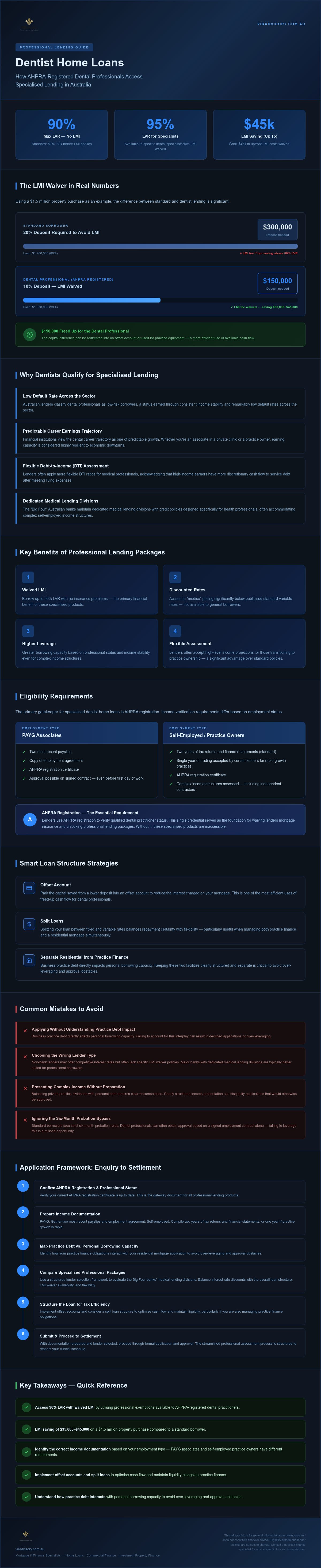
- Access 90% LVR lending with a waived Lenders Mortgage Insurance (LMI) fee by utilising professional exemptions available to dental practitioners.
- Identify the specific AHPRA registration and income verification criteria lenders use to assess eligibility for dentist home loans.
- Implement strategic debt management techniques, such as offset accounts and split loans, to optimise cash flow and maintain liquidity.
- Recognise how business practice debt interacts with personal borrowing capacity to avoid over-leveraging and approval obstacles.
- Follow a structured framework for lender selection to compare specialised professional packages that offer higher borrowing limits and flexible terms.
The Professional Advantage: Why Dentists Qualify for Specialised Lending
Australian lenders classify dental professionals as low-risk borrowers, a status earned through years of consistent income stability and remarkably low default rates across the sector. Unlike the general public, who must typically provide a 20% deposit to avoid lenders mortgage insurance (LMI), dentists can access specialised finance products that waive this requirement. This means you can secure a property with a 10% deposit while avoiding a non-refundable fee that often runs into tens of thousands of dollars. It's not just about the deposit size; it's about the lender's confidence in your long-term earning potential.
The Mechanics of the LMI Waiver
The core benefit of dentist home loans is the ability to borrow up to 90% of a property's value without the added cost of LMI. For a practitioner purchasing a home for $1.5 million, a standard borrower would need a $300,000 deposit to avoid insurance costs. A dental professional, however, only needs $150,000. By waiving the LMI, the lender saves the borrower approximately $35,000 to $45,000 in upfront costs, depending on the specific lender's premium table. While some lenders extend this to 95% LVR for specific dental specialists, the 90% waiver is the industry standard for general practitioners and associates registered with AHPRA. This capital can then be redirected into an offset account or used for practice equipment, providing a more efficient use of your available cash flow.
Lender Risk Assessment for Medical Professionals
Financial institutions view the dental career trajectory as one of predictable growth. Whether you're an associate in a private clinic or a practice owner, your earning capacity is considered highly resilient to economic downturns. Lenders often apply more flexible Debt-to-Income (DTI) ratios for medical professionals, acknowledging that high-income earners have more discretionary cash flow to service debt after meeting basic living expenses.
The "Big Four" Australian banks maintain dedicated medical lending divisions with credit policies designed specifically for health professionals. These policies often overlook the complexities of self-employed income structures that might disqualify other borrowers in different industries. While non-bank lenders may offer competitive interest rates, they often lack the specific LMI waiver policies found within the professional packages of major banks. Choosing the right lender involves balancing interest rate discounts, which are often significantly below the standard variable rate, with the overall loan structure and flexibility. You can find more details on how we assess these options on our services page.
- Waived LMI: Borrow up to 90% LVR with no insurance premiums.
- Discounted Rates: Access to "medico" pricing significantly below publicised standard variable rates.
- Higher Leverage: Greater borrowing capacity based on professional status and income stability.
- Flexible Assessment: Lenders often accept high-level income projections for those transitioning to practice ownership.
Lender Requirements and Eligibility for Dental Professionals
Securing dentist home loans requires more than just a high income; it necessitates a specific set of credentials that satisfy a lender's professional risk profile. The primary gatekeeper for these specialised products is your AHPRA registration. Lenders use this to verify that you are a qualified dental practitioner, which serves as the foundation for waiving lenders mortgage insurance. While standard borrowers might be subject to strict six-month probation rules, dental professionals often find lenders are willing to provide approval based on a signed employment contract even before their first day of work.
Income verification differs significantly based on your employment status. PAYG associates generally need to provide their two most recent payslips and a copy of their employment agreement. For self-employed practice owners or those operating as independent contractors, lenders typically require two years of tax returns and financial statements. However, if your practice has seen rapid growth, certain lenders may assess your application based on a single year of trading. It is also common for the most competitive professional packages to require a minimum annual income threshold, frequently set at $150,000, to qualify for the full suite of interest rate discounts and fee waivers.
Documentation Checklist for Approval
Preparation is essential for a streamlined approval. Lenders expect a comprehensive file that accounts for both personal and professional financial obligations. You should have the following ready:
- A current AHPRA registration certificate and evidence of professional indemnity insurance.
- Two years of personal and business tax returns if you are self-employed.
- Recent payslips and a PAYG payment summary if you are an associate.
- A full schedule of any existing practice debt, including business equipment finance or fit-out loans.
Special Considerations for Newly Qualified Dentists
Lenders often extend professional benefits to interns and residents who are just beginning their clinical careers. Even with a lower starting salary, your future income projections can occasionally be factored into borrowing capacity assessments. When understanding home loan structures, it is vital to account for how HECS or HELP debt repayments impact your serviceability. Lenders view these as a mandatory monthly expense, which can reduce your maximum loan amount. Despite this, the absence of an LMI requirement allows many new graduates to enter the property market much sooner than their peers in other industries. If your income structure involves complex trust distributions or associate agreements, you can book a consultation to review your specific documentation.
Optimising Loan Structures for Owner-Occupiers and Investors
While securing a competitive interest rate is a priority, the architecture of dentist home loans often has a more significant impact on long-term wealth and tax efficiency. For professionals who may eventually transition from an associate role to practice ownership, the way debt is organised today influences future borrowing flexibility. A well-organised loan structure ensures that your personal mortgage debt is managed separately from your professional liabilities, protecting your primary residence from business risks.
Offset accounts are particularly effective for dental practitioners due to the high cash flow nature of the profession. By placing surplus income into an account linked to your variable mortgage, you reduce the interest charged on the loan balance while maintaining immediate access to liquidity. This is often superior to a redraw facility, as it keeps your personal savings distinct from the loan, which is vital if you ever decide to convert your home into an investment property. A split loan strategy also allows you to fix a portion of your debt for repayment certainty while keeping a variable component to take full advantage of offset benefits.
Risk management is another pillar of professional lending. You should avoid cross-collateralisation, where a lender uses your family home as security for your practice or equipment finance. While this might simplify the initial application, it gives the bank significant control over your assets and can complicate future refinancing or property sales. Keeping these securities separate ensures that your home remains protected even if your business circumstances change.
Debt Recycling for Property Investors
Many dentists use the equity built up in their principal place of residence to fund investment portfolios. Debt recycling is a strategy where you use this equity to establish a separate loan account for investment purposes. This creates a clear tax audit trail, ensuring that the interest on the investment portion is deductible. Understanding the nuances of this process is essential, especially when you consider How Borrowing Capacity Is Actually Calculated in Australia. By separating these accounts, you can focus on paying down non-deductible home debt while maintaining an interest-only structure on the investment side.
Principal and Interest vs Interest-Only
The choice between principal and interest (P&I) or interest-only (IO) repayments depends heavily on your current career stage and cash flow requirements. Practice owners often prefer interest-only periods for investment loans to maximise tax deductions and preserve capital for business equipment or working capital. However, lenders typically charge higher interest rates for IO loans and may limit the period to five years. For owner-occupied dentist home loans, P&I is the standard requirement for professional packages, as it demonstrates a commitment to debt reduction and builds equity faster. We recommend assessing your total debt-to-income ratio before committing to a long-term interest-only structure.
Common Mistakes in Professional Lending and How to Avoid Them
Even with the unique benefits of dentist home loans, practitioners often fall into traps that limit their long-term flexibility. A common error is over-leveraging. While a lender might approve a high loan amount based on your clinical income, borrowing at your absolute maximum capacity leaves little room for interest rate fluctuations or unexpected practice overheads. Maintaining a financial buffer is essential for risk management, ensuring that a temporary dip in patient volume doesn't compromise your personal mortgage obligations. It's vital to borrow based on a realistic assessment of your lifestyle costs rather than just the bank's maximum limit.
Another frequent oversight is failing to account for how practice debt interacts with personal borrowing capacity. Lenders look at your total debt-to-income ratio across all liabilities. If you have significant business equipment finance or a large fit-out loan, these monthly commitments directly reduce the surplus income available to service a residential home loan. Neglecting to review your interest rates regularly is also a costly mistake. Many dentists remain on "lazy" rates with their current bank for years, missing out on newer professional packages that offer sharper discounts for high-net-worth medical clients as their equity grows.
The Trap of Generic Lending Products
Approaching a standard retail bank manager often results in a generic assessment that fails to apply professional waivers. This frequently leads to borrowers paying for lenders mortgage insurance unnecessarily because the manager is unfamiliar with the bank's own internal medical policy exemptions. Accessing the dedicated "Medicos" or professional lending departments is the only way to ensure these benefits are applied correctly. If you are already in a loan that doesn't reflect your professional status, consulting a Refinance Home Loan Guide: Strategic Debt Optimisation for 2026 can help identify where your current structure is underperforming and how to rectify it.
Inaccurate Income Disclosure for Self-Employed Dentists
For practice owners, the complexity of trust and company structures often leads to inaccurate income reporting during the application phase. Credit assessors may miss legitimate "add-backs", such as one-off depreciation expenses, interest on business loans, or voluntary superannuation contributions, which can artificially lower your perceived income. A specialist broker plays a vital role here, interpreting your financial statements to ensure the lender sees your true serviceability. Presenting a clear narrative of your practice's profitability, including how dividends are distributed through discretionary trusts, is often the difference between a standard rejection and a professional approval with high-leverage terms.
The Application Framework: From Enquiry to Settlement
The process of securing dentist home loans requires a methodical approach to ensure the professional LMI waiver is correctly applied at the point of submission. It begins with a detailed initial assessment where your AHPRA registration status is verified alongside your current income and long-term property goals. This phase is critical; it determines whether you meet the specific eligibility criteria for high-leverage professional packages. Once your profile is established, the next step is lender selection. This involves comparing specialised medical policies across major and non-bank lenders to identify which institution offers the most competitive interest rate discounts and flexible debt-to-income assessments for your specific employment structure.
Before attending auctions or making offers on a property, obtaining a formal pre-approval is essential. This provides you with a clear borrowing limit and demonstrates to vendors that you are a qualified buyer. Following the identification of a property, the lender will commission a valuation to ensure the security meets their requirements for 90% or 95% LVR lending. If the valuation aligns with the purchase price, the lender issues a formal approval, leading to the exchange of mortgage documents and, eventually, settlement. This sequential flow ensures that every detail is handled with professional oversight, allowing for a smooth and frictionless experience.
Step-by-Step Approval Process
A structured framework helps manage the momentum of your application while minimising the administrative burden on your clinical schedule. The process typically follows these stages:
- Gathering the Professional Pack: Compiling AHPRA registration, income evidence, and a schedule of existing practice liabilities.
- Medical Credit Submission: Your application is sent directly to the lender’s specialised medical credit team rather than a general processing centre.
- Valuation Management: Coordinating access for high-value property appraisals to support the proposed loan-to-value ratio.
- Document Execution: Reviewing and signing the formal letter of offer and mortgage contract.
- Settlement Coordination: Finalising the funds transfer between your legal representative and the lender.
Why Use a Specialist Broker Like VIR Advisory?
Navigating the nuances of professional lending requires more than just a standard application. With over 15 years of banking and finance experience, we understand how different lenders treat medical income and practice debt. This expertise allows us to advocate for higher borrowing capacities and more favourable loan structures that a general bank manager might overlook. You gain a direct point of contact, avoiding the frustration of general bank call centres and ensuring that every detail of your residential and business finance is managed under one strategic umbrella. To begin your assessment, Contact VIR Advisory for a confidential discussion regarding your funding requirements.
Strategic Debt Management for Dental Practitioners
Securing the right finance requires a precise understanding of how Australian lenders view your professional status. By utilising LMI waivers, you can maintain liquidity while accessing 90% LVR lending, effectively bypassing the significant upfront costs that standard borrowers face. The long-term success of dentist home loans depends on more than just the initial approval; it requires a methodical approach to loan structuring that keeps your personal residence protected from practice liabilities and optimises tax outcomes.
Founder Raina Doshi brings over 15 years of banking and finance expertise to help you navigate these complex policies. Our national service provides specialised knowledge in medical and dental professional lending packages, ensuring you receive decisive, high-value input at every stage. We focus on providing clarity and professional oversight to ensure your debt remains a strategic asset rather than a source of stress.
We look forward to assisting you with a streamlined and secure funding solution.
Frequently Asked Questions
Can I get a home loan with a 5% deposit and no LMI as a dentist?
Yes, qualified practitioners can occasionally access dentist home loans with a 5% deposit and no Lenders Mortgage Insurance. While a 10% deposit (90% LVR) is the industry standard for a waiver, select lenders offer 95% LVR for high-income dental specialists. This allows you to preserve capital for practice investments while avoiding the significant cost of mortgage insurance. Eligibility depends on your registration type and meeting specific minimum income thresholds set by the lender.
Does my HECS/HELP debt affect my borrowing capacity for a home loan?
Yes, your HECS/HELP debt directly impacts borrowing capacity because lenders treat the mandatory repayments as a monthly financial obligation. These repayments reduce your net disposable income, which is a core component of the bank's serviceability calculator. Even though the debt is government-held, the reduction in take-home pay can lower your maximum loan amount. It's often beneficial to provide a full statement of your HELP account during the initial assessment to ensure accurate calculations.
What is the maximum I can borrow as a self-employed dentist?
The maximum amount depends on your practice's net profit and specific "add-backs" like depreciation or one-off interest expenses. For self-employed dentists, lenders often apply more flexible debt-to-income ratios than they do for standard retail borrowers. Some specialised professional packages allow for borrowing up to five or six times your total income, provided you can demonstrate consistent cash flow and a stable trading history over the last two financial years.
Are there specific home loan discounts for dental specialists?
Yes, dental specialists often qualify for deeper interest rate discounts and higher loan-to-value ratio (LVR) limits compared to general practitioners. Lenders categorise specialists, such as orthodontists or oral surgeons, in a lower risk bracket due to their higher average earnings. This status may grant access to bespoke pricing that isn't publicised to the general market, alongside higher borrowing caps for both owner-occupied and investment property purchases based on professional standing.
Can I include my dental practice income if I have only been trading for 12 months?
Yes, certain lenders will assess your application based on 12 months of trading history if you are a dental professional. While most banks require two years of tax returns for self-employed borrowers, specialised medical lending departments recognise the immediate earning potential of a dental practice. You'll typically need to provide your most recent financial statements and potentially a projection from your accountant to satisfy the credit assessor's requirements for income stability.
Is it better to use a medical-specific lender or a major bank?
The choice depends on your specific financial structure and long-term goals. Major banks often have dedicated medical lending divisions that offer significant interest rate discounts and LMI waivers for dentist home loans. Conversely, medical-specific lenders may provide more niche products, such as higher leverage for practice fit-outs. Comparing both options with a specialist brokerage like VIR Advisory allows you to find the balance between a competitive rate and a loan structure that supports growth.
What happens if my AHPRA registration lapses while I have a professional loan?
A lapsed AHPRA registration typically won't trigger an immediate recall of an existing loan, but it will disqualify you from professional benefits during a refinance or a new application. Professional packages are contingent on your status as a registered practitioner. If you move into a non-clinical role or let your registration expire, the lender may transition your loan to a standard retail product, which could result in the loss of specialised interest rate discounts and fee waivers.
Can I use a professional home loan for a construction project?
Yes, professional lending benefits can be applied to construction loans for your primary residence or an investment property. You can still access LMI waivers and discounted rates, though the lender will require a fixed-price building contract and progress inspections. It's important to ensure the total loan-to-value ratio remains within the professional policy limits, usually 90%, throughout the various stages of the build to maintain your fee-free status and manage cash flow effectively.

Article by
Raina Doshi
Raina Doshi has worked in banking and finance since 2011, including experience with major Australian lenders. She helps homeowners, property investors, business owners and professionals secure and structure lending solutions across home loans, refinancing, commercial finance and business lending.
Areas of expertise include residential lending, investment property finance, debt recycling, commercial property finance, equipment finance, construction finance and strategic debt structuring.
Drawing on extensive banking and finance experience, Raina helps clients navigate lender requirements, improve borrowing outcomes and structure effective finance solutions.
Disclaimer
The information in this article is general in nature and does not take into account your personal objectives, financial situation or needs. Before acting on any information, consider whether it is appropriate to your circumstances and seek professional advice.


