

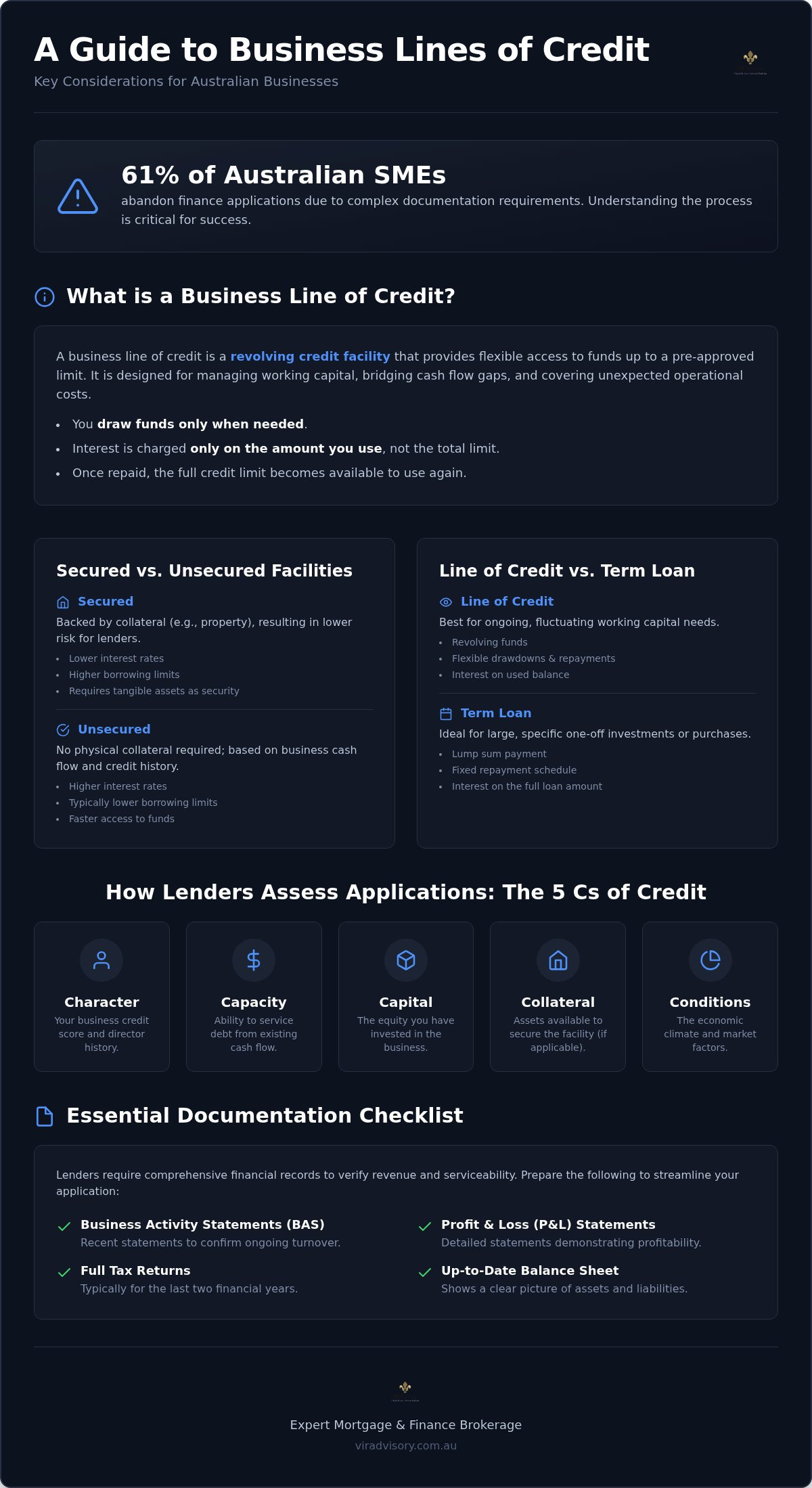
With 61% of Australian SMEs abandoning finance applications in 2026 due to documentation hurdles, it is clear that traditional lending processes often fail to meet the needs of fast-moving companies. To secure a business line of credit Australia, you must demonstrate strong serviceability and provide up-to-date financial records that satisfy both bank and non-bank risk assessments. This revolving facility allows you to draw funds as needed, paying interest only on the balance used, which is essential for managing working capital during seasonal gaps or growth phases.
You likely recognise that maintaining cash flow is difficult when dealing with market fluctuations or delayed debtor payments. This guide provides the technical insights needed to structure a facility that aligns with your operational cycles. We will examine current lender eligibility criteria, compare secured and unsecured interest rate structures, and outline a methodical process to improve your approval prospects. By the end of this article, you will have a clear framework for managing debt and accessing flexible funds to support your business objectives.
Key Takeaways
- Understand how a business line of credit Australia functions as a revolving facility, allowing you to draw funds for working capital and pay interest only on the balance utilised.
- Learn how lenders apply the "Five Cs" of credit to evaluate your application and which specific financial documents, such as BAS and P&L statements, are essential for approval.
- Compare the cost-efficiency of revolving credit against traditional term loans to determine which structure best supports your specific cash flow cycles and growth objectives.
- Discover practical strategies to clean up your balance sheet and address credit issues before submission to improve your borrowing capacity and secure favourable terms.
- Gain insights into navigating complex lender policies by leveraging professional debt structures and assessment criteria used by experienced finance specialists.
What is a Business Line of Credit in the Australian Market?
A business line of credit Australia provides flexible access to funds up to a pre-approved limit, where you only pay interest on the amount used. Unlike a traditional term loan that provides a lump sum, this revolving facility allows you to draw down, repay, and redraw capital as your operational needs change. It functions similarly to a credit card but typically offers higher limits tailored to commercial requirements. This Line of credit is a primary component of working capital management, helping you manage seasonal inventory builds or bridge the gap between paying suppliers and receiving debtor payments.
To better understand this concept, watch this helpful video:
Lenders assess these facilities based on your business's ability to service the debt from existing cash flow. Because the funds are available on demand, a line of credit provides a level of agility that fixed-term products cannot match. It's particularly effective for covering unexpected operational costs, such as equipment repairs or sudden increases in logistics expenses, without disrupting your primary capital reserves.
Revolving Credit vs. Traditional Overdrafts
A dedicated line of credit differs from a standard business overdraft in its structure and intended use. Overdrafts are usually attached to a transaction account to manage minor day-to-day fluctuations, whereas a business line of credit Australia is often a standalone facility designed for larger, more strategic funding needs. Limits are generally set based on a percentage of annual turnover. You'll encounter various fee structures, including establishment fees, ongoing service fees, and unused limit fees. These costs reflect the lender's commitment to holding capital in reserve for your exclusive use.
Secured vs. Unsecured Facilities
The choice between secured and unsecured facilities dictates your borrowing capacity and the interest rate applied. Secured lines of credit use collateral, such as residential or commercial property equity, to mitigate lender risk. This often results in more favourable interest rates and significantly higher credit limits. Unsecured facilities don't require physical assets but involve a more rigorous assessment of your business's credit history and cash flow. While unsecured options offer faster access to capital, they typically carry higher interest rates to compensate for the lack of security. With the Reserve Bank of Australia cash rate at 4.35% as of September 2026, the cost of borrowing remains a critical consideration for facility selection. You can review our various funding solutions on the services offered page to see which structure aligns with your current asset position.
How Australian Lenders Assess Line of Credit Applications
Lenders in the current market apply a methodical framework to evaluate risk, focusing on the "Five Cs" of credit: Character, Capacity, Capital, Collateral, and Conditions. Because 61% of SMEs abandoned loan applications in 2026 due to complex documentation, understanding these benchmarks is essential for a successful outcome. Character involves a review of your director history and business credit score, while Capacity measures your ability to service the debt from existing trading cash flow. Capital refers to your own equity in the business, Collateral identifies the assets available for security, and Conditions account for the broader economic environment, such as the current 4.35% RBA cash rate.
To secure a business line of credit Australia, you must provide comprehensive financial records. Most lenders require Business Activity Statements (BAS), Profit and Loss (P&L) statements, and full tax returns for the last two financial years. This documentation allows credit teams to verify that your revenue is consistent and that your business can sustain the interest costs associated with a revolving business line of credit facility.
Financial Ratios and Performance Benchmarks
Lenders prioritise the Debt Service Cover Ratio (DSCR) when assessing your application. This calculation compares your net operating income against your total debt obligations, including the proposed limit of the new facility. A DSCR above 1.25 is typically required to demonstrate a sufficient buffer. Additionally, liquidity ratios are examined to ensure your business maintains enough current assets to cover short-term liabilities. If your business experiences seasonal fluctuations, lenders will look for historical data that shows how you manage cash reserves during leaner months.
Lender-Specific Eligibility Criteria
Minimum time in trade is a standard requirement, with most major banks and non-bank lenders requiring at least 12 to 24 months of active trading history. Industry-specific risks also play a significant role in the approval process. For instance, businesses in sectors like construction or retail may face more stringent collateral requirements due to market volatility. A successful business line of credit Australia application often depends on matching your industry profile with the right lender's appetite. You can find detailed information on these requirements by reviewing the VIR Advisory faqs. If you need to evaluate your current borrowing capacity, you can schedule a consultation to discuss your specific financial position.
Line of Credit vs. Term Loans: Choosing the Right Solution
Selecting the appropriate finance structure requires a clear understanding of your capital requirements and repayment capacity. A term loan provides a single lump sum disbursement, which is ideal for specific, one-off investments. In contrast, a business line of credit Australia offers a revolving limit that you can access as needed. This distinction is fundamental to cost management; while a term loan charges interest on the full principal from the day of settlement, a line of credit only incurs interest on the funds you actually draw down. With the RBA cash rate currently at 4.35%, minimising interest expenses on unused capital is a significant advantage for businesses with fluctuating needs.
Repayment structures also differ considerably between these two products. Term loans typically require regular principal and interest (P&I) payments over a fixed period, which can create pressure on monthly cash flow. Many lines of credit allow for interest-only payments on the drawn balance, providing greater flexibility during months when revenue is lower. To compare business lines of credit against other debt instruments, you should evaluate the total cost of the facility, including commitment fees and establishment costs, against the operational benefits of having on-demand capital.
When a Line of Credit is Superior
A revolving facility is the most effective tool for managing "lumpy" cash flow or bridging the gap created by long debtor payment cycles. For example, if your business must pay suppliers for raw materials 60 days before receiving payment from customers, a line of credit provides the necessary liquidity without the need for a new loan application each time. It also serves as a critical safety net, allowing you to capitalise on urgent business opportunities, such as bulk stock discounts or sudden equipment acquisitions. You can explore how these facilities fit into a broader working capital finance strategy to ensure your business remains agile in a competitive market.
When a Term Loan Makes More Sense
Term loans are better suited for funding long-term assets with a defined lifespan, such as heavy machinery, commercial vehicles, or property. Because these assets generate revenue over several years, matching the loan term to the asset's useful life ensures that repayments are manageable and predictable. Fixed repayments also assist with long-term budgeting and financial forecasting, as the cost of debt remains constant throughout the term. If you are planning significant capital expenditures with a clear return on investment timeline, a structured term loan often provides the stability required for large-scale growth projects.
Strategies to Optimise Your Facility and Improve Approval
Securing a business line of credit Australia requires a methodical approach to financial presentation. Lenders often reject applications not because the business lacks profitability, but because the risk is poorly articulated or the documentation is incomplete. A successful application follows a precise sequence: reviewing your financials for accuracy, addressing any credit issues, structuring the request to match your actual turnover, and selecting the most appropriate lender for your industry. This methodical preparation ensures that your business is positioned as a stable and reliable borrower.
Cleaning up your balance sheet before applying is a practical lending strategy that improves your prospects. This involves reconciling director loans, ensuring all tax obligations are current, and reducing outstanding supplier payables where possible. A professional finance proposal acts as a bridge between your business and the lender's credit team. This document should demonstrate a clear understanding of your cash flow cycles and how the funds will be used to generate revenue. Common approval obstacles, such as existing tax debt or poor record-keeping, must be addressed proactively. Lenders are more likely to approve an application when they see a transparent plan for managing these specific risks.
Improving Your Borrowing Capacity
Lenders assess your total debt burden across all facilities, so reducing or consolidating high-interest debts can improve your serviceability. It is essential to understand how borrowing capacity is actually calculated in Australia, as your personal financial position often impacts business approvals. For instance, large personal credit card limits or substantial residential mortgages can reduce the amount a lender is willing to extend to your company. By consolidating minor facilities and aligning your personal and business debt structures, you create a more stable profile that satisfies strict lender eligibility criteria.
Risk Management for Revolving Credit
While a revolving facility offers significant flexibility, it can lead to a "perpetual debt" trap if the balance is never fully cleared. Success with this product depends on using it for short-term liquidity and ensuring the balance returns to zero once your business cycle completes. You must also monitor interest rate movements and participate in regular facility reviews. With the RBA cash rate at 4.35% as of September 2026, the cost of debt remains a primary consideration for any finance strategy. Ensuring your facility limit does not exceed manageable debt levels prevents your business from becoming over-leveraged during periods of persistent inflation or economic slowdown.
Securing Your Business Finance with VIR Advisory
VIR Advisory operates with a methodical approach to commercial finance, ensuring that every business line of credit Australia is structured to withstand changing market conditions. With Raina Doshi's 15+ years of banking and finance experience, we understand the internal assessment criteria that both major banks and non-bank lenders utilise to evaluate risk. This deep institutional knowledge allows us to anticipate potential approval obstacles and address them before submission. By accessing a broad network of lenders, we can identify facilities that offer the most favourable terms for your specific industry and asset position. You can explore our full range of finance services to see how we manage complex debt requirements for established companies.
The VIR Advisory Lending Process
Our process begins with a comprehensive assessment of your business goals and immediate cash flow requirements. We don't just look at a single transaction; we evaluate how a new facility fits into your broader financial strategy. Once we understand your operational cycles, we perform strategic matching to connect your needs with the most appropriate lender and structure. This stage is critical for ensuring that the repayment terms and interest rates align with your revenue patterns. We then manage the entire application process, from the initial submission through to final settlement, providing professional oversight at every step to ensure a smooth and frictionless experience.
Contact a Finance Specialist Today
Selecting the right business line of credit Australia requires more than just comparing interest rates; it requires a structure that supports long-term growth and manages risk effectively. Our focus is on providing education and clarity, ensuring you understand exactly how your finance facility operates and what your obligations are. We invite you to organise a consultation to discuss a personalised lending strategy that addresses your specific working capital needs. Our team is committed to delivering decisive, high-value input that allows you to manage your debt with complete confidence.
Structuring Your Business for Financial Resilience
Securing a business line of credit Australia requires a strategic understanding of how revolving debt interacts with your specific operational cycles. You must maintain a strong debt service cover ratio to demonstrate repayment capacity. Choosing between secured and unsecured facilities depends entirely on your asset position and liquidity needs. By addressing common approval obstacles like tax debt before submission, you improve your prospects for favourable outcomes with both bank and non-bank lenders.
VIR Advisory applies a methodical approach to debt structuring. We draw on over 15 years of banking experience to navigate complex lender policies. We specialise in matching your individual cash flow requirements with the most appropriate facility. Our focus remains on providing the technical clarity needed to manage working capital with precision. This allows you to focus on core business objectives with complete confidence.
Having a robust capital strategy in place ensures your business remains agile and prepared for future growth opportunities in a shifting economic landscape.
Frequently Asked Questions
What is the typical interest rate for a business line of credit in Australia?
Interest rates for a business line of credit Australia vary based on the security provided and the lender's risk assessment. With the RBA cash rate at 4.35% as of September 2026, secured facilities typically range from 6.8% to 9.5% per annum. Unsecured options often attract higher rates, generally between 9.5% and 18% per annum. These rates are indicative and subject to change based on your business's financial performance and credit history.
Do I need to provide a personal guarantee for a business line of credit?
Most lenders require a personal guarantee from company directors when establishing a revolving credit facility. This commitment provides the lender with additional security, ensuring that directors are personally responsible for the debt if the business cannot meet its obligations. While some non-bank lenders may offer facilities without property security, a personal guarantee remains a standard requirement across the Australian commercial lending market to mitigate the risk of default.
Can I get a business line of credit if I am self-employed?
Self-employed borrowers can secure a business line of credit Australia provided they meet specific documentation requirements. Lenders typically look for at least two years of active trading history, supported by full tax returns and Business Activity Statements (BAS). If you are self-employed, your personal credit history and the stability of your net profit are heavily scrutinised. Demonstrating a consistent ability to service debt from your business earnings is essential for a successful application.
How long does the approval process take for a revolving credit facility?
The approval timeframe depends on the lender type and the complexity of your financial structure. Non-bank lenders can often provide a conditional approval within 24 to 48 hours, provided all documentation is complete. Traditional banks generally follow a more methodical process, which may take between two and four weeks. Ensuring your financial records and BAS are up to date before submission significantly reduces the risk of delays during the credit assessment phase.
What happens if I don’t use the funds in my line of credit?
If you don't use the funds in your line of credit, you will not pay interest on the balance. However, most Australian lenders charge an ongoing facility or line fee to keep the credit limit available for your use. This fee is typically a small percentage of the total credit limit, charged monthly or annually. It is important to factor these commitment costs into your cash flow strategy when deciding on the appropriate facility limit for your business.
Is a business line of credit better than a business credit card?
A business line of credit is generally superior for larger funding requirements and strategic working capital management. Credit cards often carry higher interest rates and lower limits, making them better suited for small, daily expenses. A line of credit provides a more formal debt structure with lower rates for drawn funds, especially if secured by property. It is designed to bridge significant cash flow gaps rather than managing minor, transaction-level operational costs.
What are the common fees associated with Australian business lines of credit?
Common fees include establishment or application fees, which typically range from 0.5% to 2% of the total limit. You may also encounter ongoing facility fees, monthly service charges, and occasionally drawdown fees for each withdrawal. Some lenders also apply an unused limit fee on the portion of the credit that remains undrawn. Carefully reviewing the fee schedule is vital to ensure the facility remains a cost-effective component of your overall finance strategy.
Can I use a line of credit to fund a commercial property purchase?
A line of credit is typically intended for working capital and short-term liquidity rather than long-term asset acquisition. For a commercial property purchase, a structured commercial property loan or term loan is generally more appropriate. Using a line of credit for property can be risky due to higher interest rates and the revolving nature of the debt. However, some businesses use an existing line of credit to fund the deposit or cover initial settlement costs.

Article by
Raina Doshi
Raina Doshi has worked in banking and finance since 2011, including experience with major Australian lenders. She helps homeowners, property investors, business owners and professionals secure and structure lending solutions across home loans, refinancing, commercial finance and business lending.
Areas of expertise include residential lending, investment property finance, debt recycling, commercial property finance, equipment finance, construction finance and strategic debt structuring.
Drawing on extensive banking and finance experience, Raina helps clients navigate lender requirements, improve borrowing outcomes and structure effective finance solutions.
Disclaimer
The information in this article is general in nature and does not take into account your personal objectives, financial situation or needs. Before acting on any information, consider whether it is appropriate to your circumstances and seek professional advice.


