

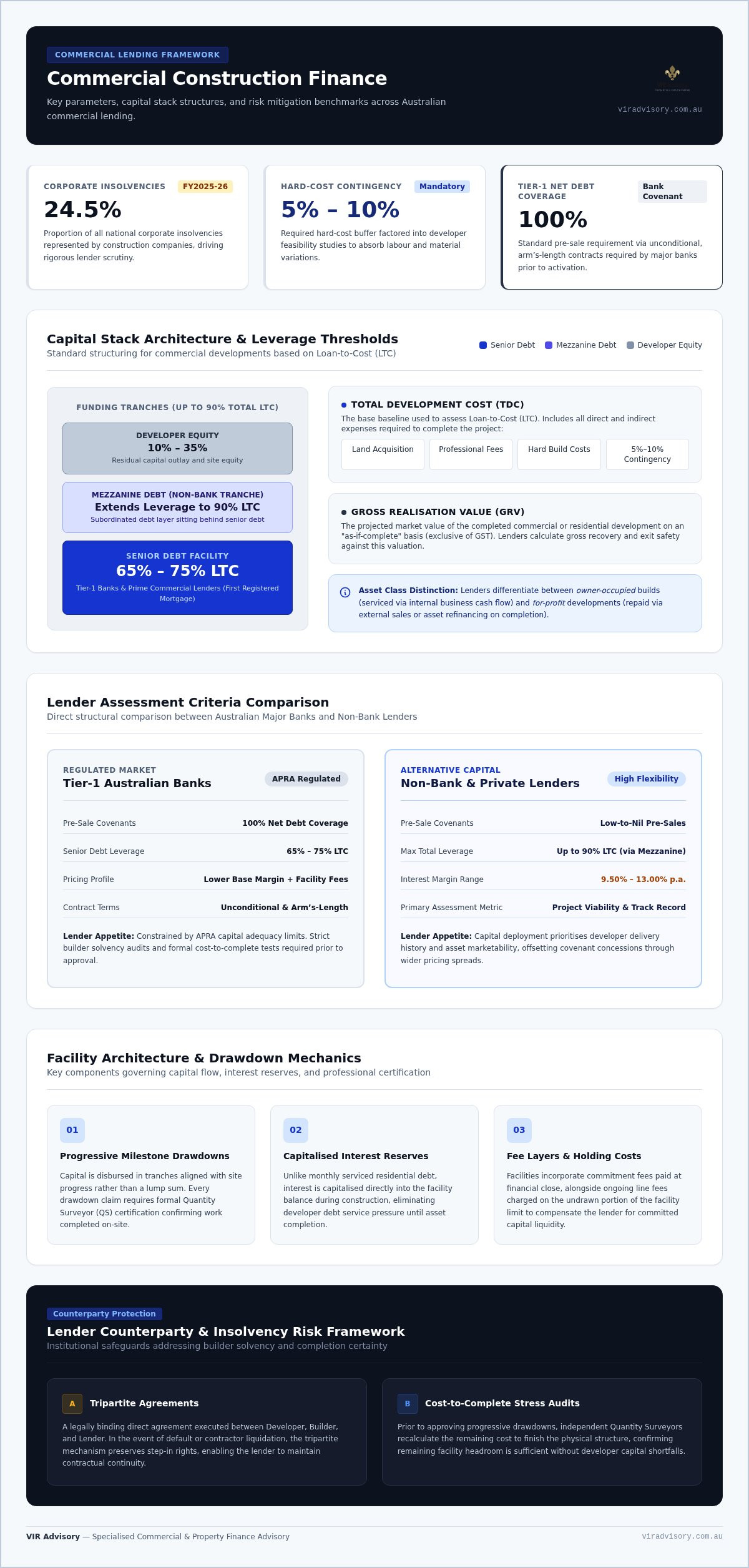
With construction companies accounting for 24.5% of all national corporate insolvencies in FY2025-26, Australian lenders have never been more meticulous in their credit assessments. Many projects don't fail because they're unprofitable. They fail because the funding isn't structured correctly from the start. To maximise leverage, developers typically target a Loan-to-Cost (LTC) ratio of 65% to 75% for senior debt, though non-bank lenders can extend this to 90% through mezzanine tranches. Success hinges on presenting a feasibility study that accounts for 5% to 10% hard-cost contingency and clear Quantity Surveyor certification processes.
It's clear that major banks are increasingly rigid with 100% net debt coverage pre-sale requirements, which can often stall project momentum. This article provides the technical insights needed to navigate these lending hurdles, from structuring the capital stack to mitigating counterparty risks. We'll examine current lender assessment criteria, risk management frameworks, and strategies to secure high LVR funding with absolute certainty of capital for the duration of the build.
Key Takeaways
- Understand how commercial construction finance operates through progressive drawdowns and specific project milestones to maintain liquidity throughout the build.
- Learn the critical distinction between Loan-to-Cost (LTC) and Gross Realisation Value (GRV) to accurately calculate your borrowing capacity and equity requirements.
- Discover how to structure a capital stack using senior and mezzanine debt to maximise leverage while managing strict lender pre-sale conditions.
- Identify common risks such as builder insolvency and soft-cost underestimation, and learn how tripartite agreements provide a layer of security for your funding.
- Gain practical insights into navigating both bank and non-bank lender requirements to ensure certainty of funding and efficient drawdown processes.
What is Commercial Construction Finance in the Australian Market?
Commercial construction finance is a specialised loan facility used to fund the development of non-residential buildings, such as industrial warehouses and office complexes, or large-scale residential projects like apartment towers. Unlike standard commercial property loans used to purchase existing assets, these facilities provide the necessary working capital to manage the entire build phase from site acquisition to completion. Fundamentally, commercial construction finance is a risk-weighted facility where the lender's exposure is assessed against the project's future value and the developer's ability to execute the build within budget.
Lenders in Australia distinguish between "owner-occupied" commercial builds, where a business constructs a facility for its own operations, and "for-profit" developments intended for sale or lease upon completion. This distinction dictates the lender's exit strategy and assessment of serviceability. Unlike standard mortgages, these loans are typically progressive, with funds released in stages (drawdowns) as construction milestones are met. Verified by a Quantity Surveyor, these drawdowns ensure that the loan balance remains aligned with the value of the physical works on-site.
Key Differences: Residential vs. Commercial Construction Lending
Lending criteria for commercial projects focus heavily on the project’s viability and the developer’s track record with specific asset classes. While residential loans often require monthly interest payments, commercial construction interest is usually capitalised. This means the interest is added to the loan balance during the build, so you don't need to make repayments until the project is finished. However, these facilities often involve higher fees, including line fees for the undrawn portion of the loan and commitment fees paid at the start. For those exploring specific construction finance structures, understanding these cost layers is essential for accurate feasibility modelling.
The Role of the Australian Prudential Regulation Authority (APRA)
APRA regulations heavily influence the lending appetite of major Australian banks by setting strict capital adequacy requirements. These rules often limit the amount of high-leverage construction debt a Tier-1 bank can hold on its balance sheet. Consequently, many developers seeking higher leverage or more flexible pre-sale conditions have shifted toward the non-bank lending market. Current 2026 regulatory trends show a continued focus on builder solvency and cost-to-complete tests. Lenders now maintain a conservative buffer against market volatility and rising labour costs, requiring more robust financial reporting from both the developer and the head contractor before approving senior debt facilities.
Lender Assessment Criteria: How Your Project is Evaluated
Securing commercial construction finance requires a transparent breakdown of the project's capital stack. This stack represents the various layers of funding, starting with the developer's equity, followed by senior debt, and potentially subordinate or mezzanine debt. Lenders evaluate these layers to determine the level of risk they are assuming relative to the project's completion. For most Tier-1 Australian banks, the primary hurdle remains the pre-sale or pre-lease requirement. These institutions typically mandate 100% net debt coverage through unconditional, arm’s-length pre-sales before a facility is activated. While non-bank lenders offer more flexibility with low-to-nil pre-sale covenants, they often offset this risk with higher interest margins ranging from 9.50% to 13.00% p.a.
Understanding GRV and TDC Metrics
Lenders use two primary metrics to determine your borrowing capacity: Total Development Cost (TDC) and Gross Realisation Value (GRV). The TDC includes land acquisition, professional fees, hard construction costs, and a mandatory contingency sum. Most Australian lenders require a 5% to 10% hard-cost contingency to be built into the feasibility budget. The GRV is the estimated market value of the project upon completion, excluding GST. Senior debt is generally capped at 65% to 75% of the TDC or 60% to 70% of the Net GRV. A higher GRV is particularly beneficial because it can reduce the developer’s required equity contribution by allowing for higher leverage against the end value of the asset.
The Importance of Developer Experience and Builder Track Record
Credit committees examine the track record of the development team as closely as the financial metrics. You must provide a comprehensive CV detailing past successful projects of a similar scale and asset class. With construction firms representing 24.5% of all national corporate insolvencies in FY2025-26, the vetting process for builders is rigorous. Lenders perform deep-dive solvency checks, requiring audited financials, insurance certificates, and current work-in-progress (WIP) ledgers. To mitigate cost overrun risks, lenders mandate "Fixed Price" Design and Construct (D&C) contracts. They also require an independent Quantity Surveyor (QS) to provide cost-to-complete reports before every drawdown, ensuring that the remaining funds in the facility are always sufficient to finish the build.
If you're looking to optimise your project's funding structure, you can book a technical strategy session to review your capital stack and lender requirements.
Structuring the Capital Stack: Funding Options and Risk
Structuring the capital stack effectively is the difference between a project that stalls and one that achieves its targeted Internal Rate of Return (IRR). In the Australian market, senior debt remains the primary layer of funding for commercial construction finance, offering the lowest cost of capital with rates currently ranging from 6.95% to 8.50% p.a. for Tier-1 bank facilities. However, these facilities come with the most stringent conditions, particularly regarding qualifying presales and developer equity. To manage these constraints, developers often introduce additional layers of capital to optimise their liquidity and project capacity.
Senior Debt vs. Mezzanine Finance
Mezzanine finance acts as a bridge, sitting between the developer’s equity and the senior loan to increase overall leverage. While senior debt typically caps at 65% to 75% of the Total Development Cost (TDC), mezzanine tranches can push the total funding to 80% or 90% LTC. This allows developers to preserve cash flow for other projects or manage multiple sites simultaneously. It's vital to recognise that mezzanine debt is subordinated, meaning the provider only receives payment after the senior lender is satisfied. Because of this increased risk, interest rates for these tranches often exceed 12.00% p.a. and typically involve a second mortgage. Many senior lenders require a deed of priority to strictly control the rights of the mezzanine provider, which can complicate the approval process if not managed with professional oversight.
Private Lending and Non-Bank Funding Solutions
Non-bank lenders have become a cornerstone of the commercial construction finance market, especially for mid-tier developers who find major bank presale targets unachievable. These lenders often provide "nil to low presale" facilities, allowing construction to commence months earlier than a bank-funded project. While this speed is advantageous, the trade-off is higher pricing, with all-in rates often sitting between 7.50% and 12.00%. For developers intending to hold the asset upon completion, transitioning to long-term commercial property finance is a common exit strategy. Private lending options offer even greater flexibility but carry risks such as shorter facility horizons, often limited to 12 to 24 months, and significantly higher default fees. Balancing these costs against the project's IRR is essential to ensure the debt structure doesn't erode the development's profitability.
Common Pitfalls in Construction Finance and How to Avoid Them
In the current 2026 economic environment, underestimating soft costs or failing to account for interest rate variance can quickly erode a project's viability. If the RBA adjusts the cash rate during your 18-month build, the capitalised interest reserve within your commercial construction finance facility may prove insufficient. This creates an immediate funding gap that developers must fill with additional equity. Accurate valuations are also a moving target. If your end-value projections don't reflect current metropolitan vacancy rates or industrial yields, you risk a valuation shortfall before the first sod is turned.
The Tripartite Agreement and Builder Risk
A tripartite agreement is a non-negotiable requirement for most commercial lenders. This contract between the lender, the developer, and the builder grants the lender "step-in rights" if the developer defaults, ensuring the project can reach completion. To avoid approval delays, ensure your builder’s insurance and bank guarantees are vetted by your broker well before the facility is documented. Lenders strictly avoid "cost-plus" contracts because they offer no protection against rising material prices. Instead, you should secure a Fixed Price Design and Construct (D&C) contract to satisfy lender risk committees.
Managing Borrowing Capacity and Equity Gaps
Many developers find that their borrowing capacity is lower than expected when a Quantity Surveyor (QS) report identifies higher costs than the initial budget. This often results in an equity gap. To mitigate this, you can look at portfolio cross-collateralisation, using equity in existing assets to support the new build. A realistic contingency buffer is essential for maintaining momentum. While lenders mandate 5% to 10%, experienced developers often model a 10% to 15% buffer for complex sites. This ensures that commercial construction finance drawdowns remain fluid even if unexpected ground conditions or supply chain issues arise during the build.
Securing Your Funding Strategy with VIR Advisory
Navigating the debt markets requires more than just a project feasibility; it demands a technical understanding of how credit committees perceive risk. VIR Advisory brings over 15 years of banking and finance experience, including more than a decade within a leading Australian bank, to the structuring of commercial construction finance. This inside perspective allows us to anticipate lender objections before they arise, ensuring that your capital stack is robust and your builder due diligence is beyond reproach. We prioritise a methodical approach that replaces the stress of uncertainty with a managed, professional oversight of the entire funding process.
The VIR Advisory Commercial Finance Process
Our engagement begins with a rigorous feasibility review and debt capacity assessment to ensure your project is positioned for the most competitive terms available. We don't just facilitate a loan; we manage the narrative of the application to align with the specific assessment criteria of both major banks and non-bank lenders. This involves:
- Lender Selection and Negotiation: Identifying the right tranches of debt, whether senior or mezzanine, and negotiating terms that protect your project's internal rate of return.
- Management of Professional Reports: Coordinating with valuers and Quantity Surveyors to ensure their reports accurately reflect the project’s Gross Realisation Value and Total Development Cost.
- Drawdown Oversight: Providing ongoing support during the construction phase to ensure the progressive drawdown process remains efficient and project momentum is maintained.
By identifying and mitigating risks such as builder solvency or interest rate fluctuations before the application is submitted, we improve the likelihood of a seamless approval. This level of precision is essential in the 2026 lending environment, where capital adequacy rules and strict pre-sale covenants can otherwise stall even the most promising developments.
Book a Strategic Consultation
Direct access to expert advice is critical when structuring complex commercial construction finance. Whether you're looking to secure funding for a new industrial build, an apartment development, or you're seeking to review your current debt structure for refinancing opportunities, a technical assessment can identify significant efficiencies. VIR Advisory provides the intellectual weight of a top-tier consultancy with the local, approachable service of a specialised brokerage. We're committed to ensuring that every detail of your project's finance strategy is handled with professional precision.
Optimising Your Capital Structure for Project Success
Successfully navigating commercial construction finance requires a methodical approach to risk and capital allocation. The difference between a stalled project and a successful settlement often lies in the precision of your feasibility study and the strength of your builder due diligence. By accurately calculating your Gross Realisation Value and maintaining robust contingency buffers, you can insulate your development against the inherent volatility of the 2026 lending landscape.
VIR Advisory provides the strategic guidance necessary to bridge equity gaps and negotiate favourable terms across both major bank and non-bank sectors. With over 15 years of banking and finance experience, Raina Doshi offers an insider’s perspective on lender assessment criteria, ensuring your project is positioned for approval before the first drawdown. We handle the complexities of the capital stack so you can focus on the physical build with absolute confidence.
Frequently Asked Questions
What are the typical pre-sale requirements for commercial construction finance?
Tier-1 banks typically mandate 100% net debt coverage through unconditional, arm’s-length pre-sales. This means the total value of exchanged contracts, excluding GST, must equal or exceed the senior debt facility. For commercial assets, lenders often accept pre-lease agreements from reputable tenants instead. These requirements act as a primary risk mitigation tool, providing the lender with a guaranteed exit strategy before the first progressive drawdown occurs on the project.
How much equity do I need to provide for a commercial development loan?
You generally need to contribute between 20% and 35% of the total project costs as upfront equity. Lenders follow an "equity-first" rule, requiring your capital to be fully utilised before any commercial construction finance funds are drawn. While senior debt typically caps at 65% to 75% of the Total Development Cost (TDC), mezzanine structures can reduce your required cash contribution by providing a secondary layer of subordinated debt at a higher interest margin.
Can I use the equity in my existing property as a deposit for construction?
Yes, you can utilise the equity in existing commercial or residential assets to satisfy the deposit requirements through cross-collateralisation. Lenders will register a mortgage over these properties to secure the equity gap, effectively reducing the need for liquid cash. This strategy is particularly effective for established developers with a portfolio of completed assets. It does increase your total exposure, so a clear valuation of all security properties is essential before loan documentation begins.
What is a Quantity Surveyor (QS) report and why is it mandatory?
A Quantity Surveyor (QS) report is a mandatory independent assessment that verifies the project’s construction budget and physical progress. Initially, the QS provides a cost-to-complete report to confirm the feasibility is realistic. Throughout the build, they conduct site inspections to certify that the work claimed in a progress claim has been completed. Lenders rely on these certifications to ensure the remaining loan balance is always sufficient to finish the building works.
What happens if construction costs exceed the original loan amount?
If construction costs exceed the original facility limit, the developer is responsible for funding the shortfall immediately. Lenders enforce a cost-to-complete test, meaning they won't release further drawdowns if the remaining loan funds are less than the remaining build costs. This is why a 5% to 10% hard-cost contingency is mandated in the initial budget. Failure to cover overruns can lead to a default, triggering the lender's step-in rights under the tripartite agreement.
Is it possible to secure construction finance with no pre-sales?
Securing commercial construction finance with no pre-sales is possible through non-bank and private lenders. These institutions offset the higher risk by charging increased interest rates, often between 9.50% and 13.00% p.a., and requiring a lower Loan-to-Value Ratio (LVR). This nil-presale approach is common for mid-market developers who wish to commence site works immediately without waiting for a lengthy marketing campaign to reach qualifying debt coverage targets.
How do interest rates for commercial construction differ from residential loans?
Commercial construction rates are significantly higher than residential mortgages because they reflect the elevated risk of development. While residential owner-occupier rates might sit closer to the RBA cash rate, senior commercial construction debt currently ranges from 6.95% to 8.50% p.a. for Tier-1 banks. Private or mezzanine tranches can exceed 12.00% p.a. These rates also include additional fees, such as line fees on the undrawn balance, which aren't found in standard residential lending.
What is interest capitalisation and how does it work during a build?
Interest capitalisation is a structure where monthly interest charges are added to the loan balance rather than paid out-of-pocket by the borrower. This is standard for commercial builds because the project doesn't generate income during construction. The lender includes an interest reserve within the total facility limit to cover these costs. If the build is delayed or rates rise, this reserve can be exhausted, requiring the developer to contribute additional capital to maintain the facility.

Article by
Raina Doshi
Raina Doshi has worked in banking and finance since 2011, including experience with major Australian lenders. She helps homeowners, property investors, business owners and professionals secure and structure lending solutions across home loans, refinancing, commercial finance and business lending.
Areas of expertise include residential lending, investment property finance, debt recycling, commercial property finance, equipment finance, construction finance and strategic debt structuring.
Drawing on extensive banking and finance experience, Raina helps clients navigate lender requirements, improve borrowing outcomes and structure effective finance solutions.
Disclaimer
The information in this article is general in nature and does not take into account your personal objectives, financial situation or needs. Before acting on any information, consider whether it is appropriate to your circumstances and seek professional advice.


