

The most critical difference between a chattel mortgage vs hire purchase Australia wide isn't just the name on the registration, it's how the structure influences your long term borrowing capacity and tax position. While both options now allow GST-registered businesses to claim the full input tax credit upfront, the timing of legal ownership and the way the debt appears on your balance sheet can vary significantly. You likely want to maximise your immediate tax deductions while ensuring your business debt doesn't hinder a future home loan application.
This guide provides a methodical comparison of these two popular asset finance structures to help you identify the most cost-effective solution for your business. We'll clarify the current 2026-27 ATO car depreciation limits, which are set at $69,883, and explain how lenders assess your eligibility in a high-rate environment. By the end of this article, you'll have a clear framework for managing your cash flow and a deep understanding of the specific requirements banks use to approve equipment finance. We'll examine the nuances of ownership, interest rate variations, and the practical steps to ensure your finance strategy supports your broader financial stability.
Key Takeaways
- Understand the core distinction between immediate ownership and hiring to ensure your asset finance aligns with your company's balance sheet requirements.
- Identify how to leverage the 2026-27 car depreciation limit and upfront GST credits to improve immediate business cash flow.
- Evaluate the specific cost-effectiveness of a chattel mortgage vs hire purchase Australia wide, focusing on interest rate variations and balloon payment structures.
- Recognise how business equipment debt influences your personal borrowing capacity and future eligibility for home loans or refinancing solutions.
- Prepare for lender scrutiny by understanding the current 2026 approval requirements and documentation needed for competitive funding solutions.
Chattel Mortgage vs Hire Purchase: The Direct Comparison
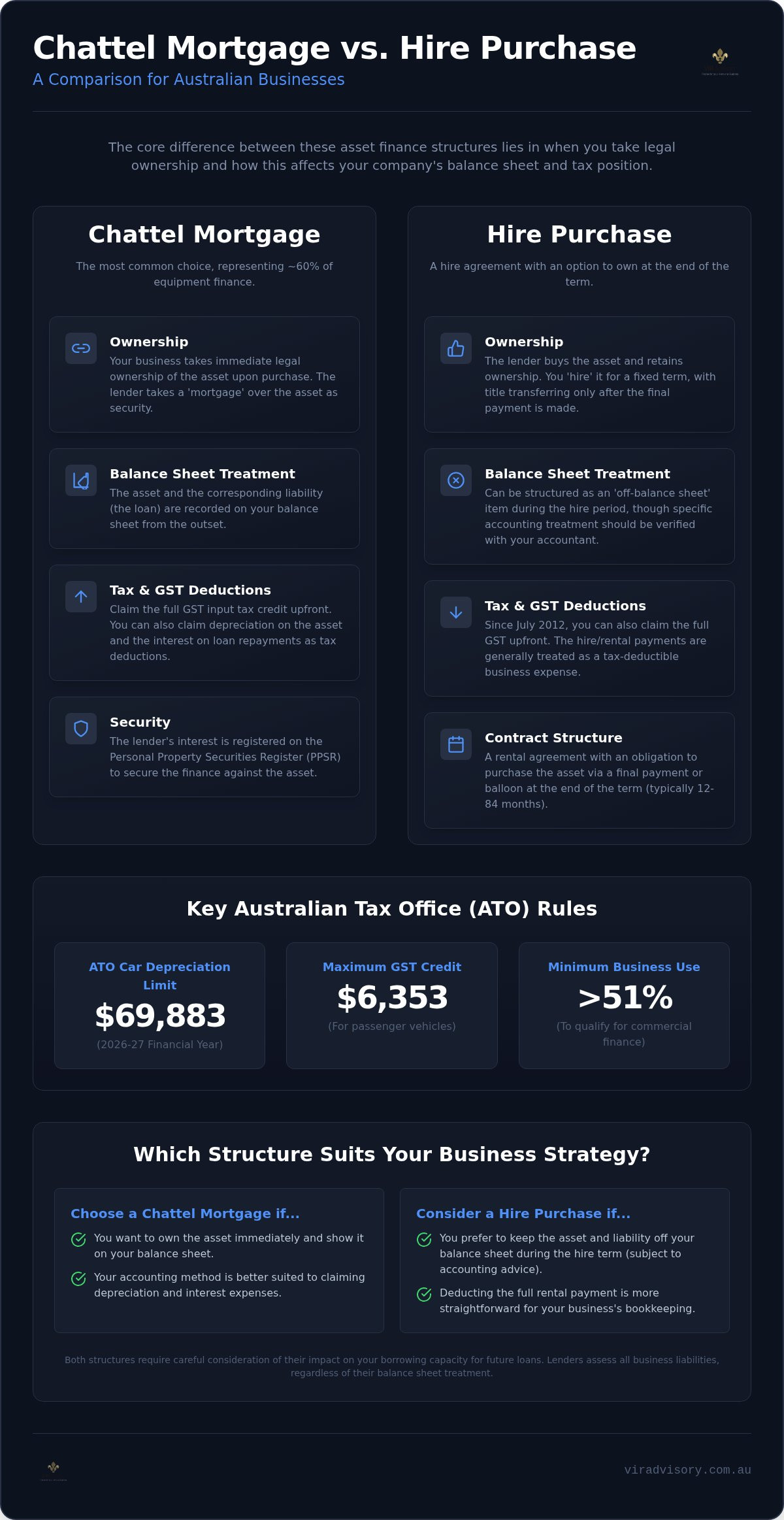
Choosing between a chattel mortgage vs hire purchase Australia wide requires a clear understanding of who holds the legal title during the finance term. A chattel mortgage allows your business to take ownership at the point of settlement, whereas a hire purchase agreement keeps the asset in the lender's name until you've made the final payment. Both structures necessitate that the asset is used for at least 51% business purposes to qualify for commercial lending rates and the associated tax benefits. This distinction in ownership timing influences how the asset is recorded in your financial statements and how you manage your monthly cash flow.
To better understand how these two structures function in a practical business environment, please refer to the following overview:
Defining the Chattel Mortgage Structure
A Chattel Mortgage functions similarly to a traditional secured loan where the asset serves as the security, or the "chattel", for the debt. This is currently the most popular choice for Australian SMEs, representing approximately 60% of equipment finance deals according to AFIA data. The lender registers their security interest on the Personal Property Securities Register (PPSR) to protect their position. In the March quarter of 2026, the Australian Financial Security Authority reported over 3.3 million searches on the PPSR, highlighting the critical role this register plays in Australian finance. One significant advantage is the ability to finance 100% of the purchase price, including the GST component, which helps you preserve working capital for other operational needs.
Understanding Commercial Hire Purchase (CHP)
Under a Commercial Hire Purchase (CHP) arrangement, the lender buys the asset, such as a heavy vehicle or specialised medical equipment, and hires it back to you for a set period. You don't own the asset immediately. Instead, legal title only transfers to your business once you've paid the final instalment or the pre-agreed balloon payment. These contracts typically offer flexible terms ranging from 12 to 84 months. While CHP was once the primary choice for businesses on a cash accounting basis, legislative changes have aligned its GST treatment more closely with other finance products. This means your decision often rests on whether you prefer the asset to remain off the balance sheet until the contract concludes, though you should always verify the specific impacts with your accountant.
When evaluating a chattel mortgage vs hire purchase Australia, the choice ultimately depends on your specific balance sheet requirements and how you wish to manage the debt over the long term. Both options provide a structured way to acquire essential assets while maintaining the liquidity needed to manage your business effectively.
Tax and GST Implications for Australian Businesses
The financial effectiveness of a chattel mortgage vs hire purchase Australia wide is largely determined by how your business manages its Goods and Services Tax (GST) obligations and income tax deductions. A common point of confusion stems from outdated information regarding hire purchase agreements. Since July 2012, the Australian Taxation Office (ATO) has allowed businesses to claim the full GST input tax credit upfront for both finance types, provided the business is registered for GST. This alignment means the choice between the two no longer hinges solely on GST timing, but rather on your specific accounting method and balance sheet structure.
GST Treatment and Input Tax Credits
When you acquire a business asset, you can generally claim the GST component on your next Business Activity Statement (BAS). For the 2026-27 financial year, the maximum GST credit you can claim for a passenger vehicle purchase is capped at $6,353, which represents one-eleventh of the car limit. If your business operates on a cash basis, a chattel mortgage provides a significant cash flow advantage because you can claim the entire GST amount in the first tax period after purchase, even if you haven't yet paid for the asset in full. This differs from other lease structures where GST is typically charged on each monthly repayment. For businesses using accrual accounting, the GST treatment is similar across both products, allowing for an immediate credit. If you're unsure how these limits apply to your specific equipment needs, you can book a strategy session to review your current tax position.
Depreciation and Interest Deductions
Both chattel mortgages and hire purchase agreements allow you to claim the interest component of your repayments and the asset's depreciation as tax deductions. For the 2026-27 financial year, the ATO has set the car limit for depreciation at $69,883. Assets exceeding this value are subject to specific depreciation caps, though heavy vehicles and specialised machinery often fall outside these passenger car restrictions. You can choose between the diminishing value method, which front-loads your deductions, or the prime cost method for a more even distribution over the asset's effective life. In 2026, lenders are increasingly focused on how these deductions impact your net profit and debt serviceability ratios. While the interest rate on a chattel mortgage may be lower due to the security structure, the total tax benefit should be calculated based on your company's marginal tax rate and the expected usage of the asset. This methodical approach ensures your finance structure supports long term fiscal health rather than just immediate tax relief.
Ownership, Security, and Balloon Payments
The structural choice between a chattel mortgage vs hire purchase Australia wide dictates how an asset is treated in your company’s financial reporting and who holds legal title during the finance term. With a chattel mortgage, the business takes ownership immediately, recording both the asset and the liability on the balance sheet from day one. Conversely, under a hire purchase, the financier retains ownership, and the asset typically doesn't transfer to your balance sheet until the final payment is made. This distinction is vital for businesses managing specific debt-to-equity ratios or those looking to build equity in their equipment quickly.
The Role of Balloon Payments in Cash Flow
A balloon payment, also known as a residual, is a lump sum due at the end of the finance term. By deferring a portion of the principal, you significantly reduce your monthly repayment obligations, which can be a methodical way to preserve working capital. However, this structure increases the total interest paid over the life of the loan because you're paying interest on a larger principal for longer. For a five-year term, the ATO often uses a minimum residual benchmark of 28.13%. It's essential to structure this balloon to align with the expected resale value of the asset. If the market value of a vehicle drops to $20,000 while your balloon is $25,000, you face a "negative equity" scenario. In such cases, many businesses choose to refinance the balloon into a new term, though this requires a fresh assessment of your current cash flow and lender serviceability requirements.
Security and the PPSR
Lenders protect their interests in these transactions by registering a security interest on the Personal Property Securities Register (PPSR). This registration acts as a public notice that the asset is encumbered. In 2026, the Australian Financial Security Authority introduced multi-factor authentication for all PPSR accounts to enhance security against unauthorised changes. When evaluating a chattel mortgage vs hire purchase Australia, understand that the lender's "charge" over the asset remains until the debt is fully extinguished. Maintaining a clear title is critical if you plan to sell or upgrade equipment before the term ends. Common obstacles often arise during business restructures or when a PPSR registration isn't correctly discharged after a loan is paid out, which can delay future funding solutions or commercial property finance applications. Lenders also scrutinise the "quality" of the security. Highly specialised machinery may attract higher interest rates, ranging from 7.49% to over 20% p.a., compared to standard passenger vehicles, as lenders assess the risk of recovering funds if the asset needs to be liquidated.
- Chattel Mortgage: Borrower owns the asset; lender takes a mortgage.
- Hire Purchase: Lender owns the asset; borrower hires it with an option to buy.
- Residual Risk: Ensure the balloon payment doesn't exceed the future market value.
- PPSR Integrity: Outdated registrations must be removed to maintain clean credit files.
Managing these ownership and security nuances requires a methodical approach to your total debt profile. By aligning your balloon payments with your asset replacement cycle, you ensure that your equipment finance supports, rather than hinders, your business's long term fiscal stability.
Lender Requirements and Borrowing Capacity
Lenders evaluate applications for a chattel mortgage vs hire purchase Australia wide by looking beyond the asset itself to the underlying health of the borrowing entity. While the equipment serves as security, your ability to meet monthly repayments is the primary focus of any credit assessment. In the current 2026 lending environment, banks have tightened their scrutiny of bank statements to identify consistent cash flow and any undisclosed liabilities. They don't just want to see profit; they want to see the liquidity required to service the debt alongside existing operational costs and tax obligations.
The Lender Assessment Process
The path to approval typically follows a methodical three step verification process designed to manage lender risk. First, financiers verify your ABN and GST status, generally requiring a minimum of two years of active trading to qualify for competitive commercial rates. Second, they conduct a deep analysis of your profit and loss statements or recent BAS to determine your debt serviceability coverage ratio (DSCR). Finally, the lender performs an asset valuation to ensure the loan to value ratio (LVR) remains within acceptable limits, often requiring a declaration that the asset will be used for at least 51% business purposes. Since the new AML/CTF regime commenced on 1 July 2026, you should also expect more rigorous identity and beneficial ownership checks during this initial phase.
Impact on Residential Lending
A common mistake among business owners is failing to recognise how business asset finance affects their personal borrowing capacity. When you apply for a home loan or look to refinance, residential lenders include your business car loan repayments as a personal liability unless you can demonstrate the business is fully servicing the debt independently. This can lead to a substantial reduction in the amount you can borrow for a home. Understanding how borrowing capacity is actually calculated in Australia is essential before committing to a large equipment purchase. We often see scenarios where a $70,000 chattel mortgage reduces a director's personal home loan capacity by over $150,000 because of how serviceability calculators weigh commercial debt. Structuring your debt correctly from the start is the only way to protect your ability to grow a property portfolio while expanding your business fleet.
Approval obstacles frequently include tax debt or inconsistent trading figures that don't match your reported profit. If you have a clean credit history and strong financials, a full-doc application will generally secure the lowest interest rates, which currently start from 7.49% p.a. for Tier 1 borrowers. For those with more complex structures or shorter trading histories, low-doc pathways may be available, though these often come with lower lending limits and higher risk margins. Professional oversight ensures you choose the pathway that aligns with your long term fiscal stability.
Strategic Asset Finance Selection with VIR Advisory
Selecting the optimal structure between a chattel mortgage vs hire purchase Australia wide is a decision that extends far beyond the immediate acquisition of an asset. VIR Advisory provides methodical finance structuring rooted in over 15 years of banking and finance experience, ensuring your equipment loans align with your broader fiscal objectives. We recognise that an isolated view of debt can lead to serviceability constraints elsewhere. Therefore, we assess your entire debt profile, including commercial property finance and residential mortgages, to prevent your business assets from hindering your future borrowing capacity.
The VIR Advisory Approach to Commercial Finance
Our methodology focuses on an educator-led brokerage model where we prioritise transparency and lender requirements. We analyse the specific trade-offs between a chattel mortgage and hire purchase based on your industry's unique cash flow cycles. For example, a medical professional might prioritise the immediate ownership and GST benefits of a chattel mortgage, while a construction firm might require the specific balance sheet treatment offered by a hire purchase. We coordinate directly with your tax professionals to ensure the chosen loan structure meets your accounting needs and maximises available deductions. By managing the application process from initial assessment through to final settlement, we provide a seamless experience that allows you to focus on daily operations. Our access to a broad network of over 40 lenders ensures we can secure funding solutions that support both business growth and long term liquidity.
Next Steps for Your Business Finance
Securing the right finance requires a proactive approach to your current and future asset needs. We recommend reviewing your existing equipment and vehicle fleet to identify refinancing opportunities that could improve your monthly cash flow or consolidate high-interest debt. Preparing your documentation in advance, including updated bank statements and recent BAS filings, is the most effective way to ensure a streamlined approval process. In a high-interest environment, the difference between a Tier 1 lender and a sub-prime provider can represent thousands of dollars in interest costs over a five-year term. Contacting an experienced finance specialist allows you to navigate these variables with professional oversight and precision.
- Comprehensive Review: We analyse how new equipment debt interacts with your existing commercial property or home loans.
- Strategic Alignment: We ensure your finance term and balloon payments match the effective life and resale value of the asset.
- Lender Selection: We match your credit profile with the lender most likely to provide a rapid approval and competitive terms.
- Ongoing Management: We provide guidance on managing PPSR registrations and future refinancing requirements.
Your business assets should function as tools for expansion rather than anchors on your balance sheet. By applying a methodical lending strategy, you can acquire the technology and transport your business requires while maintaining the financial flexibility to pursue new opportunities as they arise.
Submit a finance enquiry with VIR Advisory
Optimising Your Asset Finance Strategy for 2026
Deciding on a chattel mortgage vs hire purchase Australia wide requires more than a simple comparison of interest rates. It's about aligning your asset acquisition with your broader debt strategy and tax requirements. You now understand how immediate ownership under a chattel mortgage differs from the hiring structure of a hire purchase, and how each influences your balance sheet. Correctly managing 2026-27 depreciation limits and PPSR registrations ensures your business remains compliant while protecting your future borrowing capacity for home loans or commercial property.
VIR Advisory utilises over 15 years of banking and finance experience to help you navigate these complex lending environments. Our national brokerage service provides the methodical oversight needed to ensure your equipment finance supports your total financial profile. We prioritise lender requirements and serviceability to ensure your application has the strongest possible prospect of approval.
We look forward to helping you secure a funding solution that provides immediate cash flow benefits and supports your long term fiscal stability.
Frequently Asked Questions
Which is better for a small business: chattel mortgage or hire purchase?
The choice between a chattel mortgage vs hire purchase Australia wide depends on your specific balance sheet requirements and cash flow management. A chattel mortgage is often preferred by SMEs because you own the asset immediately and can typically claim the full GST upfront. Hire purchase may suit businesses that prefer the financier to retain ownership until the final payment. Both options require the asset to be used at least 51% for business purposes.
Can I claim the GST upfront with a chattel mortgage?
Yes, businesses registered for GST on a cash basis can generally claim the entire GST component of the purchase price on their next Business Activity Statement. This is a significant cash flow benefit as you receive the credit before you have fully paid for the asset. For the 2026-27 financial year, the maximum GST credit for passenger vehicles is $6,353. Always verify your specific eligibility with a tax professional before proceeding.
Do I need to be GST registered to get a chattel mortgage?
You don't strictly need to be GST registered to apply for a chattel mortgage, but you must have an active ABN. However, without GST registration, you cannot claim back the GST included in the asset's purchase price. Lenders typically require the asset to be used predominantly for business purposes. Being GST registered often improves your approval prospects as it demonstrates a level of business maturity and consistent trading to the financier.
How does a balloon payment work in asset finance?
A balloon payment is a predetermined lump sum due at the end of your finance term. By deferring part of the principal, you reduce your monthly repayment amounts, which helps maintain business liquidity. For a five year term, the ATO minimum residual benchmark is often 28.13%. While this assists with monthly cash flow, you'll pay more interest over the loan life. You can choose to pay the balloon, trade in the asset, or refinance.
Will a business car loan affect my ability to get a home loan?
Yes, business car loans significantly impact your personal borrowing capacity. Residential lenders include these repayments in their serviceability calculators, which can reduce your home loan limit by a much larger amount than the car loan itself. For example, a $1,000 monthly car repayment might reduce your mortgage capacity by over $100,000. Structuring your debt with professional oversight is essential to protect your ability to secure future property finance.
What documents do I need for a low-doc chattel mortgage application?
Low-doc applications generally require an active ABN held for at least two years and GST registration. You'll typically provide 6 to 12 months of business bank statements to demonstrate consistent cash flow and debt serviceability. Some lenders also require a clean credit history and proof of property ownership or a substantial deposit. These streamlined pathways allow for faster approvals without the need for full profit and loss statements or tax returns.
Can I repay my asset finance early, and are there penalties?
Most asset finance contracts allow for early repayment, but lenders usually apply early termination fees or break costs. These fees compensate the lender for the interest they lose when you close the account before the agreed term. Some older contracts use the "Rule of 78" to calculate interest, which front-loads interest charges and makes early exits more expensive. Always review the specific payout terms in your loan contract before deciding to refinance.
Is interest on a hire purchase agreement tax deductible?
Yes, the interest component of your hire purchase repayments is tax deductible for the portion of the asset used for business purposes. You can also claim depreciation on the asset up to the ATO car limit, which is $69,883 for the 2026-27 financial year. Because the tax benefits are similar to a chattel mortgage vs hire purchase Australia, the decision often rests on your preference for legal ownership timing and debt presentation.

Article by
Raina Doshi
Raina Doshi has worked in banking and finance since 2011, including experience with major Australian lenders. She helps homeowners, property investors, business owners and professionals secure and structure lending solutions across home loans, refinancing, commercial finance and business lending.
Areas of expertise include residential lending, investment property finance, debt recycling, commercial property finance, equipment finance, construction finance and strategic debt structuring.
Drawing on extensive banking and finance experience, Raina helps clients navigate lender requirements, improve borrowing outcomes and structure effective finance solutions.
Disclaimer
The information in this article is general in nature and does not take into account your personal objectives, financial situation or needs. Before acting on any information, consider whether it is appropriate to your circumstances and seek professional advice.


