

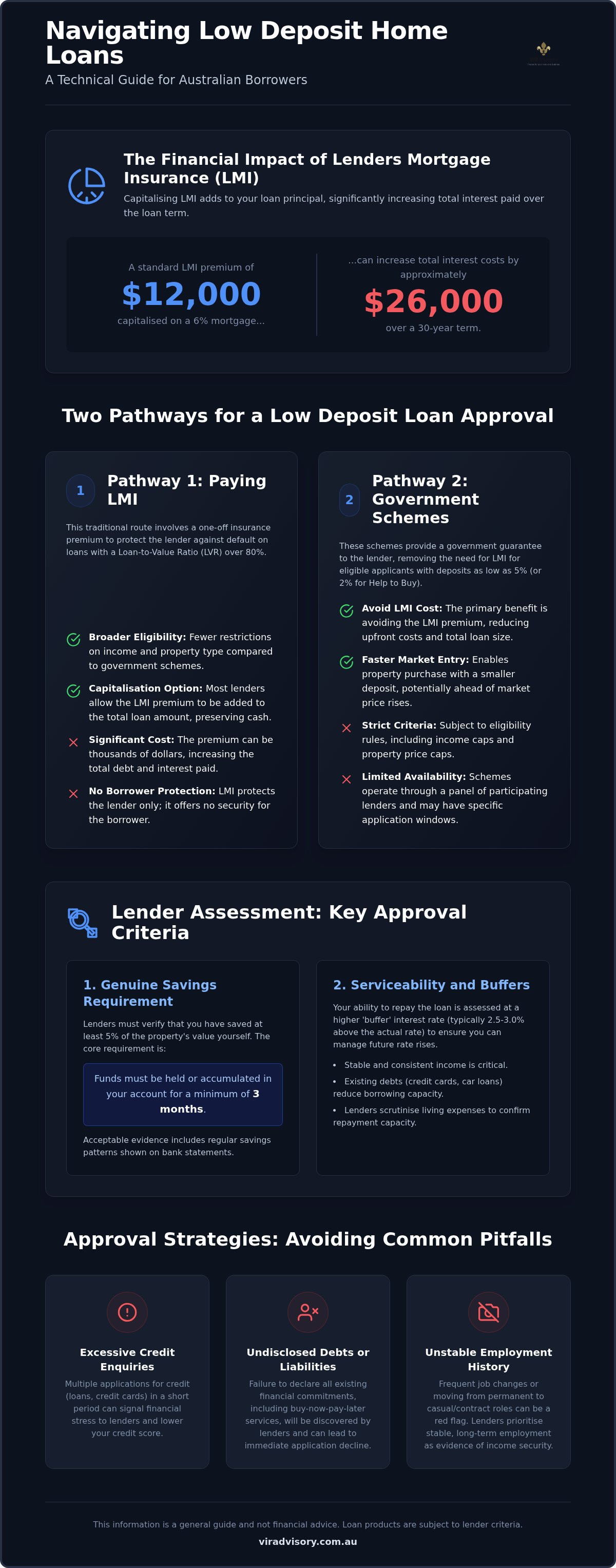
Did you know that adding a $12,000 Lenders Mortgage Insurance (LMI) premium to a 6% mortgage can increase your total interest costs by approximately $26,000 over a 30 year term? For many professionals and first home buyers, the 20% deposit requirement is a significant barrier, especially when combined with strict serviceability buffers that limit borrowing capacity. It's difficult to balance the urgency of entering the property market with the high costs associated with low deposit home loans Australia, where LMI premiums often erode equity from day one.
This guide provides a technical breakdown of current lending options to help you secure an approval with as little as a 5% deposit. We'll examine the specific assessment criteria lenders use to evaluate genuine savings and explain how to capitalise LMI to preserve your cash flow. By understanding the mechanics of the Australian Government 5% Deposit Scheme and the 2026 property price caps, you can implement a finance strategy that prioritises risk management and long term stability. We'll also cover the shared equity frameworks and lender specific policies that allow for flexible funding solutions without the traditional 20% upfront requirement.
Key Takeaways
- Understand how to navigate low deposit home loans Australia by leveraging government guarantees that remove the requirement for Lenders Mortgage Insurance (LMI).
- Compare the long-term cost of capitalised LMI against the potential equity gains of entering the property market sooner to determine the most cost-effective entry strategy.
- Identify acceptable forms of genuine savings, such as funds held for at least three months, to satisfy strict lender assessment criteria and risk management protocols.
- Learn to avoid common application obstacles, including excessive credit enquiries and undisclosed debts, to protect your borrowing capacity and approval prospects.
- Review current serviceability buffers and lender-specific requirements to ensure your loan structure aligns with 2026 regulatory standards and funding solutions.
Understanding the Mechanics of Low Deposit Mortgages
A low deposit mortgage is technically defined as any home loan where the Loan-to-Value Ratio (LVR) exceeds 80%. In the Australian lending landscape, the 20% deposit has long been the benchmark because it eliminates the lender's perceived risk of a shortfall if the property must be sold. When you provide a smaller deposit, the lender requires additional security to mitigate this risk, which is why low deposit home loans Australia typically involve more rigorous assessment criteria and additional costs.
A comprehensive approach to Understanding Mortgage Loans begins with the Loan-to-Value Ratio (LVR), which is the primary metric lenders use to assess their exposure. Most major banks view applications with an LVR above 80% as higher risk, leading to stricter requirements for income stability and credit history. However, for many professionals, the trade-off between paying for mortgage insurance and entering the market sooner is a calculated strategy to capture property value growth that might otherwise outpace their savings rate.
To better understand this concept, watch this helpful video:
The Role of Lenders Mortgage Insurance (LMI)
Lenders Mortgage Insurance is a one-off premium that protects the lender, not the borrower, in the event of a default. The Loan-to-Value Ratio (LVR) represents the percentage of the property's value that you're borrowing, and it directly determines the tiered cost of your LMI premium. Typically, LMI costs range between 1% and 5% of the total loan amount, with the percentage increasing as the deposit gets smaller. You can choose to pay this premium upfront, but most borrowers prefer capitalising it, which means adding the cost to the total loan balance and paying it off over the life of the mortgage.
Standard vs. Low Deposit Eligibility
Lenders apply different assessment frameworks depending on whether you're applying for a 90% or 95% LVR. While many discussions focus on the extremes of 5% or 20% deposits, a 10% to 15% deposit often serves as a strategic middle ground where LMI costs are significantly reduced. You should be aware that low deposit lending often places you in a higher interest rate tier, as banks price their products based on the risk profile of the LVR. Additionally, some lenders restrict high LVR loans to certain high-demand postcodes or specific property types, such as houses rather than small apartments, to ensure the underlying asset remains liquid. Understanding these loan structures is essential for managing your long-term cash flow and debt strategy.
Australian Government Guarantee Schemes and Eligibility
The Australian Government 5% Deposit Scheme, which transitioned to its current expanded structure in October 2025, serves as a credit enhancement rather than a direct cash payment. By providing a federal guarantee to participating lenders, the government allows eligible borrowers to avoid the high costs of Lenders Mortgage Insurance (LMI) while contributing a deposit of as little as 5%. This initiative has become a cornerstone for securing low deposit home loans Australia, especially since the removal of annual place limits to ensure consistent market access throughout the financial year.
While the federal scheme is broad, state-specific programs like the Queensland Housing Finance Loan offer alternative solutions for those who require different lending structures. Additionally, the Regional First Home Buyer Guarantee supports those who've lived in a regional area for at least 12 months, applying the same 5% deposit benefits to regional property markets. For those with even lower capital, the Help to Buy shared equity scheme provides a 2% deposit option, though it involves the government taking an equity stake in the property and maintains strict income caps of $100,000 for individuals.
Criteria for the First Home Guarantee
To qualify for a 5% deposit under the 2026 framework, applicants must be Australian citizens or permanent residents who haven't owned property in the last ten years. A significant change in policy is the removal of income caps for the 5% Deposit Scheme, allowing professionals with higher earnings to still benefit from LMI waivers. Property price caps remain strictly enforced to ensure the scheme targets the entry-level market, with limits varyingly applied based on whether the property is located in a major capital city or a regional centre. Lenders still require a comprehensive assessment of your borrowing capacity, ensuring you can service the mortgage at current interest rate buffers regardless of the government guarantee.
The Family Home Guarantee for Single Parents
The Family Home Guarantee is specifically designed for single parents or legal guardians with at least one dependent, allowing them to purchase a home with a deposit as low as 2%. This scheme acknowledges the specific financial hurdles faced by single-headed households by removing the LMI premium entirely, and like the 5% scheme, it no longer enforces an income cap. This initiative effectively assists market re-entry for those who previously owned property but have since lost their equity due to relationship transitions. If you're looking to assess your eligibility against current lender policies, you can book a strategy session to review your specific funding solutions.
Strategic Comparison: Government Guarantees vs. Paying LMI
Choosing between a government guarantee and paying Lenders Mortgage Insurance (LMI) involves a precise calculation of opportunity cost. While government schemes for low deposit home loans Australia are highly sought after, they aren't the only viable route to market entry. For many borrowers, the 'sweet spot' lies in a 10% or 15% deposit. At these levels, the LMI premium is significantly reduced compared to a 5% deposit, yet it still allows for much faster entry than waiting to save a full 20%.
Deciding to pay LMI is often a strategic choice based on property cycles. If you believe property price growth will outpace your ability to save, paying the insurance premium acts as a fee for earlier access to equity. However, this must be balanced against the risk of negative equity. In a fluctuating market, a 95% LVR loan leaves very little buffer if valuations soften, which can complicate future refinancing or property sales. Assessment of these risks is a core part of a robust finance strategy.
Speed to Market vs. Interest Costs
The primary benefit of paying LMI is the ability to capture property growth immediately. If a property increases in value by 5% annually, waiting two years to save an extra $50,000 might see the purchase price rise by $80,000, effectively moving the goalposts further away. You must weigh this against the long-term interest cost. Adding an LMI premium of $12,000 to a loan at a 6% interest rate can add approximately $26,000 to total repayments over 30 years. Using your borrowing capacity to model these scenarios is essential. It helps determine if capitalising the LMI into the loan is sustainable or if the increased monthly commitment will strain your cash flow in a high-rate environment.
Professional LMI Waivers
High-income professionals often have access to specialised lender policies that bypass standard LVR restrictions. Medical practitioners, legal professionals, and certain finance specialists can often secure 90% LVR loans with a complete LMI waiver. Lenders offer these concessions because these sectors historically show lower default rates and high income stability. To qualify, you typically need to provide evidence of current registration with a professional body, such as AHPRA for doctors, and meet minimum income thresholds. This allows eligible specialists to preserve their capital for other investments while still accessing competitive interest rate tiers normally reserved for 80% LVR borrowers. Most lenders require at least two years of tax returns or a current employment contract to verify professional status during the application process.
Lender Assessment: Genuine Savings and Serviceability Requirements
Lenders view a small deposit as a high risk indicator, primarily because it suggests a limited financial buffer for the borrower. To mitigate this, most major banks require proof of genuine savings, which is the most common reason for rejection in low deposit home loans Australia. Genuine savings demonstrate your ability to manage cash flow and accumulate capital over time, providing the lender with confidence in your financial discipline. Typically, this requires you to show that at least 5% of the purchase price has been held in a bank account or invested in shares for a minimum of three months.
While a gift from a family member can help reach the total deposit required, it is often classified as non-genuine savings. If you intend to use gifted funds, many lenders still require you to hold those funds in your own account for 90 days before they qualify as genuine. Alternatively, some non-bank lenders may waive the genuine savings requirement if you have a strong rental history, as consistent lease payments can serve as a proxy for savings behaviour. Lenders also scrutinise your serviceability using a stress-test buffer, usually 3% above the current interest rate, to ensure you can maintain repayments if rates rise further.
Proving Genuine Savings to Lenders
To satisfy an audit of your savings history, you must provide clear, uninterrupted bank statements. Lenders look for patterns of regular deposits and a lack of large, unexplained cash injections. If you're using rental history to support your application, you'll generally need a tenant ledger showing 12 months of on-time payments. Follow these steps to prepare your accounts for assessment:
- Consolidate all deposit funds into a single high-interest savings account.
- Avoid moving large sums of money between accounts in the 90 days prior to application.
- Ensure all account statements clearly show your name and the account number.
- Stop all "Buy Now, Pay Later" transactions, as these can complicate the assessment of your discretionary spending.
Serviceability and Cash Flow Management
Borrowing capacity is heavily influenced by your existing liabilities and monthly commitments. HECS/HELP debt is a significant factor, as lenders deduct the compulsory repayment amount from your gross income, which directly reduces your net take-home pay for serviceability calculations. Similarly, credit card limits are assessed as a monthly expense based on approximately 3% of the total limit, regardless of whether you have a balance. Reducing these limits or closing unused accounts before applying can significantly improve your prospects. Lenders will also compare your actual living expenses against the Household Expenditure Method (HEM) to ensure your debt-to-income ratio remains within safe risk management parameters.
Approval Strategies and Avoiding Common Application Pitfalls
Securing an approval for low deposit home loans Australia requires a meticulous approach to your credit profile. Every "hard" enquiry on your credit report, which occurs when you submit a formal application, can temporarily lower your credit score. Lenders view multiple enquiries within a short window as a sign of credit distress or financial instability. It's essential to conduct thorough research into lender policies before any formal submission to ensure your profile aligns with their specific appetite for risk. Undisclosed debts, such as small personal loans or undisclosed credit cards, are often discovered during the final credit check, leading to immediate rejection and a permanent mark on your file.
While obtaining a pre-approval is a vital step, it doesn't guarantee a final loan offer. In low deposit lending, the property valuation is the most significant hurdle. Since the lender is providing up to 95% of the funds, they require the property to be easily saleable and correctly valued. A finance broker plays a critical role here by identifying which lenders have more favourable policies for your specific employment type or the location of the property you intend to purchase. Their expertise allows you to navigate the complex landscape of low deposit home loans Australia without risking unnecessary credit hits.
Approval Obstacles and How to Avoid Them
Buy Now Pay Later (BNPL) accounts are frequently overlooked by borrowers but are heavily scrutinised by credit teams. Lenders generally treat these as active credit facilities, which directly reduces your borrowing capacity. To improve your approval prospects, you should close these accounts and provide proof of closure at least one month before applying. Employment stability is also non-negotiable for high LVR loans. Most lenders require you to be out of your probation period and have at least six to twelve months of continuous service. If a valuation comes in lower than the purchase price, you'll be required to cover the shortfall in cash, so maintaining a small additional liquidity buffer is a prudent risk management strategy.
Strategic Loan Structuring for Future Growth
The structure of your loan should facilitate long-term flexibility. While fixed rates provide repayment certainty in a fluctuating market, they often lack the full functionality of an offset account. For professionals planning to eventually convert their first home into an investment property, an offset account is superior to a redraw facility. It allows you to keep your savings separate from the loan principal, which is essential for preserving tax deductibility on the interest in the future. Your strategy should include a clear plan to refinance once your equity reaches 20%. Reaching this milestone allows you to exit the high-risk interest rate tier and move to a standard loan product with significantly lower interest costs and no further LMI requirements.
Strategic Implementation of Your Funding Solution
Navigating the complexities of low deposit home loans Australia requires a precise balance between speed to market and long term interest cost management. Whether you utilise the Australian Government 5% Deposit Scheme or opt for a strategic LMI capitalisation, your success depends on satisfying strict genuine savings requirements and maintaining a stable credit profile. Understanding how lenders assess your borrowing capacity at current serviceability buffers is essential for securing a sustainable approval.
Led by Raina Doshi, with over 15 years of experience in the Australian banking sector, VIR Advisory specialises in navigating the Home Guarantee Scheme and complex lender policies. We focus on professional debt structuring that aligns with your specific profile, helping you avoid common application pitfalls while prioritising long term equity growth and risk management.
With a methodical approach and professional oversight, entering the property market with a smaller deposit is a calculated and achievable step toward your long term investment objectives.
Frequently Asked Questions
Can I get a home loan with a 5% deposit in Australia?
Yes, you can secure a mortgage with a 5% deposit through the Australian Government 5% Deposit Scheme or by paying Lenders Mortgage Insurance (LMI). Under the 2026 framework, the government scheme provides a guarantee to the lender, removing the LMI requirement for eligible applicants. If you don't qualify for the scheme, most lenders will still consider a 95% Loan-to-Value Ratio (LVR) provided you meet strict serviceability buffers and show proof of genuine savings.
What is the Home Guarantee Scheme and how does it work?
The Home Guarantee Scheme is a federal initiative where the government guarantees a portion of your loan, typically up to 15% of the property value. This allows you to secure low deposit home loans Australia without paying for LMI. As of October 2025, the scheme has moved to an unlimited place structure with no income caps for the 5% Deposit Scheme, making it accessible to a broader range of professionals and first home buyers.
How much does Lenders Mortgage Insurance (LMI) actually cost?
LMI typically costs between 1% and 5% of your total loan amount, depending on your deposit size and the property value. For a $500,000 property with a 5% deposit, the premium could be approximately $17,028. This cost is often capitalised into your loan balance, meaning you pay interest on it over the loan term. It's important to remember that LMI protects the lender, not you, in the event of a default.
Do I need to show 'genuine savings' if I have a 10% deposit?
Most lenders require proof of genuine savings for any application where the deposit is less than 20%. Even with a 10% deposit, you'll generally need to demonstrate that at least 5% of the purchase price has been held or accumulated in a bank account for at least three months. This requirement proves to the lender that you have the financial discipline to manage cash flow and service a high LVR mortgage effectively.
Can single parents really buy a home with a 2% deposit?
Eligible single parents or legal guardians with at least one dependent can purchase a home with a 2% deposit through the Family Home Guarantee. This scheme removes the need for LMI and, as of late 2025, no longer enforces an income cap. It is designed to assist market re-entry for those who may have previously owned property but currently lack the capital for a standard 20% deposit while managing ongoing household expenses.
Will I pay a higher interest rate if I have a low deposit?
Borrowers with a low deposit often pay higher interest rates because lenders use risk-based pricing for high LVR loans. When your deposit is less than 20%, you are typically placed in a higher interest rate tier compared to those with more equity. However, some professionals may qualify for LMI waivers and competitive rates if they belong to specific industry groups, such as medical or legal sectors, that lenders view as lower risk.
Can I use a gift from my parents as a deposit for a home loan?
You can use a gift as a deposit, but most major lenders classify this as non-genuine savings. To satisfy strict lending criteria for low deposit home loans Australia, you may need to hold those gifted funds in your account for at least three months before applying. Alternatively, some lenders accept a gift as the full deposit if you can show a consistent 12 month rental history as a proxy for genuine savings behaviour.
What happens if the property valuation comes in lower than the purchase price?
If the bank valuation is lower than the purchase price, you must cover the shortfall in cash. For example, if you have a 5% deposit and the valuation is $20,000 below the contract price, the lender will only lend 95% of the lower valuation amount. This can be a significant obstacle for low deposit borrowers, as it increases the required upfront capital needed to reach settlement and satisfy the lender's risk management limits.

Article by
Raina Doshi
Raina Doshi has worked in banking and finance since 2011, including experience with major Australian lenders. She helps homeowners, property investors, business owners and professionals secure and structure lending solutions across home loans, refinancing, commercial finance and business lending.
Areas of expertise include residential lending, investment property finance, debt recycling, commercial property finance, equipment finance, construction finance and strategic debt structuring.
Drawing on extensive banking and finance experience, Raina helps clients navigate lender requirements, improve borrowing outcomes and structure effective finance solutions.
Disclaimer
The information in this article is general in nature and does not take into account your personal objectives, financial situation or needs. Before acting on any information, consider whether it is appropriate to your circumstances and seek professional advice.


