

Discover how expert business debt advisory services align your financial structure with your business objectives, funding requirements and long-term growth plans.
What are Business Debt Advisory Services in the Australian Context?
Business debt advisory is a specialist financial service designed to help enterprises strategically manage their capital and debt structures. It involves a detailed analysis of a company's existing liabilities, cash flow, and growth objectives to create a cohesive and optimised funding strategy. In the complex Australian lending market, these services extend far beyond simple loan procurement, focusing on long-term financial health and sustainability.
Market conditions in 2026 and beyond demand more than a standard loan application. With fluctuating interest rates, evolving lender appetites, and complex credit policies, a strategic approach is essential. A debt adviser acts as an independent expert, ensuring your business is not only funded but is also protected from inefficient, rigid, or predatory lending structures that can stifle growth.
- Definition: Debt advisory is a professional engagement focused on structuring, negotiating, and managing a business's debt facilities to align with its strategic goals.
- Market Relevance: In a dynamic economic environment, expert advisory helps businesses navigate lender requirements and secure optimal terms.
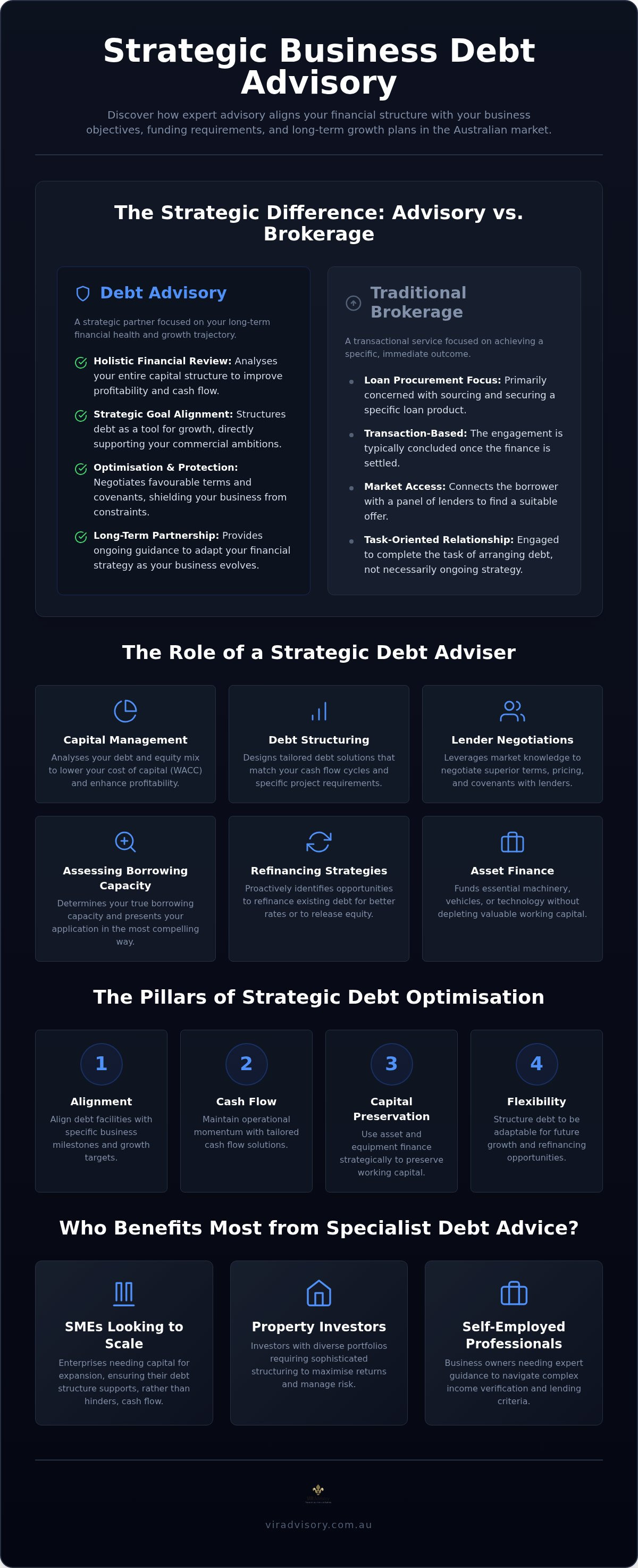
- Brokerage vs. Advisory: While a broker primarily sources and secures a loan, an adviser provides a holistic review of your entire capital structure to improve profitability and cash flow.
- Protection and Optimisation: Advisory services shield your business from unfavourable terms and covenants, ensuring your debt structure is a tool for growth, not a financial constraint.
The Role of a Strategic Debt Adviser
A strategic debt adviser provides independent commercial finance expertise, helping business owners evaluate, structure and optimise debt facilities to support long-term growth. Their role is to provide objective, expert guidance that aligns your funding strategy with your commercial ambitions. This involves a deep-dive into your financial position to identify opportunities for improvement and mitigate potential risks.
Key functions include:
- Capital Management: Analysing your current mix of debt and equity to recommend a more efficient capital structure that lowers your cost of funding and increases profitability.
- Debt Structuring: Designing tailored debt solutions that match your cash flow cycles, investment horizons, and specific project requirements, from working capital to large-scale asset acquisition.
- Lender Negotiations: Leveraging market knowledge and industry relationships to negotiate favourable terms, pricing, and covenants with banks and non-bank lenders.
- Assessing Borrowing Capacity: Conducting a thorough analysis to determine your true borrowing capacity and presenting your application to lenders in the most compelling way.
- Refinancing Strategies: Proactively identifying opportunities to refinance existing debt to take advantage of better rates, release equity, or consolidate facilities for improved management.
Who Benefits Most from Specialist Debt Advice?
While any business can benefit from a well-structured debt strategy, certain entities find these services particularly valuable. They are not just for businesses in distress; they are a powerful lever for ambitious organisations focused on sustainable expansion.
- SMEs Looking to Scale: Small and medium-sized enterprises that need capital for expansion but want to ensure their debt structure supports, rather than hinders, cash flow.
- Property Investors: Investors managing diverse commercial and residential portfolios who require sophisticated structuring to maximise returns and manage risk across multiple assets.
- Self-Employed Professionals: Business owners and consultants who need expert guidance to navigate the often complex income verification and lending criteria for self-employed applicants.
The Pillars of Strategic Debt Optimisation for Growth
Effective debt management is not merely about securing the lowest interest rate; it is about building a robust capital structure that fuels growth. Strategic debt optimisation rests on several key pillars that work together to enhance financial performance and operational flexibility.
This approach moves beyond transactional borrowing to create a dynamic financial framework that can adapt to new opportunities and challenges. It involves aligning debt facilities with specific business milestones, ensuring cash flow remains strong, and using different types of finance strategically to preserve working capital.
- Aligning debt facilities with specific business milestones and growth targets.
- The importance of cash flow solutions in maintaining operational momentum.
- Using asset and equipment finance to preserve working capital.
- Structuring debt to be flexible enough for future refinancing opportunities.
Capital Structure and Profitability
Your capital structure—the mix of debt and equity used to finance your operations—has a direct impact on business value and profitability. An experienced debt adviser can help you achieve an optimal balance, reducing your Weighted Average Cost of Capital (WACC). A lower WACC means your business is creating more value from its capital, which in turn enhances profitability and shareholder returns. The goal is to balance the need for short-term liquidity with the capital required for long-term investments, ensuring the business remains both stable and poised for growth.
- Analysing how the right mix of debt and equity drives business value.
- Reducing the Weighted Average Cost of Capital (WACC) through expert advice.
- Balancing short-term liquidity needs with long-term investment goals.
Asset Finance and Equipment Loans
For many Australian businesses, acquiring essential machinery, vehicles, or technology is critical for operations and expansion. Asset finance provides a strategic way to fund these purchases without depleting valuable working capital. By structuring these loans effectively, businesses can match the term of the loan to the useful life of the asset and often take advantage of tax benefits, such as depreciation and GST claims. A debt adviser can integrate asset finance into your broader commercial lending strategy, ensuring it complements your overall financial structure and supports your operational requirements.
- Strategies for acquiring essential assets without large capital outlays.
- Structuring tax-effective debt for equipment and technology purchases.
- Integrating asset finance into your broader commercial funding strategy.
Debt Advisory vs. Traditional Brokerage: What is the Difference?
Understanding the distinction between a strategic debt adviser and a traditional finance broker is crucial for business owners seeking the right kind of support. While both play a role in securing finance, their scope, focus, and method of engagement differ significantly. A traditional broker typically focuses on a specific transaction: finding a loan product and managing the application process.
A debt adviser, in contrast, takes a holistic and ongoing view of your business's entire financial structure. The engagement is strategic rather than transactional. It begins with a comprehensive review of your existing debt, cash flow, and commercial objectives. The aim is not just to secure a single loan, but to build a sustainable and efficient capital framework that supports your long-term growth plans. This includes analysing loan covenants, structuring for tax efficiency, and planning for future capital requirements.
| Feature | Traditional Broker | Strategic Debt Adviser |
|---|---|---|
| Primary Focus | Obtaining finance for a specific transaction | Optimising the entire capital structure |
| Engagement | Transaction-based, often ending at settlement | Ongoing advisory and strategic support |
| Scope | Individual loan sourcing and application | Holistic debt strategy and capital management |
| Cash Flow Analysis | Limited to serviceability for the new loan | Comprehensive analysis to improve operational cash flow |
| Covenant Review | Limited review, focused on meeting lender requirements | In-depth analysis and negotiation of covenants |
| Debt Restructuring | Usually not a core service | A core service to improve financial efficiency |
| Long-Term Planning | Limited to the immediate transaction | Proactive, ongoing optimisation and future planning |
Moving Beyond the Transaction
The "cheapest" interest rate is not always the best financial solution. An adviser understands that the true cost of debt includes fees, covenants, and structural rigidity. Restrictive covenants can limit your operational freedom, while an inflexible loan structure can hinder your ability to seize new opportunities. A strategic adviser looks beyond the headline rate to negotiate terms that protect your enterprise. At VIR Advisory, our approach is to understand your commercial objectives first, then design a funding strategy that serves those goals, a stark contrast to high-volume brokers focused solely on loan settlement.
The Long-Term Value of Strategic Guidance
The most significant value a debt adviser provides is ongoing strategic support. Business is not static; it grows, pivots, and evolves. Your debt structure should be dynamic enough to evolve with it. This involves regular reviews of your financial position, proactive refinancing to maintain optimal terms, and strategic planning for future capital needs. This continuous management ensures your business is always in a strong financial position, ready to capitalise on growth opportunities as they arise. For more information on our specific capabilities, you can learn more about our services.
Navigating the Debt-Raising Process: A Step-by-Step Guide
Engaging a debt adviser demystifies the complex process of raising capital. A structured and methodical approach ensures that your business is presented to lenders in the strongest possible light, maximising the chances of a successful outcome on favourable terms. The process is collaborative, transparent, and focused on achieving your specific funding objectives.
- Initial Discovery and Goal Identification: The process begins with a detailed discussion to understand your business, its financial position, and your short-term and long-term goals. This is about defining what success looks like for you, whether it's funding an acquisition, improving cash flow, or restructuring existing debt.
- Financial Modelling and Due Diligence: Your adviser will conduct a thorough analysis of your financial statements, business plans, and forecasts. This involves preparing your business for lender scrutiny, identifying any potential red flags, and building a robust financial case that demonstrates serviceability and strategic merit.
- Market Scanning and Lender Identification: Leveraging deep market knowledge, your adviser will identify the most suitable lenders for your specific needs. This often goes beyond the "Big Four" banks to include second-tier banks, non-bank lenders, and private funders who may have a greater appetite for your industry or transaction type.
- Negotiation and Settlement: Your adviser acts as your advocate, managing the application process and negotiating with lenders to secure the best possible terms, conditions, and pricing. They manage the process through to settlement, ensuring a smooth and efficient execution of your funding strategy.
Preparing Your Business for Lending Success
Lender credit appetites and documentation requirements are constantly changing. A key role of a debt adviser is to ensure your submission is comprehensive, professional, and addresses all the key criteria a lender will assess in 2026. This includes preparing clear financial reports, a compelling business case, and proactively mitigating any perceived risks. Presenting your funding request with clarity and confidence significantly improves your position during negotiations.
- Identifying the key documents and financial data every Australian lender will require.
- Structuring your business case to highlight strengths and growth potential.
- Addressing and mitigating potential risk areas before the application is submitted.
Unique Considerations for the Self-Employed
Self-employed professionals and business owners face unique challenges when seeking finance. Proving income can be more complex than for a PAYG employee, and lenders often apply stricter criteria. Personalised guidance is critical for navigating these complexities. A specialist adviser can help structure your application to clearly demonstrate consistent income and strong cash flow, positioning you as a low-risk borrower. This is essential for securing both business and personal finance, such as a home loan, when you don't fit the standard applicant profile. For more details, see our guide on navigating business loan eligibility in Australia.
- Navigating the complexities of income verification for self-employed applicants.
- Strategies for managing and presenting cash flow to meet loan eligibility criteria.
- Why specialist guidance is critical for non-standard borrowers to access competitive finance.
How VIR Advisory Helps Businesses Structure and Optimise Debt
At VIR Advisory, we specialise in providing expert, independent commercial finance advice to Australian businesses. Led by founder Raina Doshi, who brings over 15 years of banking and finance experience, our focus is on delivering practical outcomes that strengthen your financial position and support your strategic goals. We move beyond simple brokerage to offer comprehensive debt and capital management services.
Our expertise is grounded in a deep understanding of the Australian lending landscape and a commitment to achieving the best possible results for our clients. We work nationally, providing a single point of contact for all your commercial finance needs.
Our core capabilities include:
- Debt Restructuring and Refinancing: We conduct detailed reviews of existing facilities to identify opportunities for cost savings, improved flexibility, and better alignment with your business objectives.
- Commercial Finance Strategy: We help you develop a long-term funding strategy that supports sustainable growth, whether you're expanding operations, acquiring assets, or entering new markets.
- Lender Negotiations: With extensive industry experience, we negotiate directly with a wide panel of lenders to secure superior terms and pricing on your behalf.
- Commercial Property Finance: We provide expert structuring for the acquisition and refinancing of commercial, industrial, and retail properties, including via SMSF.
- Equipment and Asset Finance: We arrange tailored finance solutions for essential business assets, helping you preserve working capital and manage cash flow effectively.
- Working Capital Funding: We help businesses secure flexible working capital solutions, such as overdrafts or lines of credit, to manage day-to-day operational expenses and fund growth.
Commercial Finance Expertise and Ongoing Support
Effective debt management is not a one-off event. We provide ongoing support to ensure your capital structure remains optimised as your business evolves. This proactive approach means you always have an expert on hand to help you make strategic financing decisions.
Our ongoing support includes:
- Regular Debt Reviews: We schedule periodic reviews of your debt facilities to ensure they continue to meet your needs and remain competitive in the market.
- Strategic Financing Decisions: We act as a sounding board for key decisions related to capital expenditure, acquisitions, and expansion, providing objective financial analysis.
- Proactive Lender Management: We manage communications and reporting requirements with your lenders, freeing up your time to focus on running your business.
- Identifying Financing Opportunities: We keep you informed of market changes and new financing opportunities that could benefit your business.
Your Next Steps Toward Financial Clarity
Now is the ideal time to conduct a comprehensive health check of your business's debt. A strategic review can uncover significant opportunities to improve cash flow, reduce costs, and build a more resilient financial foundation.
Whether you are reviewing existing facilities, considering refinancing, funding business growth or planning a future acquisition, a structured debt strategy can help improve flexibility, reduce costs and strengthen long-term financial performance.
Secure your financial future—book a 30-minute strategy session with Raina Doshi today
Frequently Asked Questions (FAQs)
What is the difference between a debt adviser and a commercial mortgage broker?
A commercial mortgage broker typically focuses on the transaction of sourcing and securing a loan for a specific purpose. A debt adviser provides a more holistic service, analysing your entire capital structure, business objectives, and cash flow to design a long-term debt strategy. This includes ongoing management, covenant analysis, and strategic refinancing.
How can debt advisory services help my business grow?
By optimising your capital structure, debt advisory can lower your cost of capital, improve cash flow, and increase profitability. This creates a stronger financial platform for growth. An adviser also ensures you have access to the right type of funding at the right time to capitalise on expansion opportunities, such as acquiring new assets or entering new markets.
Is debt advisory only for businesses in financial trouble?
No, this is a common misconception. While debt advisory is crucial for businesses facing financial challenges, its primary function is strategic. It is most effective when used by healthy, ambitious businesses to proactively manage their capital for growth, improve efficiency, and build long-term financial resilience.
Can I use a Self-Managed Super Fund (SMSF) for commercial property lending?
Yes, it is possible for an SMSF to borrow to purchase a commercial property under a Limited Recourse Borrowing Arrangement (LRBA). The rules are complex and strict. A specialist adviser can guide you through the process, ensuring compliance and structuring the loan correctly to meet both superannuation law and lender requirements.
How do I know if my current business debt structure is inefficient?
Signs of an inefficient debt structure include high interest rates, restrictive loan covenants that limit your business operations, a disconnect between loan terms and asset life, or a structure that creates cash flow pressure. If you have multiple loans with different lenders or haven't reviewed your facilities in over two years, a professional assessment is highly recommended.
What kind of businesses does VIR Advisory work with across Australia?
VIR Advisory provides national services to a wide range of clients, including small and medium-sized enterprises (SMEs) across various industries, commercial and residential property investors, and self-employed professionals. Our expertise covers everything from straightforward business loans to complex, multi-facility debt structuring.
How much does it cost to engage a business debt advisory service?
The fee structure can vary. For transactional services like broking a new loan, the adviser is typically paid a commission by the lender. For more in-depth strategic advisory, restructuring, or capital management work, a fee-for-service model may be used. VIR Advisory is committed to transparency and will discuss all fees with you upfront.
What are the benefits of asset finance for a small Australian business?
Asset finance allows a business to acquire essential equipment, vehicles, or technology without a large upfront cash payment. This preserves working capital for other critical areas like inventory or marketing. It can also offer tax advantages and helps manage cash flow by spreading the cost of the asset over its useful life.

Article by
Raina Doshi
Raina Doshi has worked in banking and finance since 2011, including experience with major Australian lenders. She helps homeowners, property investors, business owners and professionals secure and structure lending solutions across home loans, refinancing, commercial finance and business lending.
Areas of expertise include residential lending, investment property finance, debt recycling, commercial property finance, equipment finance, construction finance and strategic debt structuring.
Drawing on extensive banking and finance experience, Raina helps clients navigate lender requirements, improve borrowing outcomes and structure effective finance solutions.
Disclaimer
The information in this article is general in nature and does not take into account your personal objectives, financial situation or needs. Before acting on any information, consider whether it is appropriate to your circumstances and seek professional advice.


