

Subdivision can be an effective way to unlock equity, create additional income streams, reduce debt or support long-term wealth creation. However, successful outcomes depend on careful planning, realistic budgeting and the right finance strategy. It’s a project that transforms a single property title into multiple, but more importantly, it represents a significant financial manoeuvre that can reshape your asset portfolio and personal wealth.
For sophisticated property owners, investors, and families with large blocks, the question isn't just "can I subdivide?" but "how do I structure the finances to ensure it's profitable and strategically sound?" The pathway is often layered with council requirements, tax implications, and complex lending criteria that can feel overwhelming.
This guide moves beyond the dry council regulations to focus on the financial heart of the matter. We’ll explore how to navigate your existing mortgage, budget for the true costs, and implement a lending structure that forms the foundation of a successful project. Because at VIR Advisory, we believe every successful development is a financial project first and a construction project second.
Understanding the Potential to Subdivide Property in Australia
At its core, subdivision is the legal process of dividing a single parcel of land into two or more separate lots, each with its own individual title. This allows the new lots to be sold, developed, or mortgaged independently. While the concept is simple, the application varies widely across Australia, driven by personal goals and local council planning schemes.
- Define subdivision: The legal process of splitting one land parcel into multiple titles, enabling separate ownership and development.
- Common types of subdivision in Australia: This can range from a simple backyard split (creating one new lot behind an existing home) to dual occupancy (building a second dwelling on the block) and strata titles (dividing a building into individual units).
- The strategic 'why': The motivation behind subdivision is deeply personal. It could be to unlock trapped equity for other investments, generate a new rental income stream, reduce mortgage debt by selling off a portion of land, or create a home for a family member.
- Why every subdivision project begins with a personal financial story: Your goals—whether it's achieving financial freedom, building an inheritance, or simplifying your life—dictate the entire strategy, from the type of subdivision you pursue to the way you structure your finances.
Identifying a High-Potential Subdivision Site
Before any financial modelling can begin, the physical and legal potential of your property must be confirmed. A property might seem perfect for a split, but council regulations and site limitations are the ultimate arbiters. Key factors to investigate include:
- Zoning and overlays: Your local council's planning scheme is the first port of call. It dictates the minimum lot sizes, setbacks, and types of development permitted in your area. Overlays for heritage, environmental, or bushfire risk can add further layers of complexity.
- Site dimensions and access: Does the property have sufficient width and depth to create compliant lots? Critically, each new lot must have legal and practical vehicle access to a public road, which can be a significant hurdle for narrow or unusually shaped blocks.
- Infrastructure and services: Check the location of existing essential services. Each new lot will require its own connection to water, sewerage, electricity, and telecommunications. The cost and feasibility of extending or creating new connections can heavily influence the project's viability.
The Financial Benefits of Splitting Your Title
When executed with a sound financial strategy, subdivision offers powerful benefits that go far beyond simply creating a new block of land. It is a potent wealth creation tool that allows you to:
- Create an 'equity uplift': Often, the combined value of the newly created smaller lots is significantly greater than the value of the original single property. This instant creation of equity, or 'uplift', can be accessed through refinancing or sale.
- Generate multiple income streams: A subdivided property can support multiple rental incomes. You could live in one dwelling and rent out the other, or rent out both to maximise your cash flow from a single original asset.
- Strategic debt reduction: A popular strategy is to sell one of the newly created lots to pay down or completely clear the mortgage on the remaining property. This can dramatically improve your financial position and free up capital for future investments.
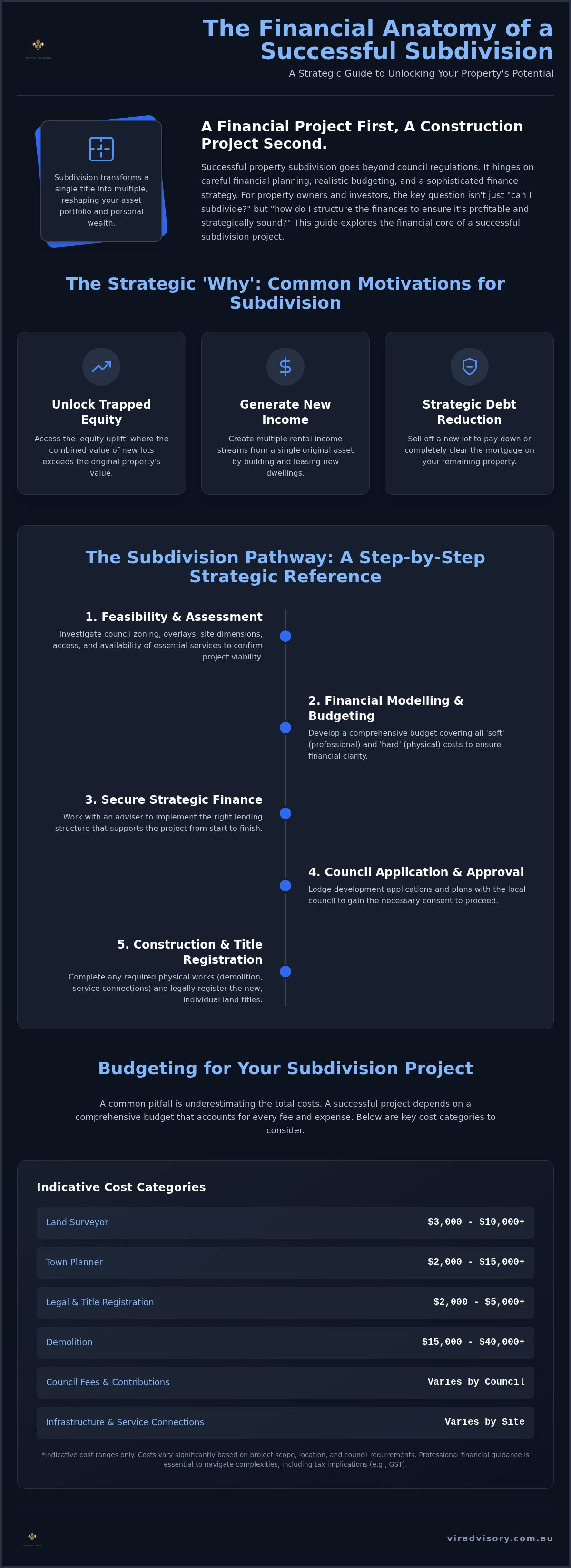
The Financial Anatomy of a Successful Subdivision
A common pitfall in property subdivision is underestimating the total costs involved. A successful project depends on a comprehensive budget that accounts for every professional fee, council charge, and construction expense. This financial clarity is essential not only for planning but also for securing the necessary finance.
Understanding the tax implications is equally critical. The Australian Taxation Office (ATO) has specific rules for property development, and getting it wrong can result in unexpected tax bills that erode your profits. Professional financial guidance is not a luxury but a necessity to navigate these complexities.
Budgeting for Your Subdivision Project
Your budget should be broken down into two main categories: 'soft costs' (professional services and administrative fees) and 'hard costs' (physical works). Below is a table of indicative cost categories to consider.
| Cost Item | Indicative Cost Range* |
|---|---|
| Land Surveyor | $3,000 - $10,000+ |
| Town Planner | $2,000 - $15,000+ |
| Legal & Title Registration | $2,000 - $5,000+ |
| Demolition | $15,000 - $40,000+ |
| Council Fees | Varies by council |
| Infrastructure Contributions | Varies significantly |
| Utility Connections | Highly project dependent |
*Indicative only. Actual costs vary significantly depending on location, project complexity, council requirements, site conditions and servicing requirements.
Beyond these items, it's essential to include a contingency fund. A buffer of 10-15% of the total project cost is a prudent measure to cover unforeseen challenges, such as unexpected site issues or delays in approvals, especially in the current economic climate.
Tax Implications and Profit Intent
The ATO's treatment of your subdivision project hinges on your intention. Are you undertaking a one-off project to improve your personal residence, or are you operating with a commercial intent to make a profit?
- The ATO's view: If your project is deemed a commercial venture, you may be required to register for GST. Any profit you make will likely be treated as income rather than a capital gain, which has significant tax consequences.
- Capital Gains Tax (CGT): If you are subdividing the land of your main residence, you may be entitled to a partial or full exemption from CGT. However, the rules are complex. For instance, if you sell the new lot, the 'main residence' exemption will not apply to that vacant land. The date you originally acquired the property is a key factor in how your CGT obligations are calculated.
- GST and the Margin Scheme: For those deemed to be in the business of property development, GST is a major consideration. The 'margin scheme' can sometimes be used to reduce the amount of GST payable on the sale of new property, but its application requires expert advice.
In short, your profit intention determines your tax treatment, influencing whether you are assessed under income tax or capital gains tax rules and if GST applies.
Lending Strategies: Why Home Loan Brokers are Essential
One of the most common questions from property owners is, "Can I subdivide my property if I still have a mortgage?" The answer is yes, but it requires careful negotiation with your lender. Your existing mortgage is secured against the entire property title. Before you can split that title, your bank must agree to it.
This is where a strategic home loan broker becomes your most valuable partner. A broker acts as your advocate, navigating the bank's complex internal processes and structuring your finance to support your project, not hinder it. They translate your subdivision goals into a financial proposal the banks can understand and approve.
For a detailed overview of how we can assist, you can explore our financial services offered.
Managing Your Mortgage During a Split
The process of gaining your bank's approval involves several key steps and potential challenges:
- Partial Release of Security: To create new titles, you need your bank to grant a 'Partial Release of Security'. This means they agree to release their claim over the portion of land being sold or retitled, while retaining security over the remaining lot.
- Re-valuation and LVR: The bank will require a new valuation on the 'remaining' land and property to ensure they are still adequately secured. They will check that your Loan-to-Value Ratio (LVR) on the remaining portion is within their acceptable limits. If the new valuation is too low, you may need to pay down a portion of the loan to proceed.
- The Risk of Cross-Collateralisation: A common bank practice is to link both new properties as security for the original loan. A skilled broker can help you avoid this 'cross-collateralisation', ensuring the titles are financially independent and giving you greater flexibility for the future.
- Refinancing to Unlock Equity: Often, the most effective strategy is to refinance the entire facility. This allows you to access the equity in your property to fund the soft and hard costs of the subdivision, rolling everything into a new, streamlined loan structure.
The Value of Strategic Finance Advice
Working with an experienced broker provides a distinct advantage. With over 15 years in banking and finance, our team at VIR Advisory understands the nuances of development funding.
- Major Banks vs. Specialist Lenders: We know which lenders have an appetite for small-scale development projects and can navigate their specific credit policies. While major banks are an option, specialist lenders often offer more flexible solutions for subdivision funding.
- Structuring for Success: The right loan structure can save you thousands in interest and tax. We help you structure your debt for long-term flexibility, considering factors like interest-only periods during construction and separating investment and personal debt for tax efficiency.
- A Trusted Guide: Ultimately, a broker's experience is critical for your approval. We anticipate lender queries, prepare a robust application, and manage the entire process on your behalf, allowing you to focus on the project itself.
The Subdivision Pathway: A Step-by-Step Strategic Reference
While specific council processes vary, the strategic pathway for a subdivision project in Australia follows a logical sequence. Each phase requires a combination of technical expertise from surveyors and planners, and financial acumen from your finance broker.
Phase 1: Due Diligence and Design
This initial phase is about confirming feasibility and creating the formal plan. It's where your vision is tested against the realities of planning rules and budget constraints.
- Conducting a Re-establishment Survey: A licensed surveyor will first need to confirm the exact boundaries of your property. This is a foundational step that all other plans are based on.
- Drafting the 'Plan of Subdivision': The surveyor then drafts the official 'Plan of Subdivision'. This is the legal document that illustrates how the original lot will be divided, showing the new boundaries, dimensions, and any easements required.
- Performing a 'Mortgage Health Check': Before lodging any applications, it's crucial to engage a finance broker. We conduct a 'Mortgage Health Check' to assess your current financial position, borrowing capacity, and overall strategy, ensuring your finance is aligned with your project goals from day one.
Phase 2: Approvals and Compliance
Once you have a plan, the focus shifts to gaining the necessary approvals from council and other authorities, and then completing the required physical works.
- Council Application and Approval: Your town planner will lodge the development application and Plan of Subdivision with the local council. This is often the longest part of the process, involving assessments and potential requests for further information.
- Organising the Physical Works: Once a planning permit is issued, you can proceed with the required 'hard costs', such as connecting drainage, sewer, and electricity to the new lot(s).
- Achieving a 'Statement of Compliance': After all conditions on the planning permit have been met and the physical works are certified, the council will issue a 'Statement of Compliance'. This is the green light that confirms you have fulfilled all your obligations.
- Lodging with the State Land Titles Office: The final step is to take your certified plan and Statement of Compliance to the Land Titles Office. They will process the documents and, once your bank provides consent, issue the separate, individual titles for your new lots.
Partnering with VIR Advisory for Your Subdivision Journey
Every subdivision project is more than a set of plans and applications; it's a personal journey towards a financial goal. At VIR Advisory, we start by listening to your unique property story. Understanding your 'why' allows us to build a financial strategy that truly serves your long-term ambitions.
Led by Raina Doshi, our approach is built on more than 15 years of banking and finance experience. We provide methodical, compassionate guidance through every stage of the complex property finance transition.
- Strategic Debt Optimisation: We don't just find a loan; we ensure your entire debt structure supports your growth, optimises your tax position, and enhances your financial well-being.
- A Relationship-Focused Advisor: We believe in building lasting partnerships. Our motto is simple: "If it’s important to you, it’s important to me." This commitment gives you the peace of mind that comes from having a dedicated expert in your corner.
Beyond the Transaction: Long-Term Financial Health
Our support doesn't end when the new titles are issued. We provide ongoing reviews to ensure your lending remains competitive and continues to align with your evolving goals. Whether you plan to sell, build, or hold, we offer strategic guidance for your next move, demystifying the lending market with clear, honest communication.
Take the Next Step in Your Subdivision Story
Now is the time to assess your property's true potential. Embarking on a subdivision journey requires courage and careful planning, but you don't have to do it alone. Having a mentor who 'walks beside you' can make all the difference between a stressful process and a rewarding financial success.
To discuss your property's potential and develop a clear finance strategy, we invite you to book a complimentary consultation.
Frequently Asked Questions (FAQs)
Can I subdivide my property if I still have a mortgage in Australia?
Yes, you can subdivide a property with an existing mortgage. However, you must obtain consent from your lender. The process involves a 'Partial Release of Security', where the bank agrees to release its mortgage over the new lot being created. They will typically require a new valuation to ensure the remaining property provides adequate security for the loan. A finance broker can manage these negotiations on your behalf.
How much does it typically cost to subdivide a block of land?
The cost to subdivide property in Australia varies dramatically depending on the location, complexity, and council requirements. Costs can range from $30,000 to over $100,000. Key expenses include surveyor fees, town planning consultants, council application fees, infrastructure contributions, and the cost of connecting utilities like water, sewer, and power.
Do I have to pay Capital Gains Tax when I subdivide my backyard?
It depends. If you subdivide your main residence and sell the newly created vacant lot, the main residence exemption from Capital Gains Tax (CGT) will not apply to the sale of that new lot. CGT will be payable on the profit. The calculation can be complex, and it is highly recommended to seek advice from a qualified tax accountant before proceeding.
How long does the subdivision process take from start to finish?
The timeline for a subdivision can range from 6 to 18 months, and sometimes longer. Key factors influencing the duration include the complexity of the project, the efficiency of the local council's planning department, and whether there are any objections or appeals. Obtaining the planning permit is often the most time-consuming stage.
What is a 'Statement of Compliance' and why is it important?
A Statement of Compliance is a legal document issued by the local council that certifies all conditions of your planning permit have been met. It is a critical milestone, as it is the final approval you need from the council before you can lodge your documents at the Land Titles Office to have the new, separate titles issued.
Will subdividing my property increase my council rates?
Yes, most likely. Once the subdivision is complete and new titles are issued, each new lot will be valued and rated separately by the council. The total rates payable for the new lots will almost certainly be higher than the rates on the original single property.
Can a home loan broker help me find the funds for the subdivision works?
Absolutely. A key role of a finance broker in a subdivision project is to help you access the funds needed to cover the costs. This is often done by refinancing your existing home loan to release equity. The broker will structure the finance to ensure you have the capital required for surveyors, council fees, and physical works.
Is it better to sell the subdivided land or build on it myself?
This is a strategic decision that depends on your financial goals, risk appetite, and market conditions. Selling the vacant land can provide a faster return and reduce debt. Building a new dwelling can potentially generate a much larger profit or a long-term rental income stream but involves significantly more cost, risk, and complexity. A detailed feasibility analysis is essential to make an informed choice.

Article by
Raina Doshi
Raina Doshi has worked in banking and finance since 2011, including experience with major Australian lenders. She helps homeowners, property investors, business owners and professionals secure and structure lending solutions across home loans, refinancing, commercial finance and business lending.
Areas of expertise include residential lending, investment property finance, debt recycling, commercial property finance, equipment finance, construction finance and strategic debt structuring.
Drawing on extensive banking and finance experience, Raina helps clients navigate lender requirements, improve borrowing outcomes and structure effective finance solutions.
Disclaimer
The information in this article is general in nature and does not take into account your personal objectives, financial situation or needs. Before acting on any information, consider whether it is appropriate to your circumstances and seek professional advice.


